
Quick answer
To get more B2B reviews in 2026, build one request workflow around the right customer segment, then send each account to the platform that matches buying intent: G2 for software comparison, Capterra for category discovery, LinkedIn for trust during live deals. Ask straight after a clear success point, send one link, ask for one specific use case, and follow up twice. If you offer any incentive, disclose it clearly under the FTC Endorsement Guides. The fastest lift usually comes from better timing and account selection, not from sending more requests.
Generic guides say “ask happy customers” and stop there. That advice misses the parts that decide whether review requests convert: list quality, trigger timing, platform fit, and what you change after the first ask gets ignored.
At BGR Review, we work on review generation and removal every day across Google, Trustpilot, Yelp, Clutch and TripAdvisor, and the same operational pattern shows up in B2B campaigns. The failures are usually obvious once you inspect the workflow: the request came from the wrong sender, landed before onboarding value was proven, or pushed a services client to G2 when a LinkedIn recommendation had far less friction and helped sales conversations faster.
Why do most B2B review programs stall after the first few asks?
Most B2B review programs stall because the first asks go to the wrong accounts, at the wrong moment, on the wrong platform. Fix customer segment selection, review request timing and platform fit before you touch the email copy.
The usual advice is to ask any “happy customer”. That fails because a polite contact is often the least qualified reviewer: an inactive admin, a procurement contact who never logs in, or a champion who liked the demo but has no recent result to describe. In BGR Review workflows, weak lists hurt response rate faster than weak copy does, especially in the first 10 requests, because those early asks set your baseline and tell you whether the problem is the segment or the message.
The better move is narrower. Ask verified power users straight after a clear success moment: renewal signed, rollout completed, a reporting issue fixed, or a team goal hit that customer success can point to in one sentence. That timing gives the reviewer something specific to say, which improves review quality signals and makes the request feel earned instead of random.
One-platform blasts waste good accounts. Sending every contact to G2, Capterra or LinkedIn without checking buyer intent burns your best reviewers on the wrong destination, and the drop in response rate gets blamed on the template instead of the list.
Who should you ask first if you want B2B reviews that actually convert buyers?
Start with 15 to 25 active customers tied to a recent win, not your whole database. A first list built around power users, multi-seat accounts and renewal-stage champions usually gives you stronger buyer-facing proof and faster traction on G2, Capterra or LinkedIn than a broad send ever will.
Blasting every customer equally fails because customer segment selection drives both response rate and credibility. Low-usage accounts write thin praise, ex-clients ignore the ask, and junior contacts rarely mention the operational detail a buyer cares about before a demo or form fill. At BGR Review, the first filter for B2B review outreach is simple: recent product usage, a measurable outcome, and clear buyer relevance. That gives you review quality signals such as role context, use case detail, rollout scope and results that help profile conversion once prospects land on the page.
The better list is narrower. Put multi-seat accounts first because they can mention adoption across teams, multi-location or multi-product proof, and the buying process behind the decision. Then pull one reviewer mix from each account: an admin for day-to-day usage, a manager for workflow impact, and an executive for commercial confidence at renewal stage. That spread reads like a real account, not a planted testimonial, and it gives buyers enough depth to move from branded search or category comparison into a call.
When should you ask for a B2B review so the request feels earned, not random?
The best time to ask is after a visible customer win, not on a fixed calendar. A successful onboarding, a solved workflow, a signed renewal or a milestone result creates the right review request timing, and for most B2B teams a 7 to 21 day window after that event beats a random quarterly ask.
Most guides tell you to send review requests in a monthly batch. That fails because the ask lands with no context, often after the original buyer has handed the account to operations, and the message feels like marketing admin rather than proof of value. The better route is to trigger the request from the event that proved the product worked, with the sales and CS handoff deciding who asks: sales at renewal or expansion, customer success after onboarding completion or a documented outcome.
If the account is in a support escalation, disputing an invoice or stuck in implementation delays, wait. Those moments depress response rate, weaken review quality signals and can damage profile conversion if the customer posts a frustrated public comment instead of the proof you wanted. BGR Review usually builds the ask into a CRM task at milestone close so the customer gets one clear link, one platform choice and a reason to respond while the win is still recent.
How do you build a B2B review workflow that sales, CS and marketing will actually run?
A B2B review workflow works when each step has one owner, one trigger and a stop rule. Customer success should build the account list, marketing should control the platform links and tracking, and the account owner should send one request plus two reminders across roughly 10 to 14 days.
Most teams break this by saying everyone owns reviews. That fails at the sales and CS handoff. Sales closes the deal, CS runs onboarding, marketing wants branded proof for profile conversion, and nobody decides which accounts are actually ready to ask. The result is poor list quality, bad review request timing and a weak response rate because the request lands before value is visible or after the contact has gone cold.
Use CRM triggers instead. Fire the first ask when onboarding is marked complete, then again at renewal, then at an expansion milestone such as added seats, a second team rollout or a signed upsell. CS should nominate only accounts with a clear win and a live contact, marketing should approve the right destination link for G2, Capterra or LinkedIn, and the named account owner should send the message from their own email rather than a generic automation.
Keep the stop rule tight: two reminders only, then stop. If there is no reply inside 10 to 14 days, change the route in the next cycle rather than nagging. In BGR Review's managed review packages, we handle the tracking and link control while your team keeps the relationship, and the same rule applies: ownership lifts follow-through, while loose shared responsibility kills it.
What should you send customers when you need a B2B review request they can act on today?
Send a short request from a real person, with one link and one prompt the buyer can answer in minutes. Ask them to describe their role, use case and outcome, because specifics are stronger review quality signals than generic praise and they lift profile conversion better on G2, Capterra and LinkedIn.
Most teams send a polished marketing email asking for a “5-star review”. That fails for two reasons: the message reads like automation, and the prompt produces thin copy that buyers skip. An honest request with specifics works better. A known sender from sales or customer success gets a higher response rate than a no-reply address, and the review itself is more useful because it tells the next buyer what changed after purchase.
Keep the request under 120 words, use plain text, and include one platform link only. This is the exact structure we use at BGR Review when clients ask us to tighten review collection before buying a managed package with a 30-day free replacement guarantee.
Subject: Quick favour?
Hi [First name] — would you be open to leaving an honest review here: [single platform link]
If you do, please mention your role, what you were trying to solve, why you chose us, and what happened after launch. Specifics help other buyers more than a rating alone.
Thanks,
[Known human name]
Should you send buyers to G2, Capterra or LinkedIn first?
Send customers to the platform your next buyer is most likely to trust during evaluation. G2 usually comes first for SaaS peer research, Capterra for category browsing and software comparisons, and LinkedIn for executive credibility tied to named relationships.
Treating all review sites equally is where most B2B review programs waste their first batch of asks. You end up pushing every customer through the same link, then wondering why response rate is thin and profile conversion stays weak. At BGR Review, this is usually the first decision we tighten before a review package starts, because our 30-day free replacement guarantee can replace missing delivery, but it cannot fix a bad platform match.
A compact way to choose the first destination is to match proof type to buyer journey.
| Platform | Send buyers here first when | What proof it creates |
|---|---|---|
| G2 | Your buyer compares alternatives, features and peer experience before booking a demo | Structured G2 review collection that supports buying-stage trust and stronger profile conversion |
| Capterra | Your category pages, comparison searches and software discovery terms matter early | Capterra reviews that help you show up where buyers browse options before they know your brand |
| Your deal depends on founder reputation, senior buyer trust or named-customer social proof | LinkedIn recommendations that validate real relationships and executive credibility |
The right order works because each platform answers a different doubt. G2 helps when the buyer asks, “How does this compare to the tools on my shortlist?” Capterra helps when discovery starts at the category level. LinkedIn helps when a CFO, founder or VP checks whether recognisable people will publicly back you. If you need help choosing that order, BGR Review handles review delivery across G2, Trustpilot, Yelp, Clutch and TripAdvisor, and the same rule applies on every platform: send the ask where the next buyer already looks.
How does G2 review collection work when you want buying-stage proof, not just volume?
G2 works best when your profile is complete and your reviewers look like the buyer you want next. Buying-stage readers compare role, company size and use-case detail before they trust a category page full of vague praise, so specificity drives profile conversion more than raw review count.
The wrong approach is chasing any G2 review you can get. That fills the page with weak review quality signals: short comments, mismatched industries, junior users with no buying authority, and use cases that do not match your pipeline. A VP comparing vendors for a 200-seat rollout will not convert from reviews written by freelancers using one feature for a side project. Finish the profile first: product description, categories, integrations, screenshots, pricing stance, and buyer-facing FAQs. If the profile looks half-built, strong reviews still leak click-through and demo conversions because the buyer lands on a page that does not support the proof.
The better approach is tighter G2 review collection from the segment you actually sell to. Ask customers whose account matches your target ICP, then prompt them to mention their role, team size, implementation scope and the problem the product solved. That gives buying-stage proof a reader can map to their own purchase. If your list is mixed, split it before outreach. Enterprise admins, agency users and small-team operators should not receive the same ask. BGR Review sells review acquisition on other platforms and review removal at $449 per removed link with $0 upfront, and the same operational rule applies here: list quality beats list size when you want reviews that move pipeline, branded search demand and conversion-ready traffic.
When is Capterra the better bet for software reviews than G2?
Capterra is usually the better route when buyers browse software categories by use case and compare several vendors in one sitting. In that buying pattern, Capterra reviews, category fit, profile completeness and recent review velocity shape profile conversion more than a short spike of new posts.
Most teams fail by copying their G2 plan to Capterra: one campaign, one customer list, one burst. That underperforms because Capterra visitors often land inside narrow software categories, scan filters, then compare screenshots, integrations, pricing fields and the latest review dates before they click through. If your vendor page is thin or miscategorised, extra review volume does little for conversions, branded search demand or downstream demo form fills.
The better approach is a steadier cadence tied to live customer milestones, with the profile filled out properly before you ask. That means accurate category placement, complete product fields, current assets and a monthly flow of relevant reviews instead of a two-week push. If you use BGR Review for this channel, keep Capterra on the consistency track rather than the burst track; our review packages carry a 30-day free replacement guarantee, but replacement does not fix poor category fit. Capterra works best when buyers can see, fast, that your product belongs in that shortlist and still has fresh proof this month.
Where does LinkedIn proof help when review platforms are not enough?
LinkedIn proof matters when your buyer wants to know who backs you, not only how your product scores on a review site. Recommendations and public advocacy from recognisable customers can raise trust before a demo, during shortlist review and again at renewal, especially when the names sit on visible executive profiles.
Most teams treat LinkedIn recommendations as a substitute for G2 or Capterra reviews. That fails because LinkedIn is weak for category comparison, filterable product research and profile conversion at buying-stage search, so it will not replace platform proof or carry branded search demand on its own. Use it for named-customer trust instead: ask champions, budget sponsors and customer advocates whose title, company and relationship to the project are clear on the page.
Put the strongest recommendations on leadership profiles first, because buyers check founders, sales leaders and delivery heads when risk feels high. Then amplify them from the company page, where posts, tagged customers and screenshots create extra social proof without pretending to be a review platform. If any incentive is involved, disclose it under the FTC's rules on endorsements and testimonials; rules vary by country and platform, and this is general information, not legal advice.
How many B2B reviews do you need before the program starts paying off?
Most teams get a return faster by winning one review platform first instead of scattering requests across G2, Capterra and LinkedIn at once. A practical target is 10 credible reviews on your main platform, then 20 to 30 reviews that cover your core buyer roles, use cases and segments before you widen the channel mix.
Most guides push total review count. That fails because 25 thin reviews spread across three profiles rarely improve profile conversion as much as 10 specific reviews on the platform your buyer already checks. When BGR Review builds review campaigns for G2, Capterra and LinkedIn, we start with the site that matches the buying motion, then expand only after the first profile has enough proof to answer the obvious objections.
The payoff usually starts when a prospect can see themselves in the reviews. That means review quality signals: job title, company type, problem solved, outcome, product used, and whether the reviewer fits the segment your sales team wants. After the first 10, build towards 20 to 30 that show multi-location or multi-product proof, because a buyer comparing vendors wants evidence that your team works across branches, regions or product lines, not one isolated success.
Recency often lifts conversions before volume does. Five relevant reviews from the last quarter can move a shortlist more than another batch of generic older praise, especially on G2 or Capterra where buyers read the newest feedback first. If you use BGR Review's managed review support, that is why the first target is focus and credibility, backed by our 30-day free replacement guarantee on review packages, rather than chasing the biggest possible count.
Are incentivised B2B reviews allowed, and where do teams cross the line?
Incentives are not banned everywhere by default, but undisclosed or selectively solicited reviews create real policy risk. G2, Capterra and LinkedIn each set their own platform policies, the FTC endorsement guides apply in the US when a reward could affect what someone says, and this is general information rather than legal advice.
Most teams get this wrong in one specific way: they offer a gift card, ask only promoters, and assume an honest review makes the campaign safe. That fails because honesty does not cancel the need for incentive disclosure, and selective asking can create review gating risk even when no cash changes hands. If you ask only the accounts that gave you a high NPS score, or only the customers your CS team expects to praise you, you are shaping the sample before the review is written.
The safer approach is narrower and more boring. Check the live policy pages for G2 review collection, Capterra reviews and LinkedIn recommendations before you offer anything, disclose any material incentive inside the request itself, and invite from a fair customer segment rather than a hand-picked cheer squad. That gives you cleaner review quality signals, lowers the chance of a policy dispute later, and protects profile conversion when a buyer clicks through and sees balanced, believable proof instead of a burst of suspicious praise.
If you use outside help, including BGR Review’s review packages with a 30-day free replacement guarantee, treat compliance as your job before launch. A platform can reject the review, remove it later, or leave the profile live but less persuasive to buyers, which hurts click-through rate and conversions long before anyone files a complaint.
What should you fix first when nobody leaves reviews after you ask?
If nobody replies, fix friction before you blame the customer. The usual causes are poor review request timing, a sender the customer does not recognise, extra clicks, or sending them to a platform they never use in a real buying decision.
Most stalled B2B review campaigns fail because teams send more reminders instead of fixing the first ask. If your response rate is flat, check three things before you touch incentives: the request should come from the account manager or CSM, the link should go straight to one destination, and the ask should land right after a completed milestone, renewal, rollout win or support resolution. A sales@ inbox with three links to G2 review collection, Capterra reviews and LinkedIn at once creates hesitation, then silence.
The better recovery move is a short sequence with tighter targeting. Send the first request from the person who owns the relationship, follow once after 3 to 4 days, then send one final reminder by day 10; five generic chasers usually depress response rate because they look automated and lower trust. If the account type is wrong, change platform before you rewrite copy: software buyers comparing vendors often leave proof on G2 or Capterra, while service buyers who care about operator credibility may respond better on LinkedIn.
If that still fails, cut the ask down again. Ask for one platform, one sentence on what changed after implementation, and one direct link; if you use BGR Review for review fulfilment support, our packages carry a 30-day free replacement guarantee, but the campaign still lives or dies on fit, timing and low-friction delivery.
Where to go from here
Start with the platform your buyers already check before a call or demo request. For most B2B teams, that means G2 or Capterra if you sell software, and LinkedIn recommendations if your sales process runs through founder, consultant or agency credibility. Fix review request timing before you chase volume. The cleanest lift usually comes from sending the ask straight after a completed milestone, a resolved support win or a successful renewal handoff from CS to sales, because that is when recall is highest and friction is lowest.
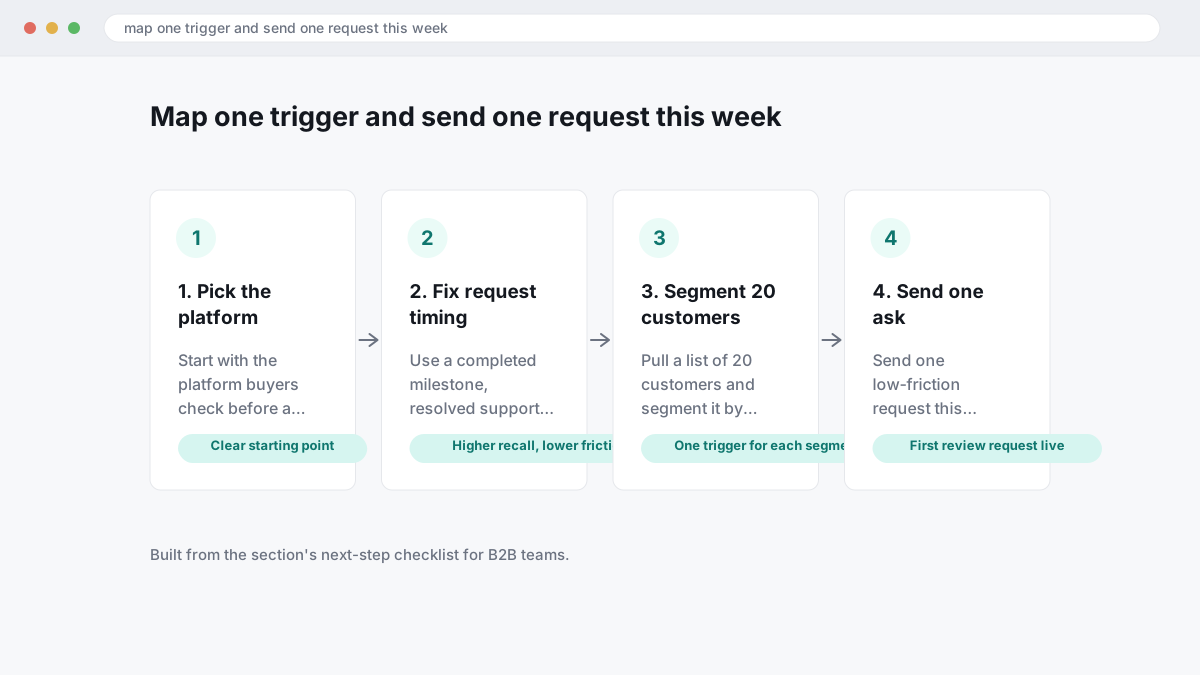
Your next step is simple: pull a list of 20 customers, segment it by account type, map one trigger for each segment, and send one low-friction request this week. Give it a few days. If replies stall, check segment quality first, then the trigger, then the sender, then shorten the ask, then switch platform if the account type was wrong. That process tells you where response rate is breaking down and which review profile is most likely to improve conversion on branded search clicks.
If you want that built and managed for you, BGR Review runs B2B review programmes across Google, Trustpilot, Yelp, Clutch and TripAdvisor, with delivery starting in 24-48 hours and a 30-day free replacement guarantee on review packages. The useful outcome is a repeatable workflow your team can keep using, not a one-off push.