
Quick answer
Customers leave reviews when three things line up: the experience creates enough emotion to talk about, the request arrives at the right moment, and the review flow feels easy. Delight, frustration, service recovery, feeling listened to and wanting to guide other buyers are the main triggers. Friction kills volume, so a direct review link, QR code or SMS prompt usually beats a generic “leave us feedback” email sent days later. Compliance matters as well: Google Business Profile rules prohibit review gating, and the FTC requires clear disclosure for incentivised endorsements.
We work on review acquisition and review removal across Google, Trustpilot, Yelp, Clutch and TripAdvisor, so this page is built from live reputation workflows rather than broad theory. In practice, the pattern is consistent: unresolved customers review from frustration, resolved customers review from reciprocity, and happy silent customers usually act only when the ask is immediate and the path is one tap or scan. That is where Customer Psychology stops being abstract and starts affecting map-pack click-through, branded search demand, calls and bookings.
Why do some customers review instantly while others never bother?
Customers review when a strong emotional moment meets the right timing and a low-friction path. Review lift usually comes from fixing request timing, platform fit and click depth together, not from sending more reminders.
The wrong approach is the generic follow-up sequence: day 1 email, day 3 email, day 7 email, all pointing to a broad “leave us a review” page with five steps and platform choice dumped on the customer. It fails because emotion intensity fades fast, and every extra tap in the review flow gives the customer another exit. A two-click mobile path sent within minutes of job completion or checkout usually beats a five-step request sent later, because the customer is still inside the service moment and the ask feels easy enough to finish.
Platform choice changes the effort. Google usually wins for speed because the user can often land straight on the review box while signed in; Yelp can add friction because the customer may need the app or an account flow, and Yelp’s recommendation software can also hide some reviews; TripAdvisor works better when the stay, meal or activity has a clear end point and the customer expects to share detail. If you sell review support across Google, Yelp and TripAdvisor, as BGR Review does, you quickly learn that “ask everywhere” wastes clicks. Match the channel to the moment.
This is the practical split:
| Platform | What the customer usually has to do | Effort level |
|---|---|---|
| Tap link, sign in if needed, write and post | Low on mobile | |
| Yelp | Open app or site, log in, find business, post | Higher |
| TripAdvisor | Log in, select listing, add fuller travel or visit detail | Medium to high |
More reminders rarely fix weak review volume. A better-timed ask with lower friction does, and it improves click-through from your profile, helps map pack performance where review recency matters, and sends higher-intent visitors who are more likely to call or book.
How do emotion, timing, and friction work together to lift review volume?
Review behaviour works as a system: emotion intensity creates the urge, timing of the ask preserves it, and friction in the review flow either converts that urge or wastes it. Most teams underperform because they polish the wording of the request and ignore the moment it lands and the path that follows.
Generic psychology lists stop at “people review when they feel strongly”. That is incomplete. A delighted customer on Tuesday often does nothing by Friday, because memory cools fast and the review ask has dropped below every other notification on their phone. In BGR Review’s dataset of 1,485 businesses observed from February to July 2026, new trades and local service firms typically saw first reviews around two weeks after launch, which lines up with immediate post-job prompts rather than delayed batch requests.
The failure point is usually mobile friction, not lack of goodwill. Once a customer has to open your site, find the right platform, log in, and search for your profile, intent leaks at each step; after step three, many abandon. That is why a direct Google or Trustpilot review link sent by SMS usually beats an email that lands on your homepage, especially where channel preference skews mobile and the customer is still holding the invoice or standing by the completed job.
The better system is simple: send the ask straight after the useful moment, choose the channel the customer already uses, and include enough context to jog memory without scripting the review. A short prompt like “Thanks for today’s boiler service — would you mind leaving feedback here?” works because it connects the action to a fresh experience and removes search friction. That same low-friction path lifts map-pack click-through and conversions later, because more recent reviews make the profile easier to trust before the customer ever reaches your site.
Which moments make happy customers most likely to actually post?
The best moment to ask is straight after the customer feels the result, before the feeling cools. Job completion, delivery confirmation and a clean problem resolution beat end-of-month batch requests because the timing of the ask still matches the customer’s emotional high point.
Most guides push monthly review campaigns because they are easier to schedule in a CRM. They fail because the memory is weaker, the customer is back in their routine, and the peak-end rule is working against you: people remember the strongest moment and the ending, so a delayed ask arrives after both have faded. In BGR Review’s dataset of 1,485 businesses observed from February to July 2026, new trades and local service firms typically saw first reviews around two weeks after launch, which fits a simple operational truth: event-triggered asks pull reviews forward while the service outcome still feels fresh.
Use the trigger that proves the outcome happened. Delivery confirmation works for ecommerce and food, job completion works for trades, and successful resolution works after support fixes a mistake because reciprocity is strongest once the issue is closed. If you are handling a removal or reputation clean-up with BGR Review, this is also the point where a follow-up ask lands best: after the fix, not during the dispute.
This is the practical split by channel preference when you want the fastest post.
| Trigger moment | Best channel | Why it works |
|---|---|---|
| Same-day job completion | SMS | Low friction, opened quickly, strong for map-pack driven local services |
| Delivery confirmed | SMS or short email | Customer can act the moment the product arrives |
| Resolved complaint or support case | Gives space for longer feedback and can lift conversions from future readers |
SMS often wins when the service finished today. Email usually works better when the customer needs a minute to explain what changed, especially on Google, Trustpilot or Clutch where longer review text can improve click-through rate and reassure the next buyer before they call, book or fill in your form.
How should you ask for a review without sounding needy or scripted?
A review request works best when it is brief, tied to the job that just finished, and built around one platform. One link, one reason to leave feedback, and no extra choices usually gets more action than a branded message that asks the customer to “support us” across Google, Yelp and Trustpilot at once.
Long copy fails because it adds friction in the review flow. A customer who has just had a delivery, site visit or repair completed will decide in seconds; if your message includes a logo block, three buttons, and a paragraph about your brand story, that moment passes. The cleaner approach is a customer review request message template under 40 words, sent on the channel the customer already used with you, whether that is SMS after a home-service fix or email after a B2B handover.
Use wording like this: “Thanks for choosing us today. If you can spare 30 seconds, please leave a Google review here: [link]. It helps other local customers choose with confidence.” Name the platform, give one direct link, and give one reason. That structure sounds human because it matches the moment, and it stays safer from compliance problems than a pushy ask with rewards, steering, or hidden review gating. If you want help building those prompts into a review package workflow, BGR Review’s managed plans include a 30-day free replacement guarantee.
Which channel gets the review fastest: email, SMS, or QR code?
SMS gets the fastest review completions, email fits longer-decision purchases, and QR codes work best at the point of service. The best channel depends on where your customer already has their phone out and how much writing the review is likely to need.
The wrong approach is picking one default channel for every job. That fails because channel preference changes with context: an SMS with a direct review link suits urgent, mobile completion after a plumbing call, while the same message can feel abrupt after a legal matter or higher-ticket B2B project where the customer wants time to write a fuller account. In BGR Review’s own dataset of 1,485 businesses observed February–July 2026, agencies and digital service firms usually collected reviews more slowly and across Google, Clutch, Yelp and Trustpilot rather than in one burst on one profile.
This comparison matters more than most guides admit.
| Channel | Best use | Why it works |
|---|---|---|
| SMS | Right after service completion | Opens usually happen within minutes, and a direct review link reduces taps on mobile. |
| Considered purchases and B2B work | Customers can reply from desktop, think longer, and leave a more detailed review. | |
| QR code | On-site, at checkout, reception, or handover | Works while the experience is live; days later, most people will not scan a code from a leaflet. |
The right approach is matching channel to moment. If you sell review support, keep it compliant: no review gating, no incentivised reviews hidden from disclosure rules, and no sending people into a generic homepage when a direct review link can take them straight to the correct platform with fewer drop-offs.
When do manual asks beat automation, and when does automation win?
Manual asks win on warmth; automation wins on consistency and scale. The strongest lift usually comes from a hybrid flow: your staff sets the expectation in person, then an automated review request sends the direct link about 5 minutes later, which is the same trigger logic BGR Review uses when building managed review flows for Google, Trustpilot, Yelp and Clutch.
Human-only asking is the wrong default once more than one person touches the customer journey. A receptionist remembers, a technician forgets, a nurse is rushed at discharge, and the timing of the ask drifts from the moment the customer still feels the result. You then get patchy review volume, weaker map pack click-through, and fewer conversions from profile views because the people who meant to leave feedback never receive a usable link. Manual asks still beat automation in one narrow case: high-trust, high-ticket work where the staff member can match the customer’s channel preference on the spot and confirm whether SMS, email or a QR code will get opened first.
The better setup is hybrid priming plus automated follow-up. Your team says one plain sentence face to face, then your system sends the link on time across every completed job, delivery or discharge, without drifting into review gating or incentive language that can breach platform rules and FTC endorsement standards. If you use outside help, be clear about the commercial model: BGR Review sells managed review fulfilment with a 30-day free replacement guarantee on review packages, while negative-review removal is separate at $0 upfront and $449 per removed link after success.
This comparison is easiest to see side by side.
| Approach | Where it wins | Where it breaks |
|---|---|---|
| Manual asks only | Personal tone, instant trust, easier channel choice | Staff forget, ask late, no link sent, poor scale |
| Automation only | Every job gets asked on time, easy multi-location consistency | Colder message, lower response if no verbal priming happened |
| Hybrid | Human warmth first, direct link second, strongest operational consistency | Needs a simple CRM or POS trigger set correctly |
Which review trigger usually brings the fastest ROI first?
The fastest return usually comes from review triggers tied to a real buying decision: a resolved complaint, a completed high-ticket job, or one standout service moment. Put your first effort into prompts that lift buyer trust and conversions quickly on Google Business Profile, Yelp, Trustpilot or Clutch, rather than chasing raw review count.
Most guides push volume first. That fails because fifty bland reviews from low-stakes visits often add less social proof than five detailed reviews from jobs where the customer spent serious money and had to choose carefully. In BGR Review's dataset of 1,485 businesses observed February-July 2026, trades businesses with complete enquiry-source data attributed 70-80% of calls and bookings to a Google Business Profile or Yelp listing, which means the review that moves map-pack click-through and conversion quality matters before the one that simply increases your total.
If you want the quickest visible win, start with service recovery. The service recovery effect is simple: a customer who was upset and then got a clear fix often writes with more detail, stronger emotion and higher credibility than a customer whose visit was merely fine. That kind of review improves buyer trust fast because prospects can see the problem, your response behaviour and the outcome in one thread, which is stronger conversion proof than a generic five-star line.
Completed high-ticket jobs should come next. A roof replacement, legal matter, dental treatment plan or agency project gives you richer proof than a routine callout, especially if the review mentions the decision, the result and the timeline. Broad brand campaigns can wait; recency-driven triggers usually move branded search demand, local-pack clicks and form fills faster because recent, specific reviews answer the question a buyer has right before they contact you.
How does solving a problem turn frustrated customers into vocal advocates?
Service recovery often creates the strongest reviews because the customer can see the before-and-after clearly. When you take ownership fast, fix the issue fairly, and ask on the same day, frustration often flips into advocacy through the service recovery effect and simple reciprocity.
Most guides tell you to avoid unhappy customers and only ask people who were pleased from the start. That fails for two reasons. First, it drifts towards review gating, which Google Business Profile and Trustpilot both prohibit in their review policies. Second, a routine job often ends quietly, while a resolved problem gives the customer a story worth posting. Updated reviews after a verified fix usually mention response speed, fairness, and ownership: who replied, how quickly, and whether you sorted the cost, replacement, refund, or revisit without an argument.
If you want that review, send the follow-up the same day the issue is resolved, while the emotional contrast is still sharp. Waiting a week turns a vivid recovery into a closed admin task, and the customer moves on. A plain prompt works: “Thanks for giving us the chance to fix this today. If the outcome felt fair, would you update your review or leave one here?” BGR Review sells verified review support and negative review removal on a pay-after-success basis at $449 per removed link with $0 upfront, but a genuine recovery ask is often the cheaper move because the customer may rewrite the public record for you.
How do identity, reciprocity, and social proof change who decides to review?
People decide to review for three different reasons at once: they want to signal who they are, repay extra effort, and follow a cue that public feedback is normal on a profile that already shows visible stars and review volume.
Most guides treat satisfaction as the whole story, then send the same review request to every customer. That fails because a satisfied buyer can still stay silent if the ask gives them no role to play. Identity signalling changes that: some people post on Google or Trustpilot because they want to be the person who warns others away from a bad choice or points them towards a reliable one, which is why BGR Review structures requests around helping the next customer rather than praising your brand.
Reciprocity is the second trigger. A customer who saw extra effort, a waived fee, a faster fix, or a thoughtful follow-up often feels a small social debt, and that is when a direct ask converts better than a generic survey link. Social proof does the rest: on profiles we build across Google, Yelp and Clutch, visible review volume makes reviewing feel routine, which lifts map-pack click-through first and later helps conversions from calls, bookings and form fills because the next reader arrives pre-sold by other people’s proof.
Why do healthcare, hospitality, and home services trigger different review behaviour?
Review behaviour changes by industry because the stakes, privacy concerns and comparison habits change. A hotel stay, a dental visit and an emergency plumbing call push people to post for different reasons, so your review request timing and wording cannot be identical across all three.
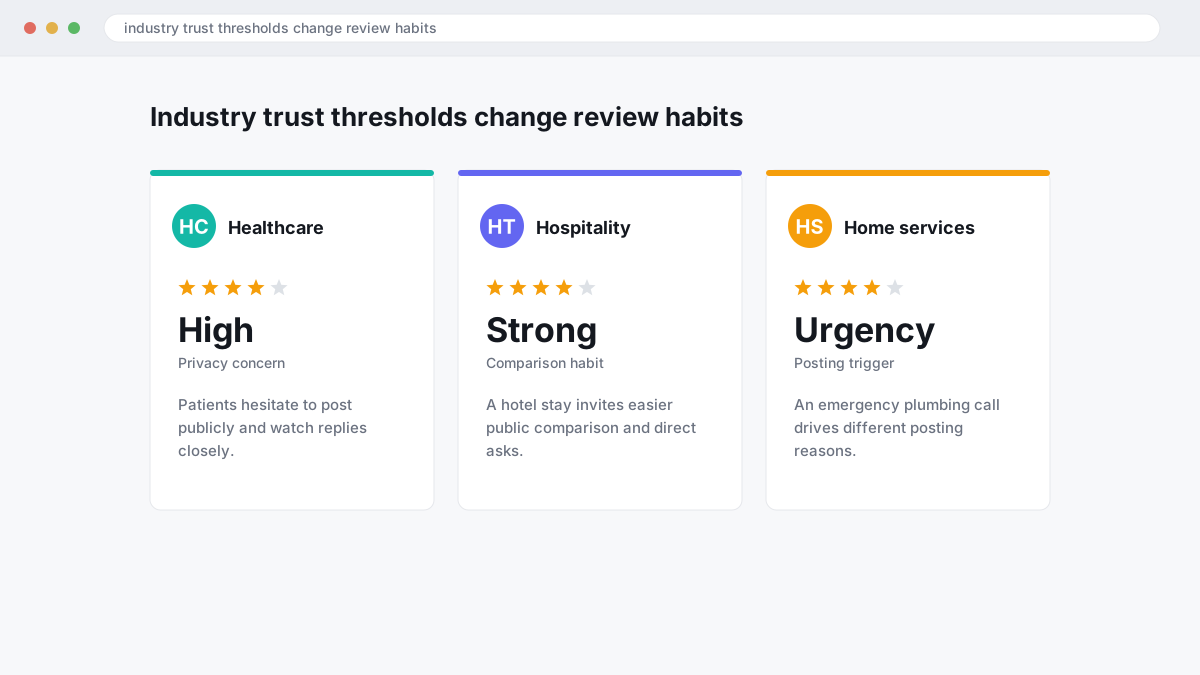
One universal review playbook fails because industry trust thresholds are different. In healthcare, emotion is high but privacy is higher, so patients hesitate to post publicly even when they are satisfied; they also read response behaviour closely, because a careless public reply can reveal too much. In BGR Review’s dataset of 1,485 businesses observed February to July 2026, dentists, lawyers, accountants and roofers usually needed 30–50 reviews before profiles performed consistently, which tells you trust builds slower where the decision carries more risk.
Hospitality moves faster because comparison shopping is immediate. Guests check Google, TripAdvisor and map-pack results while they are still travelling, so a same-day or next-morning ask works better than a delayed email; wait a week and the emotional intensity has already gone. Home services sit in a different lane: punctuality, cleanliness and service recovery drive the review, and in BGR Review’s dataset of 1,485 businesses observed February to July 2026, trades businesses with complete enquiry-source data attributed 70–80% of calls and bookings to a Google Business Profile or Yelp listing, which means review quality affects click-through rate, conversions and local pack performance directly.
The better approach is to match the ask to the category. For healthcare, keep the prompt discreet and neutral; for hospitality, ask while the stay is still fresh; for home services, ask right after the fix, especially if you solved a problem cleanly and on time. That works because the request fits the customer’s actual motive instead of forcing the same script onto three very different moments.
How can incentives or review gating backfire even when they seem to work?
Incentives and review gating can lift response rates in the short term, then create platform, trust and legal risk that costs more than the extra reviews are worth. Google policy restricts selective review collection, and a disclosed reward can still breach platform rules even where local law permits the incentive.
The wrong approach is simple: send happy customers to Google, route unhappy customers into a private feedback form, and offer a discount, gift card or prize draw to speed up the ask. That can produce a quick bump in review volume and make your map pack listing look healthier for a while, but review gating distorts the signal, weakens trust when customers spot the pattern, and leaves you exposed if a platform audits the flow. Google Business Profile policy bars discouraging negative reviews and selective asks that suppress them, so a higher short-term response rate can turn into removed reviews, lower click-through rate and weaker conversions if the profile starts to look manipulated.
The safer approach is one request flow for everyone: same timing, same channel, same review link, with no filter that screens out dissatisfied customers before they reach the platform. If you use incentivised reviews in the US, the FTC Endorsement Guides require clear disclosure of any material connection, but disclosure does not override platform rules; some sites still prohibit compensated reviews. That matters if you are buying managed review help as a service, including BGR Review packages with a 30-day free replacement guarantee, because compliance still sits above fulfilment. Rules vary by platform and country, including US FTC standards and UK consumer-protection rules, so treat this as general information rather than legal advice.
What should you do after more reviews start coming in?
Once review volume rises, your next job is controlling responses and tracking issue patterns before they harden into trust problems. Start with recent negative reviews, then reply to unanswered positive reviews from the last 30 days, and separate service fixes from policy-reporting issues before they damage your reputation signals.
The wrong move is to keep chasing volume and ignore what the new reviews are telling you. That fails because response behaviour is visible to future reviewers, affects click-through from the map pack, and leaves the same complaint themes sitting unanswered on your profile. The right move is a weekly check on four basics: average rating, review recency, reply rate, and repeated complaints such as delays, billing confusion, or no-show staff.
Escalate reviews that look fake, abusive, or written by a non-customer under the platform's own reporting rules, such as Google Business Profile review policy, Trustpilot's flagging flow, or Yelp's content guidelines. Across 12,000+ negative review cases logged by BGR Review from June 2025 to June 2026, reviews raised within 28 days and backed by a clear policy issue resolved successfully in roughly 90% of cases; beyond 28 days, the observed success rate fell to approximately 25-30%.
Where to go from here
Your review volume usually moves when you fix three things in order: ask at the emotional high point, cut the steps between the request and the review form, and stay inside each platform's rules on review gating, incentives and selective asks. That is the part generic advice misses, and it is why a “please leave us a review” email sent two days late often does nothing while a same-day SMS link after a resolved issue gets a response.
Your next step is a review acquisition audit. Map your real customer journey, mark the moments where reciprocity is strongest, check where friction enters the review flow, and separate channel preference by customer type instead of pushing everyone to one platform. You should come out of that audit with a request timing window, compliant prompt copy, a follow-up sequence, and a short list of blockers hurting map-pack clicks, click-through rate and conversions.
If you want help building that plan, BGR Review can audit the review request flow and platform mix, then recommend a compliant acquisition setup or tell you when the cheaper DIY route is enough.