

Quick answer
Fake reviews usually reveal themselves through patterns, not one awkward line. The signs worth acting on are review velocity spikes, repeated wording across multiple posts, empty or thin reviewer profile history, geographic mismatch, missing verified purchase markers, and claims you cannot match to any real job, booking or order. On Google Maps reviews, the relevant route is Google's fake engagement policy, but suspicion on its own rarely moves a case. Platforms respond better when you submit the review link with dated evidence such as invoices, CRM records, call logs, message history, or proof the reviewer never existed in your customer list.
We handle review disputes across Google, Trustpilot, Yelp, Clutch and TripAdvisor, and the same thing keeps happening after a first self-filed report fails: the business used the in-platform flag button, but attached no timeline, no transaction check and no account-level pattern evidence. In BGR Review's case file of 12,000+ negative review cases logged June 2025 to June 2026, outcomes were tracked as removal success, unresolved or unknown, and unconfirmed cases stayed unknown rather than being dressed up as losses or wins.
That matters because fake reviews distort map-pack click-through, branded search demand and conversions long before a profile owner has enough proof to remove them. This page follows the workflow we use before any paid removal work starts, including the evidence that saves time and the weak signals that do not.
Which fake-review signs actually justify action instead of just suspicion?
The warning signs that matter are patterns, not one-off quirks. When the same 3-5 reviews share a timing spike, similar wording, thin reviewer histories, and no clear transaction match, you have something worth documenting and escalating.
The wrong approach is filing a report because one review sounds odd or feels unfair. That usually fails inside a platform moderation pipeline because a single strange phrase, one new account, or one harsh rating rarely proves policy abuse on its own. In BGR Review's case file of 12,000+ negative review cases logged June 2025 to June 2026, roughly 90% of businesses that came to us after a failed attempt had used only the basic in-platform report button, and 70-80% of those initial requests had been rejected.
The better approach is to build review removal evidence around a repeated multi-signal pattern. Put the suspect reviews side by side and check whether they landed close together, reuse the same claim structure, come from profiles with little believable history, and describe a purchase, visit, or job your records cannot match. Suspicious still does not mean removable. Platforms move faster when your report ties those signals to a named rule breach, which is why BGR Review tells clients to collect the evidence first and only escalate the reviews that can be linked to policy, not just instinct.
How can you check a review quickly without missing the signs that matter?
A fast fake-review check starts with five signals in order: timing, reviewer history, wording overlap, location fit, and transaction proof. If three or more fail, stop treating it as a hunch and start collecting evidence for a platform report.
Most guides push a gut check: the tone feels odd, the star rating looks extreme, the account photo is missing. That fails because any one weak signal can describe a real customer. A repeatable screen works better because it separates mild suspicion from action-ready problems, and you can finish a first pass in 2-3 minutes per review before it starts affecting map-pack click-through, calls or form fills.
Use this same order every time.
| Step | What to check | Score |
|---|---|---|
| 1. Timing | Was it posted in a sudden burst, outside your normal review request timing, or alongside several near-identical ratings? | Pass or fail |
| 2. Profile | Does the reviewer profile show real history, mixed categories, and older activity, or a thin account built for one review? | Pass or fail |
| 3. Wording | Check for phrase recycling, copied service lists, or generic praise that reads pasted across multiple listings. | Pass or fail |
| 4. Location | Does the place, city, or service area fit your actual trading footprint and customer journey? | Pass or fail |
| 5. Transaction proof | Look for your own job record, booking, invoice, CRM note, or a platform signal such as verified purchase markers where the platform offers them. | Pass or fail |
Score 0-1 fails as plausible, 2 as suspicious, and 3+ as escalation-ready. At that point, save screenshots, URLs, timestamps, profile captures and missing-transaction checks as review removal evidence. Google Business Profile and Trustpilot moderators respond better to a mixed evidence pack than to “this looks fake”, while a lone odd sentence usually goes nowhere. If you cannot disprove the transaction, reply calmly first and escalate only when the record check supports you.
When does a burst of reviews look fake rather than naturally busy?
A burst looks suspicious when the volume, timing and star mix change without any real business trigger. Ten five-star reviews in 24 hours after months of silence is a higher-risk pattern than steady weekly growth during a sale, a seasonal rush or a service launch.
Most guides treat any review velocity spike as proof of fraud. That fails because real demand does bunch up: a roofer after a storm, a restaurant after a local event, a plumber after a winter freeze. The right check is to line the review dates up against something you can verify inside your business — bookings, ad spend, footfall, a promo email, staff rota pressure, even call volume from your Google Business Profile or Yelp listing. If demand moved and the star-rating distribution stayed mixed, with some fours and the odd critical comment, the spike often has a normal cause.
A manufactured burst looks different. You usually get compressed timing, near-identical sentiment and an unrealistically clean rating spread: all fives, no detail, no pause between posts. In BGR Review’s dataset of 1,485 businesses observed from February to July 2026, new trades and local service businesses usually built their first reviews over about two weeks, not overnight, and roughly 90% of those early reviews were positive rather than perfectly uniform. That difference matters because a fake-looking cluster can distort map-pack click-through and conversions before anyone checks whether the demand behind it was real.
How do reviewer histories reveal whether an account looks real or planted?
A reviewer account looks real when its history matches normal customer behaviour: multiple reviews over time, places that fit the business’s service area, and detail that makes sense for the visit; a one-review profile tied to irrelevant locations deserves scrutiny, not automatic trust.
The wrong approach is to treat any account with a profile photo and a five-star average as credible. That fails because reviewer profile history usually tells you more than the single post on your listing: an active local customer profile might show routine reviews across nearby restaurants, garages and shops over months, while a thin account often has one review, no local trail, and a geographic mismatch such as a plumber in Miami being reviewed by an account that otherwise posts only about businesses in Manchester. On Google Maps reviews, you can often inspect visible contribution history and location fit. On Trustpilot, you get a different picture: fewer local cues, but more weight on review timing, category spread and whether the account looks built just to praise one company.
Use this platform split when you decide whether to report.
| Platform | Useful trust signals | Main limit |
|---|---|---|
| Reviewer profile history, local place pattern, Google Maps location fit | Some profiles expose very little, so one weak signal rarely moves moderation | |
| Trustpilot | Account activity pattern, repeated brand focus, timing around invitation bursts | Geographic mismatch is weaker unless the review claims a service area it clearly does not match |
Google Business Profile’s fake engagement policy and Trustpilot’s flagging flow both respond better to mixed signals than to a hunch. If you later escalate a removal case through BGR Review’s pay-after-success model at $449 per removed link with $0 upfront, this is the sort of profile evidence worth collecting first.
How can you tell when review wording sounds templated, coordinated, or AI-written?
Templated, coordinated or AI-written reviews usually reveal themselves when 5-10 posts repeat the same niche phrasing, generic praise and sentence rhythm while avoiding checkable service details such as job type, staff name, location or timing.
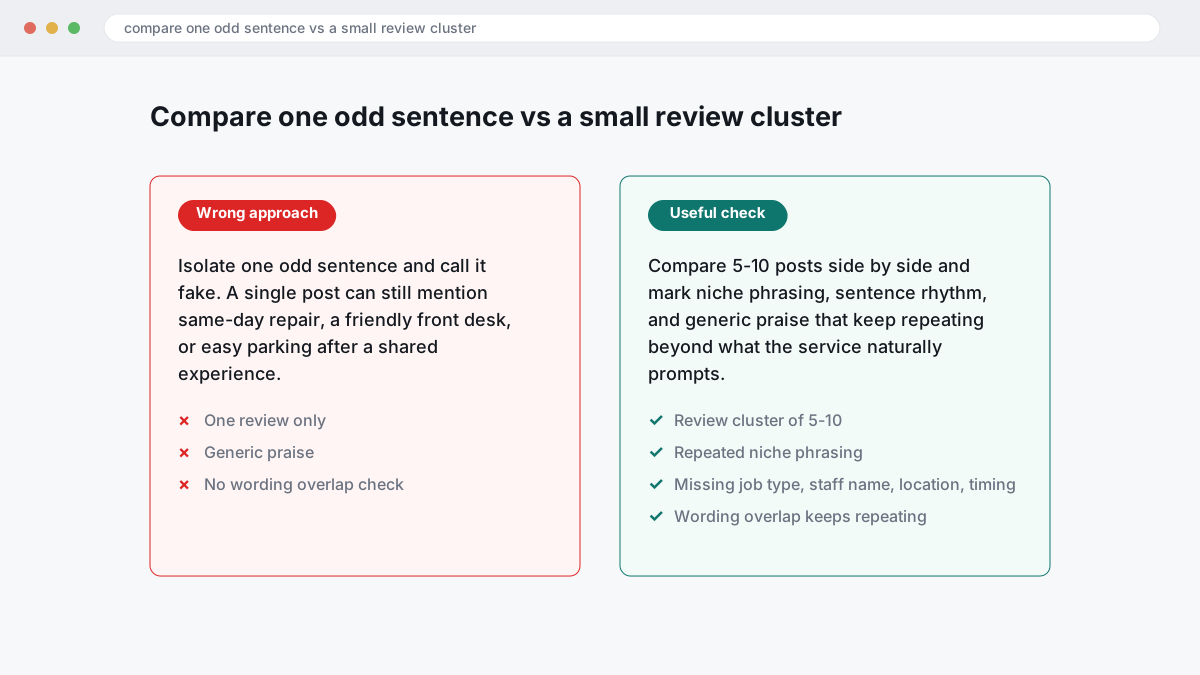
The wrong approach is to isolate one odd sentence and call it fake. That fails because real customers often use the same natural details after a shared experience: “same-day repair”, “friendly front desk”, “easy parking”. The useful check is side-by-side comparison. Before BGR Review opens a $0-upfront removal case at $449 per removed link, we compare wording across a small cluster of reviews and mark wording overlap that keeps repeating beyond what the service itself would naturally produce.
Copy-paste sentiment phrasing looks different from genuine overlap. If several reviews praise a roofer, dentist or agency with near-identical lines like “highly recommend”, “top-notch service”, “went above and beyond” and “exceptional team”, but none mention the leak, treatment, campaign, branch or date, the text starts to read synthetic. AI-written reviews do this a lot: smooth grammar, broad approval, no verifiable detail. That mixed pattern gives platforms more to work with than a single suspicious line, especially when you capture screenshots before the wording changes or disappears.
Which warning signs differ on Google Maps and Trustpilot?
Google Maps and Trustpilot surface different trust signals, so the same red flag can mean very different things: on Google, location fit and spam-pattern signals matter most; on Trustpilot, invitation method, review history and proof of a real transaction carry more weight.
Most guides treat every platform the same. That fails fast. A review burst on Google Maps reviews can be perfectly normal for a restaurant after a busy weekend, but the same burst on Trustpilot review patterns looks different if all reviews arrived through one bulk invite list, use near-identical wording, and come from accounts with no wider activity. Google Business Profile reviews sit closer to local discovery, so geographic mismatch, category mismatch and reviewer profile history usually tell you more than star-rating distribution alone.
This comparison works better when you screen the platform’s own mechanics first.
| Platform | Signals that matter most | Weak signals that waste time |
|---|---|---|
| Google Maps reviews | Reviewer location fit, account activity, repeat wording across nearby listings, sudden review velocity spikes, map-pack relevance to the business | Assuming a low-detail profile is fake on its own, or treating every 5-star run as bought |
| Trustpilot | Invitation method, whether the reviewer can be tied to a customer record, account history, duplicated phrasing, and what Trustpilot’s reporting flow asks you to prove | Flagging a review only because it is negative or because the reviewer used a private email |
Verified purchase markers are also platform-specific. They are much stronger on transaction-led platforms than on Google Business Profile, because Google often hosts reviews for offline jobs, phone enquiries and walk-ins where no checkout record exists. If you are building a removal file for BGR Review’s team, collect transaction evidence first for Trustpilot and location or identity conflicts first for Google; mixed signals like wording overlap plus geographic mismatch usually move a report further than one weak clue on its own.
Should you use a fake review checker tool or do a manual audit?
Fake review checker tools are good at spotting patterns fast, but they rarely produce enough context for a report a platform will act on. Use software to triage volume, then do a manual audit before you escalate anything into the platform moderation pipeline.
The wrong approach is treating a risk score as proof. A tool can flag review velocity spikes, wording overlap, fresh accounts and skewed star-rating distribution in minutes, but it cannot tell whether the reviewer was ever a real customer, whether the job address sits outside your service area, or whether your CRM, booking log or invoice record shows no match at all. Those service-area and customer-record mismatches are often the details that turn suspicion into review removal evidence.
A quick comparison helps:
| Method | What it catches well | What it misses |
|---|---|---|
| Checker tool | Volume spikes, duplicate phrasing, odd reviewer profile history | Customer-record gaps, geographic mismatch, false factual claims |
| Manual audit | Context, evidence quality, policy fit for escalation | Slow on large batches without triage |
The better route is mixed. In BGR Review's dataset of 12,000+ negative review cases logged June 2025 to June 2026, roughly 90% of businesses who came to us after a failed attempt had used only the basic in-platform report button, and 70–80% of those initial requests had been rejected. That is why a reportable case needs more than flags on a dashboard.
Do fake reviews actually hurt rankings, clicks, and sales enough to act fast?
Fake reviews matter when they change the trust signals buyers see while comparing you with nearby alternatives. Act first on the listings with the most search exposure, the sharpest recent rating change, and the clearest effect on calls, bookings or form fills before you spend time on low-traffic profiles.
The wrong approach is to treat every suspicious review as equal noise. That fails because a fake one-star on a quiet directory and a fake one-star inside Google Maps reviews do very different damage: the Maps version can hit local pack click-through rate first, then conversions, especially when your visible average slips from 4.7 to 4.3 and the star-rating distribution starts to look uneven beside competitors. Fake positives distort buyer choice in the same way from the other side, pulling clicks and branded search demand toward a profile that has not earned that trust.
Start triage where buyers already act. In BGR Review's dataset of trades businesses with complete enquiry-source data, observed from February to July 2026, 70-80% of calls and bookings were attributed to a Google Business Profile or Yelp listing, which is why revenue-sensitive locations and recent review damage go to the top of the queue. If the review is fresh, the case is more time-sensitive too: across 12,000+ negative review cases logged June 2025 to June 2026, reviews raised within 28 days and tied to a clear policy issue resolved successfully in roughly 90% of cases, versus approximately 25-30% for comparable cases raised later.
What evidence makes a platform more likely to remove or suppress a fake review?
Platforms act on evidence a moderator can verify, not on your certainty that a review feels fake. The strongest review removal evidence combines screenshots, timestamps, customer-record checks and a named policy breach, so the platform moderation pipeline can assess the report without guessing what you mean.
The weak approach is the one most owners start with: “This review is unfair, malicious and damaging.” That usually fails because a moderation team cannot test emotion against policy. In BGR Review’s case file of 12,000+ negative review cases logged June 2025 to June 2026, roughly 90% of businesses who came to us after a failed self-filed attempt had used only the basic in-platform report button with no supporting documents, and 70–80% of those initial requests had been rejected. A rejection did not prove the review was real. It usually meant the report gave the platform nothing concrete to check.
The stronger approach is a policy-mapped evidence pack. For Google Maps reviews, that often means showing the reviewer does not appear in your CRM, booking calendar, till records or support inbox for the date range claimed in the post, then matching that fact to Google Business Profile’s prohibited and restricted content rules such as fake engagement or conflicts of interest. Add a screenshot of the live review, the profile URL, the posting date, any location mismatch, and a short note explaining the customer-record check you ran and what it returned.
Google is far more likely to act when the basis is “non-customer” or “competitor/conflict of interest” than when the argument is “the tone sounds fake”. Timing matters too. Across the same 12,000+ cases, reviews raised within 28 days and backed by an identifiable policy issue resolved successfully in roughly 90% of cases, while comparable cases raised later dropped to approximately 25–30%; that is BGR Review’s observed outcome profile from June 2025 to June 2026, not a published Google rule.
Where do fake reviews cross the line from spam into legal risk?
Fake reviews move from platform spam into legal risk when they involve undisclosed paid endorsements, false statements presented as fact, or coordinated deception that breaches a regulator's rules as well as a platform's review policy.
The wrong approach is to treat every suspicious review as a Google or Trustpilot moderation problem and stop at the report button. That fails when the review says something verifiably false such as “this clinic billed me twice” or “this builder never held a licence” and you can prove the statement is untrue, because defamation and false statements sit in a different lane from ordinary spam. Pure opinion usually gets more protection. A line like “terrible service” is hard to challenge legally, while a made-up factual accusation can justify a legal review alongside a platform report.
The right approach is to separate policy breach from legal exposure before you act. In the United States, the FTC endorsement guides require material connections to be disclosed, so undisclosed paid reviews, staff reviews, or agency-seeded testimonials can create regulatory risk beyond account penalties. Rules also vary by country and platform: US FTC rules, UK consumer-protection enforcement, and each platform's own terms do not match exactly. This is general information, not legal advice.
What should your internal fake-review audit checklist include every time?
A usable review-investigation checklist records the same core fields every time so you can separate vague suspicion from reportable evidence, assign one action status, and decide within 48 hours whether to monitor, respond, report, or escalate.
Ad hoc note-taking fails because each manager logs different details, screenshots get missed, and the report button gets used before you have review removal evidence. The result is a weak file: no reviewer link, no claimed experience copied verbatim, no customer-record check, and no proof of whether a verified purchase marker exists on platforms that use one. A standard checklist fixes that because every suspicious review gets tested against the same facts before anyone replies publicly.
Use these fields every time:
| Field | What to record | Status use |
|---|---|---|
| Review basics | Date, star rating, platform, review URL, reviewer profile link, claimed experience | Monitor or respond |
| Internal match | Customer-record match, staff recall, order proof, job date, location match | Report |
| Evidence pack | Screenshots, verified purchase marker status, prior contact, policy issue noted | Escalate within 48 hours |
Keep one status column only. Multiple labels create drift. If the review names a service date nobody can place, the order record is blank, and the screenshot shows no verified purchase marker where one would normally appear, you have a cleaner platform report and a better internal trail if legal review becomes necessary.
What should you do if a competitor appears to be buying or directing fake reviews?
If a competitor appears to be directing fake reviews, capture the pattern before you react, then report the exact policy breach with evidence. Go public or speak to a lawyer only after you separate vague suspicion from a provable non-customer, deceptive endorsement, or false factual claim.
The wrong move is an immediate public accusation. It usually fails because the platform moderation pipeline does not act on anger, and your post can hand the competitor a clean screenshot while the underlying review pattern stays live in the map pack, keeps draining click-through rate, and starts shaping branded search demand around the wrong story. Document competitor review attacks first: take dated screenshots, save profile links, note review timestamps, reviewer names, wording overlap, location mismatch, and any cross-posting across your branches or theirs. On Google, report against the Google Business Profile review policy; on Trustpilot, use the platform's flagging route for harmful or non-genuine content.
Legal escalation comes later and only where the review states false facts, such as claiming a failed job, missed booking or refund dispute that never happened. That is where defamation and false statements may matter, but rules vary by country and platform, so treat this as general information rather than legal advice. Post an owner response only if silence would mislead real customers about a concrete allegation; keep it short, factual and non-accusatory.
Where to go from here
Start with a pattern check, not a guess. Pull the review links, screenshots, posting dates, star ratings, reviewer profile history, any wording overlap, and any geographic mismatch into one file before you report anything. That evidence pack matters because weak signals on their own waste time, while mixed signals give a platform moderator a cleaner reason to act. If the review names a transaction that never happened, add your order log or booking record. If it looks like a competitor review attack, note the timing against other new reviews and any sudden review velocity spike.
If those reviews are already hurting calls, bookings, form fills or map-pack click-through, move to a proper audit quickly. In BGR Review's case file of 12,000+ negative review cases logged June 2025 to June 2026, reviews raised within 28 days of posting and backed by an identifiable policy issue resolved successfully in roughly 90% of cases; beyond 28 days, the observed success rate fell to approximately 25–30%. A professional assessment should tell you three things: which reviews are suspicious but likely to stay, which have removal grounds, and what evidence to submit first.