

Quick answer
You can remove Google reviews only when the review breaks Google’s review policy; Google does not delete a review because it is harsh, unfair or bad for your rating. The workable route is to flag it through Google Business Profile, tie your request to a named policy breach, and attach proof such as screenshots, booking records, chat logs or evidence the reviewer was never a customer. If the first request is rejected, rebuild the evidence pack and escalate. If you want managed help, BGR Review charges $0 upfront and $449 per removed review link, payable only after success.
This page is written from live removal work, not from Google’s help text copied into softer language. In BGR Review’s case log of 12,000+ negative review cases recorded June 2025 to June 2026, the pattern is clear: the first failure usually comes from a weak in-platform flag with no timeline, no customer lookup and no policy match.
That matters because Google’s form behaviour is mechanical at first pass. If you submit “fake review” with nothing behind it, you often get nowhere; if you map the complaint to impersonation, conflict of interest, harassment or deceptive content and show the reviewer does not appear in your CRM, invoices or bookings, the odds change.
Why do some bad Google reviews come down while others stay live?
Google usually removes a review only when it breaches a named rule in the Google review policy or contains a verifiable false statement. The deciding factor is policy match and proof speed, not how damaging the post feels to your reputation, click-through rate, conversions or map-pack performance.
The wrong approach is to treat every negative comment as removable because it is harsh, unfair or bad for branded search demand. That fails because Google leaves plenty of one-star reviews live if they read like opinion, even when the wording is angry, vague or commercially painful. A rant saying your staff were rude may stay. A review tied to stronger policy violation categories such as impersonation, conflict of interest, fake engagement, off-topic content or a reviewer with no real customer link gives Google something concrete to assess inside the Google Business Profile flagging flow.
The first pass is simple: check policy fit, then evidence quality, then whether you are ready to escalate after a rejection. In BGR Review’s dataset of 12,000+ negative review cases logged June 2025 to June 2026, roughly 90% of businesses who came to us after a failed attempt had used only the in-platform report button, and 70–80% of those first requests had been rejected. That matters because a rejection does not prove the review is legitimate; it often means the report named no clear breach and supplied nothing Google could verify quickly.
How do you remove a Google review step by step from flag to appeal?
To remove a Google review, flag it in Google Search, Maps, or your Google Business Profile, select the closest Google review policy breach, save the review details at once, and appeal if Google rejects the first report. The workflow matters because weak first reports often fail before a human reviewer sees the evidence.
Clicking “Report review” and waiting is the wrong approach. It fails because the basic flagging workflow captures very little context, and once the reviewer edits or deletes their profile, you may lose useful identifiers. Before you submit anything, record the review URL, posting date, reviewer name, screenshots, and the single best policy ground, such as spam, conflict of interest, harassment, or prohibited content under Google Business Profile review policy. In BGR Review’s dataset of negative review cases with prior self-filed attempts, logged June 2025 to June 2026, roughly 90% had used only the in-platform report button with no supporting documentation, and 70–80% of those initial requests had been rejected.
The better route is methodical. Flag the review from whichever entry point you can access fastest: Google Search on your Business Profile, Google Maps, or the review management area inside Google Business Profile. Then build a small evidence pack before the first reply arrives from Google: booking records showing no matching customer, message logs, staff timeline, order ID checks, and any proof that the reviewer account authenticity looks doubtful because the account has no local history or repeats the same claim across profiles.
If Google rejects the first request, reopen it with a tighter appeal and organised attachments rather than repeating the same text. Support escalation works best when you pin the timeline to one policy issue and label each file clearly, for example “no_customer_match_invoice_log_12_March” instead of dumping screenshots. In BGR Review’s 12,000+ negative review cases logged June 2025 to June 2026, reviews raised within 28 days and backed by an identifiable policy issue resolved successfully in roughly 90% of cases; for comparable cases raised later, the observed success rate fell to approximately 25–30%.
Which Google review policy category gives you the strongest removal case?
The strongest removal case is the narrowest policy fit you can prove under the Google review policy. Fake engagement, off-topic content, impersonation, harassment, hate, and exposed personal information usually give you a better opening than saying a review feels unfair or contains false statements.
Most failed requests argue everything at once: fake, defamatory, competitor-written, misleading, damaging. Google cannot verify that bundle cleanly, so the flagging workflow often stalls at the first pass. In BGR Review's case file of negative review cases with prior self-filed attempts, logged June 2025 to June 2026, roughly 90% arrived after the business had used only the in-platform report button, and 70–80% of those initial requests had been rejected. The better route is one precise breach Google can check from its own systems or from simple attached evidence.
Fake engagement is often the strongest ground when the reviewer account authenticity looks weak and the behaviour is coordinated. That means bought, swapped, or organised review activity: several accounts posting similar wording across unrelated profiles, reviewers with no plausible customer trail, or a cluster tied to a seller or partner. Off-topic reviews also remove well because they are binary: the text attacks the wrong company, the wrong branch in a Google Business Profile, or an event your location had nothing to do with.
Harassment, hate, and personal information can move faster because the policy violation categories are clearer and the risk to users is more obvious. If a reviewer posts a staff member's phone number, slurs, threats, or targeted abuse, lead with that single issue instead of arguing service quality. Broad claims of defamation and false statements are harder unless the review states a checkable fact that you can disprove cleanly; "they are scammers" is usually weaker than "this review names our old address and describes a visit to a different location."
What evidence actually helps Google verify a review should be removed?
The strongest evidence pack is short, dated and easy to check: screenshots, transaction records, timeline notes and any proof the reviewer was never your customer. Google usually moves faster when a human reviewer can verify the mismatch in a few minutes rather than read a long complaint.
Most failed requests are vague. Across negative review cases with prior self-filed attempts in BGR Review’s records from June 2025 to June 2026, roughly 90% came in after a basic in-platform flag with no supporting documentation, and 70–80% of those initial requests had been rejected. A long emotional explanation fails because it asks Google to believe you. Dated proof tied to one ground in the Google Business Profile review policy works better because it gives support escalation something concrete to verify.
Your screenshots need context, not just the star rating and text. Capture the full review, the business listing, the profile name, the visible posting date, and any on-page detail that helps place it in time; if the review was edited, save that version as well. Then add records Google can compare against your own systems: invoice history, booking logs, call logs, staff rota notes, delivery records, and where lawful in your country, a CCTV timeline showing that no matching visit happened at the claimed time. This is where reviewer account authenticity matters: if the account has no transaction match, uses a name absent from your CRM, and appears to post across unrelated locations, that supports a fake-engagement argument, but only when paired with records.
A one-page chronology usually beats three pages of outrage. Put the review date first, list the claimed event, show the check you ran, and end with the mismatch in one sentence. That same clean structure also protects profile health: while the dispute is pending, your public response can stay calm and factual, which helps map-pack click-through and conversions more than a defensive essay ever will.
What does a practical Google review dispute template need to say?
A usable dispute template should name the exact Google review policy category, cite two or three verifiable facts, and ask for review under that rule. Short wording works better than threats, defamation claims you cannot prove, or a long rant about how unfair the review feels.
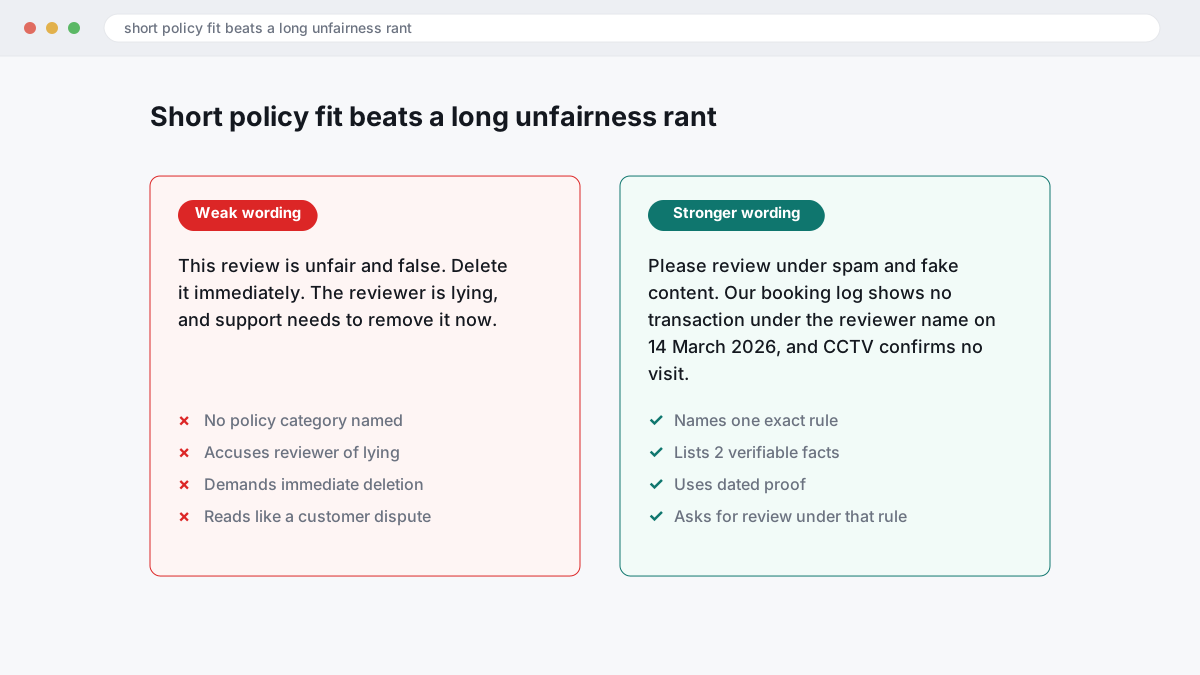
Most failed requests use the wrong tone. If you accuse the reviewer of lying, demand immediate deletion, or insult Google support, the flag reads like a customer dispute rather than a policy breach. The stronger approach is to anchor your evidence pack to one rule such as spam and fake content, then list dated proof: your booking log shows no transaction under the reviewer name on 14 March 2026, your CCTV or reception record shows no visit on 15 March 2026, and your CRM has no call, invoice or email thread matching the claim between 1 and 31 March 2026. Facts give support something to verify.
Use wording like this and keep it under 150 words:
I request review of this post under Google’s spam and fake content policy. We cannot match the reviewer or the described transaction to any customer record. Attached evidence: (1) booking log for 1-31 March 2026 showing no booking under this name, (2) reception record for 15 March 2026 showing no visit matching the complaint, and (3) CRM export dated 31 March 2026 showing no phone, email or invoice linked to the reviewer. Please review the attached documents and remove the review if it breaches Google review policy.
What should you do if Google rejects your removal request?
If Google rejects your request, do not send the same complaint again. Reclassify the review under the Google Business Profile policy that actually fits, rebuild the evidence pack, cite the earlier case ID in your appeal, and assume you may need a live-with-it recovery plan.
The usual mistake is repeated flagging under a vague label such as “conflict of interest” or “spam” with no proof attached. That fails because Google often treats a second identical submission as the same unsupported claim. In BGR Review’s records of 12,000+ negative review cases logged June 2025 to June 2026, roughly 90% of businesses who came to us after a failed attempt had used only the in-platform report button, and 70–80% of those first requests had been rejected. A rejection did not prove the review was valid; it usually meant the case was thin.
The better move is diagnosis. Check the first report against the exact Google review policy category you can evidence: off-topic content, impersonation, fake engagement, harassment, or a false factual claim you can disprove with dated records. Then rebuild the evidence pack around that breach: booking log showing no customer match, screenshots of the reviewer account authenticity problem, timeline of contact, and the public review URL. In the appeal, reference the prior case ID and ask for support escalation because new evidence narrows the policy issue rather than repeating it.
If Google still leaves the review live, switch from removal mode to damage control. Use a response strategy that corrects the record without accusing the reviewer of lying, then work on profile recovery by earning fresh compliant reviews to protect map-pack click-through, conversions from calls and form fills, and branded search demand. If you want outside help after a failed DIY attempt, BGR Review handles removals on a pay-after-success basis at $449 per removed review link with $0 upfront.
When is DIY review removal enough, and when is paid help worth it?
DIY removal usually works best when the review breaches a named Google Business Profile policy and your proof is clean. Paid help starts to earn its keep when the problem repeats, spans multiple locations, touches defamation or false statements, or has already been rejected and now needs tighter support escalation.
The wrong approach is hiring an agency because you think agencies can delete anything. That fails for the same reason your first flag fails: Google still wants policy fit, a clear evidence trail, and a consistent timeline. In BGR Review's case file of 12,000+ negative review cases logged June 2025 to June 2026, roughly 90% of businesses who came to us after a failed self-filed attempt had used only the in-platform report button, and 70-80% of those initial requests had been rejected.
The right approach is to use DIY when the breach is simple and localised: one location, one review, one obvious issue such as impersonation, off-topic content, or a reviewer with no transaction record against your booking log. Good paid help improves the process rather than promising a magic result. That means rebuilding the evidence pack, matching it to the exact Google review policy category, and pushing support escalation only when the file is tight enough to survive scrutiny.
This is the practical split:
| Situation | Best route | Why |
|---|---|---|
| One review, one branch, clear proof | DIY | Fastest and cheapest if your records show no customer match |
| Repeated attacks or reviewer account authenticity issues | Managed help | Needs structured evidence and escalation |
| Multi-location businesses with copy-paste reviews | Managed help | Each profile needs its own chronology and supporting records |
| Legally sensitive claims | Managed help or legal review | Platform policy and legal risk need separate handling |
If you do pay, judge the offer by the model. Be wary of any service that guarantees removal regardless of evidence, because Google does not sell guaranteed outcomes and neither should an honest provider.
Which review problem should you fix first if you want the fastest business impact?
Fix what prospects will see first. Recent one-star posts, unanswered accusations, and obvious fake-review clusters usually damage trust and conversions faster than older complaints buried lower down; your priority should follow visibility, recency and likely enquiry loss, not irritation.
The wrong move is chasing the review that annoyed you most. That fails because a six-month-old complaint on page two of your Google Business Profile often has less effect on map-pack click-through and form fills than a fresh one-star review sitting in the top three visible posts, especially if it alleges fraud, no-show service or unsafe work and you have left it unanswered. In BGR Review’s dataset of 1,485 businesses observed from February to July 2026, trades firms with complete enquiry-source data attributed 70–80% of calls and bookings to a Google Business Profile or Yelp listing, which is why the review most visible on the profile usually hits conversions before it hits your average rating.
The better move is to audit the last 30 to 90 days for review velocity and profile health. A single bad review can sting, but a short run of low-star posts, sudden reviewer-account oddities or three similar allegations in a month will do more damage to trust, local-pack clicks and branded search demand than one isolated complaint. Your response strategy matters here: if removal is uncertain, answer the allegation with dates, next steps and a contact route while the flag or appeal is pending, because an unanswered accusation can suppress calls even when the star average barely moves.
Can removing Google reviews cross a legal or policy line?
Yes. Paying for undisclosed reviews, making false claims in a dispute, or using legal threats as pressure can create more risk than the review itself. Google review policy, platform enforcement, and legal standards are separate systems, and they vary by country, so your removal approach should stay factual, documented, and tied to a named policy breach.
The wrong approach is treating an unfair review as a free pass for any tactic. That fails because undisclosed paid endorsements can breach the FTC endorsement guides in the US, and Google can still reject or act on activity that conflicts with its review policy even if you believe the underlying review was unfair. A cleaner route is to challenge the review on what you can evidence: impersonation, conflict of interest, fake engagement, or a false factual claim that can be disproved with dated records, booking logs, invoices, CCTV stills, or message history.
False factual accusations can also raise defamation and false statements issues, but the legal test depends on jurisdiction. A review saying “slow service” is usually opinion; a review saying “this clinic billed me twice on 14 March” is a factual allegation you may be able to rebut. UK and EU consumer-protection rules differ from US standards, including rules around misleading commercial practices and fake reviews, so this is general information only, not legal advice.
How should you respond publicly while a removal request is still pending?
Post a short, calm reply on your Google Business Profile if the review could affect prospects before Google decides. Your aim is to reassure future readers that you handle complaints properly, not to win an argument in public.
The wrong response strategy is to fight point by point, accuse the reviewer of lying, or paste private order details to prove your side. That usually fails twice: it gives the complaint more oxygen, and it creates a second trust problem for anyone comparing you in the map pack. If the allegation could affect calls, bookings or form fills, reply within 24 to 72 hours so the review does not sit unanswered during the period when prospects are deciding.
Keep the reply brief. A safe structure is: acknowledge the concern, say you are reviewing it, invite offline contact by phone or email, and avoid admitting facts you dispute. Do not post names, invoice numbers, appointment times, medical details, or anything else that exposes private customer data.
The right approach de-escalates the situation and shows control. Prospects scanning your Google Business Profile care less about who “won” than whether you sound measured and responsible. If Google removes the review, update or delete your reply so the public record stays clean and you do not keep a dead dispute visible longer than necessary.
How does the removal workflow change for multi-location businesses?
For multi-location businesses, review removal works best when one team owns the case log, each Google Business Profile branch gets its own evidence pack, and every flag, screenshot and appeal deadline follows the same file naming rule from day one.
Letting each branch handle disputes its own way usually creates conflicting reports. One manager flags the review as spam, another replies publicly, a third opens support escalation with a different explanation, and Google now sees three versions of the same complaint tied to one reviewer. That slows the workflow and weakens policy fit. In BGR Review's case file of 12,000+ negative review cases logged June 2025 to June 2026, reviews raised within 28 days of posting and backed by an identifiable policy issue resolved successfully in roughly 90% of cases; for comparable cases raised beyond 28 days, the observed success rate fell to approximately 25–30%.
A central tracker fixes that, but the evidence still has to stay local. If the reviewer names your Manchester branch, do not attach screenshots from London, your head-office CRM, and a generic “no customer found” note. Use one case ID per review link, one screenshot format such as GBP-LocationCode-Date-ReviewID, and one deadline column for flag date, appeal date and support escalation date. That keeps the map pack risk contained to the affected profile, protects branch-level click-through rate and conversions, and stops duplicate filings from damaging profile health across the wider account.
| Approach | What happens | What to do instead |
|---|---|---|
| Each branch files separately | Duplicate reports, mixed explanations, missed deadlines | One shared case log with one owner |
| Generic evidence for all locations | Weak match when the review names a specific branch | Separate branch evidence tied to that Google Business Profile |
What does a real first-flag-to-outcome workflow look like in practice?
A workable removal process is disciplined: classify the policy ground, document it, flag it, track it, appeal once with better proof, then switch to mitigation if Google still refuses. Most wasted effort comes from weak categorisation and missing evidence, not from using the wrong button.
The ad hoc approach fails because it starts with emotion. A business owner sees a one-star post on a Google Business Profile, replies in anger, taps the report option, and leaves no trail. In BGR Review's dataset of negative review cases with prior self-filed attempts, logged June 2025 to June 2026, roughly 90% arrived after only the basic in-platform report button had been used, with no supporting documentation, and 70–80% of those initial requests had been rejected. That is a flagging workflow with no evidence pack, no case log and nothing useful for support escalation.
The cleaner route starts on day 1. Classify the exact Google review policy issue before you post any public reply: spam, fake engagement, conflict of interest, off-topic content, or a reviewer account authenticity problem you can evidence. Capture screenshots, timestamps, booking records, staff rota gaps, CCTV stills if relevant, and a short timeline showing why the reviewer could not have had the claimed experience. Then flag the review inside the profile, save the case ID, note the date, and check status changes through days 2 to 7 instead of re-reporting blindly.
One common recovery path looks like this: the first flag says “false review” and gets nowhere; the appeal works after the file is rebuilt around a narrower breach, such as a competitor or ex-employee posting from an undisclosed account, with a dated timeline and matching proof. If Google still leaves it live after one evidence-led appeal, stop burning time on duplicate submissions and switch to response strategy: post a calm factual reply, strengthen recent legitimate review flow, and protect click-through rate, conversions and map-pack trust while the review remains visible.
Where to go from here
Start by naming the exact Google review policy issue before you touch the report button: spam, conflict of interest, impersonation, off-topic content, harassment, or a false factual claim you can evidence. Then build the evidence pack around that single breach. Include timestamps, order records, staff rota, message history, screenshots of profile edits, and anything that shows the reviewer was never a customer or that the statement is objectively false. A vague complaint gets vague treatment. A tight file gives support something they can verify.
If your first flag has already failed, treat that rejection as a routing problem, not a verdict on the review itself. Rebuild the case around one policy category, tighten the timeline, and escalate with cleaner documentation. That is usually the point where a proper removal review makes sense, because the map pack, click-through rate and conversions keep taking the hit while the case sits unresolved.
If you do it yourself, expect clearer outcomes from a structured file than from repeated flagging with no new evidence.