

Quick answer
Yes, you can sometimes sue for a fake review, but only if it crosses a legal line such as defamation, impersonation, false statements of fact, or unlawful commercial conduct. A harsh opinion usually will not support a claim. In most cases, platform removal is the faster and cheaper first move because court action takes longer and legal costs rise quickly. At BGR Review, fake-review removal runs on a pay-after-success model: $0 upfront and $449 per removed review link. Rules vary by country and platform, so this is general information, not legal advice.
If you are asking can you sue for a fake review, the useful question is usually which route has evidence behind it: platform policy, a lawyer’s letter, or a filed claim. We handle both review growth and negative review removal for businesses across Google, Trustpilot, Yelp, Clutch and TripAdvisor, and the cases that move fastest usually start with a tight evidence pack rather than a long complaint.
That pack is practical: the review URL, dated screenshots, the posting timeline, customer-record mismatch, impersonation proof, and any prior flag history. One field often decides whether an appeal goes anywhere: the direct explanation of why the reviewer could not have been a real customer, backed by records you can show if the platform asks.
When a fake review becomes legally actionable
A fake review becomes legally actionable when it states a false fact that can be proved false and harms your business; anger, exaggeration and a bare low rating usually do not clear that line. Courts in the US often separate verifiable statements such as “this clinic billed me twice” from opinion such as “awful service”, and the same basic split appears in UK defamation analysis even though the legal tests differ by country. This is general information, not legal advice.
The claim route is usually defamation, but lawyers also look at injurious falsehood and business disparagement where the post targets trading reputation or sales. Those labels matter because a review saying “they use counterfeit parts” raises a different issue from “I would never go back”, even if both hurt conversions on Google Business Profile or Trustpilot. BGR Review treats that distinction as the first screen before suggesting removal work or telling a client to speak to counsel.
A one-star rating on its own rarely supports a lawsuit because a rating, without factual wording, reads as opinion. The same applies to vague lines like “terrible company” unless the review adds a concrete allegation that can be checked against records, messages or invoices. In practice, a post that names a fake transaction, fake employee interaction or fake safety issue is the kind of review that moves from platform dispute into legal territory.
The four legal elements courts usually look for
Courts usually ask for four things before a fake-review claim goes anywhere: falsity, publication, harm, and fault.
Falsity means the review states something untrue that can be checked, such as saying your clinic billed for a treatment the person never booked or your agency missed a deadline for a customer who does not exist in your records. Publication is usually the easy part. One public post on Google Business Profile, Yelp, or Trustpilot is generally enough because other people could read it, screenshot it, and act on it.
Harm is where most business owners hit resistance. A judge will usually want more than “this hurt our reputation”. You need something measurable tied to that post: cancelled bookings, a lost tender, a drop in enquiries after the review URL went live, or staff time spent answering it. If you are comparing legal action with BGR Review’s pay-after-success removal model at $0 upfront and $449 per removed link, this is often the point that decides whether court makes economic sense.
Fault asks what the reviewer knew or should have known when posting. The exact standard varies by country and by platform context, so this is general information, not legal advice. In practice, the stronger claims are the ones backed by customer-record mismatch, impersonation proof, and screenshots captured before the post is edited or deleted.
What usually fails, even when the review feels unfair
Most unfair reviews do not become strong lawsuits because opinion, substantial truth, and cost can each stop the claim before a court deals with the merits.
A line like “terrible service” usually reads as opinion, and opinion is often protected in the US and UK unless it carries a false factual sting underneath it. “The food was cold” or “staff were rude” can also survive if they reflect personal judgement rather than a provable lie. That is why platform complaints and court claims both fail when the review is harsh but vague. Google Business Profile’s review policy targets spam, impersonation and prohibited content; it does not remove a post simply because the wording feels unfair.
Small errors do not rescue a weak claim. If the core allegation is substantially true, minor mistakes on dates, order value or staff names usually do not change the result. Cost kills plenty of disputes too.
Platform removal or lawsuit: choose the faster route first
Platform reporting is usually the faster and cheaper first move, and court action makes sense later if the review stays live, the reviewer keeps posting, or you cannot identify who is behind the account.
| Route | Typical cost to start | What it can do |
|---|---|---|
| Platform report | Your time, or a removal service | Remove policy-breaking content without filing in court |
| Removal service | Fixed price per removed link | Build the policy case, submit, appeal, and track the live URL |
| Lawsuit | Legal fees from day one | Seek disclosure, damages, injunctions, or pressure for settlement |
Google Business Profile gives you named policy lanes before you go near a claim form. The review system allows reports for spam and fake content, impersonation, and conflicts of interest under Google’s prohibited and restricted content policy. That matters because a fake review often breaks platform rules more clearly than it proves defamation at the start.
The practical reason to start there is speed. A court case can take months before you get disclosure or an order, while a platform report can resolve the issue without lawyers if your evidence is tight and the review URL, screenshots, and customer-record mismatch all line up. If the same person reposts after takedown requests, or hides behind throwaway accounts, legal action becomes more useful because the platform route stops giving you leverage.
A practical fake-review removal workflow
A practical fake-review removal workflow starts with preservation on day 1, because the moment you flag a review you risk losing context you may need for appeal or court. Save the live review URL, full-page screenshots, the reviewer name, star rating, date, profile link, and your Business Profile or platform ID before you touch the report button. Pull the matching customer record at the same time. If no order, booking, ticket, or email trail exists, note that mismatch immediately.
Your first route is the platform report, but it needs policy-specific evidence rather than “this is fake”. On Google Business Profile, tie the report to the prohibited and restricted content policy category that actually fits, such as spam, off-topic, or conflict of interest. On Trustpilot, use its flagging flow with documents that show the reviewer was never a customer or was impersonating one. Generic complaints usually get auto-rejected because the reviewer can still look plausible from the platform side.
If the first report fails, the next move is escalation, not repeated flagging. That can mean a legal notice to the reviewer or platform, subpoena planning if identification matters, or an ORM-led rebuild of the evidence pack so the second submission fixes the missing proof.
The evidence pack that makes a claim stronger
An evidence pack is the file set that links a suspicious review to verifiable records, named platform rules and preserved source data, so your report or legal claim rests on proof instead of suspicion.
Start with the review URL, the reviewer name as shown, the profile link if visible, and full-page screenshots taken on the day you spotted it. Then match the review date against your bookings, invoices, CRM logs, call records, delivery notes or visitor sign-in records for that same window. A clean mismatch matters: if no customer, patient, diner or guest with that name, email, phone number or order details exists, the review is easier to challenge.
Keep the original files, not cropped copies. Save screenshots, emails, CCTV stills where lawful, and exports from your CRM with creation dates intact, because metadata and file timestamps help if authenticity gets challenged later.
Add the policy match in plain language. For Google, that often means conflict of interest signals, impersonation indicators, or a reviewer claiming an interaction that your records cannot place against your Google Business Profile activity. The stronger packs also include prior flag history, any reply you posted, and a short timeline showing when you reported the review and what the platform sent back.
Anonymous reviewers and the problem of identification
Anonymous fake reviews are hard to sue over because you usually cannot name the defendant without platform records, and platforms rarely hand those over without a court order. Google Business Profile, Yelp and Trustpilot may display only a first name, initials or a handle, which leaves you with a review URL and screenshots but no real identity. In practice, identification often depends on a subpoena or disclosure order aimed at the platform or an internet service provider. That route turns on local law and platform terms, so this is general information, not legal advice.
A disclosure request usually needs a viable claim first. Courts do not grant subpoenas because a review looks suspicious; you normally need a pleaded defamation or similar claim, plus evidence that the post refers to your business and states a false fact. Cross-border storage slows this down. A US business may be chasing data held by an Irish or UK entity, or a platform may require service in another jurisdiction, which adds weeks or months before you even reach the identity question.
If the reviewer is still unknown after your evidence pack is built, paying lawyers to unmask them can stop making economic sense quickly.
Damages, costs, and whether the case is economically sensible
Suing over one fake review is only economically sensible when you can prove damage that is larger than the legal bill. In the US, UK and EU, the threshold and cost rules differ, so this is general information rather than legal advice. A single one-star post rarely justifies full litigation unless it triggered a cancelled contract, a measurable drop in enquiries, or a statement of fact serious enough to support a defamation claim.
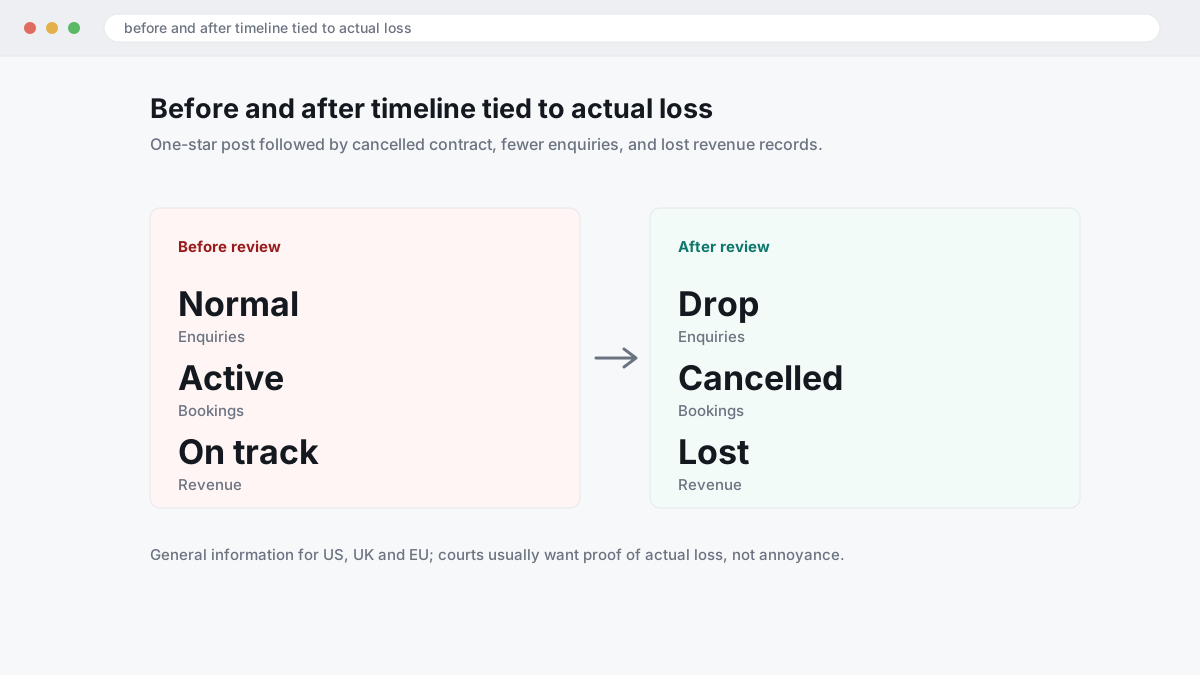
Courts usually want evidence of actual loss, not annoyance. That means documents such as lost revenue records, cancelled bookings, a client email withdrawing work after seeing the review, or a before-and-after timeline that ties the review to reputational harm. If you cannot show that link, legal fees often outrun the value of the dispute long before you reach disclosure, subpoenas, or a hearing.
| Route | What you need | Cost picture |
|---|---|---|
| Platform-targeted removal | Review URL, screenshots, policy breach, customer-record mismatch | Fixed price per removed link |
| Litigation | Identity, falsity, damage evidence, legal pleadings | Usually far higher than one review’s direct commercial impact |
If the review is isolated and removable under platform rules, a targeted removal campaign is usually the cheaper first move. Reserve court action for cases where the reviewer is identifiable, the statement is clearly false, and the financial harm is large enough to justify legal spend after platform appeals stop being efficient.
What the major platforms will remove without a court order
Major review platforms will remove some fake reviews on policy grounds alone, without any court order, if your report matches a named rule and your evidence ties the review to that rule.
| Platform | What policy covers | What usually gives you a real chance |
|---|---|---|
| Google Business Profile policies prohibit fake engagement, impersonation, and content posted because of a conflict of interest. | A review URL, screenshots, and a clean customer-record mismatch work better than arguing the review is “unfair”. | |
| Yelp | Yelp bars compensated reviews and deceptive or promotional content under its content guidelines. | Proof of payment offers, staff links, or a reviewer account used to push competitors is stronger than a general denial. |
| Trustpilot | Trustpilot accepts reports for harmful, illegal, or non-genuine content under its guidelines and reporting flow. | Order-number mismatch, impersonation proof, and a dated timeline usually matter more than legal threats. |
Most platform reports fail because the business describes harm, while the platform asks for a policy breach. The appeal forms and support threads usually turn on one point: can you show this reviewer was never a customer, is impersonating someone, or had a prohibited incentive.
How the rules differ in the US, UK, and EU
The rules differ because a fake review can trigger defamation law, advertising law, or consumer-protection law depending on where you operate and which platform hosts it.
In the US, disputes often turn on defamation if the review states a false fact that harms your business, while undisclosed paid reviews can also raise Federal Trade Commission issues under the FTC’s 2024 rule on fake reviews and testimonials. A review that says “I was a customer and they stole my deposit” creates a different legal problem from a vague opinion like “terrible service.” Platform rules sit alongside that legal layer, so a review can breach Google Business Profile policy or Trustpilot’s fake-review rules even when a court claim would be weak.
| Region | Common legal route | Extra rule often in play |
|---|---|---|
| US | Defamation | FTC endorsement and testimonial rules for paid or undisclosed reviews |
| UK | Defamation | Consumer law, including the Digital Markets, Competition and Consumers Act 2024 |
| EU | Defamation or local civil claim | Misleading commercial practice rules under the Unfair Commercial Practices framework |
Use this as general information, not legal advice.
When legal counsel makes sense after removal efforts stall
Legal counsel makes sense once your platform appeals have stalled and the review now reads like a defamation or unfair-competition problem rather than a standard policy flag. Move faster if the post accuses you of crimes, fraud, abuse, or safety failures, because those claims can cause immediate commercial damage and are more likely to justify formal legal review. Rules vary by country and platform, so treat this as general information, not legal advice; if Google Business Profile or Trustpilot has already rejected a well-documented report, that rejection history matters.
Ask a lawyer to step in sooner when several reviews land close together, use similar wording, or target the same allegation across profiles, because that can point to coordinated competitor conduct rather than one unhappy buyer. Bring a dated evidence file to the first call: review URL, screenshots, timestamps, customer-record mismatch, impersonation proof, and every platform case ID or appeal response.
How practical order of action from first screenshot to legal claim actually works
Start by preserving the review, matching your proof to the strongest policy breach, and filing the best platform report first. If removal fails and the post makes false factual claims that have caused real commercial loss, move to a tailored cease and desist letter and legal advice on a claim.
The wrong sequence is common: you post an angry reply, threaten to sue, then start looking for proof. That fails because the reviewer can edit or delete details, staff memories drift, and your legal threat says little if you have not checked whether the person was ever a customer. Capture full-page screenshots, the profile URL, the review link, timestamps, booking or CRM records, invoices, call logs, and any messages that show the person does or does not exist in your records. That evidence pack is what supports both platform-first removal and any later damages argument.
Test the platform ground before you send a legal letter. On Google, that usually means matching the review line by line to Google Business Profile prohibited and restricted content, then attaching the proof that supports the exact breach rather than making a broad “this is fake” claim. In BGR Review’s case file of 12,000+ negative review cases logged June 2025 to June 2026, reviews raised within 28 days of posting and backed by an identifiable policy issue resolved successfully in roughly 90% of cases; raised later, the observed rate fell to approximately 25–30%.
If the review alleges specific false facts, repeats across profiles, or you can tie it to lost enquiries, map-pack click-through loss, or dropped conversions from calls and form fills, bring in counsel. That is the point for a cease and desist letter aimed at the false statement, the evidence behind it, and the remedy sought.
Where to go from here
Start with the review text itself. Pull out each factual claim and separate it from opinion. “Rude staff” is hard to sue over. “They billed me twice”, “they sold a counterfeit item”, or “I was never refunded” can be actionable if your records show the statement is false and the post is hurting bookings, leads or supplier trust. Build one clean evidence pack: review URL, dated screenshots, timeline, order or CRM mismatch, impersonation proof if the person was never a customer, and any prior flag history.
Use that pack for platform removal first. In live review disputes, this is usually where weak cases stall: people send a paragraph of anger instead of documents, or they keep refiling the same appeal after the platform has clearly stopped engaging. Once you hit that point, more flags rarely change the outcome. If the review still stands and it alleges specific false facts with real commercial harm, ask a lawyer in your country for a defamation view; rules differ between the US, UK and EU, and this is general information, not legal advice.