

Quick answer
Local SEO targets searches with local intent, such as “dentist near me” or “plumber in Brooklyn”, where Google often shows a 3-pack of map results before standard organic listings. The work centres on your Google Business Profile, review volume and quality, local landing pages, citation consistency, service-area signals and proximity. Traditional SEO chases broader organic rankings across regions or national demand. If your leads depend on calls, visits or bookings from a defined area, local SEO usually comes first because you are competing for one of three map positions, not only a website click.
We work on both sides of this problem every week: building verified review profiles and cleaning up review issues that suppress local visibility. The pattern is usually obvious once you inspect the assets properly: a technically sound site, an underbuilt Google Business Profile, mismatched name-address-phone listings, and a weak review profile that loses trust at the click stage.
The operational detail matters more than most guides admit. A basic in-platform flag rarely moves a harmful review on its own; across 12,000+ negative review cases logged by BGR Review from June 2025 to June 2026, roughly 90% of businesses that came to us after failing had filed only the report button with no supporting evidence, and 70–80% of those first requests had been rejected.
What local SEO is designed to do
Local SEO is the work that helps your business appear in location-based searches and Google Maps when someone is looking for a nearby service. It targets local-intent queries such as “dentist near me”, “emergency plumber in Austin” or “accountant London”, where Google usually shows a map pack and business profiles before, beside or above standard web results. The core asset is your Google Business Profile, because that profile feeds Maps visibility, reviews, opening hours, service areas and click-to-call actions in a way a regular website page does not.
Traditional SEO aims at broader organic rankings across web search, and a site can rank there without a Google Business Profile at all. A software company selling nationally can win traffic through pages, links and content alone. A roofer, clinic or restaurant usually cannot rely on that route, because the local result set is built around proximity, profile strength and location signals. In BGR Review’s own dataset of 1,485 businesses observed from February to July 2026, trades businesses that shared complete enquiry-source data attributed 70–80% of calls and bookings to a Google Business Profile or Yelp listing, not a standalone website.
What traditional SEO is designed to do
Traditional SEO is built to win organic search results that are not tied to a specific service area, Google Business Profile, or map-pack placement. The work usually centres on topical coverage, internal linking, crawlability, page speed, indexation, and links from relevant sites, because Google ranks those pages through its core web search systems rather than local profile signals; Google Search Central’s guidance on ranking systems and helpful content is the right frame here. If you run a national SaaS brand, the page that matters is often a product, feature, comparison, or pricing URL, not a city listing.
You can see the operational difference in where effort goes each month. A broader SEO campaign spends time on content briefs, page updates, technical fixes, and authority building, while our own review and removal work at BGR Review tends to affect conversion trust around those pages rather than whether a software company appears in a local pack. That is why a firm selling nationwide software may invest in organic pages for “project management software for accountants” and ignore location modifiers entirely, even while keeping review profiles clean with pay-after-success removals at $449 per removed link when a false review starts hurting branded searches.
The real difference is search intent, not just geography
The real difference between local SEO and broader SEO is search intent: one usually signals a nearby decision soon, while the other often starts earlier research.
If you search for “roofer near me” or “emergency dentist”, Google reads that as immediate local intent and serves the map pack, Google Business Profiles and location-matched pages first. In BGR Review’s own dataset of 1,485 businesses observed from February to July 2026, trades firms with complete enquiry-source data attributed 70–80% of calls and bookings to a Google Business Profile or Yelp listing, which tells you where that intent converts.
Broader searches sit higher up the buying journey. A query like “how to choose an accountant” or “best CRM for small teams” usually leads to guides, category pages and comparison content because the searcher is still narrowing options, often over weeks rather than the next few days.
Google’s layout follows that intent signal. Add a town name, “near me”, mobile location data, or a service with obvious local relevance, and the results shift toward maps, localised pages and review-heavy business profiles. If your site is technically sound but your profile is thin, your reviews are weak and your location signals are inconsistent, Google can still hold you back in local results even while your broader pages rank.
When a business needs local SEO, broader SEO, or both
The right channel depends on where your sale starts: the map pack, the organic results, or both.
Single-location shops, clinics and service-area firms usually need local SEO first because the lead comes from nearby, high-intent searches such as “roofer near me” or “emergency dentist”. In BGR Review’s dataset of 1,485 businesses observed from February to July 2026, trades firms that shared complete enquiry-source data attributed 70–80% of calls and bookings to a Google Business Profile or Yelp listing, not a website form. If that sounds like your business, visibility in Google Business Profile, review quality and accurate listings deserve budget before broad content campaigns.
| Business model | What to prioritise | Why |
|---|---|---|
| Single-location or service-area business | Local SEO first | Most demand is local and immediate, so maps visibility, reviews and consistent NAP data move faster than national content. |
| Multi-location brand | Local SEO plus broader SEO | Each branch needs its own location signals, while the main site still has to rank for category terms, buying guides and non-brand searches. |
| Nationwide e-commerce store | Broader SEO first | If you ship across the country and customers rarely visit a physical location, product, category and informational rankings matter more than map pack exposure. |
Multi-location businesses usually need both channels running together. A chain with five branches can win local intent through separate profiles and location pages, then use broader SEO for “best office chairs”, “payroll software” or other non-local searches that no map pack will capture. If your revenue depends on footfall or booked local jobs, start local; if your revenue depends on national product discovery, start with broader SEO; if you have branches and a content-driven site, split the work instead of forcing one channel to do both jobs.
How Google Business Profile changes the local SEO playbook
Google Business Profile changes local SEO because Google can rank your profile in the map pack even when your website is technically sound, and that profile drives calls, direction requests and visible review signals straight from the search result. In BGR Review's own 2026 dataset of 1,485 businesses, trades firms that shared complete enquiry-source data attributed 70-80% of calls and bookings to a Google Business Profile or Yelp listing rather than a website. If you rely on local demand, that shifts the work: your profile becomes a ranking asset, not a directory listing you fill in once.
The fields that move the needle are the boring ones. Primary category, secondary categories, services, opening hours, photos, business description and consistent name-address-phone details all affect whether Google trusts the listing enough to show it for nearby intent. A wrong primary category can suppress visibility even if reviews are strong, and mismatched hours or phone numbers often break conversion after you do win the click.
Most guides give too much space to GBP posts. Posts can help with freshness and promotions, but they usually matter less than category accuracy, steady review activity and clean NAP consistency across your site and listings. That is why a profile with recent verified reviews, complete services and matching contact details often outranks a more active poster whose basics are wrong. If your review profile is weak, BGR Review handles verified review campaigns with a 30-day free replacement guarantee, while removal work sits on a separate pay-after-success model at $449 per removed link with $0 upfront.
How ranking factors differ between local SEO and SEO
Local SEO ranks you in Google's local systems by relevance, distance and prominence, while traditional SEO leans harder on content quality, backlinks, crawlability and internal links in organic search.
| Channel | Inputs weighted most heavily | What usually loses the click |
|---|---|---|
| Local search and map pack | Google Business Profile category match, service-area or address proximity, review profile, brand mentions, local prominence | A profile that sits farther from the searcher, has weak reviews, or sends mixed location signals |
| Traditional organic SEO | Page usefulness, search-intent match, links, site architecture, crawl/index health, internal linking | A thin page, poor topical depth, weak authority, or pages Google cannot crawl properly |
Google Business Profile Help names relevance, distance and prominence as the core local factors. Distance changes the outcome fast. A stronger website can still miss map visibility if the search happens across town and a closer competitor has a cleaner profile, better category alignment and more review activity.
Organic rankings behave differently. If your service page is technically sound, well linked and clearly answers the query, it can rank across a wider area than your map listing. That gap matters in practice: in BGR Review's own dataset of 1,485 businesses observed from February to July 2026, trades firms that shared complete enquiry-source data attributed 70-80% of calls and bookings to a Google Business Profile or Yelp listing, which is why a business can have a solid site and still feel invisible locally.
Where reviews fit in local rankings and conversions
Reviews sit at the point where local visibility and lead generation meet, because they feed Google’s prominence signals and they change whether a searcher clicks your profile or skips it. Google Business Profile documentation names prominence as one of the local ranking inputs, and reviews are part of how that prominence is understood in practice. In BGR Review’s own dataset of 1,485 businesses observed from February to July 2026, new trades and local service firms that reached 20–30 reviews over the first three months were associated with stronger local visibility, although other ranking factors were active at the same time.
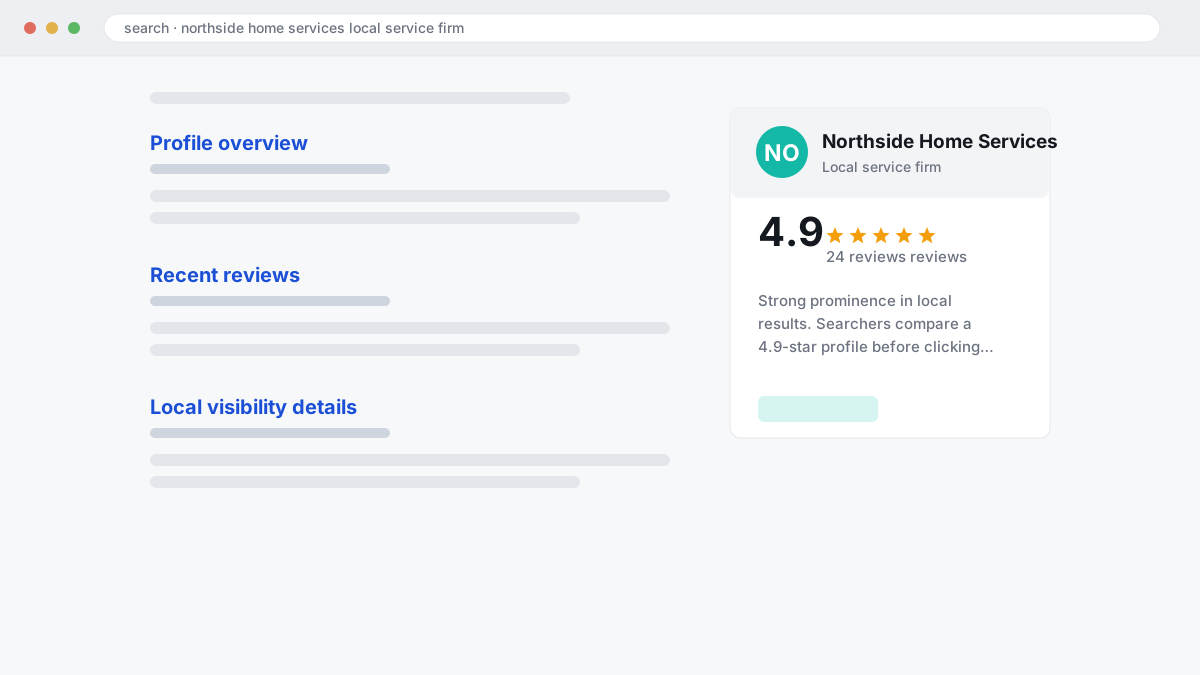
9-star competitor before anyone reads a single landing page. That difference affects map-pack click-through, calls and direction requests because the star rating sits beside your business name, not buried in your site copy.
Fresh reviews, useful owner responses and natural language in customer feedback all help a local profile feel active and relevant. A profile full of old five-star reviews can still lose clicks if the last review landed months ago, nobody replied, and recent complaints sit unanswered. Response quality matters because your reply is often the first proof that you are present, accountable and still trading; the best ones address the issue plainly, mention the actual service or location, and avoid keyword stuffing that reads manufactured.
What citations and local landing pages actually do
Citations confirm that your business details match across third-party platforms, while local landing pages give each location a page on your site that can rank in organic search beyond the map pack. A citation usually means the same name, address, phone number and primary category showing on places like Yelp, Apple Maps and Bing Places. Google does not need hundreds of directory listings to trust you. It needs the core identity signals to stop conflicting.
If your Google Business Profile says “roofing contractor” but Apple Maps or Yelp carries an old phone number or a broader category, you create doubt around entity matching. That weakens local relevance even when your site is technically clean. In audits we run before review-growth work starts, inconsistent NAP and category data often sits beside an underbuilt profile and suppressed map visibility.
Local landing pages do a different job. A multi-location business needs a real page for each town or branch so it can rank for local organic searches, earn links, and convert visitors who never open the Google Business Profile. One thin “locations” page rarely carries enough detail. A useful page needs the branch address, service area, opening hours, unique copy, and reviews or proof tied to that location.
What the month-to-month work looks like in each channel
Month to month, local SEO revolves around your live business profile and listings, while broader SEO revolves around your site, content and link graph.
| Channel | Core monthly work | What changes first |
|---|---|---|
| Local SEO | Google Business Profile updates, review requests and replies, citation fixes, local landing page edits, spam-checking on maps | Customer-facing signals often move week to week: new reviews, corrected hours, cleaner categories, fewer duplicate listings |
| Traditional SEO | Content production, technical audits, internal-link improvements, backlink earning, indexation and crawl fixes | Ranking movement usually takes longer and shows up across non-local queries first |
If you hire an agency for local work, the recurring jobs are usually operational: update holiday hours in Google Business Profile, add fresh photos, answer reviews, fix inconsistent name-address-phone citations, and tighten city or service pages so they match what the profile says. That is why local campaigns produce visible weekly changes your staff and customers can actually see.
Traditional SEO runs on a slower publishing and improvement cycle. A typical month means new service or guide content, an audit of crawl and index issues against Google Search Central guidance, internal-link cleanup, and link earning to strengthen page authority. Most agencies still report monthly, but local work has more frequent front-end movement because review management and listing edits do not wait for a quarterly content plan.
BGR Review sits inside that local workflow where reputation is the blocker.
A practical local SEO workflow from audit to improvement
A practical local SEO workflow moves from profile accuracy and review risk in week 1 to page, listing and service fixes in weeks 2-4 so map visibility has a chance to recover.
| Timing | What gets checked | What usually gets fixed |
|---|---|---|
| Week 1 | Google Business Profile audit, primary and secondary categories, NAP consistency, review profile | Wrong primary category, outdated phone or address, weak review triage under Google Business Profile review policy |
| Weeks 2-4 | Local landing pages, duplicate listings, missing services, service-area setup | Duplicate GBP entries, thin location pages, unlisted services, broken internal links from the site to the profile |
Week 1 is usually where the real problem shows up. A technically sound site can still lose map pack exposure because the GBP uses the wrong primary category, the business name and phone differ across directories, or the review profile is thin and carrying unresolved policy issues. If a review looks removable, the first pass is evidence collection, because the basic report button alone often fails; in our case file, roughly 90% of businesses that came to us after a failed attempt had filed with minimal supporting documentation.
Weeks 2-4 are cleanup and build. That means merging or removing duplicate profiles, adding missing services to the GBP, expanding weak local pages, and checking whether a suspension is blocking everything else.
Mistakes that waste budget when businesses confuse local SEO with SEO
Budget gets wasted when you use broad SEO tasks to solve local ranking problems that live inside your Google Business Profile, review profile and category signals.
Publishing blog posts alone will not repair an incomplete GBP. If your primary category is wrong, services are thin, photos are stale and the profile has weak review coverage, extra articles on your site usually leave map visibility flat even when organic pages index fine. Google Business Profile Help makes that separation clear: the local result is built from relevance, distance and prominence, and only one of those sits on your website.
Buying general backlinks misses the same point. Links can help domain authority, but they rarely fix proximity, duplicate listings, mismatched NAP details or poor category relevance. A local pack problem often starts with profile structure, not link volume.
Reviews are where the spend mistake becomes expensive. Rankings can hold steady while click-through drops because searchers see a thin or damaged review profile beside competitors. If the issue is simply too few recent reviews, removal will not solve it.
Where to go from here
If your phone calls, bookings or walk-ins depend on people searching in a specific town, city or service area, fix local signals first. That usually means three things in order: your Google Business Profile needs to be complete, your name-address-phone details need to match across listings, and your review profile needs enough recent, credible activity to support map visibility and conversion. A technically sound site helps, but it rarely carries a weak local profile on its own.
The next practical step is simple. If your profile looks thin, start with BGR Review’s review growth service and expect a structured plan around verified reviews, platform fit and a 30-day free replacement guarantee on review packages. In our removal records, review age mattered sharply: cases raised within 28 days and backed by a clear policy issue resolved successfully far more often than older ones. If the problem is there now, act while the evidence is still fresh.