
Quick answer
The google algorithm is a shorthand term for Google's ranking systems, not one master formula. In 2025, a visibility drop does not automatically mean a penalty. Google Search Central says core updates can take up to a month to fully roll out, and recovery usually comes from improving overall page quality, search intent match, trust signals, and technical health rather than changing one tag or paragraph. Check Google Search Console first, separate indexing or crawl errors from update impact, then audit pages with thin evidence, weak E-E-A-T signals, poor structured data, or titles that lost click-through rate.
This page is written from the operator side of the problem. At BGR Review, our teams in New York, London and Thornhill handle the fallout after traffic drops, map-pack slippage and branded search decline, and the first workflow is usually the same: annotate the date, split page groups, compare brand versus non-brand clicks in Search Console, then decide whether the cause is technical, content-led, local, or reputational.
That distinction matters because rankings can hold while leads still fall. We see that when a profile keeps position but loses clicks after fresh negative reviews, weak review recency, or a drop in snippet appeal; and on removal work the same principle applies, where businesses often arrive after using only the in-platform report button with no evidence pack, which is one reason Google rejects so many weak submissions. We sell review growth and pay-after-success removals at $449 per removed link with $0 upfront, so the commercial angle is clear, but the diagnosis here is still the cheaper first step for many readers.
Why did leads drop even though rankings did not collapse?
A lead drop with steady positions usually means click-through rate or map-pack exposure weakened before Google’s ranking systems moved your blue-link rankings enough to show a “collapse” in the rank tracker.
The wrong approach is to stare at total sessions and assume a small traffic dip means a small business problem. That fails because search intent is uneven: losing a few branded clicks or one emergency service page can cut calls harder than a broader 10% decline on blog pages. In BGR Review’s dataset of trades businesses with complete enquiry-source data, observed from February to July 2026, 70–80% of calls and bookings came through a Google Business Profile or Yelp listing, so local pack visibility often matters more than a stable organic position.
The right approach is to compare branded vs non-branded clicks, service-page CTR, and Maps actions on the same dates. If titles, snippets, review stars, or reputation cues look weaker, CTR can fall while rankings still look “fine”; if the local pack slips a spot, calls can drop even when your website holds page-one visibility.
How does the Google algorithm actually decide who appears first?
Google does not run on one master formula. It layers multiple ranking systems to match search intent, judge quality, pick the best format for the query, then reshuffle results as content, competition, location and freshness change.
Most guides talk about the Google algorithm as if one score decides everything. That fails because Google may rank a service page for “emergency plumber near me”, a guide for “how to stop a leaking pipe”, a map result for “plumber open now”, and a video for “replace tap washer” even when the same business targets all four. The right way to read rankings is system by system: relevance to the query, page quality, usability, location, and result type all interact, so the page with the strongest copy does not always win the click-through rate or the booking.
Structured data helps Google understand what a page is about and can make it eligible for rich results, but it does not buy position one. Schema on a weak page usually changes presentation, not rank. For local firms, that distinction matters because in BGR Review’s dataset of trades businesses with complete enquiry-source data, observed from February to July 2026, 70–80% of calls and bookings came through a Google Business Profile or Yelp listing rather than a website. If your branded search demand is flat and conversions are slipping, the winning format may have changed before your ranking did.
Was it an algorithm update, a manual action, or a site problem you already had?
A manual action is a policy enforcement notice, an algorithm update is a ranking reassessment, and a site problem is usually technical breakage. Check Google Search Console messages, indexing status, and your deployment history before you blame the Google algorithm.
The wrong move is treating every drop as a penalty and rushing into backlink cleanup, content rewrites or review-repair work. That fails because manual actions appear directly in Google Search Console under security and manual-action reporting, while algorithmic drops do not arrive with a warning at all. If Search Console shows a manual action, you have a policy issue. If it shows nothing, you still may have lost visibility, but Google has reassessed relevance, quality signals or search intent rather than enforced a penalty.
Indexing and crawl issues behave differently again. A bad robots.txt rule, a canonical change, a noindex tag pushed in a template, or a server error can knock pages out within hours, sometimes before your calls and form fills fully dry up. Core updates usually look broader: site-wide non-brand clicks soften over several days, categories slide together, and one service page rarely vanishes overnight unless something technical changed on your side.
This comparison is what you should check before paying for the wrong fix, including BGR Review's $449 pay-after-success removal service, because review removal will not restore leads if Google simply stopped indexing your money pages.
| What happened | How it usually appears | First check |
|---|---|---|
| manual actions | Direct notice in Google Search Console | Read the stated policy issue and affected pages |
| algorithm reassessment | No direct notice; visibility shifts over days | Compare page groups, queries and brand vs non-brand clicks |
| indexing and crawl issues | Pages drop fast after robots, canonical or server changes | Inspect URLs, coverage status and recent deployments |
Which ranking problem hurts leads first, so where should you triage first?
Prioritise by revenue path, not by SEO noise. Lost indexing on service pages, weaker branded clicks, and reduced local pack visibility usually cut calls, bookings, and form fills sooner than a wobble on informational traffic after a Google update.
The wrong move is to chase the pages with the biggest traffic graphs. That fails because your highest-traffic URLs are often blogs, while your highest-converting URLs are service, location, pricing, and contact pages. If Google Search Console shows page indexing or crawl issues on a money page, treat that first: a deindexed boiler repair page can hurt faster than ten blog posts slipping three positions, because the intent is closer to booking.
Brand trust comes next. Average position can stay almost flat while your branded search demand still converts worse because the SERP now shows fresh negative reviews, weak star sentiment, or an unhelpful Google Business Profile impression before the click.
Map-pack losses usually outrank both for urgent local categories. In BGR Review's dataset of trades businesses with complete enquiry-source data, observed from February to July 2026, 70–80% of calls and bookings came through a Google Business Profile or Yelp listing rather than a website. If you are a plumber, dentist, or restaurant, a drop from the local pack can reduce lead volume before your organic rankings show any dramatic collapse.
What do core updates usually change for business websites?
Core updates usually reassess overall usefulness across your site rather than punishing one trick. You often see movement across many queries at once, and recovery tends to follow substantive improvements plus a later reevaluation by Google’s ranking systems over the next few weeks.
Google Search Central describes core updates as broad changes to its ranking systems, which is why a business website can lose non-brand visibility across service, city and comparison terms without any single page being “penalised”. The pages that slip most often are thin location pages built from the same template, stale advice pages that no longer match search intent, and service pages with weak comparative depth, weak sourcing or no clear E-E-A-T signals such as named authorship, firsthand evidence, pricing context or policy detail. If your branded search demand holds but discovery clicks soften, that usually points to a relevance-and-trust reassessment rather than a technical failure.
Most owners make the same mistake after a broad update: they treat a core update demotion like a direct penalty, start deleting pages in bulk, rewrite title tags overnight, and file reconsideration-style requests that do nothing because there is no manual action to revoke. That fails because core updates do not work like a switch that Google flips back on after an appeal. The better move is slower and less exciting: improve weak page groups, merge duplicate location copy, refresh dated claims, tighten comparisons, and add evidence a real buyer would trust before calling or filling a form.
Recovery rarely lands the next morning. If Google decides your site is more useful after those changes, improvements often appear on later crawls and broader reevaluations, sometimes over several weeks, and the business effect shows up first in click-through rate and form fills before rankings fully settle. If the ranking drop is mild but leads are down hard, BGR Review usually tells clients to check whether weaker review sentiment or thinner local proof has cut map-pack clicks at the same time, because a core update can expose credibility gaps you already had.
When is the helpful content system the real problem, not the update headline?
The helpful content system is usually the real issue when your pages keep indexing and some rankings hold, but enquiries soften because the content feels written to capture searches rather than help a buyer make a decision.
Most guides tell you to publish more pages after a drop. That fails when those pages repeat the same service with a new town name, reword the same advice, or answer a keyword without adding proof, examples or a next step.
E-E-A-T carries more weight when the topic affects money, safety, health or reputation, which is exactly where many service pages go vague. If you give advice on review disputes, legal risk or lead loss, you need first-hand process detail, named policies and honest limits. A page that says every bad review can be deleted reads like search-first content; a page that explains when Google will refuse, and when a simple owner response is the cheaper route, reads like someone who has done the work.
Content pruning helps when too many near-duplicate pages drag down trust. Cut or merge weak pages, keep the stronger URL, and rebuild it around one real intent: pricing, policy, evidence, turnaround, or platform-specific guidance. BGR Review does this on service-led content by consolidating overlap and keeping fixed facts visible, such as the 30-day free replacement guarantee on review packages, because clearer pages improve click-through rate and conversions faster than publishing ten more weak ones.
Could spam signals or site reputation abuse be suppressing visibility instead?
Yes — spam signals can suppress visibility without a dramatic rankings collapse, because Google’s spam updates can discount manipulative patterns quietly while its Search spam policies still allow manual actions for link spam, hacked content, scaled abuse and site reputation abuse.
The wrong approach is to blame every drop on “toxic backlinks” and start buying disavow files or mass link removals. That fails because Google often just ignores weak, irrelevant backlinks rather than rewarding or punishing them, so you spend time on noise while the real violation sits elsewhere. The right approach is to separate ignored weak links from enforceable spam violations: paid link schemes, doorway-style scaled pages, hacked sections, or third-party publishing on your domain with little editorial oversight. That works because those are policy issues, not ordinary ranking volatility.
Site reputation abuse is the clearest example. Google’s March 2024 spam policy update targeted pages published on strong domains mainly to borrow authority, especially coupon, betting, essay or affiliate sections run by outside parties with minimal review. If your leads dropped and you also run sponsored subfolders, partner pages or templated city pages, audit ownership, oversight and indexation first.
What should you check in Google Search Console in the first 30 minutes?
In your first 30 minutes, use Google Search Console to check manual actions, indexing losses, query-level impression drops, and damage to revenue pages. That separates an algorithmic reassessment from crawl, rendering, structured data, or policy issues before you rewrite a single page.
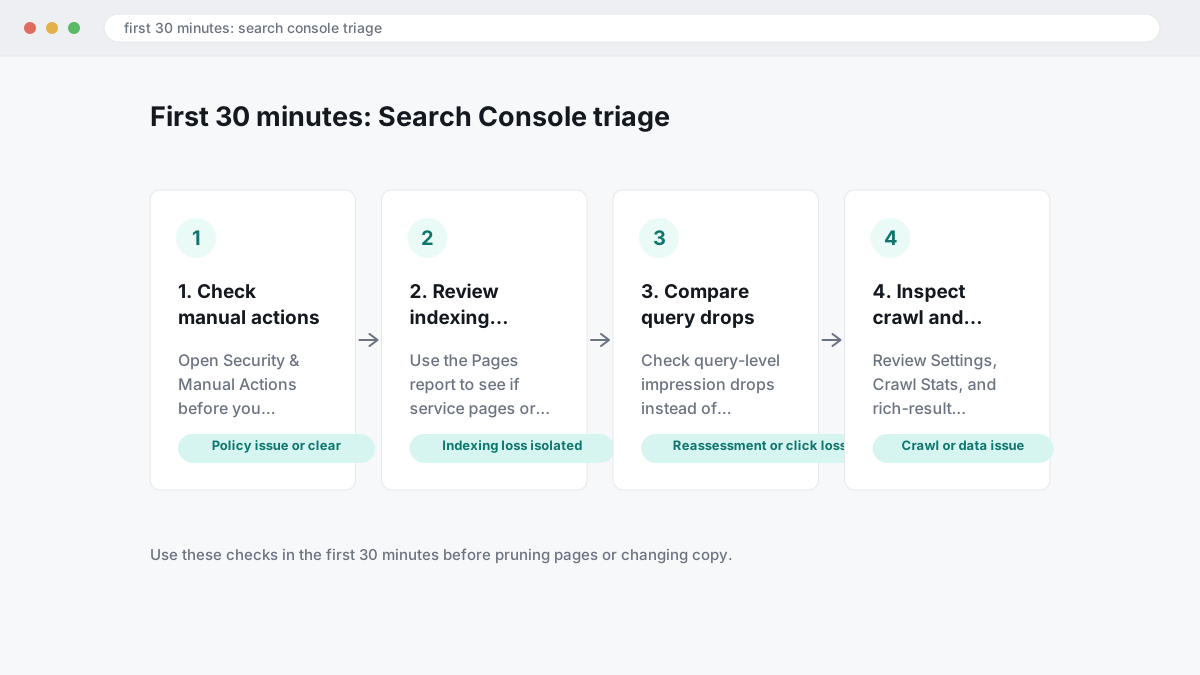
The wrong move is editing titles, pruning service pages, or adding new copy as soon as traffic dips. That fails because Search Console often shows a different cause: a manual action in the Security & Manual Actions area, money pages falling out of the Pages report, crawl spikes in Settings and Crawl Stats, or rich-result warnings under Enhancements that cut click-through rate even while average position looks stable. This is the first check we run at BGR Review before we tell a client whether they need technical SEO help, local-profile work, or review support.
Use this order first, then compare the last 7 days against the previous 28 days so one bad weekend does not distort the picture.
| Report | What to compare | What usually matters first |
|---|---|---|
| Performance | Queries, pages, devices; last 7 days vs previous 28 | Sudden impressions loss on non-brand terms, mobile-only drops, branded clicks holding while form-fill pages fade |
| Pages | Indexed, not indexed, newly excluded URLs | Deindexed service pages, canonical mistakes, noindex accidents, soft 404 clusters |
| Manual actions | Any active action or security issue | Policy problem, not a core update |
| Enhancements / structured data | New warnings or invalid items | Lost rich-result eligibility, lower SERP appeal, weaker click-through |
If impressions collapse across many queries at once, you are looking at ranking-system reassessment or a broad crawl problem. If one high-converting page disappears from indexing while branded search demand stays steady, the issue is usually page-level, and fixing that page is cheaper than rewriting the whole site. If rankings look similar but clicks and calls fall, check whether rich-result warnings, poor review sentiment, or weaker local pack visibility are suppressing conversions after the impression.
How do you recover after a Google update without making the drop worse?
Recover in sequence: confirm the failure pattern, clear technical blockers, strengthen weak money pages, then watch query clusters for several weeks. Panic rewrites, mass deletions and rushed link buying usually slow recovery after core updates because they add fresh variables before you know what actually broke.
Freeze non-essential site changes for 48 to 72 hours. Keep checkout, booking and lead forms live, but pause redesigns, CMS migrations, template swaps and bulk content pruning until you have isolated whether the drop sits in service pages, blog pages, location pages or branded search. The wrong approach is rewriting half the site on day one because one head term fell. That fails when the real issue is indexing and crawl issues, a robots change, canonical confusion or a broken internal link path that Google can see in Search Console long before you can fix it with new copy.
Fix what blocks access first. If Google cannot crawl, index or render key pages, E-E-A-T improvements will not surface because the pages are weakly discovered or partially dropped from the index. Once coverage, canonicals, redirects, structured data and internal linking are stable, improve the pages that drive calls, bookings and form fills: tighten search intent, add first-hand proof, update author and business credentials, and remove vague claims that say nothing about your service. BGR Review handles the reputation side separately from this SEO triage, because buying more reviews will not recover a page that Google has stopped indexing.
Track recovery by query clusters for 4 to 8 weeks, not by one volatile head term. Group branded, non-brand service, local pack and comparison queries, then watch clicks, impressions and conversions together.
Can algorithm changes damage brand reputation even when the site still ranks?
Yes. A Google algorithm change can cut discovery traffic first, then hurt leads later when branded searchers meet weak reviews, poor click signals or a damaged Google Business Profile and pick someone else.
The wrong response is to look only at rank trackers and conclude you are safe because the site still holds page-one positions. That fails because search intent changes lower in the funnel: once fewer new people find you on non-brand terms, a bigger share of visits comes from branded searches, where star ratings, review snippets and third-party profile titles shape click-through rate harder than an organic position alone. If negative snippets dominate your brand results, rankings do not rescue conversions. In Google Search Console, compare brand versus non-brand clicks and impressions before and after the drop; if brand impressions hold but clicks fall, the problem has moved from visibility to trust.
Maps can turn faster than organic. In BGR Review's dataset of trades businesses with complete enquiry-source data, observed February-July 2026, 70-80% of calls and bookings were attributed to a Google Business Profile or Yelp listing rather than a website. That is why a service failure, a cluster of poor reviews or weaker local pack visibility can depress calls while your main site still ranks.
What checklist should stakeholders use each time Google rolls out an update?
Use a simple update checklist each time Google changes rankings: log the rollout date, map the affected pages and lead metrics, review Google Search Console, separate technical faults from core updates, assign owners, and set 7-day and 30-day checkpoints before you escalate.
Most teams default to an SEO news recap. That fails because a timeline of core updates does not tell your sales lead why calls fell, why the map pack lost click-through rate, or whether branded search demand is still intact. The useful version is a stakeholder checklist that forces one decision: technical fix, content revision, local profile work, or reputation response.
Use this template at the first alert.
- Update date and source logged.
- Affected sections named: revenue pages, blog clusters, location pages, or brand queries.
- Lead metrics checked: calls, bookings, form fills, branded CTR, and local pack visibility.
- Google Search Console reviewed for clicks, impressions, indexing losses, coverage changes, and manual actions.
- Owner actions assigned with deadlines.
- 7-day review for movement, 30-day follow-up for page rewrites or content pruning.
- Escalate within 24 hours if manual actions appear, key pages deindex, or branded CTR collapses while rankings hold.
If clicks drop because review sentiment changed rather than rankings, treat that as a reputation issue, not an algorithm mystery.
Where to go from here
Treat the next 48 hours as a diagnosis window, not a rewrite sprint. Pull the date of the drop, compare brand versus non-brand clicks in Google Search Console, split the loss by page group, then check whether impressions held while click-through rate, calls, bookings or form fills fell. That pattern usually points in different directions: a ranking-system shift if visibility dropped, an indexing or crawl issue if pages vanished, a local pack problem if map actions fell, or a reputation issue if rankings held but searchers stopped clicking after seeing weak reviews.
Your next concrete action is a one-page triage sheet with four columns: technical, content, local and reputation. Add the evidence under each before you spend on fixes. Expect one of two outcomes: a clear repair list you can handle in-house, or a narrow brief for a specialist instead of a costly “full SEO overhaul”.