

Quick answer
A DMCA takedown notice is a formal copyright complaint you send to a platform, hosting provider or other service provider to remove copied material. To file one properly, identify the original work, list the exact infringing URLs, add your contact details, include a good-faith belief statement and a statement under penalty of perjury, then send it to the provider’s designated agent. The required elements sit in 17 U.S.C. § 512(c)(3). If accepted, the content can come down fast, but a valid counter-notice can put restoration back on the table unless you escalate.
This guide is written from the operator side, where the filing mistake that kills a case is usually simple: a homepage URL instead of the copied page, a screenshot with no source link, or proof of ownership that never ties the work back to your brand. That is the gap generic legal explainers leave open.
At BGR Review, we handle review and reputation disputes across Google, Trustpilot, Yelp, Clutch and TripAdvisor, plus negative review removal on a pay-after-success model at $449 per removed link with $0 upfront. The same workflow discipline applies here: vague complaints stall, exact URLs move, and platform forms often behave very differently from a host abuse desk once a dmca claim lands in queue.
Who can remove the copy fastest: the host, the platform, or Google?
The fastest route depends on where the copied material lives. Send the complaint to the host or platform that controls the file if you want the source removed, and use Google’s copyright form mainly for search deindexing when the page itself stays live.
Most guides send you to Google first. That fails when your real problem is the copied image, text block, or fake review screenshot still sitting on the original page, still getting shared, and still hurting click-through rate, conversions, branded search demand and map-pack trust after the search result drops out. Google can remove a result from Search; it usually does not remove the file from the website. BGR Review uses that distinction early, because paying to chase visibility before the source is tackled wastes time.
This route choice is easier if you map control first.
| Where the copy lives | Best first route | What that route can do |
|---|---|---|
| Independent website or blog | Hosting provider abuse desk or the service provider designated agent | Remove or disable the source file |
| YouTube, Facebook, Instagram, X, TikTok | Platform-specific forms | Remove the post, reel, video or image inside the platform |
| Google Search result linking to a live page | Google copyright form | Search deindexing of the result, not host-level deletion |
If the site is U.S.-based and you cannot find a clear abuse address, check the U.S. Copyright Office directory for the service provider designated agent. Start there before you escalate to Google. If the asset sits on YouTube or another social platform, use the platform-specific form first because that team can act on the account, the post and any repeat infringer policy attached to it, which is usually far more useful than deindexing one URL.
Are you dealing with copyright infringement, or is this a different kind of claim?
Use a DMCA notice for copied protected material such as your written copy, product photos, videos, artwork, or page design. If the problem is a false accusation, impersonation, or another reputation attack, a different complaint route usually has a better chance of removal.
Most guides treat any harmful post as a copyright issue. That fails because copyright infringement covers unauthorised copying of original expression, not general harm to your name. If someone posts “this company scammed me” and the statement is false, that points toward defamation or a platform policy report, not a DMCA takedown; Google’s legal removal routes separate copyright complaints from defamation requests for exactly that reason.
The right approach is to match the claim to the content. File copyright only when you can point to the original asset and the copied version side by side: the same review screenshots lifted from your site, the same before-and-after gallery, the same sales-page text. That works because a reviewer or designated agent can test ownership and copying quickly, while a vague complaint about “damage” gives them nothing concrete to verify.
Commentary, criticism, parody, and some screenshots can still stay up under fair use, especially when the image is used to discuss or critique the original rather than replace it. Jurisdiction and country rules matter here: the DMCA is a US statute, while UK defamation law, EU platform rules, and local consumer-protection regimes can point you to a different notice path. BGR Review sells review removals on a pay-after-success basis at $449 per removed link with $0 upfront, but for a pure copyright match the cheaper move is often a correctly filed notice before you pay anyone.
Is filing a DMCA notice worth it, and which assets should you prioritise first?
A DMCA notice usually earns its keep when the copied asset is hurting revenue, search visibility, or trust. Start with the pages, videos, images, or review screenshots that rank, convert into calls or form fills, or create branded-search confusion in the map pack and search results.
The wrong move is chasing every scraped paragraph and old blog image equally. That burns time while one copied landing page can outrank your original within days or weeks, siphon click-through rate from branded queries, and send lower-intent traffic to a clone instead of your booking page. File first on assets tied to conversions, branded search demand, and trust signals your prospects actually see.
If the issue is clear copyright infringement, a takedown can beat a full legal dispute on cost and speed; if it is defamation, impersonation, or a fake review with no copied content, another route fits better. Search deindexing matters most when the copy already appears in Google, but a host or platform removal usually fixes more than a search-only result. Where the same account keeps posting copied assets, the platform's repeat infringer policy can add leverage because you are no longer arguing about one URL, but a pattern of abuse.
If you are weighing DIY against paid help, file the notice yourself first on the highest-damage asset.
How do you file a DMCA takedown notice that survives first review?
A durable DMCA filing ties the copied asset to the right recipient, includes every required item under 17 U.S.C. § 512(c)(3), and sends an evidence pack with URLs, timestamps, screenshots and ownership proof that a moderator can verify fast. That is the difference between a notice that clears first review and a complaint email that sits in an abuse queue.
Most failed notices start as a vague accusation: “this page stole our content, please remove it.” That fails because the reviewer still has to identify the exact infringing material, compare it with your original work, confirm your authority, and check whether the notice is legally complete. In BGR Review’s logged dataset of 12,000+ negative review cases from June 2025 to June 2026, roughly 90% of businesses who came to us after a failed self-filed attempt had sent only a basic platform report with little or no supporting documentation; many rejections came from that thin first submission, not from a finding that the claim lacked merit.
The right approach is mechanical. Collect the source URL for your original asset, every infringing URL, dated screenshots of both, capture timestamps, and one clean ownership document before you draft a word. Then include every DMCA takedown notice element: your contact details, identification of the copyrighted work, identification of the infringing material and its location, a good-faith statement, an accuracy-and-authority statement made under penalty of perjury, and a physical or electronic signature. If the platform has a form, use it; if it points to a service provider designated agent, send the notice there instead of to generic support.
Send one notice per platform route unless that provider explicitly accepts grouped URLs in the same submission. A grouped notice to the wrong inbox slows review, and a mixed batch across Google, a hosting provider abuse desk and a marketplace usually gets split or rejected.
What should your evidence pack include before you press send?
A usable evidence pack proves three things fast: what you own, where the copied material sits, and how a moderator can verify the match without guessing. Side-by-side screenshots, live URLs, visible timestamps, and publication proof usually do most of the work.
The weak approach is attaching screenshots alone. That fails because a screenshot does not show whether the page is still live, when you captured it, or whether the content belongs to your account at all. In BGR Review's dataset of negative review cases with prior self-filed attempts, logged June 2025 to June 2026, roughly 90% of businesses came in after using only a basic in-platform report flow with no supporting documentation, and 70-80% of those initial requests had been rejected. Moderators need something they can check, not just something that looks wrong.
The stronger approach is one folder with the original URL and the infringing URL copied in full, each capture showing the browser bar and the date. Add the source file if you have it, the original publication date, and ownership evidence such as your CMS dashboard, channel login view, or invoice for commissioned creative. If the copyright infringement is obvious because someone reused review screenshots and stolen content or copied a page layout, include one side-by-side image that aligns the same headline, image crop, review text, or star graphic in both places. That gives a platform form, a hosting provider abuse desk, or Google's legal team something concrete to verify quickly.
Which DMCA notice template wording actually helps instead of hurting?
The best DMCA template is a fill-in structure, not a threatening letter. Mirror the required DMCA takedown notice elements, keep the original-work URL separate from the infringing URL, and make ownership, contact details, signature, good-faith belief and accuracy statement easy for a moderator or service provider designated agent to verify.
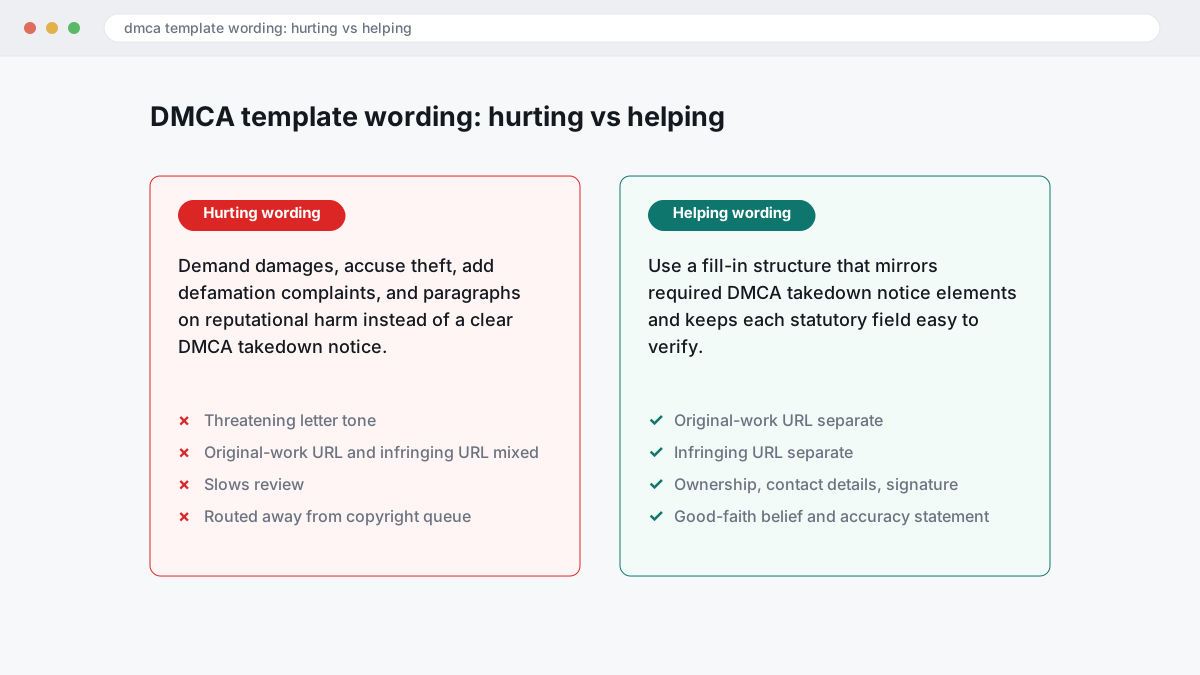
The wording that hurts you is the copied law-firm rant: damages demands, accusations of theft, defamation complaints, and paragraphs about reputational harm. That fails because moderators triage for statutory fields first, and anything outside copyright infringement slows review or gets routed away from the copyright queue. Across negative review cases with prior self-filed attempts logged by BGR Review between June 2025 and June 2026, roughly 90% had used only the basic report route with no supporting documentation, and 70–80% of those initial requests were rejected; a weak submission wastes time even when the underlying complaint is valid.
Use wording like this instead:
Copyright owner: [full legal name / company]
Original work: [title or short description] at [URL where your original appears]
Infringing material: [exact URL of the copied page, post, image or video]
Contact information: [name, address, email, phone]
I have a good-faith belief that the use described above is not authorised by the copyright owner, its agent, or the law.
I state, under penalty of perjury, that the information in this notice is accurate and that I am the owner, or authorised to act for the owner, of the copyright involved.
Signature: [typed full name / electronic signature]
Date: [day month year]
Keep those two statements next to the signature line. That plain structure gives the reviewer exactly what they need to process the notice fast.
Where should you submit the notice on Google, YouTube, social platforms, or a web host?
Send the notice to the service that controls the content first. Platforms remove user uploads inside their own systems, a web host can disable the source page, and Google usually handles search deindexing rather than deleting the file from the web.
The common mistake is sending the same DMCA complaint everywhere and hoping one sticks. That fails because display, hosting and indexing sit with different parties: Google Search may remove a result from its index, but the copied page can stay live and keep harming branded search demand, conversions and map-pack click-through if people still reach it through direct links or social shares.
This route map is the one that usually saves time:
| Destination | Use it for | What it can actually do |
|---|---|---|
| Google copyright removal tool | Copied content appearing in Search | Search deindexing of the URL or cached result, not removal of the source page |
| YouTube, Meta, X platform-specific forms | Videos, posts, images or uploads hosted on-platform | Remove or restrict the upload inside that platform after its own review |
| Hosting provider abuse desk | Content on an independent website | Disable the page or account faster than a registrar or CDN, which often do not host the file |
If the copy sits on YouTube, Facebook, Instagram or X, use the platform-specific forms rather than a generic email. Each asks for different fields, and the field that often decides first review is the exact infringing URL plus your ownership link, not a broad complaint about reputation damage. Across 12,000+ negative review cases logged by BGR Review from June 2025 to June 2026, roughly 90% of businesses who came to us after a failed first attempt had used only a basic in-platform report with little supporting documentation.
If the copy sits on a standalone site, find the host’s abuse desk or the service provider designated agent listed in its DMCA policy. A registrar manages the domain name, and a CDN may only cache delivery, so both can be slower or refuse to act unless they also host the material. Pick the route by control: platform for uploads, host for source pages, Google for search visibility.
What do you do if the notice is ignored, rejected, or answered with a counter-notice?
If your DMCA notice stalls, diagnose the failure before you send anything again. Most failed submissions come down to weak ownership proof, the wrong recipient, or a plausible fair use or misidentification argument, and each one needs a different fix.
Resending the same notice usually fails for the same reason the first one failed. In BGR Review's dataset of 12,000+ negative review cases logged June 2025 to June 2026, roughly 90% of businesses that came to us after a failed self-filed attempt had used only a basic in-platform report button with no supporting documentation, and 70-80% of those first requests had been rejected. That is why the next move is to test three points in order: did your evidence pack prove ownership, did you send it through the right platform-specific form or abuse desk, and does the complaint actually fit copyright infringement rather than defamation, impersonation or a policy breach?
A counter-notice changes the timeline. Under the DMCA process, the service provider can restore the material after about 10 to 14 business days unless you show that you filed a court action, so a counter-notice is the point where you stop arguing by email and decide whether the claim is strong enough to pursue.
If the first route ignored you, change the route rather than the wording alone. A narrowed notice with exact URLs, dated source files, publication dates and a side-by-side comparison often survives review where a broad complaint fails; if Google will only deindex while the host can remove the file, the host is the better recovery target for branded search, click-through rate and conversions.
Could a bad DMCA filing create legal risk for you?
Yes. A DMCA filing can create legal risk if you knowingly misidentify infringement, ignore fair use, or claim rights you do not own. The main danger is a bad-faith or careless notice, not an ordinary good-faith mistake that you correct quickly.
The risky approach is simple: your content was copied, or a post annoyed you, so you send a notice against every URL you can find. That fails when the use was licensed, authorised reposting by a distributor or franchisee, or a quotation that may qualify as fair use under US law. 17 U.S.C. § 512(f) deals with knowing material misrepresentation in takedown notices, which is the core misrepresentation liability point most generic guides skip.
The safer approach is narrower. Confirm who owns the copyright, check whether you granted a licence in a contract, and ask whether the copied material is being used for commentary, criticism, news reporting, or comparison before you file. A precise notice works better because the reviewer sees a rights claim tied to a specific asset, and your branded search demand, click-through rate, conversions and local pack visibility are less likely to take collateral damage from a public counter-dispute.
Jurisdiction and country rules matter. The DMCA is a US framework, while platforms often apply their own global copyright forms and local policies, so the same upload can trigger a different outcome on a US host, a UK platform, or Google search deindexing. This is general information, not legal advice. If ownership, fair use, or licence scope is disputed, get a lawyer to review it before you send anything.
How does DMCA help when fake review screenshots or stolen review content spread online?
DMCA works in reputation disputes when someone republishes your protected review screenshots, testimonial graphics, or review-widget content without permission. It does not remove a genuine negative review just because it damages trust, map-pack click-through rate, or conversions.
The wrong move is firing off a copyright claim against any bad review. That usually fails because an authentic opinion is a content-moderation, defamation, or consumer-rule issue, not copyright infringement. The right move is to use platform-specific forms or a host abuse desk when the copied asset itself is yours: a branded testimonial tile lifted from your site, a fake social post built from your review screenshots and stolen content, or a scraped website widget that republishes your review feed.
Brand teams often pair the copyright notice with impersonation, fraud, or misleading-commercial-practice complaints because copied review content is rarely the only breach. Google, Meta, YouTube, and many hosts review those routes separately, so a weak filing that says “this hurts our reputation” tends to stall, while a notice with the original URL, the infringing URL, capture dates, and ownership proof usually survives first review. If the copy sits on a standalone site, deindexing helps branded search demand, but host removal is the faster fix.
What does a practical filing workflow look like from first capture to final outcome?
Preserve the proof first, pick the actor with the fastest power to remove the copy, file a statute-complete notice, and track the response. If the first route fails, switch channels with corrected evidence instead of sending the same complaint again.
The wrong approach is one-and-done filing: one form, one screenshot, then silence. That fails because the host, the platform and Google do different jobs; a platform form may remove a post fastest, a hosting provider abuse desk may act on the whole page, and Google only handles search deindexing after the content still exists elsewhere. In BGR Review's dataset of negative review cases with prior self-filed attempts, logged June 2025 to June 2026, roughly 90% arrived with only basic in-platform reporting and no supporting documentation, and 70-80% of those first requests had been rejected.
The practical workflow is simple. In the first 30 minutes, capture the live URL, cached URL, timestamp, source file, ownership proof and your evidence pack; decide whether this is copyright infringement or a different claim; then file the fastest route first and log every submission in a spreadsheet with date, target, case ID, response deadline and next follow-up. If source removal stalls, add search deindexing for the highest-traffic URLs first, then escalate by business priority: pages ranking for your brand name, pages depressing map-pack click-through, and pages hurting conversions such as calls or form fills.
Where to go from here
Start by choosing the fastest route with the strongest reviewer-facing proof: the platform form if the content sits on Google, Trustpilot, Yelp or another live review profile, the host’s abuse desk if the page is on an independent site, and search removal only when you need deindexing after the source stays up. That order saves time. Search deindexing can protect click-through rate on branded searches, but it does not remove the page itself, so the local pack, conversions and future screenshots may still suffer if the source remains live.
If the dispute involves copied review screenshots, stolen website text, reused images or any other copyright infringement, build the evidence pack before you file: exact URLs, timestamps, original source links, ownership proof and the statement required in a proper DMCA notice. If the issue also carries reputation harm, move from DIY filing to a managed assessment.