

Quick answer
Local SEO is the work that improves how your business appears in Google Search and Google Maps for nearby searches. Reviews influence trust, clicks and profile activity, but review velocity on its own does not move rankings for long. A steady flow of genuine reviews is safer than a sudden spike, which can trigger Google Business Profile spam checks or leave you with a pattern that looks manufactured. If a review breaks policy, Google provides reporting routes through Business Profile support and flagging tools. BGR Review handles removals on a pay-after-success basis at $449 per removed review link, with $0 upfront.
This page is built from live reputation management work, including review acquisition and harmful-review removals across Google, Trustpilot, Yelp, Clutch and TripAdvisor. We track what usually happens after a bad review lands: triage the text, match it against the platform policy, compile an evidence pack with timestamps and account records, choose the right flagging route, then escalate if the first submission gets an auto-reject.
That matters because local seo advice often stops at profiles and citations, while the real movement usually comes from how review patterns change click behaviour, branded searches and profile engagement after the clean-up work starts. BGR Review has served 15,000+ businesses, offers a 30-day free replacement guarantee on review packages, and runs removal cases from offices in New York, London and Thornhill.
How local SEO works in Google Maps and local organic
Local SEO in Google means two connected ranking systems: Google Maps and the local pack use relevance, distance and prominence, while local organic results also weigh your page content, links and how clearly your site matches a place and service. Google states those three Maps factors in its Google Business Profile Help guidance, and they explain why a plumber two streets away can still sit below a rival in the pack. At BGR Review, this is the split we explain before any Google review campaign with our 30-day free replacement guarantee, because profile work alone does not move the website results.
Distance is the easiest factor to understand and the least controllable. If the search is “dentist near me”, Google will usually favour a nearby profile, but prominence can override pure proximity when one listing has stronger branded searches, stronger review trust, cleaner citations and a more established web footprint. That is why a closer business with a thin profile often loses clicks and position to a slightly farther competitor with steadier review acquisition and better sentiment.
Local organic works differently. Your service pages, title tags, internal links, local landing pages and backlinks still matter there, so a weak site can cap visibility even when the Google Business Profile looks polished. That matters commercially: if you hire outside help, review delivery may start in 24-48 hours, but map gains and organic gains rarely move on the same timeline.
Where review velocity fits in local SEO
Review velocity is the pace and consistency of new reviews over time, and in local SEO it works best as a steady pattern rather than a burst. Google Business Profile Help says local ranking uses relevance, distance and prominence, and its guidance also points users to “review count and review score” as visibility and click factors in the local pack. That does not mean Google rewards any spike. A profile that adds 3 to 8 genuine reviews each month usually looks safer than one that jumps by 20 reviews in 48 hours, especially if those reviews arrive with thin text, repeated phrases or no matching customer history.
Your review pace affects two things first: trust on the profile and the chance of tripping platform filters. Google can hold, filter or stop showing reviews that hit spam signals, so a fast burst often creates the worst outcome twice — fewer published reviews and a profile that looks manipulated to searchers. If you buy help, the operational question is pacing, not volume alone. That is why review campaigns we run are structured for consistency, with delivery starting in 24-48 hours and a 30-day free replacement guarantee on review packages when published reviews later drop out under platform filtering.
Use velocity as a control variable. If your Google profile has been quiet for months, restart with a modest monthly cadence tied to real completed jobs, then watch publication, star mix and response handling before you scale.
What review patterns tend to lift clicks before they lift rankings
Review patterns often lift click-through before they lift local rankings because people react to fresh, believable proof faster than Google recalculates map prominence. In the Google Maps pack, a profile with recent review dates usually earns more taps than one showing old praise from months back, even if positions stay flat for a while. You can see that effect within days on active profiles: calls, direction requests and website visits move first, while map positions may take longer to shift. That timing is why BGR Review starts delivery on review campaigns in 24-48 hours and backs packages with a 30-day free replacement guarantee.
A 4.7 average often converts better than a perfect 5.0 when the volume looks real and the review dates keep moving. Searchers read a clean 5.0 with a thin count as fragile or filtered; a 4.7 with steady, recent detail usually looks like a trading business with normal customer friction. The win here is credibility, not an instant rankings jump. If you are deciding whether to fix the profile or fix the proof first, this is usually the cheaper place to start before paying $449 per removed review link on a takedown case.
Which review signals correlate with stronger local visibility
Review signals that correlate most often with stronger local visibility are fresh review flow, enough review count to show current demand, and detailed text that matches real services, while star average on its own is a weak read.
If your Google Business Profile has a 4.9 average from a thin batch of old one-line reviews, it usually loses ground in Maps to a profile with steady recent feedback that names actual jobs, staff roles or outcomes. Operators usually watch three things first: recency over the last 30-90 days, volume relative to your category, and text detail that sounds like a customer wrote it without prompting. That is why BGR Review review packages start delivery in 24-48 hours and include a 30-day free replacement guarantee, because local profiles respond better to consistent review flow than to a one-off spike.
Keyword stuffing is unnecessary. A review that keeps forcing phrases like “best plumber in Brooklyn” or repeats the city and service in every sentence can look manipulated to users and to Google’s spam systems, and it often reads worse than a natural review. Better signals are simple ones: a photo from the visit, a clear service mention such as boiler repair or wedding catering, and a natural city or area reference if the customer would say it anyway. Those add relevance without sounding scripted, which is exactly what you want if you are buying help rather than asking staff to chase reviews by hand.
What unnatural review velocity looks like to Google and customers
Unnatural review velocity is a review pattern that looks manufactured: a sudden spike from brand-new accounts, near-identical wording posted the same day, or multiple reviews tied to the same device or IP trail. Google’s fake engagement policy and Google Business Profile review policy both target content created to mislead users, and undisclosed incentivised reviews sit in the same risk bucket. Thirty identical five-star reviews after three quiet months does not read like customer demand. It reads like someone switched a campaign on.
Google can assess more than the star rating. Account age, review history, posting cadence, repeated phrases, and technical overlap all matter. A burst where half the reviewers have no prior contribution history and all mention the same service line in the same sentence gets more scrutiny than ten reviews spread across four weeks with natural detail. Customers spot it fast as well. They notice when every review says “highly recommend” and none mentions a staff name, a job type, or a real wait time.
If you are buying help, shape matters. Delivery that starts in 24-48 hours and then lands at a believable pace is safer than any offer promising dozens overnight, which is why BGR Review pairs review packages with a 30-day free replacement guarantee rather than a volume dump.
How review velocity interacts with Google Business Profile optimisation
Review velocity helps local SEO when your Google Business Profile already tells Google the same thing your reviews say. If your primary category says “Dentist” but your service list and landing page lean into “Invisalign” or “Emergency dentist”, review momentum gets diluted because Google’s relevance signals are split. That is why review campaigns with delivery starting in 24-48 hours work best after you have fixed category choice, mapped services to real intent, and linked each service to a matching local page.
If you are seeing new reviews arrive but Maps visibility barely moves, check profile neglect before you blame the reviews. A thin profile wastes momentum: missing services, weak business description, no booking link, and a homepage link where a location page should sit all make the extra trust harder for Google to place. Google Business Profile Help still treats categories, services and website targets as core profile fields, and reviews amplify those fields rather than replace them.
More profile views also need converting. Fresh posts, answered Q&A and recent photo uploads give searchers something current to act on, which matters after a review push increases profile visits. If you are paying for help, keep the operational pieces aligned too: BGR Review’s 30-day free replacement guarantee covers review packages, but it does not fix a profile that sends “plumber near me” traffic to a generic national page.
Review velocity versus citations, links and on-page local signals
Reviews usually move local SEO through prominence and click behaviour, while citations mainly confirm that your business name, address and phone details match across sources Google can reconcile.
| Signal | Main local effect | What it changes first |
|---|---|---|
| Review velocity and recency | Prominence, trust, branded click-through | Calls, direction requests, profile interaction |
| Citations | Entity confirmation and duplicate cleanup | Data consistency |
| Local links | Authority when profiles look equally strong | Map and organic tie-breaks |
| Service-area pages | Organic relevance outside the map pack | Rankings for town and service queries |
Most guides overrate citations. They matter when your listings conflict, a duplicate profile exists, or old directories still show the wrong phone number. After that, another directory mention rarely does what a steady review flow can do for click-through, especially if you are comparing two Google Business Profiles with similar categories, photos and response history.
If competitors sit on similar ratings and profile quality, local links often decide the next step. A real link from a chamber of commerce, local newspaper or trade body can separate near-identical map listings, while well-built service-area pages decide who ranks in local organic for places your profile does not surface strongly. If you buy help, keep the priorities in that order; BGR Review's review packages carry a 30-day free replacement guarantee, but no review service replaces broken location pages or weak local link acquisition.
A practical review-velocity framework by business type
Your review-velocity target should match your category’s real purchase frequency and the pace of the top three Google Maps competitors in your area.
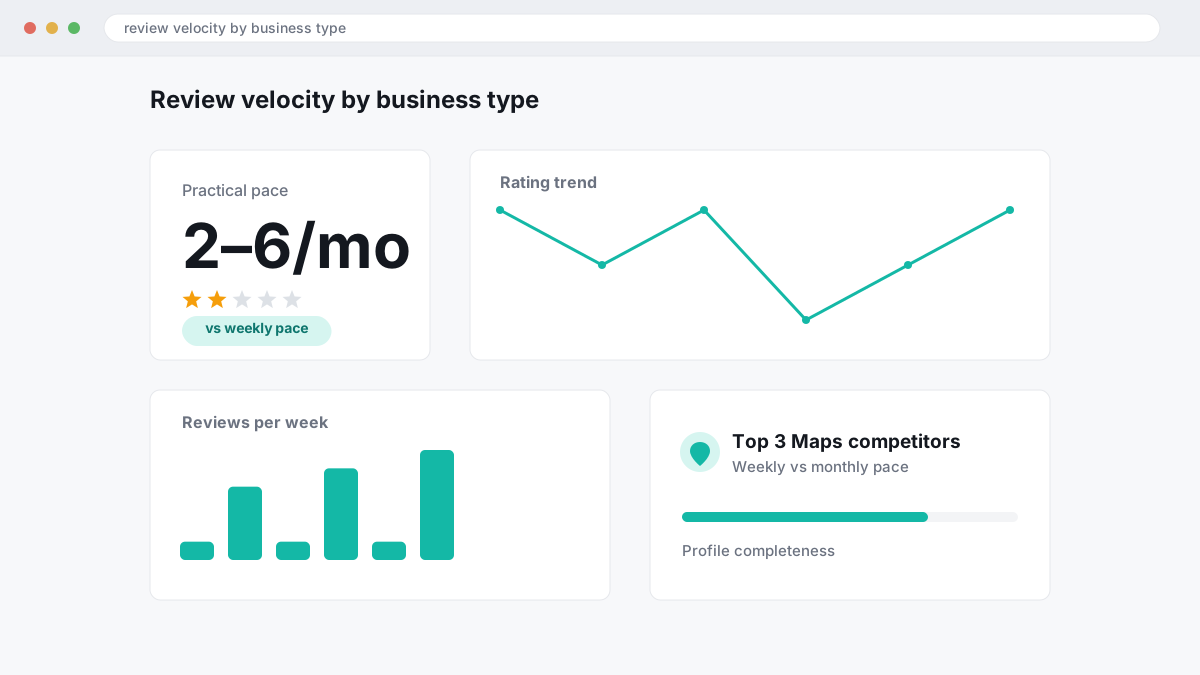
Restaurants, cafés, bars and other high-frequency categories can usually sustain weekly review acquisition because customers transact every day and Google Business Profile activity moves fast in those niches. A plumber, dentist, family lawyer or B2B service firm usually cannot. For those lower-volume services, 2 to 6 new reviews a month is often a sensible operating range, and trying to force a weekly pace is where profiles start to look manufactured to both users and Google’s review systems.
| Business type | Practical pace | What to benchmark |
|---|---|---|
| Restaurant, salon, gym | Weekly | Top 3 local map listings, last 30-60 days |
| Dentist, roofer, solicitor | 2-6 per month | Top 3 local map listings, same service area |
| B2B agency, consultant | Low but steady monthly flow | True local competitors, not national brands |
Benchmark local leaders, not chains with national brand demand, multiple branches and offline volume you cannot copy. Pull up the map pack for your core term, check the top three profiles, and count how many recent reviews each earned over the last month or two. If you buy help, set the pace before delivery starts; BGR Review begins review campaigns in 24-48 hours and gives a 30-day free replacement guarantee, but the safer plan is always the one that fits your category’s natural demand.
What actually happens when you flag a suspicious review
Flagging a suspicious Google review creates a support case inside Google Business Profile; it does not remove the review on the spot.
The first step is the in-profile report route, where you choose the policy reason under Google Business Profile review policy categories and submit the URL. Google usually leaves the review live while that case sits in review, and the first response often lands several days later rather than the same day. That first outcome is frequently a rejection or a generic “doesn’t violate policy” reply, which is why operators who stop after one flag miss the real work.
The useful work starts with an evidence pack. Screenshots help, but they rarely win the case alone. The stronger items are booking records showing the reviewer was never a customer, staff rota or delivery logs showing nobody by that name visited, and timeline mismatches where the review mentions a service date your location was closed or your profile had not yet opened that service line. If the reviewer names an employee, job-title records matter. If the review alleges an incident, contemporaneous messages and CCTV retention notes can matter too.
After that, the case usually needs escalation through Google support with the evidence attached in a clean chronology: review link, policy reason, proof, and contradiction. Some reviews stay up because they are opinion rather than policy breach. That is where many flag attempts fail.
Platform rules, legal limits and review management risk
Review management sits inside platform policy, advertising law and defamation risk, so the safe answer depends on where you operate, which site you use and what exactly the review says; this is general information, not legal advice.
In the US, the FTC’s rules on endorsements and testimonials cover undisclosed paid endorsements, which means any review campaign has to be disclosed correctly if compensation is involved. Google Business Profile, Trustpilot and Yelp each apply their own review rules on top of that, and those rules are stricter than many owners expect. If a review states a false fact rather than an opinion, defamation may also come into play, but platform removal and legal action are separate routes.
In the UK and EU, misleading-commercial-practice rules can also catch aggressive or disguised solicitation campaigns, including review requests that hide incentives or selectively suppress unhappy buyers. If your plan depends on fake reviews, hidden rewards or guaranteed removals, stop there, because neither platform policy nor consumer-protection law supports it.
When to run local SEO in-house and when to buy help
Run local SEO in-house if one owner or marketing lead can update Google Business Profile, local landing pages and a review workflow every week without gaps.
That model works for a single location with stable listings, a small stream of new reviews and no recurring policy issues. Set a weekly cadence: check profile edits, answer recent reviews, log any harmful posts, and keep an evidence folder with screenshots, order records and message history ready for Google Business Profile policy flags. A monthly review-response and evidence routine beats ad hoc cleanup because the details you need for a flag often disappear once staff forget dates, names or transactions.
| Best fit | Keep it in-house | Buy help |
|---|---|---|
| Single location | Yes, if one person owns the weekly checklist | Only for review removal or setup gaps |
| Multi-location brand | Hard to keep consistent | Usually better for central control |
| Suppressed listings or spam attacks | Slow if handled reactively | Better if you need evidence packs, escalation and repeat monitoring |
Outside help fits fastest when listings are suspended or suppressed, locations keep merging, or competitors trigger recurring spam attacks with fake edits and reviews.
How should you get more Google reviews after visibility fixes start working?
Once your visibility starts lifting, the next move is a compliant review system tied to real customer moments. Send the Google Business Profile review request as close to job completion as you can, usually within 24 hours, and judge the programme by review quality and recency rather than raw volume.
Delay kills response. In BGR Review's dataset of 1,485 businesses observed from February to July 2026, new trades and local service firms usually saw their first reviews around two weeks after launch, and reaching 20–30 reviews over the first three months was associated with better local visibility while other ranking factors were active at the same time. The practical takeaway is simple: trigger the ask from your CRM when the work is signed off, paid, or marked complete, then send one clean link to your Google Business Profile.
Review gating is the wrong approach. Screening happy customers toward the review link and steering unhappy ones into a private form fails because it distorts the profile, creates compliance risk, and usually leaves you with thin, samey praise that does less for click-through rate and conversions than genuine, detailed feedback. A compliant request works better: ask every real customer, use neutral wording, never offer conditional incentives, and keep the path frictionless.
Stale profiles lose trust even above 4.5 stars. Check recency every month, because an older rating often drags down map-pack clicks before rank drops, especially when a nearby competitor is earning fresh reviews with better service detail.
What should you do in the next 30 days if you want Maps movement, not more theory?
Start with the top three competitors in your area, then fix profile relevance, review trust and the landing pages tied to that profile before you chase wider authority. That 30-day order usually gives you the cleanest route to more Google Maps local pack visibility and stronger click demand.
More reading fails because it turns local SEO into background research while your competitors keep collecting reviews, refining categories and matching pages to queries. In week 1, benchmark the three profiles already winning your money terms: compare primary and secondary categories, review count and recency, and which location or service pages their profiles send clicks to.
This is the 30-day sequence worth putting on the calendar.
| Week | Priority | Why it moves Maps and clicks |
|---|---|---|
| 1 | Benchmark top 3 competitors | Shows where you are losing on relevance, distance and prominence, rather than guessing from generic local SEO checklists. |
| 2 | Fix Google Business Profile categories and duplicate profiles | Wrong categories and duplicate listings dilute relevance and can split reviews, which weakens Google Maps local pack performance. |
| 3 | Strengthen local landing pages | Your profile converts better when the linked page matches the service and area the searcher expected to find. |
| 4 | Clean core citations and earn local backlinks | Citations fix trust gaps; local backlinks help prominence once the profile and pages are already aligned. |
The right approach is scheduled action in that order. If you skip straight to citations or local backlinks while the profile points to the wrong page or a duplicate still exists, you often see very little movement in calls, form fills or branded search demand.
Where to go from here
Local SEO behaves like a system: your Google Business Profile quality, your website signals, and your review pattern push on each other at the same time. A profile with fresh, policy-compliant reviews usually converts better and gives Google fewer reasons to doubt prominence, while a neglected profile with unresolved spam, thin service detail and long response gaps often stalls even when the basics are in place. That is the part most checklist-style guides miss.
Your next step is simple. Audit the last 90 days of reviews for timing, source mix, rating spread, response rate and any obvious policy issues, then check whether your profile categories, services, photos and business details still match what you actually sell. If a harmful review appears to break platform rules, build the evidence before you flag it: screenshots, order records, chat logs and the exact policy section. That usually tells you whether to respond, report, escalate or leave it alone.
Expect clarity first: what is removable, what is not, and which fixes are more likely to move visibility than another round of generic SEO tasks.