

Quick answer
Real estate agent reviews drive calls because buyers and sellers compare trust before they contact you. The strongest setup starts with Google Business Profile, then adds agent-led platforms such as Zillow and Realtor.com where your profile ownership and review eligibility differ. Google’s fake engagement and prohibited content rules make steady, policy-compliant review collection safer than short bursts. If a false review lands, BGR Review handles removal on a pay-after-success basis: $0 upfront and $449 per removed review link. For review packages, we offer a 30-day free replacement guarantee.
We work this at the platform level, not as generic “get more reviews” advice. A Google flag with only the in-profile report button usually goes nowhere; the cases that move need an evidence pack with the review URL, policy match, timeline, transaction proof or proof of no customer record, and screenshots preserved before the reviewer edits or deletes the text.
That process detail matters because brokerage profiles, individual agent profiles, merged Google listings and third-party portals all fail in different ways. BGR Review has served 15,000+ businesses, and this page sticks to the parts weak guides skip: platform priority, request timing, ownership disputes and the point where you stop chasing one bad review and start rebuilding trust with new compliant reviews.
Why do agents lose leads when Google, Zillow and Realtor.com are treated the same?
Real estate review sites do different jobs. Google Business Profile affects map-pack visibility and local click-through rate, Zillow agent reviews often shape shortlists while a buyer or seller is actively comparing names, and profile ownership at brokerage level decides who keeps the reputation asset if an agent moves.
The wrong approach is copying one review plan across all three. That fails because Google rewards proximity, category relevance and review recency inside local search, while Zillow agent reviews sit inside an intent-heavy comparison journey where people are already checking transaction history, areas served and competing agents; Realtor.com profiles can help trust and branded search, but review visibility changes by market and by how complete the profile is. A single request link cannot solve those differences, and it also misses lead-routing: some profiles send enquiries to the individual agent, others to the brokerage office.
This is the platform split BGR Review uses before any outreach starts, because review generation only works when the profile owner, lead source and response path match.
| Platform | Main job in the funnel | What breaks if you treat it like the others |
|---|---|---|
| Google Business Profile | Map-pack clicks, calls, direction requests, local SEO visibility | Brokerage vs individual agent profile confusion splits reviews and weakens conversions |
| Zillow agent reviews | Shortlist filtering during active home search | Strong Google ratings do not automatically carry trust inside Zillow's agent comparison flow |
| Realtor.com profiles | Trust support and branded-name validation | Incomplete profiles suppress credibility even when review sentiment is good |
The right approach is matching effort to lead source and profile ownership first. Put Google first if you need more local-pack exposure and calls, protect Zillow if clients already compare agents there, and clean up brokerage vs individual agent profiles before you ask for anything new; if ownership is wrong, you can grow a review asset you do not control. That is why BGR Review separates platform setup from request delivery, then backs review packages with a 30-day free replacement guarantee instead of treating every site as interchangeable.
Where should an agent focus first if time and budget are limited?
Focus on the profile closest to the point where leads stall: Google Business Profile for local discovery, Zillow agent reviews for agent comparison, and brokerage-owned pages when brand control matters more than one adviser’s profile. If your time and budget are thin, fix the platform nearest the lost lead first.
Starting everywhere at once is the wrong move. It spreads requests, weakens review recency, and leaves the real gap untouched. If your local SEO visibility is weak, your map-pack click-through is soft, or branded searches show a thin Google profile, start with Google Business Profile because that is where local trust breaks first. If Zillow profile views already turn into buyer or seller enquiries, prioritise Zillow agent reviews because the prospect is already comparing agents there, not discovering you for the first time.
This is the faster triage order we use before any package starts delivering in 24-48 hours.
| Signal | First platform | Why it comes first |
|---|---|---|
| Weak map-pack presence, thin branded trust | Google Business Profile | Improves local discovery and branded clicks |
| Strong portal traffic, weak agent comparison | Zillow agent reviews | Supports shortlist decisions already in progress |
| Multiple agents under one brokerage brand | Check brokerage page first | Decide whether reviews should lift the brand page or individual pages |
How many reviews does an agent need before review work starts paying off?
Agents need enough reviews to look current and believable against the rivals a seller or buyer can already see, not to hit a magic number. Compare the top three nearby competitors on count, review recency, and star-rating distribution, then close the smallest visible trust gap first.
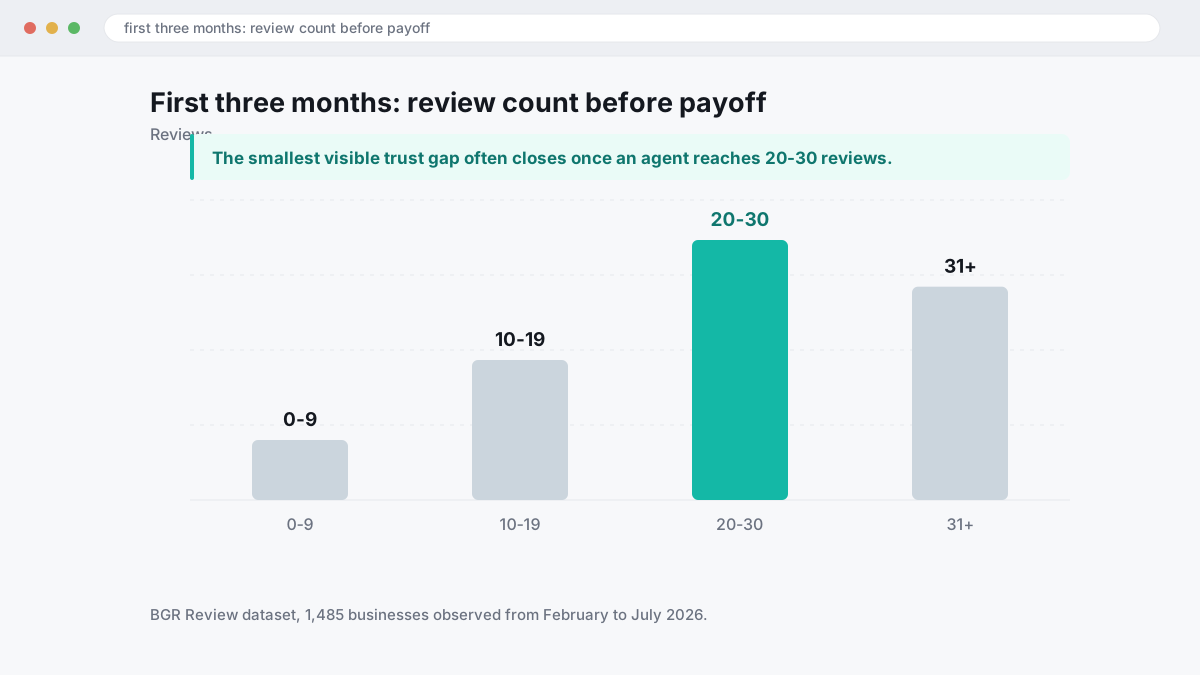
Chasing a universal target fails because Google Business Profile, Zillow agent reviews and Realtor.com profiles do not display trust the same way, and your local SEO visibility rises or stalls against the agents beside you, not against a national average. In BGR Review's dataset of 1,485 businesses observed from February to July 2026, local-service firms that reached 20-30 reviews over their first three months tended to see stronger local visibility, but that was an observed pattern across mixed local categories, not a rule for every agent market.
Use a simple benchmark grid before you spend time or budget.
| Check | What to benchmark against 3 local rivals | What to fix first |
|---|---|---|
| Count | Total published reviews on the profile winning map-pack clicks | Thin count if you look empty beside them |
| Recency | How many reviews landed in the last 30-90 days | Stale profiles with no recent proof |
| Rating spread | Mix of 4, 5 and occasional critical reviews with replies | Weak response coverage if the profile already has volume |
A perfect 5.0 from six reviews often looks less credible than a 4.8 built from recent, varied feedback with visible replies. That star spread usually lifts click-through from the local pack before it lifts rankings, because the reader sees normal human variation, active review response management and fresh proof — then calls, form fills and branded search demand follow. If your profile already has enough volume, do not chase more blindly; fix the stale month, the unanswered negatives or the obvious trust gap first.
When should you ask for a review so it feels natural and converts?
Ask straight after a positive milestone, not months later. For estate agents, the best review request timing usually sits within 24-72 hours of closing, key handoff, or a short move-in check-in, while the experience is still specific enough for the client to mention names, speed, and communication.
The weak approach is asking once at random, often at month-end when you remember, then chasing three or four times if nothing comes back. That fails because the client has mentally left the transaction, the details have blurred, and your message reads like admin. You also lose review recency, which matters on Google Business Profile and helps a profile look active rather than stalled. If you use BGR Review to support review generation, delivery starts in 24-48 hours, but the request still works best when your own trigger is tied to a real milestone.
The stronger approach is a fixed cadence: first ask within 24-72 hours of the positive event, then send one follow-up 5-7 days later if there is no reply. One reminder works because it catches clients who meant to respond but missed the first message; repeated chasing drags response quality down and can annoy the very people you want praising your service. Keep the trigger in your CRM or transaction workflow, and use the same timing on Google, Zillow agent reviews, and Realtor.com profiles only after checking where that client already engaged most.
How do you build a repeatable review workflow without relying on memory?
A repeatable review system uses one verbal ask, one same-day text, and one scheduled email fallback. It works when each step has an owner and every request sits in one CRM record instead of in your memory.
The weak version is ad hoc: the agent remembers to ask when a deal feels warm, someone in the office sends a link later, and nobody records whether the client was meant for a Google Business Profile, Zillow agent reviews, or a brokerage profile. That fails because review request timing slips; the ask lands days after closing, the client forgets the details, and the review ends up on the wrong profile. If your brokerage and individual agent both need coverage, you need that decision made before the first message goes out.
Use one simple ownership model and keep it boring. The agent asks in person or on the handover call, the coordinator sends the text the same day, and the manager audits the pipeline once a week for missed sends, duplicate requests, and profile mix.
Track the workflow in one sheet or CRM, with one line per closed client.
| Step | Owner | What to log |
|---|---|---|
| Verbal ask at close | Agent | Request date, chosen platform, agent or brokerage profile |
| Text sent same day | Coordinator | Send status, link used, reply or review outcome |
| Email fallback after no response | Coordinator; manager checks weekly | Next follow-up date, final outcome, notes |
This documented cadence is the part most teams skip. Even if you later buy review support from BGR Review, where delivery on review packages starts in 24-48 hours and includes a 30-day free replacement guarantee, your internal log still decides whether requests go out on time and to the right profile.
What should a real estate review request actually say?
The best review request is brief, tied to a real milestone, and simple to complete. Mention the closing date or the week the client collected keys, thank them in that context, and send one direct link to the platform you want to grow first.
The wrong approach is the brokerage blast: “Please review us on Google, Zillow, Facebook and Realtor.com.” It fails because the client has to choose, and most choose nothing. A better message names the transaction and points to one profile only, usually your Google Business Profile for local pack visibility or Zillow agent reviews if your profile already wins branded search. For brokerages, the sender should be the agent the client dealt with, not a generic office inbox.
Use wording like this: “Hi Sarah, thanks again for trusting me with your purchase on Maple Street and for completing closing on Friday. If you have 60 seconds, would you mind leaving a review on my Google profile here: [link]. It helps future sellers and buyers know what working together was like. — James Carter, Carter Homes.”
Should the brokerage collect reviews, or should each agent own them?
Neither setup wins everywhere. A brokerage gets tighter brand control and steadier routing, while an agent builds portable trust that moves with them; the right model depends on where leads should land, how often agents turn over, and whether your reviews need to lift a location or a person.
Most guides push one rule for every team. That fails because a Google Business Profile serves a physical office and map-pack visibility, while Realtor.com profiles and other marketplace profiles often influence trust in the named agent. If every review is forced onto the brokerage, your best producers lose personal credibility and branded search for their name converts worse; if every review sits with the agent, succession gets messy when that agent leaves and the office keeps the lease, staff and phone lines.
This split works better when you set ownership by lead routing, not by hierarchy.
| Profile type | Who should own reviews | Best fit |
|---|---|---|
| Google Business Profile | Brokerage or office | Location-based calls, directions, local pack clicks |
| Realtor.com profiles | Individual agent | Agent-name searches, listing-side trust, portable reputation |
Multi-office teams usually need separate rules: each office controls its own Google listing, while each agent owns their marketplace profile and sends review requests there after a closed transaction. If you use a paid review service, lock this routing before you buy anything from BGR Review, because our packages carry a 30-day free replacement guarantee and replacements only help when the reviews were sent to the right profile in the first place.
How should you compare DIY review management with a paid service?
DIY keeps direct spend low and gives you full control, while paid help usually wins on consistency, reporting and recovery support. Your choice comes down to team capacity, compliance risk and how quickly you need gaps on Google Business Profile closed without relying on memory or manager follow-up.
The wrong comparison is “cheapest option wins”. That fails because DIY only stays cheap if someone on your team sends every request, tracks every follow-up, watches star-rating distribution, and handles review response management before a stale comment sits unanswered for a week. A solo agent with a small past-client list can do this well in a spreadsheet, and that is often the right call; a brokerage with multiple agents usually loses control once replies, reminders and profile checks depend on staff discipline.
This is the cleaner way to compare the two routes.
| Factor | DIY | Paid service |
|---|---|---|
| Monthly cost | Lower cash cost, but internal time sits with admin staff or a manager | Higher direct spend; BGR Review packages also include a 30-day free replacement guarantee |
| Setup time | Usually fast to start, slow to keep consistent | Setup takes brief onboarding, then delivery can start in 24-48 hours |
| Integrations | Often manual from CRM export, email and text tools | Usually structured campaigns, reporting and response workflows |
| Contact-list ownership | You keep full ownership if you manage requests in-house | Check the contract carefully; you should still own the client list and Google Business Profile access |
| Recovery support | Limited to what your staff can document and escalate | Some providers add fake-review removal support; BGR Review charges $0 upfront and $449 per removed review link |
The better test is lowest total effort with the fastest consistent execution. If you need light-touch collection and you can trust one person to own replies, DIY works. If you need reporting, multi-agent oversight and a recovery path when a false review lands, paid help usually moves faster because the process already exists and the evidence pack gets built properly before escalation.
Can real estate agents offer incentives for reviews without creating a compliance problem?
Be careful with incentives. Undisclosed rewards, selective asking, or review gating can breach platform rules and advertising law, including the FTC endorsement guides, even when the client genuinely liked your service.
The wrong approach is offering a gift card, fee rebate, prize draw entry, or “send us a five-star review” message only to happy clients. That fails because Google Business Profile policies prohibit discouraging or prohibiting negative reviews, and gated funnels can distort your star-rating distribution and weaken trust if they surface later. Zillow agent reviews carry their own moderation standards, so a reward tied to positive sentiment or hidden from readers can create a compliance problem on the platform and in advertising disclosures at the same time.
The safer approach is an unbiased request sent to every recent client after a clear milestone, with no condition on rating and no pressure on wording. A small thank-you gesture after the fact is lower risk only if it is not tied to positivity, is available on the same terms, and is disclosed where the endorsement appears if the benefit could affect the review under the FTC endorsement guides. Rules vary by platform and country, including US FTC requirements and UK consumer-protection rules, so treat this as general information rather than legal advice. If you use a paid provider, that still applies; BGR Review’s review packages include a 30-day free replacement guarantee, but no service can make an undisclosed incentive compliant.
What should you fix first when reviews are recent but still not winning trust?
If reviews are already coming in, fix credibility signals before you chase more volume. An odd star-rating distribution, the same complaint repeating across recent posts, or unanswered negatives can hold back trust and conversions even when your average looks strong.
The wrong approach is staring at a 4.8 and assuming the job is done. Shoppers comparing agents side by side on Google Business Profile, Zillow agent reviews and Realtor.com profiles scan the fuller trust picture: a long run of perfect scores with no detail can look manufactured, while three recent complaints about missed callbacks or pushy follow-up can outweigh dozens of older positives. The right move is review response management with intent: answer the negative first, address the complaint theme directly, and show what changed. That lifts click-through from the map pack and helps calls or form fills because the reader sees a real operator, not a frozen profile.
Facebook Recommendations matter here because they add social proof in a different setting. Search platforms still do the heavier local SEO work, but a prospect who sees a believable mix on Google and then finds recent Recommendations on Facebook usually feels safer booking a valuation or enquiry. If you pay for review support, this is also where to judge it properly: BGR Review gives a 30-day free replacement guarantee on review packages, but more volume will not fix a weak response trail or a suspicious review spread.
What should you do if a fake review damages an agent or brokerage profile?
Start with evidence, not outrage. Save screenshots, confirm whether the reviewer was ever a real client, flag the post under the closest policy ground, and publish a calm public reply only if removal does not happen quickly.
The wrong move is arguing in public first. That usually hardens the record, gives the reviewer more material to edit around, and leaves you with no clean evidence pack when Google Business Profile support or Zillow agent reviews moderation asks what policy was actually broken. Build the file first: full-page screenshots, transaction records from your CRM or closing file, call logs, roster checks for the agent or team named, and any proof that the person never bought, sold, toured or enquired through you.
The route changes by platform, so treating fake review removal as one template wastes time. Google Business Profile usually turns on a named content-policy issue such as spam, impersonation, conflict of interest or off-topic content, while Zillow often needs category-specific proof that the reviewer was not a client of that agent, team or brokerage. Across 12,000+ negative review cases logged by BGR Review from June 2025 to June 2026, reviews raised within 28 days and backed by an identifiable policy issue resolved successfully in roughly 90% of cases; comparable cases raised later fell to approximately 25–30%.
This is the evidence split you should work from before you escalate.
| Platform | Best first evidence | What usually fails |
|---|---|---|
| Google Business Profile | Screenshot, profile URL, timeline, CRM or call-log mismatch, roster check | Using only the report button with no supporting detail |
| Zillow agent reviews | Address or transaction mismatch, no showing record, no lead record, brokerage confirmation | Generic claim that the review is “fake” without client-status proof |
If the post makes false factual claims, you may also have a defamation issue, but rules vary by country and platform. In the US, FTC endorsement rules cover deceptive endorsements; in the UK, consumer-protection rules now target fake reviews; and a defamation claim depends on provably false statements, not hurt feelings. That is general information, not legal advice. If removal stalls, contain the damage with a brief response that states the record does not match your files, invites offline contact, and avoids naming the reviewer or disclosing deal details.
Where to go from here
Start with Google Business Profile. For most agents and brokerages, that profile shapes map-pack click-through before any secondary site does, and the quickest lift usually comes from fixing review request timing, tightening response management, and making sure reviews land on the correct brokerage or individual agent profile. Then add the secondary platform that matches how your leads research you: Zillow for agent comparison, Realtor.com for profile credibility, and Facebook Recommendations if local sharing still drives calls in your market.
If false reviews are dragging the average down, pause and assess removal first. A weak profile with fresh legitimate reviews can recover, but a profile carrying a clear false factual claim, impersonation, or policy breach often needs an evidence pack before you ask for more client feedback. In BGR Review's case file of 12,000+ negative review cases logged June 2025 to June 2026, reviews raised within 28 days and tied to an identifiable policy issue resolved successfully in roughly 90% of cases; older comparable cases fell to approximately 25-30%.
com side by side, mark the profile owner, count recent reviews from the last 90 days, and isolate any review that may breach platform policy.