

Quick answer
To rank in Perplexity, build pages for citation rather than relying on standard SEO positions. Put the direct answer in the first 100 words, keep the page in crawlable HTML, use clear query-led headings, and add original evidence that another source can verify. Perplexity usually prefers pages it can extract cleanly and cross-check against reviews, publisher coverage, or other brand mentions. If it keeps citing a competitor, the problem is often your wider source footprint across your site, review profiles, and third-party references, not a single page.
We track where AI-search answers actually come from in live reputation and visibility work: owned pages, review profiles, directory listings, and publisher mentions. A common pattern is simple: your service page is indexed, but the answer still pulls from Clutch, Trustpilot, or a trade publication because your page buried the answer, used messy page structure, or gave Perplexity nothing independent to corroborate.
That matters if you sell locally or depend on trust before the click. At BGR Review, we work across Google, Trustpilot, Yelp, Clutch, and TripAdvisor, and the same citation logic shows up repeatedly in Perplexity: extractable answers win first, then reviews and third-party trust signals decide whether your brand gets named with confidence.
Why do most Perplexity SEO guides miss how visibility actually works?
Perplexity visibility goes to sources it can cite, cross-check and extract cleanly. Your page can sit in the index and still lose if another brand has stronger third-party brand mentions, tighter query-answer formatting, and clearer supporting citations across the web.
Most guides treat Perplexity like ordinary SEO: publish a well-optimised service page, add keywords, wait for rankings. That fails because an indexed page is only a stored document; a citable source gives Perplexity a direct answer it can lift in seconds, usually in the first 100 words, then verify against other publishers. We see the same gap when a company buys review growth but leaves its core page vague: BGR Review can deliver verified review packages with a 30-day free replacement guarantee, yet Perplexity will still cite a review platform or trade publication if your own page buries the answer under sales copy.
The better approach is blunt. Put the answer near the top in plain HTML, write it in query-answer language, and make sure independent sources mention your brand in the same topic cluster. One strong landing page rarely beats corroborating mentions on review sites, directories, niche publishers and comparison pages, because those extra citations make your claim safer for Perplexity to repeat.
How does Perplexity choose which pages to cite in an answer?
Perplexity tends to cite pages it can parse fast, trust enough and merge without introducing contradictions. Clear passages, corroborating mentions, visible dates and reputable publishers raise the chance that your page appears in the final set of citations.
That is why the highest-ranking page in normal search often loses here. A service page may rank for your brand, yet Perplexity can still cite a review platform, a trade publisher or Google Business Profile Help because those sources look safer to synthesise: stronger publisher authority, cleaner wording and facts repeated elsewhere. We see this failure pattern constantly in reputation work at BGR Review: a page is indexed and even branded, but the answer engine lifts the third-party source because it contains the extractable claim and the independent corroboration.
The better approach is to publish claims that can survive comparison. If your page states a concrete fact such as BGR Review's 30-day free replacement guarantee on review packages, or its pay-after-success removal model at $449 per removed review link with $0 upfront, Perplexity can quote that cleanly if other trust signals support it. Freshness then decides tie-breaks. For current queries such as platform policy changes, pricing, app features or review rules, a recently updated source with a visible date often replaces an older page that still ranks well in blue-link search.
What must a page look like before Perplexity can reliably extract and cite it?
Perplexity only cites pages it can fetch and parse without guesswork. The safest setup is crawlable HTML, clear query-answer formatting, one idea per section, and a visible summary sentence near the top of the page.
Most weak pages are rendered for users only. The answer sits inside tabs, accordions, client-side JavaScript blocks, or a comparison widget that looks fine in a browser but leaves thin source text for extraction. Google Search Central’s JavaScript SEO guidance still makes the same point in 2026: if critical copy depends on rendering, access becomes less reliable. That is why an indexed service page can lose the citation to a Clutch profile, Trustpilot page, or publisher roundup. The competitor did not always have better SEO. It gave the answer in plain text.
The page that gets cited usually states the question in the heading, answers it in the first sentence, and keeps the passage tight enough to lift cleanly into an AI response. Query-answer formatting helps passage selection because the model can map the user’s wording to your wording without stitching together three scattered paragraphs. We often fix this before pushing review acquisition, because third-party trust helps more when your own page already contains an extractable answer.
Schema markup helps with context. It can label an FAQ, product, organisation, or local business entity, and that can reduce ambiguity around brand mentions, location, and publisher authority. Schema does not rescue weak copy. Visible HTML still carries the answer, while schema markup mainly confirms what the page is about.
Which workflow gives you the best chance to rank in Perplexity AI?
A workable Perplexity workflow starts with prompt mapping, then moves to extractable pages, first-hand proof, corroborating mentions and citation tracking. One polished page rarely breaks through because answer engines prefer source agreement across crawlable HTML, reviews and publisher citations.
Start by grouping queries into four buckets: branded searches, comparison searches, problem-led searches and local intent. A branded prompt needs a page that answers who you are in the first lines and links to your strongest proof; a comparison prompt needs a neutral feature or service comparison; a problem query needs a direct fix; a local query needs place terms, service terms and location proof on the page. Single-page optimisation fails here because your service page may be indexed yet still lose the citation to a review site or publisher if it lacks an extractable answer, original evidence and internal support links to related pages that build topical authority.
This is the workflow we use before we ask a client to spend on reputation assets or review growth, including review packages that carry BGR Review's 30-day free replacement guarantee.
| Query type | Page opening | Proof to add | Support source |
|---|---|---|---|
| Branded | Direct company answer in 2-3 sentences | Named service details, office locations, contact data | Review profiles and company listings |
| Comparison | Clear side-by-side answer | Method, pricing model, guarantee terms | Publisher roundups and industry directories |
| Problem | Fix the issue in the first paragraph | Screenshots, policy references, process steps | Help articles and cited policy pages |
| Local | Service + city answer | Address, phone, local reviews | Maps, local press, regional directories |
The right approach is source-ecosystem optimisation. Build the page first, then strengthen third-party corroboration with brand mentions on publisher, review and industry sites that Perplexity already cites, and check whether competitor citations keep appearing because those sources state your value more cleanly than your own page. If you need a commercial shortcut, BGR Review sells verified review growth and pay-after-success removals at $449 per removed review link with $0 upfront, but the cheaper DIY route is often enough when your page already answers the prompt and only needs independent corroboration.
How do brand mentions and third-party trust change whether Perplexity includes you?
Perplexity is more likely to include your brand when your claims appear in more than one place, because unlinked brand mentions, review profiles and publisher references give it corroboration that a self-written homepage cannot.
Most teams push harder on their own site copy. That fails when the only source saying “best-rated”, “specialist” or “trusted by clients” is your own domain. Perplexity can index that page and still cite a Trustpilot profile, a Clutch listing, a local publisher feature or an expert quote in a trade article because those sources carry independent publisher authority and clearer reviews and reputation signals. A company page saying you serve London means less than the same service area, category and customer feedback repeated on Google Business Profile, Trustpilot and a publisher profile.
The stronger approach is to line up the same core facts across crawlable third-party pages: brand name, service category, location, founder or spokesperson quote, and recent review language that matches the query. That works because brand mentions help entity recognition even without a link, and repeated third-party wording gives Perplexity safer material to cite. If you use BGR Review for review acquisition, the practical aim is not volume for its own sake; it is to build verified review coverage on platforms Perplexity already trusts, with delivery starting in 24-48 hours and a 30-day free replacement guarantee on review packages.
How much do reviews and reputation signals influence Perplexity answers?
Reviews influence Perplexity answers when they give the model independent, citable proof that your quality claims are true, and the strongest effect comes from a broader reputation footprint across Google reviews, Trustpilot pages and other brand mentions rather than a star score alone.
The wrong approach is chasing a 4.9 average on one profile and assuming that will carry your brand into answers. That fails because Perplexity often validates claims such as “trusted”, “best rated” or “reliable” by pulling citations from third-party sources with crawlable text, recent review language and visible brand mentions, so a thin service page can lose to your Trustpilot profile or a publisher roundup even when your own site ranks in Google.
The right approach is to build corroboration. Recent Google Business Profile reviews help on local trust queries, Trustpilot adds a separate reputation layer Perplexity can cite, and consistent review text across platforms gives the model repeated evidence for the same brand claim. In BGR Review’s dataset of 1,485 businesses observed from February to July 2026, agencies and digital service firms reached 20–30 reviews more slowly and spread them across Google, Clutch, Yelp and Trustpilot rather than one profile, which fits how corroborating citations tend to work in AI answers.
If negative reputation pages rank for your brand name, Perplexity can surface them for trust-led searches before your sales page ever gets considered.
How should local and multi-location businesses optimise for Perplexity?
Local businesses show up in Perplexity when the location evidence is specific and confirmed elsewhere. Unique city pages, matching business details, recent local reviews and citations from a Google Business Profile, map listings, local directories or local press give the model enough corroboration to trust that one branch serves that area.
The wrong approach is one generic services page copied into ten city URLs with only the place name swapped. That fails for local intent because Perplexity can already see stronger location proof on your Google Business Profile, Apple Maps, Bing Places, chamber listings and review platforms, so it cites those instead. The page that gets extracted usually carries original evidence: branch photos, staff names, service-area boundaries, parking or access notes, location-specific pricing context, and answers to branch-level questions in crawlable HTML.
Google Business Profile and map citations do more than support the local pack. They also shape click-through rate and conversions because the same reviews and reputation signals that earn a citation answer the reader’s trust question before the click. In BGR Review’s dataset of trades businesses with complete enquiry-source data, observed February to July 2026, 70–80% of calls and bookings were attributed to a Google Business Profile or Yelp listing rather than a website.
If you run multiple locations, keep NAP consistency exact at branch level and build review signals per location, not only at brand level. A London branch with fresh Google reviews and matching citations can be cited for London queries while a Manchester branch with weak corroboration gets skipped, even if both sit under the same domain. If a location has thin proof, fix that before you chase broader branded search demand.
How is ranking in Perplexity different from ranking in Google Search?
Google ranks pages and sites across ten blue links and SERP features; Perplexity assembles one synthesised answer, then rewards passages it can quote cleanly and verify against other sources, so citation eligibility matters more directly than classic page-level ranking alone.
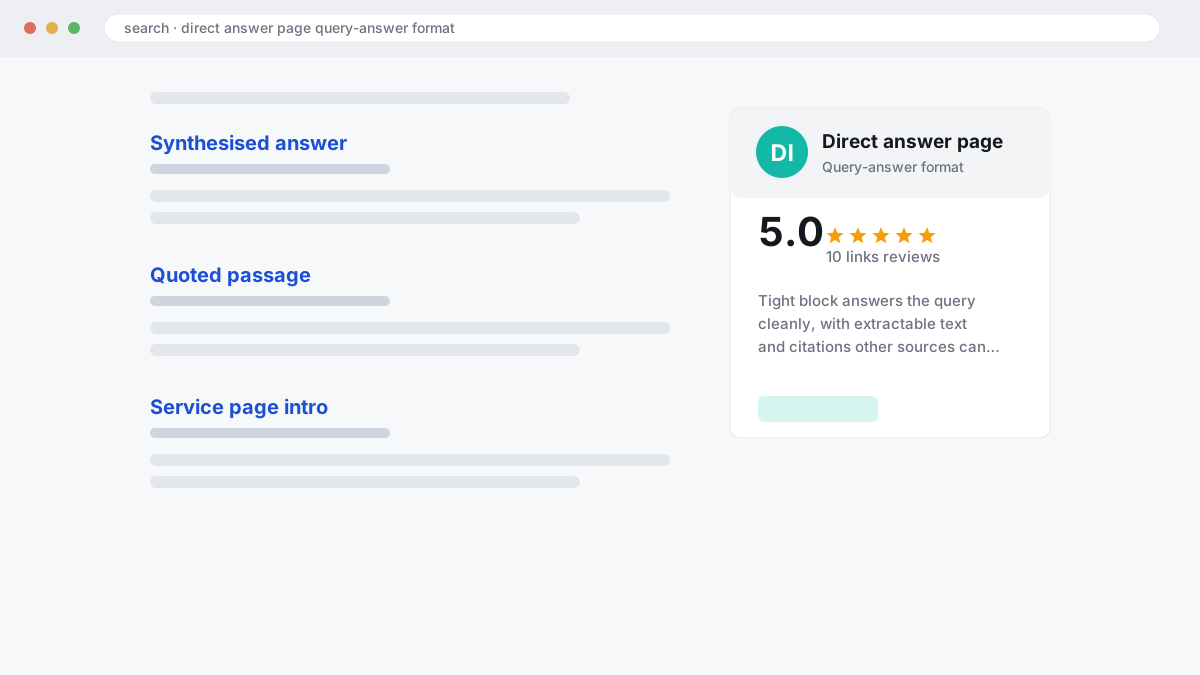
The wrong approach is to optimise for Perplexity as if it were normal Google SEO: long introductions, soft brand copy, and a service page that ranks but never answers the query in a tight block. That fails because Perplexity needs extractable text with clear query-answer formatting, while Google can still rank a broader page on topical authority, backlinks and internal linking even if the answer is buried halfway down.
The better approach is to write a short answer near the top, support it with crawlable HTML, and give the model reasons to trust it through corroborating citations on review and publisher sites. Backlinks still matter because they help pages get discovered and strengthen site-level topical authority, but for Perplexity the more direct lever is whether your page can be cited alongside independent agreement from Google reviews, Trustpilot, Clutch or a trade publication. That is why a plain FAQ-style block often beats a polished 500-word introduction.
You can see the commercial difference in local services. In BGR Review's dataset of trades businesses with complete enquiry-source data, observed February-July 2026, 70-80% of calls and bookings were attributed to a Google Business Profile or Yelp listing rather than a website. Google can send those clicks through the map pack; Perplexity often cites the listing, a review profile or a publisher summary first, then sends branded search demand later.
| System | What usually wins | Why |
|---|---|---|
| Google Search | Strong pages on strong sites | Page relevance, backlinks, internal linking and wider topical authority can overcome weaker on-page answer placement |
| Perplexity | Clear answer blocks with corroborating citations | The model needs quotable passages and source agreement before it will include your brand in the final answer |
Does ranking in Perplexity actually drive leads or just brand exposure?
Ranking in Perplexity usually creates assisted demand before it creates last-click traffic, and the payoff shows up most clearly in branded searches, stronger click-through rate from third-party citations, and better-quality enquiries over a 30-90 day window.
Most guides judge the channel by referral sessions alone. That fails because a buyer can read your brand in cited answers, scan your reviews and reputation signals on Google or Trustpilot, then search your name later and convert through branded search, the map pack or a direct visit. The right way to measure it is closer to PR than standard SEO: log every citation appearance, note whether freshness changed inclusion after page updates, and compare assisted branded demand with lead quality, not just raw clicks.
This matters most in high-consideration services where buyers cross-check sources before they call. A roofer, solicitor or agency can win conversions from Perplexity exposure even when the final click lands elsewhere, because independent citations and recent third-party review coverage reduce doubt before contact.
What should you do when Perplexity cites competitors instead of your brand?
When Perplexity cites a competitor, identify the source type that won first: a publisher article, a review platform, a comparison page or the competitor’s own site. Recovery usually comes from building the missing trusted source with fresher proof, stronger corroboration and the same source format, not from rewriting metadata.
The common wrong move is to edit title tags, add the keyword again and wait. That fails because competitor citations usually reflect source trust, not wording alone. If Perplexity keeps pulling a trade publication, Clutch profile or third-party comparison, audit the recurring cited domains before you touch your service page copy. Check whether the winner has higher publisher authority, clearer query-answer formatting, newer dates, named authors, stronger reviews, or original evidence such as pricing screenshots, policy references or product tests.
This comparison tells you what to replace.
| Source Perplexity cites | Why your page loses | What to build instead |
|---|---|---|
| Publisher article | No independent proof, weak byline, no dated evidence | Earn or place coverage with named data, dates and verifiable claims |
| Review platform | Self-published testimonials carry less trust | Strengthen verified review profiles and keep recency consistent |
| Comparison page | No side-by-side facts Perplexity can quote | Publish a factual comparison with sources, dates and limitations |
If the winning citation is a review site, match that source type. A thin home page will rarely displace a strong third-party profile. Use both only where the evidence gap is real.
How do you reduce the risk of wrong citations or misleading AI answers?
Reduce the risk of harmful AI answers by checking answer accuracy every week, not only where you rank, and by keeping evidence of wrong citations, false factual claims and undisclosed endorsement signals before they spread across higher-authority sources.
Most Perplexity guides tell you to track visibility like normal SEO. That fails because a top mention can still damage click-through rate, branded search demand and conversions if the answer cites the wrong publisher, repeats an old accusation or lifts weak reviews and reputation signals out of context. Run a weekly branded-prompt check, save dated screenshots, and note the exact cited URLs, because the problem is often the citation layer rather than your own page.
If an answer states a false fact about your business, the issue can move beyond rankings into defamation territory, and the rules vary by country. In the US, a false statement presented as fact raises a different risk from an opinionated review; in the UK, consumer-protection and defamation standards differ again. This is general information, not legal advice. Keep a record of the answer, the prompt, the citation source and any missing correction on the source page before you ask for edits or removal.
Paid endorsements need disclosure. The FTC's Endorsement Guides require clear disclosure when a review, testimonial or creator mention is compensated, and weak disclosure can poison the trust value of those citations if Perplexity extracts them anyway. BGR Review sells verified review packages and negative review removal, so the compliance line is plain: use disclosed, policy-compliant review acquisition, and avoid publisher authority built on hidden incentives that can later turn into misleading AI answers.
What belongs on a Perplexity optimisation checklist before you publish anything new?
Use a checklist that starts with extractability, then corroboration, then monitoring. A page can answer the query cleanly and still lose if nobody else supports it, and a well-mentioned brand can still miss citations if the source page is hard for Perplexity to extract.
Most guides push you to publish more. That fails when the new page still hides the answer behind sliders, tabs or JavaScript, lacks query-answer formatting, or buries dates and authorship so the page looks stale. Fix the asset first: use crawlable HTML, open with a direct answer in the first paragraph, keep visible dates on priority pages, and add schema markup that matches the page type rather than stuffing every property you can find.
Run this check before any new page goes live:
- Open the page without scripts and confirm the main answer still renders in crawlable HTML.
- Rewrite the intro so the first 40-60 words answer one search question directly.
- Show a visible updated date on the page, not only in schema markup.
- Check third-party corroboration across Google, Trustpilot, Yelp, Clutch, TripAdvisor, trade associations and industry databases.
- Search your own branded prompts monthly, log source changes in one spreadsheet, and note which competitor citations replaced you.
If corroboration is weak, fix that before commissioning another content batch.
Where to go from here
Start with one live query that matters to your revenue, then check which sources Perplexity cites for it. If it skips your site and pulls a publisher, directory or review platform instead, the gap is usually clear: your page is indexed but weakly extractable, thin on original evidence, or unsupported by independent mentions. Rewrite that page around a direct answer, add crawlable HTML headings that match the query, tighten schema where it helps understanding, and publish proof that another source can corroborate.
Then fix the layer most brands ignore. Third-party trust often decides whether your page gets cited or whether Perplexity leans on Clutch, Trustpilot, Google reviews or a trade publisher. You should expect better citation recovery first, then stronger click-through rate, more branded search demand and cleaner assisted conversions from people who have already seen outside validation before they visit your site.
The practical next step is a citation audit of your top five money pages and the third-party sources Perplexity trusts more than you right now.