
Quick answer
Bing in 2026 mixes classic search results with Microsoft Copilot-style AI-generated answers, publisher citations and stronger local result panels, so visibility now depends on being cited accurately as much as ranking in the blue links. That change can cut click-through rate on informational searches while lifting exposure on commercial queries where your brand, reviews or location details are quoted. Track impressions in Bing Webmaster Tools, citation appearances, branded search accuracy and map-pack style local visibility. If an AI answer shows the wrong phone number, address, review claim or business description, correct the source page first, then your local profiles, schema markup, crawlability and index status.
This page is written from the operator side of reputation work. At BGR Review, our team handles review acquisition across Google, Trustpilot, Yelp, Clutch and TripAdvisor, and negative review removal on a pay-after-success model at $449 per removed link with $0 upfront, so we spend our time tracing where search systems pick up business facts and where they go wrong.
The practical part matters more than the product announcement. When an AI answer pulls a bad brand detail, the fix usually starts with the source URL, then a profile audit, then a recrawl request, then citation monitoring; if the page is crawlable but the wrong detail persists, that is when you escalate rather than keep editing blindly.
What changes first for marketers when Bing turns a results page into an answer page?
The first movement is usually fewer exploratory clicks, more exposure inside AI-generated answers, and more dependence on being cited than simply sitting high in the results. For marketers, Bing changes lead flow before a classic ranking report shows much at all.
Microsoft Copilot now surfaces answer snapshots directly inside Bing and in Edge, so the searcher can get a usable summary before the organic blue links win any attention. That is where early click-through rate drops first: top-of-funnel queries, comparison searches, and brand checks that used to earn a visit now end inside the answer box. At BGR Review, this is the point where we stop reading position reports in isolation and compare Bing impressions, branded CTR, and the actual source of calls, bookings and form fills before recommending review growth or citation cleanup.
Most guides still tell you to watch rankings. That fails because a page can hold position while losing attention to publisher citations inside the answer, which means your visibility looks stable while your lead-source mix changes underneath it. The better approach is citation-and-CTR reporting: track whether Bing cites your site, a directory, or a review profile, then tie that to branded search demand and enquiry attribution. If the answer snapshot names you, even without a click, you may see more branded searches later; if it cites a third-party profile instead, that third party starts shaping trust first.
How does Bing generative search actually work from query to answer?
Bing generative search mixes retrieval with generation: it interprets your query, pulls likely sources, writes an AI-generated answer, and shows publisher citations with follow-up prompts. The result keeps more users inside Bing before they click a site, which matters if you sell on reputation, reviews or local trust signals the way BGR Review does across Google, Trustpilot, Yelp, Clutch and TripAdvisor.
Most guides still describe a ten-blue-links flow: rank a page, win the click, convert on site. That fails on Bing because a commercial search can now return a summary, a comparison block and suggested next questions in one screen. Bing first classifies intent, then retrieves web documents, then composes the snapshot; after that, the searcher can click a cited publisher, reformulate the query, or continue the journey inside Microsoft Copilot. Your page can influence the answer without winning the first organic click.
For operators, the practical shift is simple. A user searching for the best review management service may read the AI summary, inspect two or three publisher citations, then ask Copilot a narrower question about pricing, guarantees or review removal. If your offer is specific, such as BGR Review's 30-day free replacement guarantee on review packages or $0 upfront and $449 per removed review link after success, that detail is easier for Bing to surface than vague brand copy.
When does Bing keep blue links visible, and when does the AI answer take over?
Bing does not replace organic blue links evenly. AI-generated answers usually expand on exploratory and comparison searches, while direct navigational searches still lean on classic links, brand modules and other standard result blocks.
The wrong approach is to judge exposure from one branded search and assume the whole SERP behaves the same. That fails because a query like your company name or “bing login” usually keeps link-heavy navigation, while “best CRM for plumbers” or “X vs Y accounting software” invites a broader answer panel that can absorb attention before the first click. The right approach is to sort your tracked terms by intent first: navigational, informational and comparison, then review how much space the answer takes on each.
Search queries with commercial intent often keep stronger link modules, product cards or shopping-style elements because the page still has to support action. Even then, layout can change on the same day by device, by query wording and inside Edge where Copilot integration can shift the visible click path. If you sell review growth or removal like BGR Review does, check the same term on desktop, mobile and Edge before you call a traffic drop real.
How does Bing AI search differ from Google AI Overviews where visibility risk matters most?
Bing and Google both answer the query, but they do not distribute attention the same way. Bing usually makes source attribution easier to inspect inside Microsoft Copilot-style answer layouts, while Google AI Overviews apply stronger zero-click pressure because they sit across far larger search volume.
The wrong approach is to treat them as one AI channel and optimise only for rank tracking. That fails because visibility risk sits in different places: Bing often leaves publisher citations clearer and closer to the answer, while Google can keep the user inside a denser answer layer with follow-up prompts, maps, shopping modules and fewer reasons to visit your site. When we review demand capture before recommending any review package with BGR Review’s 30-day free replacement guarantee, this is the split we check first: can the searcher still see who said it, and is there still a reason to click?
The better approach is to sort queries by intent. On branded searches, Bing can still send useful click-through rate from explicit citations if your name, review signals and landing page match; Google often satisfies the search earlier if the brand entity is already strong. On search queries with commercial intent such as “best roofer near me” or “accountant for small business”, local and comparison intent diverge faster between the two ecosystems, especially once Google layers in Maps.
That matters in lead flow. In BGR Review’s dataset of trades businesses with complete enquiry-source data, observed February to July 2026, 70–80% of calls and bookings were attributed to a Google Business Profile or Yelp listing rather than a standalone website. If you market a local service, Google usually carries the bigger map-pack risk, while Bing gives you a better chance to win the citation and the branded follow-up click.
| Area | Bing AI search | Google AI Overviews |
|---|---|---|
| AI layer | Feels more tightly integrated with Microsoft Copilot | Broader reach and heavier market attention |
| Source visibility | Publisher citations are usually easier to inspect | Richer answer layers can absorb more attention before a click |
| Commercial and local risk | Stronger citation opportunity on branded and comparison searches | Higher click-through risk on local, comparison and map-led journeys |
Does Bing generative search reduce website traffic, or can it still create demand?
Yes, Bing generative search can cut clicks on simple queries. It can also create demand by putting your brand inside publisher citations and prompting later follow-up searches with commercial intent. The useful measure is qualified visibility and assisted conversion, not sessions alone.
The wrong approach is to see lower click-through rate on informational queries and call Bing a loss. That fails because an answer page often resolves the first question on-platform, then sends the user back later for a branded search, a map-pack check, or a form fill when they are closer to buying. We sell review growth and negative review removal, so this is the lens we use with clients: if Bing cites your buying guide, location page, or review profile source, the referral may arrive later in the decision journey and convert better than a cold visit from a broad query.
The right approach is to pair impressions in Bing Webmaster Tools with calls, bookings, and form submissions from the same period, then check whether branded search demand rises after citation visibility expands. A cited click from an AI answer is usually more valuable than a random blue-link visit because the user has already read the summary and scanned the source list. If impressions rise, click-through rate softens, and conversions hold or improve, Bing has shifted demand rather than stolen it.
Can Bing AI show the wrong business details, and what should you correct first?
Yes. Bing AI can surface wrong business details when source pages conflict, old listings stay indexed, or attribution is weak. Fix the core facts first: your business name, address, phone, opening hours, and location or service pages, because those errors do the fastest damage to calls, bookings and map-pack trust.
The wrong approach is arguing about tone, taglines or a preferred one-line description while Bing is showing the wrong phone number or an old address. That fails because AI-generated answers lean on publisher citations, brand mentions and local business profiles to resolve entity details; if those inputs disagree, you get hallucinated business facts with high commercial risk. A slightly awkward summary rarely hurts click-through rate. A bad number or closed-on-Sunday message does.
Document the error before you touch anything. Save a screenshot of the answer, copy the query used, note the timestamp, and list every source URL Bing appears to cite. Then check the source page itself, your Bing Places and other local business profiles, and the matching service page for crawlable NAP details.
How do local businesses show up differently in Bing generative search than national brands?
Local firms in Bing generative search are judged by profile data, map context and location-level consistency more than raw site authority. A national brand can lean on broader brand mentions and recognition; your local branch usually needs cleaner local business profiles and tighter location pages to stay visible and accurately described.
The wrong approach is copying a national template: one generic locations page, one phone number, and branch names scattered across third-party listings. That fails because Bing Places, map data and publisher citations can blend nearby branches, especially when two offices share similar names or service areas. The fix is boring but effective: give each branch its own page with a unique address, local phone, opening hours, service-area wording and matching on-page schema markup, then align that with Bing Places and your main citation sources.
That matters because local answer panels often pull business details before a click happens, which affects map-pack exposure, branded searches and calls. In BGR Review’s dataset of trades businesses with complete enquiry-source data, observed from February to July 2026, 70–80% of calls and bookings came through a Google Business Profile or Yelp listing rather than a website. Bing is a different platform, but the operating lesson carries across: clean profile signals win local demand faster than homepage authority alone.
Do reviews still matter if Bing answers the question before a customer clicks?
Yes — once Bing serves AI-generated answers on a local-intent query, your review signals often shape trust before your website gets a look-in, because the searcher can judge star rating, review text and recency straight from Bing surfaces and local business profiles.
Website-first evaluation is the wrong approach here. It fails because the customer may never reach your homepage before deciding whether to call, book or keep scrolling. On local discovery journeys, they compare the rating, the last review date and whether recent review text mentions the exact service they need; that affects click-through rate from the answer panel and whether your branded search demand grows later.
Reputation-first evaluation works better because Bing can compress the choice into a few trust cues. In BGR Review’s dataset of trades businesses with complete enquiry-source data, observed from February to July 2026, 70–80% of calls and bookings were attributed to a Google Business Profile or Yelp listing rather than a website. Bing does not use those same surfaces in the same way, but the commercial lesson carries across: if your local business profiles look stale, thin or disputed, answer-led discovery leaks conversions before the site visit starts.
Which technical signals make Bing more likely to understand and cite your pages?
Bing is more likely to understand and cite your pages when they can be crawled cleanly, indexed fast, and read as unambiguous entities, because retrieval systems cannot quote a service page, location page or review page they failed to fetch or interpret.
Most guides push page volume. That fails when your new pages sit behind weak internal linking, mixed canonicals, blocked resources or thin near-duplicates, because indexing and crawlability break before content quality even gets judged. The better move is fewer pages with clear purpose: one service, one location, one primary business fact set, each linked from navigation and XML sitemaps so Bing can revisit changes after a price update, address correction or review-policy page edit. That matters the same week a bad citation starts cutting click-through rate, calls or form fills.
Schema markup helps Bing connect the page to the real business behind it. Use it to state your organisation, local business details, products or services, and keep brand mentions consistent across your site, Bing Places, social profiles, directories and publisher citations. If your legal name, trading name, phone or city keeps shifting, Microsoft Copilot has more room to assemble the wrong answer. We see the practical version of this in reputation work: one mismatched brand mention can outrank your own correction page if the source is easier to crawl and parse.
How do you track whether Bing AI is citing you and stealing or shifting clicks?
Track Bing AI with four inputs together: query screenshots, citation logs, impressions in Bing Webmaster Tools, and click-through rate by query class. If clicks drop while branded search demand or assisted conversions rise over a 4-to-8-week window, visibility has shifted rather than vanished.
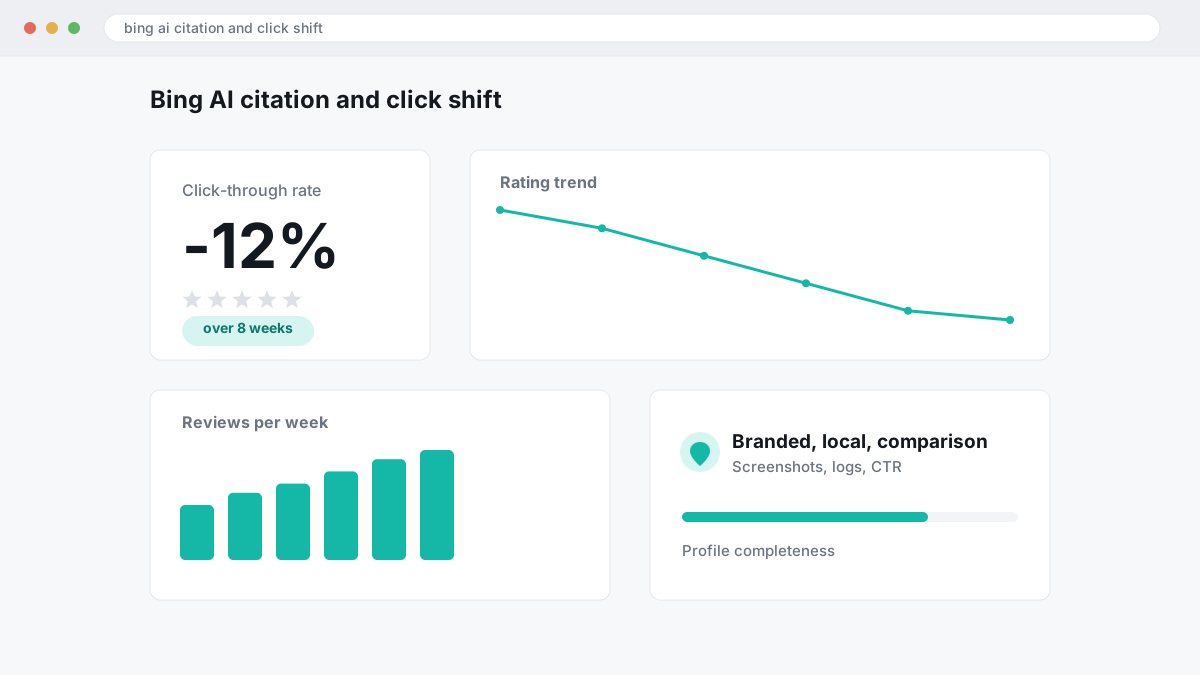
The wrong approach is position tracking on its own. It fails because an answer page can keep your URL visible as one of several publisher citations while cutting blue-link clicks, or it can push more branded follow-up searches and later form fills without winning a higher tracked rank. The right approach is to split search queries with commercial intent into branded, local, comparison, and service-specific buckets, then capture the live layout each week with screenshots that show whether Bing cites your site, a directory, or a rival.
Use one sheet for the page evidence and one for performance. In Bing Webmaster Tools, compare impressions and CTR before and after a visible AI layout change on the same query class, then line that up with Bing-assisted conversions in your analytics and any lift in branded search demand over the same 4-to-8-week period. At BGR Review, we tell clients to hold that window before changing review-acquisition or removal priorities, because our own delivery on review packages can start in 24-48 hours and you do not want to confuse a SERP-layout shift with a reputation change.
This is the simplest logging structure to use.
| Query class | What to capture | What to compare |
|---|---|---|
| Branded | AI answer screenshot, publisher citations, date | Impressions, CTR, branded-search lift |
| Local | Answer layout, map visibility, cited profiles | Impressions, calls, bookings |
| Comparison | Which review sites and directories Bing cites | CTR, assisted form fills |
| Service-specific | Exact cited landing page and answer wording | Impressions, CTR, lead quality |
What should go on a Bing AI optimisation checklist this week?
Start with four fixes this week: make sure Bing can index your key pages, correct your core business facts, tighten schema markup, and check where AI answers cite you on your highest-value queries. Those jobs improve eligibility, answer accuracy and measurement faster than publishing another batch of general content.
Most teams reach for broad content production first. That fails when indexing and crawlability are broken, canonicals still point to retired URLs, or thin location pages say the same thing with a city name swapped in. Bing's answer layer will usually trust cleaner source pages, stronger publisher citations, consistent local business profiles and visible review signals before it rewards volume.
Give this work to named owners and close it inside 7 days:
- Remove crawl blocks on money pages, test live status codes, and replace stale canonicals with the current service or location URL.
- Rewrite thin location pages so each one has distinct service copy, address details, opening hours and proof of local relevance.
- Add or validate schema markup for Organisation, LocalBusiness, Service and Review so Bing can match facts across pages.
- Audit your top 20 commercial queries in Bing, check AI-generated answers for wrong facts, missing citations and inconsistent profile data, then align your site, Bing Places and other local listings.
If a wrong detail still appears after the source page and profiles are fixed, log the query, screenshot the answer and request a recrawl before escalating.
What does a practical Bing AI response workflow look like when citations or facts go wrong?
A workable Bing correction flow starts by capturing the exact query, device, timestamp, screenshot and every visible citation, then fixing the source pages in order: your owned pages first, external listings second, platform review request last, followed by the same query check each week for 4 weeks.
The wrong move is a one-off complaint saying the answer is wrong. That usually fails because Bing can keep pulling stale publisher citations or mismatched local business profiles even after you edit one page. The better move is documented: save the triggering search, check whether the issue is a crawlable page, schema field, profile detail or a fully hallucinated business fact, then update your site, Bing Places and other listings in that order. If the answer still repeats the error, file platform feedback with the evidence pack and recheck weekly.
Where to go from here
Start with a live audit of your own brand on Bing: search your company name, your main service plus city, and two high-intent queries that usually lead to calls or form fills. Check what Microsoft Copilot says, which publisher citations it pulls, whether your local business profile shows the right phone, hours and category, and whether reviews support the click. This takes 30 minutes. You should come out with a short fix list: wrong facts on source pages, weak review recency, missing schema markup, duplicate citations, or a profile that ranks but does not convert.
The first gains usually show up in cleaner branded search results, fewer hallucinated business facts, and better click-through rate from local listings before you see any obvious ranking lift. If Bing’s AI answer keeps repeating a false detail, fix the source page first, request recrawl in Bing Webmaster Tools, then watch impressions and branded query changes over the next few weeks.