


Quick answer
Fake reviews create direct commercial risk because they skew buyer decisions, shift click-through rate in the local pack, and depress conversions from calls, bookings and form fills. The World Economic Forum estimated fake reviews and listings influence about $152 billion in global online spending each year. In the US, the FTC’s final rule on fake reviews and testimonials took effect in October 2024, which raised the enforcement risk for undisclosed paid endorsements and review manipulation. For you, the useful question is where the evidence sits, which platform will act, and how fast.
This page is built from live reputation work, not a recycled stat round-up. At BGR Review, we have logged 12,000+ negative review cases between June 2025 and June 2026, and the pattern is consistent: most failed removals start with a bare in-platform report and no evidence pack, even though the details that usually move a case are review URLs, date clusters, wording overlap, reviewer profile signals and the exact platform rule match.
We also sell review and removal services, so the useful line here is plain: DIY reporting is often enough for a weak spam post, but once a case stalls after the first rejection, you need a documented workflow, not another button click.
Which fake review statistics still hold up in 2026, and which ones are too stale to trust?
The only review-fraud numbers worth using in 2026 are recent, source-labelled and tied to a market or platform. If a stat has no year, no method and no enforcement context, it is weak input for any decision about reporting, reply strategy or whether a $449 pay-after-success removal attempt is worth making.
Most ranking pages still recycle pre-2023 headline figures as if Google, Amazon, Trustpilot and Yelp enforce the same way. That fails because platform moderation systems changed, regulators moved, and old consumer trust surveys rarely tell you which market they covered or whether they measured first-party reviews on a brand site or third-party platform reviews. The right approach is simple: label each figure before you use it by source year, market and platform, then ask whether it still matches current rules such as the FTC’s 2024 rule on fake reviews and testimonials or a live platform transparency report.
The World Economic Forum loss estimate gets quoted constantly because the number is large. Use it as a global risk signal, not as a local decision tool for your Google Business Profile, map-pack click-through rate or branded search demand. For operational decisions, fresher numbers matter more: across 12,000+ negative review cases logged by BGR Review from June 2025 to June 2026, roughly 90% of businesses who came to us after a failed self-filed attempt had used only the basic in-platform report button, and 70–80% of those first requests had been rejected.
How does the World Economic Forum’s $152B loss estimate translate into real business risk?
The World Economic Forum’s $152 billion annual estimate matters because fake reviews distort buying decisions at scale. For you, the risk shows up much earlier: lower trust, wasted spend, and lost revenue before you ever get to a removal request or BGR Review’s $449-per-link pay-after-success model.
The wrong approach is to treat that number as a distant moderation problem affecting “the internet” rather than your own funnel. That fails because consumer deception hits ordinary commercial steps first: a buyer clicks the wrong listing, compares you against an inflated star average, then leaves without calling, booking or filling your form. Consumer trust surveys keep landing on the same point even when their percentages differ by source and year: people use reviews to screen who gets the click, and once trust drops, your branded search demand and map-pack click-through usually soften before any platform takes action.
The right approach is to translate the macro loss into where your exposure sits. Service brands lose through misallocated ad spend and lower call conversion; marketplaces lose through weaker trust in the whole transaction layer; multi-location firms carry a wider star-rating manipulation risk because one bad cluster can drag down local pack performance across several branches. In BGR Review’s dataset of trades businesses with complete enquiry-source data, observed February to July 2026 within a subset of 1,485 businesses, 70–80% of calls and bookings were attributed to a Google Business Profile or Yelp listing. If those profiles are distorted, the revenue leak starts at the listing, not your website.
Why do most fake-review guides miss the evidence that actually helps removals and revenue recovery?
Most fake-review guides stop at prevalence numbers. The gap is operational: what evidence counts, which issue damages revenue first, and how a platform’s reporting and appeal workflow limits what you can actually get removed.
The wrong approach is awareness content that leaves you with a scare statistic and a report button. It fails because removal decisions turn on grounds, not outrage: impersonation, conflict of interest, unverifiable customer relationship, coordinated wording, or a clear breach of a named platform rule such as the Google Business Profile review policy. Across 12,000+ negative review cases logged by BGR Review from June 2025 to June 2026, roughly 90% of businesses that came to us after a failed attempt had used only the basic in-platform report button with no supporting documentation, and 70–80% of those first requests had been rejected.
The right approach starts with revenue triage. A single false post matters less than star-rating manipulation that drags down map-pack click-through, weakens calls and bookings, and makes your branded search look risky when prospects compare you with a nearby rival. Fix the reviews that distort the average, sit high on the profile, or cluster around a promotion or competitor push before you spend time on low-visibility edge cases.
An evidence-first workflow works because it improves both escalation quality and internal priority. Build one pack with the review URLs, posting dates, wording overlap, reviewer profiles, the exact policy match, and the route already used in the reporting and appeal workflow; then note what stalled after the first report, because that usually decides whether a second submission has any chance.
How can you spot fake reviews before you waste time reporting the wrong ones?
Reliable fake-review signals show up as a pattern, not a lone hunch: repeated wording, a sudden one-day spike, thin reviewer history, and factual claims that fail against your own booking or invoice records. Start there before you report anything.
The wrong approach is to fixate on one angry, vague post and assume it is fake because the tone feels off. That usually fails because platforms look for review fraud detection signals they can verify: copied phrases across multiple reviews, several posts landing within hours, reviewer profiles jumping between unrelated cities or categories, and account histories with no believable connection to your service area. A single odd review might still be real; a same-day cluster using near-identical wording is much stronger evidence.
Check the basic facts next. If a reviewer says your fitter missed a Tuesday booking, your cleaner damaged a room, or your restaurant lost a reservation, match that claim against your diary, CRM, invoice log, job sheet, call record, or table booking list. Verified purchase and verification labels help, but they do not prove a review is truthful; they only show the platform tied the account to a transaction or profile state. Reviewer history matters more than most guides admit, especially when the same account reviews a dentist in Manchester, a roofer in Miami, and a hotel in Toronto within days.
That extra checking saves time later. Across negative review cases with prior self-filed attempts in BGR Review's dataset from June 2025 to June 2026, roughly 90% had used only the basic in-platform report button, and 70-80% of those initial requests had been rejected. If you can show wording overlap, timing clusters, unrelated locations in the reviewer history, and no matching service record, you move from suspicion to something a moderation team can actually assess.
How much can star-rating manipulation actually hurt clicks, leads, and conversions?
Fake reviews cut revenue when they change perceived trust faster than you can correct the record. Even a small shift in your average rating can reduce map-pack clicks, shortlist rates and form fills before Google Business Profile, Trustpilot or Yelp has acted on a report.
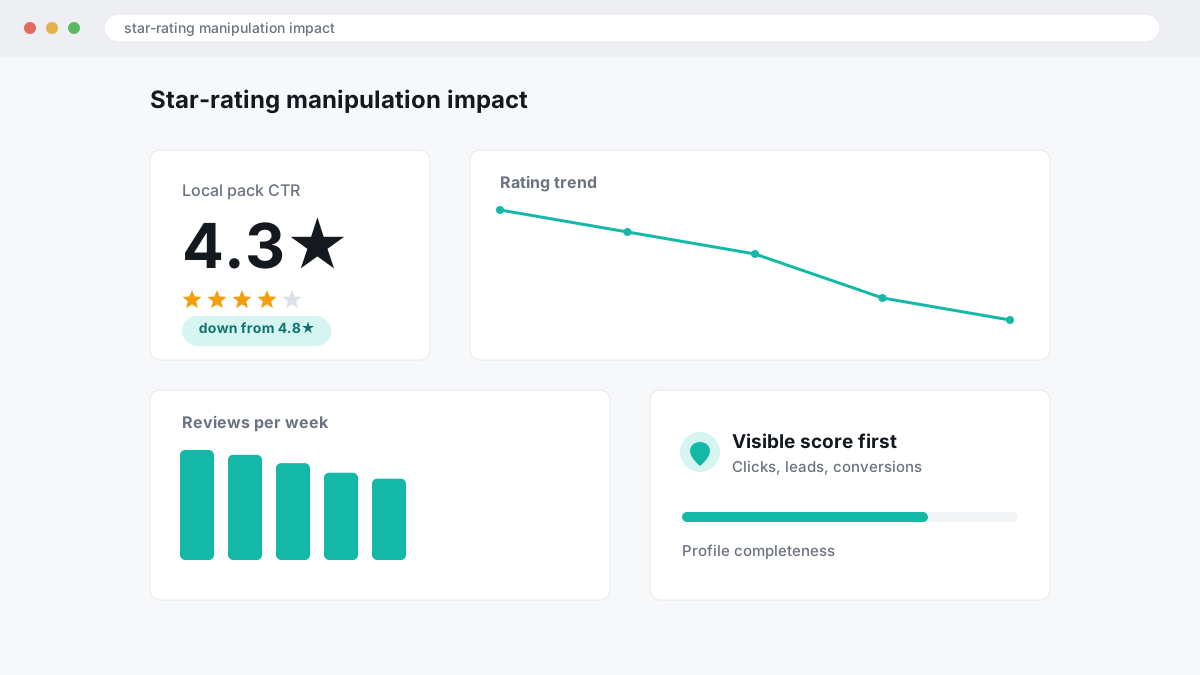
The wrong approach is to treat star-rating manipulation as a reputation annoyance and chase every suspicious comment in the order it appeared. That fails because buyers usually react to the visible score first. A move from 4.8 to 4.3 changes how you look on a shortlist even before anyone reads the text, and it can depress click-through rate from the local pack before it does lasting damage to branded search demand. Consumer trust surveys keep landing on the same practical point: people compare rating bands fast, and a low-4 profile gets judged differently from a high-4 profile even when the written reviews look similar.
The right approach is to measure the commercial damage by source and by distortion type. In BGR Review's own dataset of 1,485 businesses observed from February to July 2026, trades firms that shared complete enquiry-source data attributed 70–80% of calls and bookings to a Google Business Profile or Yelp listing rather than a website, which is why rating drops usually hit leads before they hit brand perception. Fake negatives suppress conversions by lowering trust. Fake positives do damage too: they inflate your baseline, hide service issues, and send your team after the wrong response priority when close rates fall despite a strong-looking profile.
If you are deciding where to act first, fix the score distortion that sits closest to enquiries. For most local operators we speak to from New York, London and Thornhill, that means the profile driving calls now, then the reviews affecting quote acceptance, then a formal removal attempt if the wording, reviewer profile and platform rule match are strong enough to justify escalation.
When do verified badges and platform labels help, and when do they create false confidence?
Verified badges cut some review fraud risk, but they do not prove a review is accurate, current or fair; they show that one part of the transaction or account history was checked by that platform’s moderation system, under that platform’s own rules.
The wrong approach is to treat a verification label as proof and stop there. That fails because Google, Amazon and Trustpilot verify different things: Google may show local reviews with no purchase trail at all, Amazon’s Verified Purchase ties the review to an order, and Trustpilot can mark an invitation or verified reviewer state while still relying on its own fraud filters and investigations.
This comparison matters because the label only makes sense inside the platform that issued it.
| Platform | What the label usually signals | What it does not prove |
|---|---|---|
| Account and contribution history feed Google Business Profile moderation | That the reviewer bought from you or stated facts accurately | |
| Amazon | Review links to an order through Verified Purchase | That the opinion is unbiased or the text is fully reliable |
| Trustpilot | Invitation or account checks sit inside Trustpilot’s detection system | That the review cannot breach policy or misstate events |
First-party testimonials on your own site usually carry weaker trust than independent third-party reviews because you control publication, selection and layout. They still help conversions on landing pages, but third-party profiles usually do more for map-pack click-through, branded search demand and removal credibility when a disputed review turns into a platform case.
How do Google, Amazon, and Trustpilot differ in how they detect and remove fake reviews?
Google, Amazon and Trustpilot do not police review fraud the same way. Their platform moderation systems use different signals, policy categories and appeal routes, so one reporting method usually fails across all three.
The useful comparison is below, because the enforcement trigger matters more than the star rating you are trying to fix.
| Platform | What usually triggers detection | What removal requests work best with |
|---|---|---|
| Google Business Profile policy matches, account trust signals, location mismatch, review bursts and user flagging | A clear rule match, review URL, date cluster, reviewer profile evidence and the right flagging route | |
| Amazon | Verified purchase patterns, refund or incentive abuse, linked accounts and coordinated review networks | Order-linked inconsistencies, seller-buyer connection evidence and signs of organised manipulation |
| Trustpilot | Automated fraud filters, invitation integrity checks, business reports and reviewer verification disputes | Evidence that the reviewer was never a customer, plus a policy-grounded dispute through Trustpilot’s process |
Most guides tell you to report every suspicious review the same way. That fails because Google often wants a policy category first, Amazon leans heavily on purchase-linked behaviour and coordinated abuse detection, and Trustpilot sits in the middle with automated screening plus a formal dispute process for both businesses and reviewers. If you send a vague “this looks fake” complaint to all three, you usually get a rejection or silence.
Google is the clearest example. In BGR Review’s log of 12,000+ negative review cases from June 2025 to June 2026, roughly 90% of businesses who came to us after a failed attempt had used only the basic in-platform report button, and 70–80% of those first requests had been rejected. That is why our removal workflow starts with the platform match before any paid escalation: if Google has a prohibited and restricted content angle, build for that; if Trustpilot can verify the reviewer, challenge the customer relationship; if Amazon can tie the review to purchase abuse, lead with that.
Is a fake review checker enough, or does a manual audit catch what tools miss?
Fake review checkers help when you need scale, but a manual audit catches context software misses: branch mix-ups, impossible service claims, reviewer conflicts, and statements your records can disprove. For actual removal work, evidence-backed human judgment usually carries more weight than a pattern score.
The wrong approach is to trust a scanner on its own. Tools are good at review fraud detection signals such as repeated wording, sudden bursts of one-star posts, fresh reviewer accounts, and rating swings across a large review set. That matters when you run ten branches and need to spot multi-location reputation risk quickly, because software will surface the burst in Manchester or Miami faster than a person reading line by line. It fails when the review looks natural but names the wrong technician, refers to a service your branch does not offer, or confuses a first-party review on your own site with a third-party platform review that sits under a different policy and appeal route.
The right approach is a hybrid check. Use software to narrow the pile, then verify names, job dates, invoices, booking logs, call records, branch territory, and whether the review contains a false factual claim rather than a harsh opinion. Across 12,000+ negative review cases logged by BGR Review between June 2025 and June 2026, roughly 90% of businesses who came to us after a failed attempt had used only the basic in-platform report button, with no supporting documentation, and 70–80% of those initial requests had been rejected.
When are fake reviews illegal, and when are they mainly a platform-policy violation?
Fake reviews can be illegal as well as against platform policy, but the claim depends on what happened. In the US, the FTC’s 2024 final rule on fake reviews and testimonials targets deceptive reviews, insider reviews presented as independent, and undisclosed incentives; a Google or Trustpilot report can remove content under platform rules, while FTC enforcement sits in a different lane.
The wrong approach is to treat every suspicious post as a crime. That fails because many review disputes are policy breaches only: bought ratings, review gating and suppression, or staff asking happy customers to post while filtering unhappy ones can breach platform rules and consumer-protection standards without giving you a clean defamation claim against one reviewer. The better approach is to sort the issue first: policy violation, legal exposure, or both.
Legal exposure starts to matter when a review states false facts that you can disprove. “They never delivered my order” or “the clinic used unlicensed staff” can move into defamation and false statements if your records show the event did not happen; “service was terrible” usually stays opinion. UK and EU rules add another layer, because hidden endorsements and misleading commercial practices can trigger action under CMA and consumer-law frameworks even where a platform has already acted. This is general information, not legal advice. If you want removal rather than argument, send review URLs, date stamps, account screenshots and the exact platform rule match to team@bgrreview.com before the post ages out of the easy first-report window.
What should a fake review audit checklist include before you flag or escalate anything?
A useful audit checklist puts the review, the policy ground and the proof in one record. If you cannot connect suspicion to evidence, your report usually fails at the first step of the reporting and appeal workflow.
The weak version is a spreadsheet that says “looks fake” and a screenshot of the star rating. That fails because platforms do not remove on instinct; they remove on rule match. In BGR Review’s case file of negative review cases with prior self-filed attempts, logged June 2025 to June 2026, roughly 90% of businesses that came to us after a failed report had used only the basic in-platform button with no supporting documentation, and 70–80% of those initial requests had been rejected. A rejection did not prove the review was genuine. It usually proved the flag was thin.
The stronger version is an evidence pack built for removals. Start with the review URL, post date, platform, star rating and every claimed service fact: job date, staff name, branch, product, invoice reference, location. Then match the review to an actual removal ground under that platform’s policy, such as impersonation, conflict of interest, off-topic content, harassment or a false factual claim. Review fraud detection signals help here: date clusters, wording overlap, reviewer accounts with no local history, or the same profile posting across competitors on the same day.
Keep everything in one pack: screenshots of the live review and reviewer profile, CRM checks showing no matching customer record, and short notes on reviewer patterns. What usually stalls a case after the first report is simple: the business has proof, but it is scattered across email, your CRM and three screenshots with no policy argument tying it together.
What do you do after fake reviews are flagged but nothing gets removed?
If a suspicious review stays live after you flag it, the next step is usually sharper evidence and a tighter appeal route, not five more copies of the same report. Repeating a weak flag wastes time, pushes the reporting and appeal workflow back to the start, and can hide the point that actually matters.
The usual mistake is citing the wrong ground. A fake-looking review often fails on a named platform rule or on a false factual claim, not on a generic “spam” label. Re-check whether your first report matched the platform’s own policy, then separate platform breach from defamation and false statements: “this person was never a customer” belongs with records and timeline; “the review says we charged for work we never performed” needs invoices, booking logs, or service records to show the statement is false. Across 12,000+ negative review cases logged by BGR Review from June 2025 to June 2026, roughly 90% of businesses who came to us after a failed attempt had used only the basic in-platform report button, with no supporting documentation, and 70–80% of those first requests had been rejected.
The better route is a cleaner escalation file. Send the review URL, posting date, profile screenshots, wording overlap with other suspect reviews, reviewer-account notes, the exact policy clause or false statement, and the route already used.
If you run a branch network, track multi-location reputation risk like an incident log rather than a single complaint. Record outcomes by location, reviewer pattern, and platform response time, because one cluster hitting three branches can depress local pack click-through and branded search across the whole region even when only one review is removed. That location-by-location log tells you whether you have a branch problem, a competitor pattern, or a platform-specific bottleneck.
Where to go from here
Start with a one-hour audit of the reviews that worry you most. Pull the review URLs, posting dates, star mix, wording overlap, reviewer profile details, and any obvious date clusters across locations. That gives you a workable evidence pack instead of a gut feeling, which matters because the basic report button rarely tells the platform enough to act.
Match each item to a named rule before you file anything. Google Business Profile, Trustpilot and Yelp all ask for different things, and a weak category choice stalls cases fast. In BGR Review's log of 12,000+ negative review cases recorded June 2025 to June 2026, cases raised within 28 days and backed by an identifiable policy issue resolved successfully in roughly 90% of cases, while comparable cases raised later fell to approximately 25-30%.
Then choose the route. If the breach is clear and you have the screenshots, report it internally first and track the appeal window. If the review affects calls, bookings, form fills or a multi-location map-pack listing and the first report fails, use a managed removal service.