

Quick answer
Star ratings affect SEO most clearly in local search, not as a simple site-wide organic ranking factor. Google Business Profile results use review count and review score alongside relevance and distance for local ranking, and stronger ratings also lift click-through rate and conversions before anyone reaches your site. For 2026, the practical work is clear: improve review quality, keep review recency and review velocity steady, reply to negative reviews quickly, and use review schema markup only where Google's review snippets policy actually allows it.
This page comes from live reputation work, not a generic SEO checklist. BGR Review has served 15,000+ businesses, and the patterns here come from review generation, response handling and removal disputes across Google, Trustpilot, Yelp, Clutch and TripAdvisor, including the point where a rating drop starts hurting map-pack clicks before it shows up in lead volume.
We also see where advice breaks. Across 12,000+ negative review cases logged from June 2025 to June 2026, the first failed attempt usually looked the same: the business hit the in-platform report button, added no evidence pack, and got nowhere; our own records show roughly 90% of businesses who came to us after a failed self-filed attempt had done exactly that, which is why this guide separates ranking effect, click effect and the removal workflow that changes the outcome.
Why do star ratings change clicks, leads and local visibility in different ways?
Star ratings affect search performance through three separate levers: local pack rankings, search-result click-through rate, and what happens after the click. Generic SEO guides blur these together, but each one moves for different reasons and on a different timetable.
Most guides say more stars means higher rankings. That fails because Google treats reviews as one local signal inside Google Business Profile, while classic organic rankings still lean far more on page relevance, links, technical health and content. Your average star rating can strengthen local pack visibility and map-pack trust, yet leave your blue-link position almost unchanged.
Stars usually move clicks before they move position. If your result shows a stronger review profile, searchers pick you more often because the rating answers the trust question before they visit the site. That is a click-through rate effect, not a page-authority effect, and it is why a profile can pull more calls, bookings and form fills without any obvious ranking jump in Search Console.
A 4.7 profile can also convert better even when rank stays put. If two businesses sit in similar local pack rankings for the same query and distance, the one with the cleaner average star rating, fresher review text and visible owner replies usually looks safer to contact. In BGR Review's dataset of 1,485 businesses observed from February to July 2026, trades businesses with complete enquiry-source data attributed 70–80% of calls and bookings to a Google Business Profile or Yelp listing rather than a website, which is why review-led trust often beats another small on-page SEO tweak first.
How do star ratings affect SEO when Google is deciding who appears in the local pack?
Star ratings affect SEO most clearly in Google Business Profile results, where review quality and review count support prominence in the local pack. They do not overrule proximity or relevance, but they often separate two nearby listings that match the same query and category equally well.
The wrong approach is treating reviews like a direct ranking switch: buy a burst, push the average star rating up, expect map positions to jump tomorrow. That fails because Google still weighs distance to the searcher, category fit, and profile completeness before it decides local pack rankings. The better approach is steady review acquisition on your Google Business Profile, with real text that mentions the service and location naturally, because review count, score and written content all strengthen the prominence signals Google can already trust.
Google says local results are shaped by relevance, distance and prominence in its Google Business Profile Help documentation, and reviews sit inside that prominence bucket rather than above it. In BGR Review’s dataset of 1,485 businesses observed from February to July 2026, new trades and local service businesses typically saw first reviews within about two weeks after launch, and reaching 20–30 reviews over the first three months was associated with improved local visibility while other ranking factors were active at the same time. That timeline matters because map movement usually shows up over weeks of consistent review growth, not overnight after one good week.
If two plumbers have similar categories, service areas and profiles, the listing with a stronger average star rating backed by a deeper review count usually looks safer for Google to surface and safer for the searcher to click. The boundary case is obvious: a weaker-reviewed business closer to the searcher can still outrank you in the local pack. That is why a review campaign often helps most when your location, categories and profile setup are already in order, rather than as a substitute for them.
Why can stronger reviews lift organic traffic even when your rankings barely move?
Stronger reviews can lift your SEO traffic without any ranking gain because more searchers choose the result that looks safer to click. That effect usually shows up first on branded searches, service pages and product pages where a stronger average star rating sharpens click-through rate before position changes at all.
The wrong read is “traffic went up, so rankings must have improved”. That fails because a standard organic listing can win more clicks at the same position when your brand name is already known and the searcher is comparing trust signals in the title, review language on the page and any visible stars. In BGR Review campaigns, this is why review generation work and on-page listing work are handled separately: one improves trust-driven CTR, the other targets rankings.
Rich-result stars need valid schema markup and eligibility under Google’s review snippets policy; Google Business Profile reviews on their own do not place stars on your regular blue-link result. Google Search Central’s review snippet guidance makes that distinction clear, and it matters because a business can add 20 fresh Google reviews, hold the same organic position, and still see traffic rise only after its service pages qualify for review rich results.
The right approach is to track rankings and clicks as separate outputs in Search Console. If impressions stay steady, positions barely move and clicks climb, your reviews are improving selection rather than visibility.
When do review stars still show in organic results, and when does Google block them?
Review stars in organic search only appear for eligible schema markup on eligible page types that meet Google's review snippets policy. For most local services, marking up your own on-site LocalBusiness reviews will not produce stars in organic results, even if the code validates perfectly.
The wrong approach is simple: add review schema to a homepage, service page or location page, paste in your Google Business Profile average, and expect stars to appear next to your result. Google tightened this area in 2019 when it restricted self-serving reviews for LocalBusiness and Organisation markup, so plumbers, dentists, agencies and other local firms usually cannot mark up their own testimonials and win review snippets on their own site. That fails because eligibility depends on content type and policy, not on whether a schema generator says the markup is valid.
The right approach is to match the markup to the page's actual content. Product pages, Course pages and some other structured ratings can still qualify where the page is primarily about that item and the schema markup reflects first-party content rather than a business marking up itself. That works because Google can connect the entity on the page to a supported rich-result type instead of treating it as self-serving reputation markup.
This is the practical check we make before anyone spends on review generation or removal work billed at $449 per removed link after success: if your stars matter for organic click-through rate, fix eligibility first. Google can ignore abusive schema even when it passes technical validation, especially if the rating is copied from another platform, hidden from users, or applied sitewide in a way the review snippets policy does not allow. For local visibility, your Google Business Profile still does the heavy lifting; schema helps only where the page type qualifies.
How much do better reviews increase leads once visitors actually click?
Better reviews usually lift leads before they lift rankings because people screen for trust first. Your average star rating, review count and review recency often decide whether a click from Google Business Profile, Yelp or your site turns into a call, booking or form fill.
The wrong approach is to judge review work only by position changes in SEO tools. That fails because a prospect who already clicked still compares a 4.1 with sparse, ageing feedback against a 4.5 with steady recent reviews, and the weaker profile gets dropped from the shortlist even if both businesses rank in the same local pack. In BGR Review's own dataset of trades businesses with complete enquiry-source data, observed February to July 2026, 70-80% of calls and bookings were attributed to a Google Business Profile or Yelp listing rather than a website, so the lead gain often happens at the conversion step before any ranking movement becomes obvious.
The right approach is to treat review improvement as a lead-generation job first: raise the average score, add enough review count to remove doubt, and keep review recency alive so the profile looks active this month rather than last year. A move from 4.1 to 4.5 often changes shortlist inclusion because the visitor stops hesitating, especially where two businesses look similar on distance, category and price. If you are deciding between another technical SEO task and a review campaign, this is the point where fresh verified reviews usually return faster than waiting for rankings to catch up; BGR Review starts delivery in 24-48 hours on review packages and backs them with a 30-day free replacement guarantee.
What does a safe review growth pattern look like before Google starts filtering suspicious activity?
A safe review pattern is steady, customer-led and in proportion to your real job or order volume. Sudden bursts from weak reviewer accounts can get filtered, while consistent weekly review recency supports freshness without sending obvious manipulation signals to Google Business Profile.
Most guides push speed. That fails when review velocity jumps far beyond what your review count and trading pattern can support, especially if several reviews land in a few days from thin accounts with little profile history, no photos and no other visible activity. The result is often disappointing rather than dramatic: some reviews never become publicly visible, your average star rating barely moves, and the local pack trust gain you expected does not fully show up.
The safer approach is a regular request flow tied to real customer moments such as job completion, delivery or check-out, with review recency spread across weeks instead of compressed into one campaign. In BGR Review's dataset of 1,485 businesses observed from February to July 2026, new trades and local service businesses typically saw first reviews around two weeks after launch, and reaching 20-30 reviews over the first three months was associated with improved local visibility while other ranking factors were active at the same time. That does not mean every profile should chase the same pace; seasonal businesses should match demand swings, because fresh reviews in busy periods help your listing look active without creating an unnatural spike.
How should local businesses and multi-location brands handle reviews differently for SEO?
Local SEO works branch by branch: a single brand rating helps recognition, but each location still needs its own Google Business Profile review count, recency and replies if you want stronger local pack rankings, better click-through rate and more calls from nearby searches.
The wrong approach is centralising reputation. Multi-location businesses often point to a corporate average on the website and assume it will lift every branch equally. It does not. Google Business Profile surfaces local proof at the listing level, so a 4.8 national reputation will not rescue a weak Birmingham or Brooklyn profile with stale reviews and no response history. In BGR Review’s dataset of 1,485 businesses observed from February to July 2026, established practices typically needed 30–50 reviews before profiles performed consistently; that stability happens per location, not across the group.
The right approach is local review momentum for each branch, then mirror that proof on the matching location page. Use branch-specific snippets, named staff replies and nearby service references so the page supports branded search and conversions after the map click. Do not duplicate the same review block across every city page or mark up copied testimonials with review schema. Google’s review snippet guidance is strict on self-serving markup, and duplicated “proof” weakens trust faster than a thin page does.
Which wins on cost, control and speed: in-house review outreach or a managed service?
In-house review outreach gives you lower cash outlay and tighter day-to-day control. A managed service usually wins on consistency, reporting and problem handling, especially if you run several locations or you do not have staff who will follow the same process every week.
The cheap route fails when "we'll ask after each job" never becomes an actual workflow. One missed week hurts review recency, another missed week slows review responses, and a third missed week leaves a rating drop sitting in public with no reply while your Google Business Profile loses trust at the exact moment prospects are deciding whether to call. For a single-location firm with a disciplined CRM trigger after job completion, DIY can be the better ROI. For multi-location businesses, the admin load is the cost: request timing, branch-level follow-up, response standards and policy-safe outreach all drift unless one person owns them.
This comparison is clearer in a simple side-by-side view.
| Approach | Cost and control | Speed and operational result |
|---|---|---|
| In-house outreach | Lower vendor cost, full control over tone, timing and staff scripts | Works if your team sends requests weekly and answers new reviews fast; most firms feel the effect in 30 to 90 days, not in a few days |
| Managed service | Higher spend, less direct handling, stronger monitoring and reporting | Usually steadier review flow, better review recency, cleaner response coverage, and escalation when a bad review needs removal support at BGR Review's $0 upfront, $449 per removed link model |
The right approach is the one you can execute without gaps. If you only need a simple request system, keep it in-house. If you need branch-by-branch monitoring, review response drafting, and a path from bad review to evidence pack and removal escalation, managed support saves more than another minor SEO tweak.
What Google review request template gets more reviews without breaking platform rules?
The request that gets the most usable Google reviews is a plain message sent within 24 hours of the job, with one direct Google Business Profile review link, no reward, and no filtering people by whether they sound happy first.
The wrong approach is the persuasive one: long copy, gift cards, “tell us privately if anything went wrong”, then only sending the Google Business Profile link to pleased customers. That fails twice. Google’s fake engagement and review content rules prohibit incentives and review gating, and delayed asks hurt review recency because the service details have already faded.
The version that scales is shorter than most businesses expect. Use your CRM or job-completion trigger the same day, send one link, and ask in plain language. If you want the flow built for you, BGR Review uses the same 24-hour trigger logic in managed campaigns; delivery starts in 24-48 hours and review packages carry a 30-day free replacement guarantee.
Hi [First name], thanks for choosing [Business name] today. If you have a minute, could you share your experience here: [direct Google review link]. Your feedback helps other local customers find us.
Keep it there. No emoji chain, no “5-star” wording, no discount code, no second link.
What should you do after a bad review drops your average rating?
A bad review should trigger a 24-72 hour recovery plan: post a clear public reply once the facts are checked, steady your average star rating with compliant new reviews, and track map-pack clicks, calls and direction requests for 8 weeks before judging the damage.
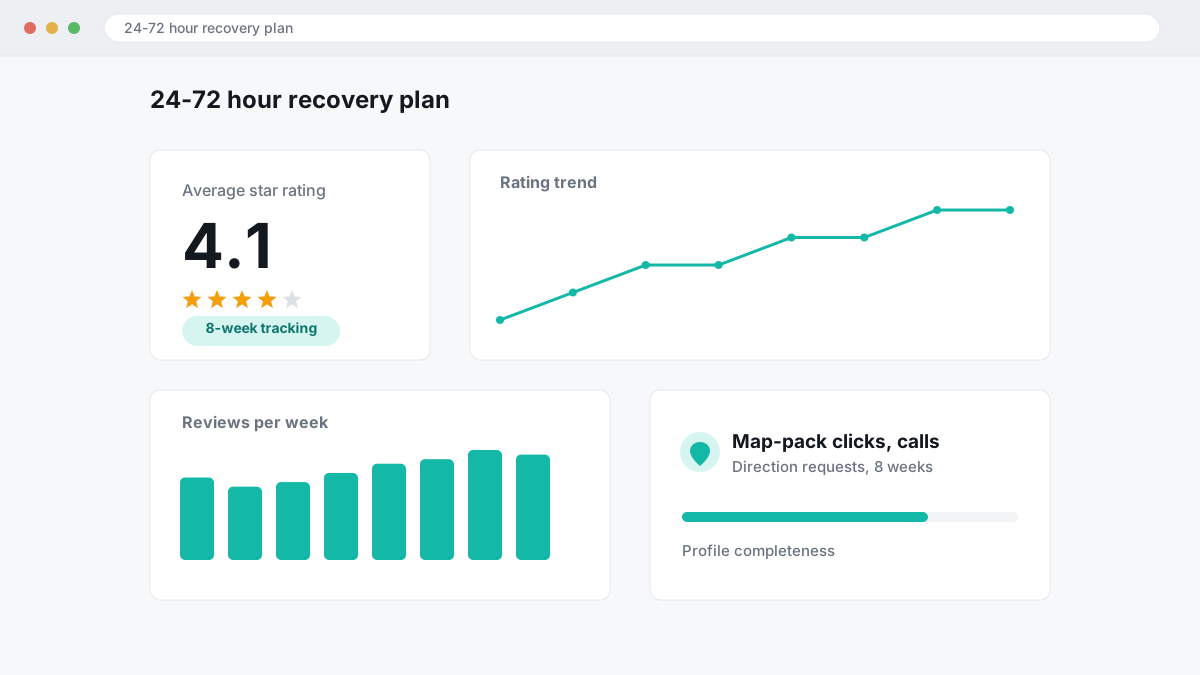
The wrong move is to chase deletion first and leave the profile silent. That fails because the review sits there affecting click-through rate and conversion while prospects read an unanswered complaint, and many first attempts get rejected anyway. Across 12,000+ negative review cases logged by BGR Review from June 2025 to June 2026, roughly 90% of businesses that came to us after a failed self-filed attempt had used only the basic in-platform report button, and 70-80% of those initial requests had been rejected.
The better sequence is to stabilise trust, then assess negative review removal grounds. If the review appears to breach Google Business Profile policy, gather proof before filing: order record, message trail, location mismatch, or evidence the reviewer was never a customer. While that runs, publish one factual response within 24 to 72 hours, avoid arguments, and invite the person to continue offline. Strong review responses often protect calls and bookings faster than another SEO tweak because they change what the searcher sees in the local pack immediately.
Then dilute one-off rating damage with compliant review requests sent to recent real customers. In BGR Review's dataset of 1,485 businesses observed from February to July 2026, new trades and local service firms typically saw first reviews around two weeks after launch, and reaching 20-30 reviews over the first three months was associated with better local visibility, though other ranking factors were active at the same time.
Can buying reviews hurt rankings, listings or legal compliance?
Yes. Buying reviews can hurt visibility indirectly by triggering review removals, Google Business Profile suspensions, trust loss and legal exposure. Google’s fake engagement policy, the FTC’s endorsement rules in the US, and local consumer-protection laws create risk long after a paid review has posted.
Most sellers treat the test as simple: if the review sticks, it is safe. That fails because platform risk and legal risk are separate. Google can remove reviews or restrict a listing when review velocity spikes in a way that looks manufactured, and a profile can lose map-pack click-through rate and calls before any formal suspension notice arrives.
The safer approach is disclosed, policy-compliant review generation from real customers, with timing tied to an actual job completion or purchase and with no misleading incentive. In the US, the FTC’s Guides Concerning the Use of Endorsements and Testimonials in Advertising and its 2024 rule on fake reviews both target undisclosed paid endorsements. Rules also vary by country and platform — Google, Trustpilot and Yelp each enforce different review rules, and UK enforcement can involve the CMA and DMCC Act. This is general information, not legal advice.
How does a real review recovery workflow move from bad review to removal request or public reply?
Classify the review before you touch the report button: real service failure, misunderstanding, policy violation, or a false factual allegation. That choice decides whether you post a public reply, ask for fresh reviews to steady the rating, file for negative review removal, or escalate with an evidence pack.
Most guides push the same move for every bad review: flag it. That fails because platforms judge different things. A one-star review from a real customer with poor service details usually stays, so your job is a tight public response that fixes the trust hit and protects click-through rate in the local pack; a fake review policy issue, impersonation, conflict of interest, or a review that states a false fact such as “never delivered” when the signed invoice shows delivery belongs in a removal file instead.
This is the pack that gives the request a chance of moving: invoice or booking record, dated timeline, staff notes from the day, screenshots of messages, and the review URL. Across 12,000+ negative review cases logged by BGR Review from June 2025 to June 2026, reviews raised within 28 days of posting and backed by an identifiable policy issue resolved successfully in roughly 90% of cases; for comparable cases raised after 28 days, the observed success rate fell to approximately 25–30%. Delay hurts.
The path changes by platform, so the evidence has to match the rule you are invoking.
| Situation | Best path | What to attach |
|---|---|---|
| Legitimate complaint | Public review response | Internal timeline, refund or fix offered |
| Fake reviewer or policy breach | Platform report under fake review policy | Account mismatch, no customer record, screenshots |
| False factual claim | Report, then legal review if needed | Invoice, delivery proof, written contradiction |
UK and EU consumer rules on misleading commercial practices, and US FTC rules on endorsements and testimonials, matter if reviews are incentivised or undisclosed; defamation may matter when a review states a false fact, but the threshold varies by country and platform, so this is general information, not legal advice.
What should you measure first if you want review work to improve SEO results fastest?
Measure the trust signals customers can see first: your average star rating, review count, review recency, and lead rate against three local rivals in the map pack. Fix the weakest visible gap before you change outreach cadence, add automation, or spend more on broader SEO work.
The wrong approach is tracking local pack rankings alone. That fails because reviews move clicks and leads on different timelines: a stronger average star rating can lift click-through rate and form fills before position changes, while stale review recency can hold back trust even if your listing still appears. The right approach is a monthly benchmark of rankings, clicks, calls, bookings and form leads together, using the same three competitors each time so the comparison stays clean.
Start where the customer notices the problem fastest. If your review count is close to rivals but your latest review is three months old, fix recency first; if recency is fine but your rating dropped after one disputed review, address that first.
| Metric | Check monthly | Why it comes first |
|---|---|---|
| Average star rating | You vs top 3 map-pack rivals | Changes trust and lead conversion fastest |
| Review count | Total gap and monthly growth | Affects credibility in side-by-side local pack comparisons |
| Review recency | Days since last review | Old feedback weakens clicks even with stable local pack rankings |
| Lead rate | Calls, bookings, form fills per profile visit | Shows whether review work is producing revenue, not vanity movement |
Where to go from here
Treat your review profile like part of your search setup, because that is how Google and your buyers use it. A weak average star rating, stale review recency or a run of unanswered complaints will usually hurt map-pack click-through rate before it changes position, and the drop in calls, bookings and form fills is what you feel first.
Start with a simple audit this week: check your Google Business Profile, your average score, your last 10 reviews, your response rate and any review that may breach platform policy. Remove the reviews that have a real policy angle, answer the rest properly, then build a steady request flow from the point where a customer has actually received the service. If you run several branches, do this location by location rather than pushing every customer to one profile.
Expect cleaner trust signals first, then better local-pack clicks and stronger conversion from the traffic you already have.