

Quick answer
Star ratings change conversions most when a buyer is comparing similar options and feels close to booking, calling or buying. Public benchmark data still cited in 2026 from the Spiegel Research Center found that displaying reviews can lift conversions by up to 270%, with the biggest effect on lower-priced products. The average score never works alone, though. A 4.8 average from 12 reviews often loses to a 4.6 from 240 recent reviews because buyers read review volume, recency and rating distribution together before they trust the number.
We work on review acquisition and review-removal campaigns across Google Business Profile, Trustpilot, Yelp, Clutch and TripAdvisor, so this page is built from the patterns managers actually have to fix rather than recycled benchmark prose. One detail generic guides miss: a Google flag sent through the basic report button usually goes nowhere if you do not attach the policy reason, screenshots and timeline that explain why the review breaches the platform's rules.
That is why we treat star ratings as one signal inside a wider conversion problem: review mix, recent verified volume, response quality and platform context all change what the score means.
Why do buyers judge star ratings as a mix of score, volume, recency, and review content?
Star ratings change conversions as a bundle of signals, not a single number. Before they click, call, book or buy, most buyers test the average star rating against review volume, review recency and the detail inside the review text.
The wrong approach is to chase a higher average score in isolation. It fails because a 4.8 from 12 reviews carries less certainty than a 4.6 from 240 when the larger profile shows a recent stream of credible comments, a healthier rating distribution, and replies to complaints that remove doubt; that difference shows up first in click-through rate, then in calls and form fills. At BGR Review, this is why we audit the review mix before recommending any verified review package with the 30-day free replacement guarantee, rather than telling you to force the headline number up.
If you want the rating to convert, read the profile the way a cautious buyer reads it. A tight cluster of five-star posts from last year looks weaker than mixed but mostly positive feedback from this month, because fresh reviews answer current objections on price, delivery, service quality and whether the business still performs at the same standard.
The trust cues also change by platform, so the same score can sell differently.
| Platform | What the buyer sees first | What usually shapes trust fastest |
|---|---|---|
| Google Business Profile | Average score, total review count, snippets, map-pack placement | Recent reviews, owner responses, local relevance and whether the profile looks active enough to justify a click |
| Trustpilot | TrustScore layout, volume, review text, date cues and profile context | Content depth, recency, verification cues and whether lower-star reviews were answered properly |
That is why one-number advice misleads managers. Score matters, but the conversion rate usually moves when the score, count, freshness and review content support each other.
How do star ratings change clicks, trust, and completed sales at each step of the funnel?
Star ratings change performance in stages. They first change whether you get the click, then whether a buyer trusts you enough to call, book or add to basket, and only after that do they affect whether the sale or enquiry actually completes after comparison shopping.
Most guides treat stars as a checkout issue. That fails because searchers often make the first cut in the local pack or map pack, where they can see your average, review count and distance before they ever reach your site. In BGR Review’s dataset of trades businesses with complete enquiry-source data, observed from February to July 2026 within a wider sample of 1,485 businesses, 70–80% of calls and bookings were attributed to a Google Business Profile or Yelp listing. That means click-through rate often moves before on-page conversion rate does.
If your rating slips, lead quality usually drops before volume stabilises. High-intent channels bring buyers who are comparing price sensitivity and risk at the same time; a weak score attracts more bargain hunters, more objection-heavy calls and more abandoned forms, even when some traffic still comes through. The right fix is to protect trust earlier in the funnel: answer harmful reviews properly, tighten review recency with fresh verified feedback, and improve the review mix on the profile where the click starts. Chasing checkout tweaks while the profile shows a thin 4.1 with stale reviews usually wastes the cheaper fix.
Where does conversion lift flatten between 4.2, 4.5, 4.7, and 4.8 stars?
The biggest gains in conversion rate usually come from lifting your average star rating out of the low 4s and into the mid 4s. Once you sit around 4.6 to 4.8 with credible review volume, extra tenths usually matter less than recent, specific reviews that read like real buying proof.
Most managers chase 4.9 first. That target fails because buyers rarely read a 4.2, a 4.5 and a 4.8 as simple maths; they read them against review count, how fresh the last few reviews are, and whether the comments answer the risk they care about. A visible 5.0 with 9 reviews can look less trustworthy than a 4.6 with 120, especially on Google Business Profile or Trustpilot where decision-stage readers scan the latest comments before they call or fill a form.
The better target is the trust threshold your buyer accepts. For many categories, that sits at 4.5 and above, where hesitation drops and branded search, map-pack clicks and direct enquiries start to recover; after that, the jump from 4.2 to 4.5 usually does more work than moving from 4.7 to 4.8. When clients use BGR Review to rebuild recent verified review volume, delivery can start in 24-48 hours and the package carries a 30-day free replacement guarantee, because fresh proof usually lifts conversion faster than obsessing over a near-perfect score.
This comparison is the one that usually matters on high-intent pages.
| Average rating band | How buyers usually read it | Likely effect on conversion |
|---|---|---|
| 4.2 | Borderline; readers look for what went wrong | Noticeable friction before calls, bookings or form fills |
| 4.5 | Meets the trust threshold for many buyers | Stronger lift than small gains at the top end |
| 4.7 | Strong, provided volume and recency back it up | Usually converts well already |
| 4.8 | Excellent, but close to diminishing returns | Smaller incremental gain unless the review mix improves |
When does review volume make a 4.5 rating convert better than a 4.8?
Review volume can beat a small score gap because buyers trust a larger sample. In many side-by-side comparisons, a 4.5 average star rating backed by 300 reviews feels safer than a 4.8 built on 18, especially on a Google Business Profile or Trustpilot page where the count sits next to the score.
The wrong move is chasing the prettier number and ignoring how believable it looks. That fails because buyers read a thin sample as unstable: one bad month, one staff change, or one awkward fulfilment batch can move the average fast. In BGR Review's dataset of 1,485 businesses observed from February to July 2026, established practices such as dentists, lawyers, accountants and roofers usually needed 30–50 reviews before profiles performed consistently, which is a useful credibility threshold rather than a platform rule.
The better move is to judge the score with the count and the date of the last few reviews. A 4.5 with 300 reviews often converts better than a 4.8 with 18 when the offer, category, price point and page quality are otherwise comparable, because the larger review volume lowers perceived risk and lifts click-through rate from the map pack or product page. The smaller profile can still win if its review recency is much stronger and the bigger profile looks stale.
Under 50 total reviews, recent feedback carries more weight than the headline average. That is why the first recovery step after a dip is usually rebuilding fresh verified volume before pushing for a higher score; on our review packages, delivery starts in 24–48 hours and every package carries a 30-day free replacement guarantee, which matters when you need the recent sample to look current rather than thin.
Why can a 4.0 profile still lose sales when the average looks acceptable?
A 4.0 average can still leak conversions. Buyers read the newest 1-star reviews, look for repeated complaint themes, and judge your negative review response; if those signals look risky, calls, bookings and form fills fall even when the headline score looks passable.
The wrong assumption is that 4.0 is safe everywhere. It fails because buyers do not read an average in isolation; they read the rating distribution. A profile with years of older 5-stars and three recent 1-star reviews about no-shows, refund disputes or rude staff tells a different story on Google Business Profile or Trustpilot than a profile with mostly 4-star and 5-star feedback and one outlier complaint. The second profile feels stable. The first looks like a business that slipped.
Unanswered complaints make that risk worse. A short, factual owner reply can contain the damage by showing you investigated the issue and offered a fix, while silence lets the reviewer frame the whole transaction. If a recent review also appears to breach platform rules, speed matters: in BGR Review’s log of 12,000+ negative review cases from June 2025 to June 2026, reviews raised within 28 days and backed by an identifiable policy issue resolved successfully in roughly 90% of cases, versus approximately 25–30% for comparable cases raised later. That is why the right move is to fix the recent visible negatives first, then rebuild fresh verified volume, rather than obsessing over the displayed average alone.
Which star rating improvements usually deliver the fastest ROI first?
The fastest return usually comes from fixing the weakest trust signal, not squeezing the average as high as possible. For most profiles, moving a low-4 score into the mid-4s, adding recent reviews, and closing obvious complaint-response gaps lifts conversion rate faster than chasing another tenth.
The vanity move is pushing 4.7 to 4.8 while your last five reviews are six months old and two one-star complaints still have no negative review response. That fails because buyers read the page like a stack of signals: average score, review recency, visible replies, then review text. In BGR Review’s workflow, we tell complaint-heavy categories to fix the public response gap before paying for fresh acquisition or any review package, because unanswered complaints depress form fills and calls even when the badge still looks strong.
This is the order we usually use when speed matters.
| Fix | Why it usually pays first | Where BGR Review fits |
|---|---|---|
| Lift 4.1 to 4.4 | Crosses a visible trust threshold buyers notice fast | Rebuild verified volume with a 30-day free replacement guarantee |
| Add 15 recent reviews | Freshness often changes buyer confidence more than a 0.1 average increase | Review delivery starts in 24-48 hours on active campaigns |
| Answer complaint clusters | Removes the clearest conversion blocker on high-intent pages | Where a review breaks policy, removal is pay-after-success at $449 per link with $0 upfront |
If the blocker is one or two policy-breaching reviews, deal with them early. Across 12,000+ negative review cases logged by BGR Review from June 2025 to June 2026, reviews raised within 28 days of posting and backed by an identifiable policy issue resolved successfully in roughly 90% of cases; comparable cases raised later fell to approximately 25-30%. That is why “get the average up” often loses to “remove the biggest trust blocker first”.
How do Google Business Profile, Trustpilot, and on-site stars change the conversion effect?
Star ratings change buying behaviour at different points in the journey. Google Business Profile drives local discovery, map-pack click-through rate, calls and direction requests; Trustpilot usually reassures ecommerce shoppers before cart or checkout; on-site stars mostly strengthen product confidence after the visit has already started.
The wrong approach is to push the same review target everywhere and expect the same conversion effect. That fails because a plumber's Google Business Profile often decides whether the phone rings at all, while a DTC store can win the click on Google and still lose the sale if its Trustpilot page looks thin, stale or full of unresolved delivery complaints. In BGR Review's dataset of trades businesses with complete enquiry-source data, observed from February to July 2026, 70-80% of calls and bookings were attributed to a Google Business Profile or Yelp listing rather than a website.
The right approach is to match the channel to the decision stage. On Google Business Profile, stronger review recency and reply quality tend to lift map-pack clicks before they lift anything on your site. On Trustpilot, buyers often read reviews mid-journey to check refund friction, shipping reliability and whether the brand feels real enough to trust with card details. On your own pages, schema markup can make review stars eligible for rich results under Google's review snippet documentation, but eligibility does not guarantee display as of 2026, so treat schema as a click-through aid, not a promise.
If you are buying review growth or fixing a drop, split the work by channel first. BGR Review sells verified review packages across Google and Trustpilot with a 30-day free replacement guarantee, and that only makes sense when the platform lines up with where your conversion loss actually starts.
What star rating is strong enough for restaurants, ecommerce, and local services?
A rating that is strong enough depends on how people buy. Restaurants need fresher proof, home services need deeper trust signals, and ecommerce ratings have to hold up next to price, shipping speed and return terms.
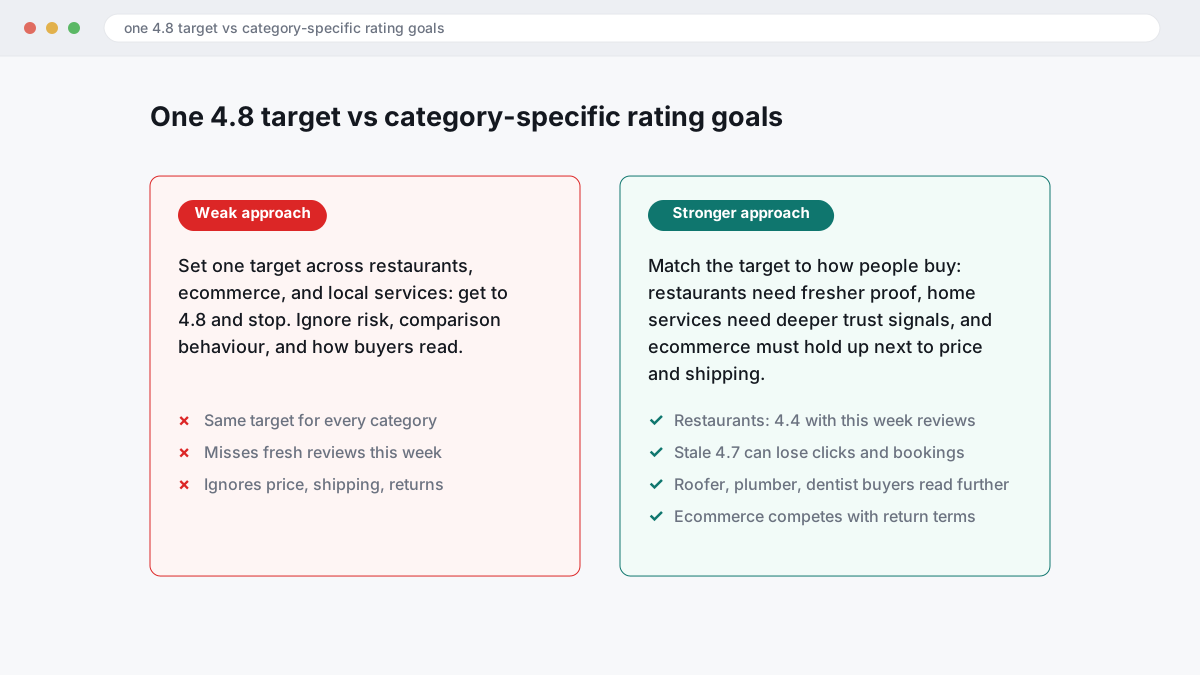
The wrong approach is setting one target across every category, usually “get to 4.8 and stop”. That fails because industry benchmark differences come from risk and comparison behaviour. On a restaurant’s Google Business Profile, a 4.4 with recent reviews from this week can win more map-pack clicks and bookings than a stale 4.7, because diners expect quality to change fast. For a roofer, plumber or dentist, buyers read further down the page; in BGR Review’s dataset of 1,485 businesses observed February to July 2026, established practices usually needed 30–50 reviews before profiles performed consistently.
This is the practical threshold guide we use before recommending any review package with BGR Review’s 30-day free replacement cover.
| Category | Usually strong enough | What matters alongside the score |
|---|---|---|
| Restaurants | Mid-4s can convert well | Review recency, recent negative review response, Google Business Profile photos |
| Ecommerce | Higher bar in competitive ranges | Price sensitivity, shipping, returns, product-review volume, Trustpilot reputation |
| Local services | Mid-4s with real depth | Review count, detailed service mentions, verified trust signals, response quality |
Ecommerce is the most direct comparison environment. A store can show a respectable score on Trustpilot and still lose conversions if a rival sits one tab away with similar ratings, lower shipping cost and cleaner return language. That is why chasing average alone is a weak fix; for local services, build trust depth first, and for restaurants, rebuild recent volume before you obsess over another tenth of a star.
How should you recover after a visible star rating drop without making it worse?
Recover from a visible rating drop by finding the cause before you try to lift the average. Answer public complaints, fix the service issue behind them, and rebuild trust with fresh, compliant reviews from real customers over the next few weeks.
The wrong reaction is to panic-buy a burst of reviews the same day. That fails for two reasons: buyers can spot unnatural review recency and thin review content, and platforms can suppress or remove sudden clusters that do not match normal customer flow. Start with the diagnosis instead. Check whether the average fell because new negatives landed, older positives disappeared, or Google Business Profile is showing a temporary display lag after moderation, a profile edit, or a listing merge.
If the drop came from complaint-led reviews, post a negative review response within 24 to 72 hours. On Google Business Profile and Trustpilot, that public reply often affects click-through rate before it changes the average, because searchers read the latest complaint and your answer side by side in the map pack or profile view. Keep it short, factual, and specific about the next step; defensive replies usually depress conversions more than the original review.
Then rebuild volume naturally. Ask recent customers through your normal job-completion email, SMS, CRM trigger, or checkout flow, and avoid incentives because the FTC's rule on fake reviews and many platform policies treat undisclosed compensated reviews as a compliance risk. If you use a review service such as BGR Review, the safer brief is steady verified volume with a 30-day replacement guarantee, not an overnight spike that makes the rating look manufactured.
What should a star rating audit checklist show before you chase a higher average?
A useful rating audit puts your score, review volume, review recency, reply coverage, complaint themes and competitor gaps on one page. That shows whether your conversion rate is falling because the average star rating dropped, or because buyers see stale feedback, thin volume or unanswered criticism around it.
The wrong audit tracks one number. A 4.6 can still leak clicks from the local pack, branded search and high-intent landing pages if the last 90 days produced only a handful of reviews, half the low-star posts have no negative review response, or one product line carries the same complaint theme again and again. Before BGR Review recommends any review package with a 30-day free replacement guarantee, or a $0 upfront removal case billed only after success at $449 per removed link, this is the view we build first because it shows what to fix before you chase a higher average.
Use a monthly comparison against the top three competitors, not a quarterly snapshot, because Google Business Profile and Trustpilot profiles change fast enough to affect click-through rate and completed sales.
| Check | What to segment | Why it affects conversions |
|---|---|---|
| Average rating, total count, last 90-day volume, reply rate | By platform and location | Shows whether trust loss comes from score, weak volume or poor recency |
| Top complaint themes | By product line or service category | Finds the issue depressing close rates after the click |
| Your profile vs top three rivals | Monthly, same platform | Adds context; a lower score can still win if freshness and volume are stronger |
How do fake reviews, disclosures, and platform rules turn rating gains into risk?
Star-rating gains turn risky when reviews are bought, left by staff, friends or other connected parties, or posted without clear disclosure. The US FTC endorsement guides, each platform policy, and country-specific consumer rules can turn a short-term lift into removals, feature limits, suspension or plain trust damage.
The shortcut is obvious: manufacture better stars fast. It fails because the signal pattern gives it away — thin review content, sudden review volume spikes, repeated language, reviewer-account overlap, or undisclosed incentives. Google Business Profile, Trustpilot and Yelp each enforce their own platform policy, and the UK CMA and DMCC Act rules add another layer if you operate there. This is general information, not legal advice.
The safer path is slower and holds up better: ask real customers at the right moment, disclose any incentive clearly, and keep the review request flow consistent across your CRM trigger, email and SMS. That protects click-through rate, conversions and your map-pack visibility because buyers trust recent, specific review content more than a suspicious jump in the average. BGR Review sells verified review campaigns and negative review removal, but the same rule applies either way: if the method would look bad in a platform audit, do not use it.
Where to go from here
Your next move is simple: pull your last 20 reviews on the platform that drives the enquiry, then sort them by date, star score and theme. If your Google Business Profile or Trustpilot page has gone quiet, rebuild recent verified volume before you chase a higher average. If one or two reviews are dragging conversion on high-intent pages, write a proper negative review response first, then check whether the review breaks platform policy and is worth escalating.
That order matters. In live reputation work, a profile with steady recent feedback and clear owner replies usually lifts click-through rate and form fills faster than a profile obsessing over a small average-star movement. A perfect 5.0 can even look thin if the review count is low, the rating distribution is narrow, or the last review is months old. Buyers read the mix, and searchers in the map pack do the same.
If you need outside help, compare the problem before you buy the fix: review generation for weak volume and recency, removal support for policy-breaking reviews.