

Quick answer
For a pest control company, reputation management comes down to three actions: ask for recent Google reviews right after completed jobs, answer negative reviews fast, and challenge reviews that break platform rules with evidence. Google Business Profile policies prohibit fake engagement and misleading content, so random low-quality review buying creates risk for your listing and your local pack conversion. The fastest wins usually come from tighter job-completion request timing, faster review response time, and policy-based escalations for false factual claims. BGR Review handles removals on a pay-after-success basis at $449 per removed review link, with $0 upfront, and review packages include a 30-day free replacement guarantee.
This page is written for operators choosing a reputation partner, not homeowners booking treatment. We focus on the parts that move calls, booked inspections and recurring service: Google Business Profile review velocity, response handling, negative review removal and location-level execution for service-area businesses.
That comes from live operational process, not theory. In the removal cases we handle, the outcome often turns on whether the evidence pack matches a named policy category before the first flag is filed, and whether response copy goes live in parallel so the listing is protected while the appeal sits in queue; BGR Review has served 15,000+ businesses, works from New York, London and Thornhill, and logs outcomes as success, unresolved or unknown rather than padding claims.
Why do some pest control companies book more inspections before they outrank anyone?
Pest control prospects usually pick the company that feels safest to hire before they pick the one sitting highest in the map pack. Fresh reviews, visible owner replies, and comments that mention the actual job can lift calls and booked inspections before your local pack position moves at all.
The wrong approach is waiting for rank to fix trust. That fails because shoppers on a Google Business Profile often compare three things before they tap call or visit your site: star rating, how recent the latest reviews are, and whether the owner replies like a real operator. In BGR Review's dataset of trades businesses with complete enquiry-source data, observed February-July 2026, 70-80% of calls and bookings were attributed to a Google Business Profile or Yelp listing rather than a website. If the listing looks stale, the click goes elsewhere even when you appear above them.
The better approach is to improve local pack conversion first. A nearby 5.0 with six old reviews can lose the click to a 4.8 profile with a healthier star-rating distribution, recent feedback, and clear replies about termite treatment, rodent follow-up, bed bug prep, or whether the technician returned when activity persisted. That works because pest control buyers are scanning for proof of reliability, not abstract praise. They want to see that you turned up on time, explained the treatment, and handled the second visit without friction. If your replies show that level of accountability, you can book inspections before you outrank anyone.
What should you fix first when reviews are hurting calls, clicks, or quote requests?
Fix the signals people notice first: fresh one-star reviews, slow review response time, and stale review activity. For most pest control operators, recency and replies improve trust faster than trying to squeeze a small lift out of the average score.
The wrong move is chasing a perfect 5.0 while a recent one-star cluster sits at the top of your Google Business Profile unanswered. That fails because local pack conversion drops on the visible trust leaks first: a skewed star-rating distribution in the last few reviews, no owner replies, and a profile that looks inactive this month. In BGR Review's dataset of 1,485 businesses observed February-July 2026, trades businesses that shared complete enquiry-source data attributed 70-80% of calls and bookings to a Google Business Profile or Yelp listing, so the fastest payback usually comes from cleaning up what searchers see before they click.
Fix order matters. Start with any recent one-star run, especially if two or three land close together, because review recency usually changes the first-screen impression within 30 days faster than the overall rating changes. Then close reply gaps: answer every unresolved negative review, because a fast, specific response protects clicks and quote requests even when the platform leaves the review live. After that, repair weak request timing so new reviews arrive steadily after completed jobs and booked inspections stop depending on old feedback.
Track this by location every week, not at brand level. Use three lines only: call clicks from the profile, form leads, and booked inspections, then compare them against review response time and the age of your latest reviews; if one branch has the same rating but fresher reviews and faster replies, it usually converts better in the map pack.
How do you get more pest control reviews without creating awkward asks or filtered spikes?
The safest review workflow is job-triggered, not batch-triggered: send the first request straight after completed service, follow up once, and keep volume tied to real job flow. Bursts after weeks of silence draw more filtering and get ignored more often than a steady stream tied to actual lead-to-job follow-up.
Most guides tell you to send a monthly blast to every customer on file. That fails for pest control because spring surges create an artificial spike in review velocity that does not match how your jobs were completed, and the ask lands too late to feel natural. The cleaner approach is simple: trigger the first ask within 2 hours of job completion from your CRM or dispatch tool, while the technician experience is still fresh and the customer still remembers whether the wasp nest was removed, the bait stations were explained, and the invoice matched the quote.
Use SMS first for urgent jobs such as rodents, bed bugs, or same-day callouts, because the customer is usually still on their phone and wants the issue closed fast. Email works better for annual service plans and recurring preventative work, where the relationship is longer and the customer has time to write a fuller review after the visit summary arrives. In BGR Review's dataset of 1,485 businesses observed from February to July 2026, new trades and local service businesses typically saw first reviews around two weeks after launch, which fits a steady, job-triggered cadence far better than a once-a-month push.
If you use a managed service, keep the rhythm boring on purpose. BGR Review starts review delivery in 24-48 hours and backs packages with a 30-day free replacement guarantee, but the same rule applies whether you do this in-house or through us: during seasonal pest demand, do not double request volume just because bookings jump for one week. Match asks to completed jobs, send one follow-up, then stop.
When should technicians ask on site, and when should the request wait until after service?
Ask on site only when the customer has already seen a clear result, and move the actual review link into a later SMS or email when the job ends with uncertainty, chemicals, or a promised return visit.
The wrong move is a hard close on the doorstep while the technician is still packing up. That fails after spray treatments, attic inspections, or first-visit rodent work because the customer has not felt the outcome yet, so the ask lands as pressure rather than proof of technician experience. In BGR Review's dataset of 1,485 businesses observed from February to July 2026, new trades and local service businesses typically saw first reviews around two weeks after launch, which fits a simple rule: steady, well-timed asks beat rushed bursts.
Use the softer handoff instead. Have the technician mention the review in person after a visible win such as a wasp nest removal or rodent capture, then let your lead-to-job follow-up send the link later that day or after the customer confirms the problem has stopped. That sequence works because the technician plants the request while trust is high, and the later message gives the customer a clean moment to write without feeling cornered.
How fast is too fast for review growth during peak pest season?
Fast review growth is only risky when it outruns real completed work. In pest control, April through August often produce normal spikes because seasonal pest demand lifts booked inspections, follow-up treatments and end-of-job review requests from different households across the same service window.
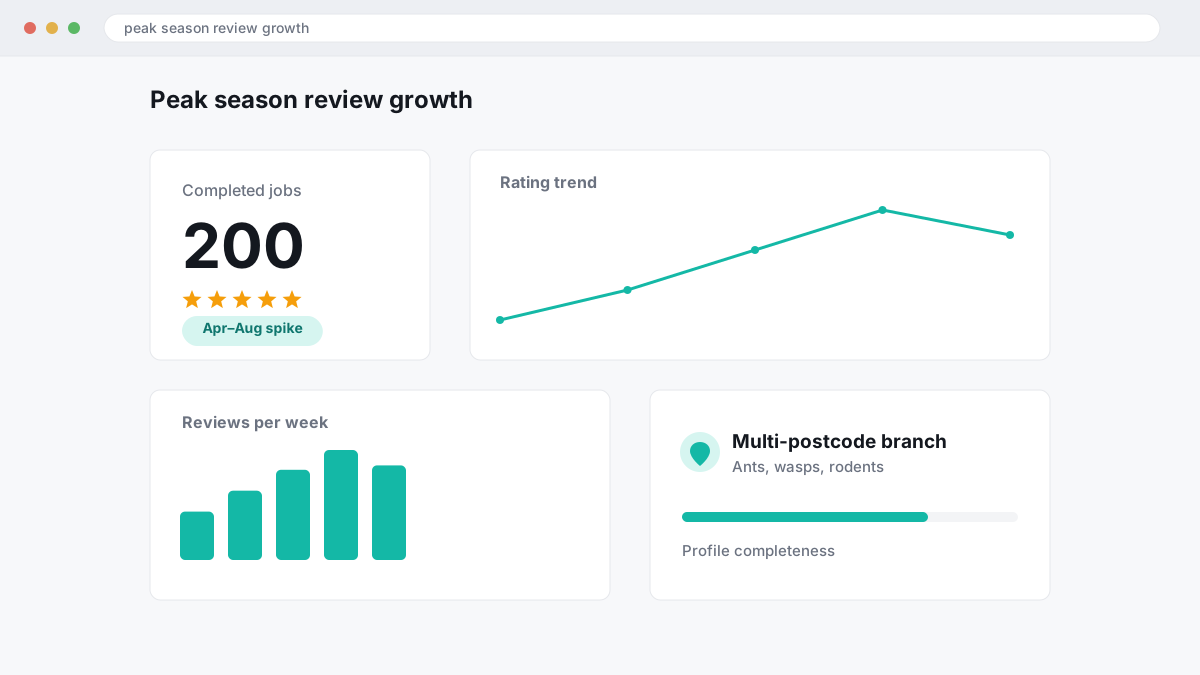
Most guides treat any spike in review velocity as suspicious. That fails because Google Business Profile does not judge volume in a vacuum; a branch closing 200 jobs in a busy month can support far more asks than a solo owner covering one van route, especially for service-area businesses handling ants, wasps and rodents across multiple postcodes. In BGR Review's dataset of 1,485 businesses observed February-July 2026, new trades and local service businesses typically saw first reviews around two weeks after launch, and reaching 20-30 reviews over the first three months was associated with improved local visibility while other ranking factors were active at the same time.
The safer approach is to match request volume to completed-job volume, market size and service mix. A one-off wasp nest removal creates a clean same-day ask; a recurring pest contract usually lands better after the first successful follow-up visit, because the review reads more credible and helps local pack conversion when searchers compare technician experience and recency. If your review curve jumps harder than your diary did, slow the sends, spread them by job-completion date, and keep the customer mix broad enough that the growth looks like real demand rather than a campaign burst.
How do Google Business Profile rules change the playbook for service-area pest companies?
Service-area pest companies win under a different Google Business Profile setup than storefronts. A hidden address does not stop you ranking, but inaccurate service areas, weak local reviews and mixed location signals will drag down visibility and local pack conversion.
The wrong approach is copying a storefront playbook: showing a residential or unstaffed address, stuffing every nearby town into the profile, and assuming the map will sort it out. Google Business Profile rules for service-area businesses say you should hide the address if you do not serve customers there during stated hours with staff present, and that matters because a bad setup creates trust problems before a searcher even clicks. In BGR Review's dataset of trades businesses with complete enquiry-source data, observed February to July 2026, 70-80% of calls and bookings were attributed to a Google Business Profile or Yelp listing, so a messy profile costs real inspection volume.
The right approach is tighter. Pick the best primary category for the core job, set realistic service areas around where crews actually travel, and build reviews that mention the place served and the technician experience in natural language. Categories, service areas and reviews influence local pack impressions together; if one is vague, the others have to work harder. You can still appear without a visible address, but relevance and trust have to be cleaner.
Location pages need their own proof. Shared brand praise like “great company” helps the parent brand, but it rarely closes local gaps when one branch wants bookings in Croydon and another wants forms from Queens. Give each page its own review signals, its own service-area copy and its own recent responses, because Google reads location intent at page level long before branded search demand catches up.
What do you do in the first 24 hours after a bad pest control review lands?
Verify the facts first, then post a calm public reply the same day if you can. In pest control, review response time matters because the newest complaint often becomes the first thing a prospect reads in the local pack, and many decide whether to call before they ever reach your site.
The wrong move is to defend the technician on instinct. That fails when your own records tell a different story, or when the reviewer mixed up a no-show window, a follow-up visit, a billing issue, or a recurring-service reminder. Before you write anything, pull the service date, technician notes, invoice, call recording if you have one, and route logs or dispatch history; this is the same first-hour check BGR Review asks clients to complete before we draft response copy or assess whether a later flag has any policy basis.
The right move is a two-track response. First, verify what happened and whether the complaint reflects technician experience, a communication miss, or a false factual claim. Then publish a short public reply within 24 hours when possible: acknowledge the concern, state that you are reviewing the appointment record, and give one visible recovery step such as a direct contact name, a reinspection offer, or a request to continue the discussion by phone or email.
Keep the specifics offline, but do not leave the public thread empty. A blank profile makes the complaint look uncontested, and one unanswered 1-star review can distort your recent star-rating distribution long before your average rating changes in a meaningful way. If the review later proves removable under Google Business Profile review policy, you still need the public reply in place while the flag and escalation process runs.
Which bad reviews can actually be removed, and what evidence makes a flag more likely to work?
Most bad reviews stay live unless they break a platform rule or make false claims you can prove wrong with records. The strongest negative review removal attempts tie one clear policy ground to one evidence pack and skip the “this feels unfair” argument.
The wrong approach is common: you flag a one-star review on your Google Business Profile and write that the customer was rude, the rating hurts, or the comment is misleading. Google does not remove reviews for being harsh, vague, or commercially painful. The right approach is narrower. Match the review to a named policy issue such as spam, off-topic content, or conflict of interest, then attach the document that supports that exact point.
False factual claims sit in the middle. “They never came” or “they charged me after cancelling” can be removable if you can show the statement is factually wrong with a signed service agreement, invoice, dispatch route log, technician timestamp, call recording, or SMS confirmation. “I still saw mice two days later” usually stays live because that is an opinion about the outcome, even if your treatment notes are strong.
This is where most self-filed flags fail. In BGR Review’s dataset of 12,000+ negative review cases logged June 2025 to June 2026, roughly 90% of businesses that came to us after a failed attempt had used only the basic in-platform report button with no supporting documentation, and 70–80% of those initial requests had been rejected.
A compact evidence map keeps the flag tight:
| Issue on Google Business Profile | What you need to show |
|---|---|
| Spam or fake engagement | No matching job record, no caller history, no address, no estimate, and no payment trail |
| Off-topic content | The review talks politics, another company, or a non-service dispute unrelated to pest control work |
| Conflict of interest | Reviewer is a competitor, former employee, or connected account, supported by public profile links or business records |
| False factual claims | Invoice, contract, route log, call record, or technician notes that directly contradict the statement |
If you cannot point to a policy ground, move fast on the public reply instead of forcing a weak flag. A clean response protects local pack click-through and booked inspections while the review stays live. That is often the cheaper route than paying $449 per removed link on a pay-after-success basis for a case with no policy match.
Can a pest control company buy reviews, offer incentives, or use gated feedback without getting burned?
Buying reviews, paying for undisclosed praise, or funnelling only happy pest control customers to Google can damage your listing, weaken trust in the local pack, and create regulatory exposure that a short-term boost in review velocity does not justify.
The wrong approach is simple: pay for reviews, hand out gift cards without disclosure, or use gated feedback so unhappy customers see a private form while happy ones get the public review link. Google Business Profile policies prohibit fake engagement, which includes inauthentic reviews and selective review collection that discourages negative feedback. In the US, the FTC endorsement guides require clear disclosure when a reviewer got a material incentive or has a connection to the business, and that rule follows the review wherever it appears. If your velocity jumps after a promotion and the wording looks templated, you may gain stars for a week and lose click-through rate and bookings once prospects spot the pattern.
The safer route is compliant review generation: ask every completed job for feedback, use the same post-service process across mosquito, rodent and termite work, and let the customer choose the platform without filtering. Country rules matter here. UK and EU misleading-practice standards also apply to hidden incentives and manipulated testimonials, so this is general information, not legal advice. If you use a service provider, check that the process reaches real customers, does not suppress criticism, and does not promise immunity from Google policy; at BGR Review, review packages carry a 30-day free replacement guarantee, not a licence to ignore platform rules.
Should a pest control company handle reputation in-house or hire a managed service?
DIY works when one owner can enforce follow-up, responses and weekly reporting for a single branch without drift. Managed help starts to make sense once you have multiple locations, unresolved removal issues, or more review demand than office staff can keep up with.
The wrong comparison is software fee versus agency fee. That misses the real cost: slow review response time, missed call-backs after completed jobs, and weak local pack conversion when a prospect sees an unanswered one-star review sitting on your Google Business Profile for six days. In BGR Review's dataset of 1,485 businesses observed from February to July 2026, trades companies with complete enquiry-source data attributed 70-80% of calls and bookings to a Google Business Profile or Yelp listing, so neglected profiles usually cost more than the tool you saved money on.
DIY fits a disciplined operator with one location, a clear lead-to-job follow-up trigger, and someone who will check Google, Yelp and Trustpilot every week. It breaks when nobody owns negative review removal, nobody gathers evidence for false factual claims, and replies slip until the listing looks unmanaged even if rankings hold.
Managed service earns its keep when the workload spreads across platforms and branches.
How do multi-location pest brands keep every branch on-message without flattening local accountability?
Multi-branch pest brands stay consistent by centralising the rules, templates and escalation triggers while leaving each branch responsible for the facts, the response deadline and the outcome on its own listing.
The wrong setup is full central control: one head-office login, one generic reply bank, and one blended report that says the brand averages 4.7 while three branches are bleeding calls from unresolved one-star reviews on Google Business Profile. That fails because pest control is local, especially for service-area businesses where the searcher judges the nearest branch, its latest review response, and whether the reply mentions the actual visit, technician name or missed inspection window. In BGR Review's dataset of trades businesses with complete enquiry-source data, observed February to July 2026, 70-80% of calls and bookings were attributed to a Google Business Profile or Yelp listing, so branch-level trust affects conversions before branded search catches up.
A governed local model works better. Central brand approves response templates, policy language and escalation rules; local managers fill in the factual detail, post within SLA, and escalate anything alleging property damage, false factual claims, billing disputes or safety issues the same day.
Use a simple operating table and score every location monthly.
| Control point | Central brand | Branch manager |
|---|---|---|
| Reply SLA | Set 24-hour standard | Reply on time on each branch profile |
| Escalation path | Approve legal, removal and complaint route | Escalate same day with job notes and photos |
| Monthly scorecard | Review branch-by-branch metrics | Own rating, review response time and unresolved issues |
If you run a franchise or multi-location governance model, never report reputation as one brand average. Report location by location, because the branch with slow replies drags local pack click-through and booked inspections in its own postcode, even if the wider brand still looks healthy.
What response template should pest control teams use for positive, mixed, and negative reviews?
Use short reply templates that sound specific, not canned: thank the reviewer, mention the service category, and give one next step. For negative feedback, acknowledge the concern in public, keep account details out of the thread, and move resolution to phone or email fast.
The weak approach is filler like “Thanks for your feedback” pasted under every job. It fails because readers can spot a script, and slow review response time leaves a bad review sitting unanswered while you are still trying to protect local-pack click-through and booked inspections.
Use these as working copy, then localise the service and branch details.
| Review type | Template |
|---|---|
| Positive | “Thanks for choosing us for your [termite / rodent / wasp / general pest] service. We’ll pass your comments to [technician name] — professionalism on site matters to our team. If you need a follow-up inspection or seasonal treatment, call us on [number].” |
| Mixed | “Thank you for the feedback. We’re glad the visit helped, and we’re reviewing the issue you raised about [arrival window / communication / follow-up]. Our next step is to have a manager check your job notes and contact you at [phone/email] today or the next business day.” |
| Negative | “We’re sorry to read this and want to resolve it quickly. For privacy, we won’t discuss service details here. Please contact [manager name] at [direct number/email] so we can review the booking, technician notes, and the best next step.” |
Where to go from here
Start with a 30-day sweep of your Google Business Profile and your top location pages. Reply to every open review, cut your review response time, and check whether your request timing sits after a completed inspection or treatment visit rather than after the initial quote. For pest control, that timing matters because seasonal pest demand compresses decisions; a homeowner who sees a fresh reply and a recent five-star review is more likely to call from the map pack now, not bookmark you for later.
Then sort your review profile into two piles: reviews you can answer and reviews you can challenge. If a review contains false factual claims, comes from a non-customer, or breaches platform rules, build the evidence pack first and file the flag with the right policy match instead of using the basic report button alone. Expect cleaner star-rating distribution, stronger local-pack trust, and more booked inspections from the traffic you already have.