

Quick answer
LLM optimization means making your brand easy for AI systems to identify, verify and cite. The work is practical: keep your name, services, locations and claims consistent across your site, Google Business Profile, review platforms and authoritative listings; publish crawlable pages with evidence; and remove conflicts that raise hallucination risk. Google AI Overviews, ChatGPT citations, Gemini and Perplexity usually pull from sources that repeat the same facts in multiple places. Start with service pages, review profiles and core brand facts, then fix missing or conflicting proof before you publish more content.
We see the same pattern in live reputation work for brands that come to BGR Review from New York, London and Thornhill: the homepage says one thing, Trustpilot or Google says another, and the AI answer cites the cleaner third-party source instead of the site the brand owns. A citation often turns on dull details most guides skip, like a mismatched business name, an unverified review profile, or a service claim with no supporting page that a crawler can actually read.
That is why LLM Optimization sits close to reputation management. In review removals, the field that decides the outcome is usually the evidence you attach after the in-platform report fails; across 12,000+ negative review cases logged June 2025 to June 2026, we tracked outcomes as success, unresolved or unknown rather than guessing. The same discipline applies here: clean entity data, review-backed proof and fewer contradictions make your brand easier to cite.
Why do some brands get cited in AI answers while better-written pages get ignored?
Brands get cited in AI answers when the model can verify who you are across more than one source. Clean entity recognition, review-backed trust signals and third-party validation usually raise citation eligibility faster than another pass on homepage copy.
Most guides push copy optimisation first. That fails when your site says one thing, your Google Business Profile says another, your Clutch or Trustpilot profile uses a shortened name, and old directory listings point to the wrong URL. ChatGPT citations, Gemini summaries and AI Overviews all synthesise from brand mentions across the open web, so polished wording on a single page does little if the entity looks fragmented. The model does not need prettier claims. It needs a stable brand it can reconcile.
The stronger route is boring and verifiable. Match your trading name, primary domain, phone number and core service wording across your site, Google profile, review platforms and key listings, then support claims with first-party evidence and third-party proof. A line like “top-rated agency” is weak on its own; a consistent profile with recent Google reviews, a complete Clutch page and the same brand name on every citation gives the answer engine something safer to quote. That is why review-platform proof often beats unsupported marketing copy in answer synthesis.
At BGR Review, the first citation audit step is simple: compare one brand fact across the site, review profiles and third-party listings, then fix the conflict before chasing new mentions. If you want help with that cleanup or with verified review acquisition, BGR Review offers a 30-day free replacement guarantee on review packages, and negative review removal runs on a pay-after-success model at $449 per removed link with $0 upfront.
Why is your brand missing from ChatGPT, Gemini or AI Overviews right now?
If ChatGPT, Gemini or AI Overviews skip your brand, the usual reason is simple: they cannot verify who you are, what you do or why your claims deserve trust. The fastest diagnosis is a source-gap audit across your site, review profiles, directories, media mentions, comparison pages and the prompts buyers actually use.
The wrong approach is checking one vanity query where your homepage already ranks and assuming you are ready for AI answers. That fails because ranking somewhere in Google does not make you citation-ready: the model still needs consistent brand mentions, matching facts and enough source coverage to quote you without increasing hallucination risk. In the audits we run before review-growth or removal work, the first break usually shows up in basic entity data such as service list, location wording, phone format or review count wording across Google, Trustpilot, Yelp, Clutch or TripAdvisor.
Check the top 10 prompt patterns your buyers use. Mix direct brand searches, category searches, comparisons, “best” queries, problem queries and local intent. Then audit these five source types side by side.
| Source type | What to check |
|---|---|
| Site | Core facts, service claims, schema, contact details |
| Reviews | Verified proof, recency, reviewer language, reply quality |
| Media | Named mentions, linked references, factual consistency |
| Directories | NAP consistency, category fit, duplicate listings |
| Comparison pages | Whether competitors are named and you are absent |
The right approach is fixing conflicts before chasing new mentions. Once the same brand fact appears cleanly across first-party evidence and third-party validation, citation eligibility improves fast, and that lifts your odds of appearing in answer boxes that drive branded search, map-pack clicks and form fills.
How do you make your brand citation-eligible before you chase mentions?
Citation eligibility starts with pages AI systems can parse, verify and quote without guessing. Clear claims, current facts, visible contact details and structured data give ChatGPT, Gemini and AI Overviews a safer source to cite.
The wrong approach is publishing 50 thin pages stuffed with service terms while hiding the basics. That fails because retrieval systems need stable facts they can match across your site: a services page, a pricing page where prices are actually stated, an about page with named people or locations, a contact page with real channels, and an evidence page with licences, screenshots, reviews or documented results. On BGR Review’s own pages, fixed facts such as the 30-day free replacement guarantee on review packages and removal pricing of $0 upfront plus $449 per removed link are easier to quote than vague sales copy.
The right approach is fewer pages with clean, quotable facts backed by first-party evidence. Add Organization schema site-wide, LocalBusiness schema where location data is real, and FAQ schema only where the answer will stay stable; changing answers every few weeks weakens E-E-A-T signals and increases hallucination risk. Refresh stale claims as a rule: screenshots older than 12 months, expired team bios, or old review counts make your brand look unresolved, and that can block citation eligibility before brand mentions help at all.
How do you optimise for LLM citations without turning the site into spam?
Optimising for LLM citations means giving each important claim a crawlable page with clear evidence, then backing it with matching third-party proof. The target is retrieval and trust in ChatGPT, Gemini and AI Overviews, not stuffing pages with model-friendly phrasing.
The wrong approach is publishing generic AI-written blog posts around broad terms like “best reputation management” and hoping brand mentions will follow. That fails because prompt patterns are specific: buyers ask “best company for Google review removal”, “Trustpilot vs Google reviews for agencies”, or “review help near me”, and a vague post matches none of those intents cleanly. We handle this by mapping one page to one claim, one comparison, or one local service intent, then making the page title, body copy and supporting proof say the same thing.
The page only becomes citation-eligible when every key statement has one named source and an update date. If you say you remove policy-violating reviews, cite the Google Business Profile review policy or Trustpilot’s flagging rules and mark when you checked them; if you say your review packages include a guarantee, state BGR Review’s actual 30-day free replacement guarantee rather than “industry-leading support”. That is first-party evidence tied to a verifiable fact, and those are stronger E-E-A-T signals than another 1,500-word opinion piece.
Rewrite every superlative the same way. Readers trust that faster, and models cite it more safely because the hallucination risk is lower when the claim already arrives with proof.
Where do ChatGPT citations usually come from, and what can brands control?
ChatGPT citations usually come from sources it can retrieve and cross-check: publisher sources, reputable third-party pages, review profiles and your own clear brand documents. You cannot submit your brand for forced inclusion, but you can raise citation eligibility by tightening facts, evidence and corroboration across the pages ChatGPT already trusts.
The wrong approach is treating LLM optimisation like a form submission problem. Teams ask how to “get listed in ChatGPT”, then publish a fresh landing page full of unchecked claims and expect the model to quote it. That fails because ChatGPT weighs hallucination risk; if your site says “best-rated” while your Google Business Profile, Trustpilot or Clutch page says something weaker, the model often skips the claim or wraps it in cautious wording.
The right approach is to strengthen the source stack around one fact at a time. If BGR Review audits a claim such as office locations, we check the site copy against Google Business Profile, Trustpilot, Clutch and company contact pages, then remove conflicts before chasing more brand mentions. A page that says New York, London and Thornhill, backed by matching third-party references and visible reviews, is easier for ChatGPT citations to reuse than a polished page with no off-site proof.
Publisher coverage still matters because linked, independent references help a model verify that your brand exists beyond its own website. Your controls are simpler than most guides suggest: keep one quotable page per claim, keep review profiles active, and make sure every brand reference says the same thing.
How do AI Overviews decide which brands look safe enough to cite?
AI Overviews usually cite sources Google Search can crawl, interpret and trust for the exact query in front of it. Organic rankings help Google discover your page, but source citations go to brands with clear evidence, consistent facts and little room for conflict.
Most guides tell you to chase rankings first and trust the overview to follow. That fails when your page ranks for a term but leaves basic verification work undone: the service name differs from your Google Business Profile, review platforms repeat an older address, or the site makes claims with no first-party evidence behind them. If those facts drift, AI Overviews have more hallucination risk and less reason to quote you.
Queries with money, health or legal stakes get filtered harder. Google’s Search Quality Evaluator Guidelines classify these as “Your Money or Your Life” topics, so a page about pricing, treatment, claims or legal outcomes needs stronger corroboration than a page about opening hours. The safer route is to tighten entity data, show proof beside the claim, and make third-party validation easy to reconcile with the site. That is why a lower-ranked brand can still win source citations over a page with better organic rankings but weaker evidence clarity.
How do Gemini and Perplexity change the citation playbook?
Gemini and Perplexity usually surface brands faster when they can verify the same claim across fresh, varied sources. A clear service page on your site plus recent third-party validation creates more citation openings than relying on a single polished homepage.
The weak approach is one authoritative page that makes every claim itself. It fails because live web retrieval gives both systems more to work with, and answer synthesis gets cautious when the only evidence is your own copy repeated on your own domain. If your homepage says you handle Google, Trustpilot, Yelp, Clutch and TripAdvisor reviews, but your review profiles, business listings and comparison pages are thin, stale or inconsistent, the model has little reason to trust the claim.
The stronger approach is a spread of corroborating sources published close together: an updated service page, current review-platform profiles, a recent comparison page, and visible customer proof that matches your entity details exactly. That source diversity helps Gemini and Perplexity reconcile brand mentions quickly, sometimes within days rather than waiting months for slower citation systems to catch up. For reputation-led brands, even one fresh Trustpilot or Clutch profile update can support branded search demand, lift click-through from AI answers, and send better-qualified leads into calls or form fills.
What improves AI answer visibility first when budget and time are limited?
The fastest gains usually come from fixing entity consistency, then strengthening evidence-heavy service pages, then adding trustworthy third-party proof. If your name, address, service area or brand variants conflict across your site, Google Business Profile, Clutch or Trustpilot, every later step feeds weak entity recognition.
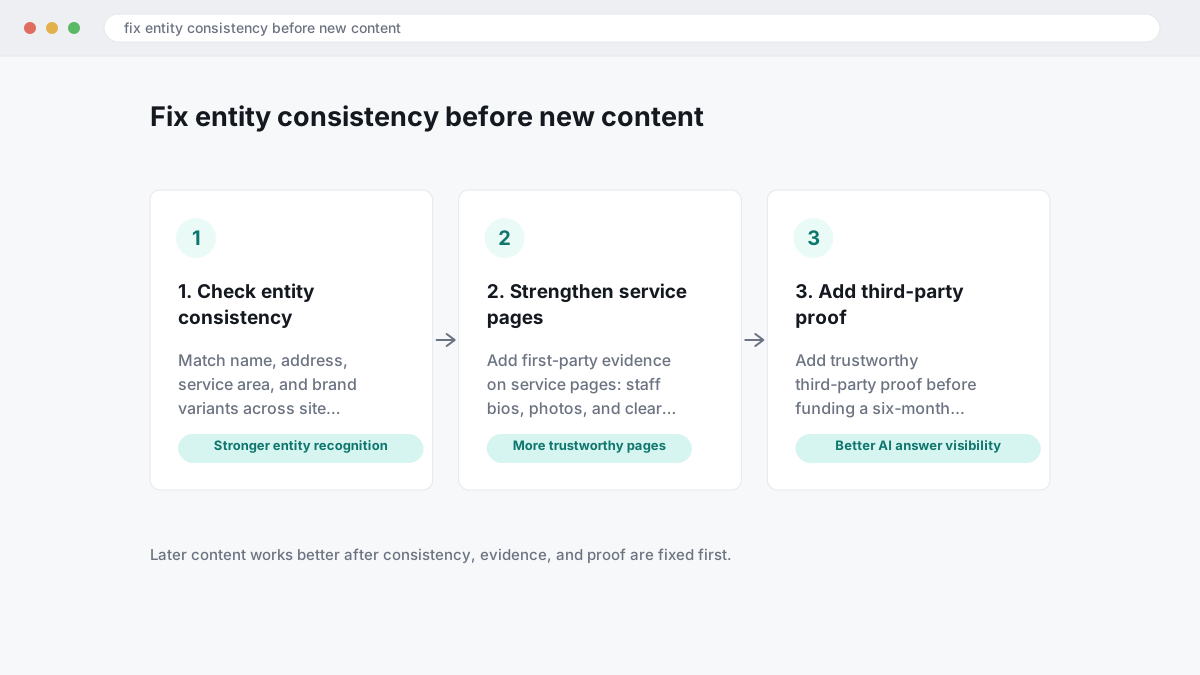
Most teams spend limited budget on fresh top-of-funnel articles. That usually fails because AI systems can read the copy but still hesitate to cite the brand behind it. A six-month content backlog does little if your footer says one location, your review profiles show another, and your service page makes claims with no first-party evidence such as staff bios, photos, pricing cues, case examples or policy pages.
Use a 30-day sprint instead. Week 1 fixes brand facts and location data across your site and third-party listings. Week 2 upgrades proof pages. Week 3 strengthens reviews and replies. Week 4 targets third-party validation through comparison pages, directory profiles and relevant media mentions. If you buy review support during that sprint, BGR Review's packages carry a 30-day free replacement guarantee, which matters because stale or disappearing proof weakens citation eligibility fast.
This is the order to follow when time is tight.
| Priority | Fix first | Why it moves AI visibility |
|---|---|---|
| 1 | Brand name, location, contact and service consistency | Clean entity recognition stops AI Overviews, Gemini and ChatGPT citations from splitting or skipping your brand. |
| 2 | Service pages with first-party evidence | Verifiable claims reduce hallucination risk and make comparison-style answers easier to source. |
| 3 | Reviews and platform profiles | Third-party validation gives the model safer trust signals than self-written copy alone. |
| 4 | Media and comparison mentions | External mentions help once the underlying facts are already clean. |
When does LLM optimization outperform classic SEO, and when does it overlap?
LLM optimization and classic SEO overlap on discoverability and trust, but they aim at different wins. SEO is built to earn clicks from rankings; LLM optimization raises the chance that ChatGPT, Gemini, Perplexity or AI Overviews selects your brand for mention, summary or citation.
The wrong budget split is to judge both channels by traffic-first SEO metrics alone. That fails because a page can rank, pull impressions and still miss AI answers if its structured data is thin, its brand facts conflict across review profiles, or its prompt patterns never match the way people ask comparison questions. The better approach is to treat citation eligibility as a separate outcome: can a model find a crawlable page, verify the same facts on third-party sources, and quote you without increasing hallucination risk.
The overlap is strongest on branded comparisons and local intent. In BGR Review's dataset of trades businesses with complete enquiry-source data, observed February to July 2026, 70-80% of calls and bookings were attributed to a Google Business Profile or Yelp listing rather than a website, which is why local pack visibility, review proof and accurate entity details often lift both search clicks and AI answer visibility together. If your budget is tight, fix the shared layer first: crawlable service pages, consistent NAP data, review-platform evidence and schema that states the same brand facts everywhere.
| Situation | SEO lead | LLM lead |
|---|---|---|
| Non-branded category terms | Ranking position and click-through rate matter most | Usually overlaps, but citations follow later |
| Branded comparisons | Helpful comparison pages support demand capture | Selection and citation likelihood usually matter more |
| Local service queries | Maps, local pack and profile completeness drive calls | AI answers often reuse the same trust signals |
How do reviews and local reputation signals help service businesses appear in AI answers?
For local service brands, AI visibility usually follows reputation visibility first. Fresh review signals, accurate Google Business Profile details, matching service-area data and credible third-party validation create the trust pattern that ChatGPT citations, Gemini answers and AI Overviews are more willing to surface.
The wrong approach is chasing a high star average on its own. A 4.9 score from last year with an incomplete Google Business Profile, patchy opening hours and service areas that do not match your site copy often loses to a lower average with current Google reviews, filled-out categories, recent photos and consistent town coverage, because answer systems are checking whether the entity looks current and corroborated, not whether the number looks impressive in isolation.
If you run a local service business, check the last 90 days first. Recent review recency can lift map pack click-through rate and conversions before position changes, especially when the review text repeats the same jobs, neighbourhoods and response patterns shown on your profile and website. In BGR Review's dataset of trades businesses with complete enquiry-source data, observed February to July 2026, 70-80% of calls and bookings were attributed to a Google Business Profile or Yelp listing rather than a website, which is why stale local reputation signals suppress visibility faster than weak blog content does.
The better setup is a complete local proof footprint: Google reviews on an active profile, a Trustpilot page that matches your trading name and service wording, plus niche directories that confirm location and category. That stack reduces hallucination risk, supports branded search demand, and gives AI systems more than one place to verify who you are before they cite you.
How do you build a source stack that makes your claims easy to trust?
A source stack earns citations when your page makes the claim, reviews support the lived experience, and independent mentions confirm the brand exists beyond its own marketing. AI systems give more weight to claims that show first-party evidence beside third-party validation, because that mix reduces hallucination risk and strengthens E-E-A-T signals.
The weak approach is a site that says “trusted”, “top-rated” or “transparent pricing” with no proof beyond its own copy. That fails because ChatGPT citations, Gemini and AI Overviews can read the sentence, but they cannot verify it against anything else. If you say you offer review removal, show the exact commercial detail on-page, such as BGR Review’s $0 upfront model and $449 per removed review link, then back it with reachable contact details like team@bgrreview.com and published phone lines for the US and UK.
The stronger approach pairs every claim with one internal proof and one outside echo. A practical stack has three layers: your site page with the exact offer, review platforms confirming delivery and service quality, and independent brand mentions that repeat core facts without copying your wording. If your page mentions a 30-day free replacement guarantee on review packages, the supporting layer should include review text that references replacements or responsiveness, plus external profiles that repeat your business identity consistently across New York, London and Thornhill. That is how unverified site copy turns into citation-eligible evidence.
How do you keep LLM optimization safe, accurate and compliant as visibility grows?
Safe LLM optimisation depends on accurate claims, disclosed endorsements and the same core facts appearing everywhere your brand is referenced. Rules vary by country and platform, and this is general information rather than legal advice.
The wrong approach is citation bait: invented customer quotes, fabricated case results, spun review signals and claims that only exist on your site. That fails twice. It can breach the FTC’s Endorsement Guides in the US when a material connection is not disclosed, and it gives ChatGPT, Gemini and AI Overviews more contradictory text to reconcile, which raises hallucination risk and weakens brand control.
The safer approach is evidence-led. Keep service claims, pricing and proof aligned across your pages, your Google Business Profile, Trustpilot, Clutch and other third-party validation sources, then remove or rewrite anything you cannot support. Specific, consistent facts travel further than inflated copy.
Conflicts are what usually break trust. If your homepage says “industry leader”, your profile says “boutique agency”, and your review platforms describe a narrower service, the model has no stable entity to cite. Clean entity data, disclosed endorsements and matching proof keep AI answers accurate as your visibility grows.
What should your team check every month to grow AI citations steadily?
A workable monthly routine tracks 10 priority prompts, the sources each AI system cites, your brand facts across profiles, the age of your latest reviews and any proof pages that need updating. Progress is faster when one person owns fixes, one person approves factual changes, and both report into one dashboard before anything goes live.
The wrong approach is a one-off audit. It fails because ChatGPT citations, Gemini results and AI Overviews shift as pages age, reviews slow down, and entity recognition breaks when your site, Google Business Profile, Trustpilot, Yelp or Clutch profiles stop matching. Check the same 10 prompts every 30 days, log the cited sources by platform, then compare them against your own pages, your NAP details and your structured data so you can see which source won and why.
Keep the monthly handoff tight.
- One owner fixes NAP conflicts, stale schema, missing service pages and weak review recency.
- One approver verifies address, phone, opening hours, offer claims and review-platform consistency before publish.
- One dashboard records prompt, platform, cited URL, brand mention, local reputation signals and action status.
This works because citation maintenance is cumulative. Fresh proof pages, recent third-party reviews and clean local listings make your brand easier to resolve as one entity, and if review velocity drops, BGR Review's review packages include a 30-day free replacement guarantee to help you keep recency from slipping.
Where to go from here
Run a source-gap audit on one claim first: your business name, service category, location, pricing model, or a proof point you want ChatGPT citations, Gemini, Perplexity and AI Overviews to repeat accurately. Put your site copy beside your Google Business Profile, Trustpilot, Yelp, Clutch or TripAdvisor profile, then add the third-party listings that rank for your brand name. You are looking for conflicts, weak evidence, old wording and missing corroboration. Fix those before you publish another “optimised” page. That usually reduces hallucination risk, improves citation eligibility and lifts click-through rate from branded search and the map pack because the same facts appear everywhere a model is likely to retrieve.
Expect the first win to be cleaner brand mentions, not instant inclusion in every AI answer. The pages most likely to get cited are the ones with first-party evidence on-site and matching third-party validation off-site. If you want help, BGR Review handles this as a practical audit: check the fact pattern, compare review-platform evidence, then prioritise the pages and profiles to repair.