

Quick answer
For landscaping businesses, reviews on your Google Business Profile usually move the needle first because they affect map-pack click-through, estimate requests and trust before a prospect visits your site or calls. The workable system is straightforward: send one direct review link within hours of visible job completion, ask every happy customer, reply to every review, and keep request timing consistent so review velocity stays natural. Google Business Profile rules prohibit review gating, so you should not screen customers before asking. If a review is false or breaks policy, BGR Review handles removals on a pay-after-success basis at $449 per removed review link with $0 upfront.
This page is built from the workflows we use in live reputation work, not from generic local SEO advice. The handoff that works best is simple: the crew marks the job complete, the office sends the review link the same day, then a second follow-up goes out only after the invoice or before-and-after photo confirmation lands.
That level of detail matters because most posts about landscaping talk about websites and gallery images, then stop before the parts that change calls and booked estimates. BGR Review has handled review operations across Google, Trustpilot, Yelp, Clutch and TripAdvisor for 15,000+ businesses, including false-review removals where the first flag failed because the owner used only the in-platform report button with no evidence attached.
Why do landscaping reviews change calls and estimate requests before rankings visibly move?
Landscaping reviews usually change click-through, calls and estimate trust before you see any obvious movement in the local pack. On a Google Business Profile, review freshness, believable review text and visible owner responses tend to improve lead quality faster than position changes do.
Most guides push volume. That fails because more reviews alone do not explain why a homeowner should call you for a £6,000 patio or a seasonal maintenance contract. What moves first is the search result itself: a stronger star rating distribution, two or three recent comments that mention punctuality or clean-up, and before-and-after photos that make the work feel real before the click.
The right approach is to treat reviews as conversion assets inside the profile, not as a vanity count. A mixed but healthy-looking rating spread often earns more trust than a suspicious wall of identical five-star posts, and recent photo-backed reviews usually filter weaker enquiries before they become time-wasting quote requests. That is why booked estimates often improve before map rankings visibly do.
In BGR Review's dataset of 1,485 businesses observed from February to July 2026, trades businesses with complete enquiry-source data attributed 70-80% of calls and bookings to a Google Business Profile or Yelp listing rather than a website. For a landscaper, that means you should track calls, form fills and booked quotes for 8-12 weeks after review work starts, because conversions and branded search demand can move while map-pack position still looks flat.
Where should a landscaper ask for reviews inside the quote-to-job workflow?
The best time to ask is when the homeowner has just seen the finished work, then again with the invoice or completion message. Landscaping is visual, so review request timing works best at the satisfaction peak during the final walkthrough, with a second prompt 24-72 hours later if no review has landed.
The weak version of the quote-to-job workflow is familiar: the crew leaves, the office gets busy, and somebody remembers to ask a week later. That fails because job completion timing has already drifted past the moment when the customer is looking at the fresh turf, clean edging or before-and-after photos and feeling sure they hired the right company. Click-through rate from the map pack usually improves before rankings visibly move, but only if you collect reviews while the job is still fresh enough to earn specific praise.
The stronger setup gives one person ownership after completion. The crew marks the job done in your CRM, adds one note that the walkthrough happened, and the status change to completed triggers an SMS with a direct review link within hours; if there is no response, the office sends the same link again with the invoice or photo confirmation, then one last follow-up 24-72 hours later. That handoff closes the gap that kills consistency on half-finished admin days.
At BGR Review, this is the handoff we build for local service companies because “ask the crew to remember” is not a system. If you want map-pack visibility and more booked estimates from branded search and profile views, tie the ask to the status change, not to memory, and keep the review link ready before the first job closes.
How should crews ask without sounding pushy or forgetting half the jobs?
Ask briefly on site, make sure the homeowner is happy, then let an automated text carry the link. That keeps the moment human at job completion and keeps the actual request consistent after the crew leaves.
The weak version is crew improvisation: one foreman asks for “a quick review”, another forgets, a third sends the homepage, and half the jobs never enter the quote-to-job workflow at all. That fails because the client has to search for your Google Business Profile later, the ask lands before the final walkthrough, or nobody in the office knows which completed jobs still need a follow-up. Use one short review link, tied to the completed-job stage in your CRM or job sheet, and have the crew leader say one line before leaving: “If you’re happy with the result, our office will text the Google link this afternoon.”
A QR card works only after verbal permission and a positive walkthrough. Handing it over cold feels pushy and gets ignored. The better handoff is simple: crew marks the work done, office sends the review link within hours, then a second follow-up goes only after the invoice or before-and-after photo confirmation if no review came in. That is the same process BGR Review builds into review campaigns with delivery starting in 24-48 hours, because consistency beats memory every time.
Which review request template gets more responses from busy homeowners?
A landscaping review request gets the best response when it is short, tied to the job you just finished, and sends the homeowner straight to your Google review link. Mention the work, thank them, and ask for honest feedback with no incentive, no pressure, and no vague “leave us a review” line.
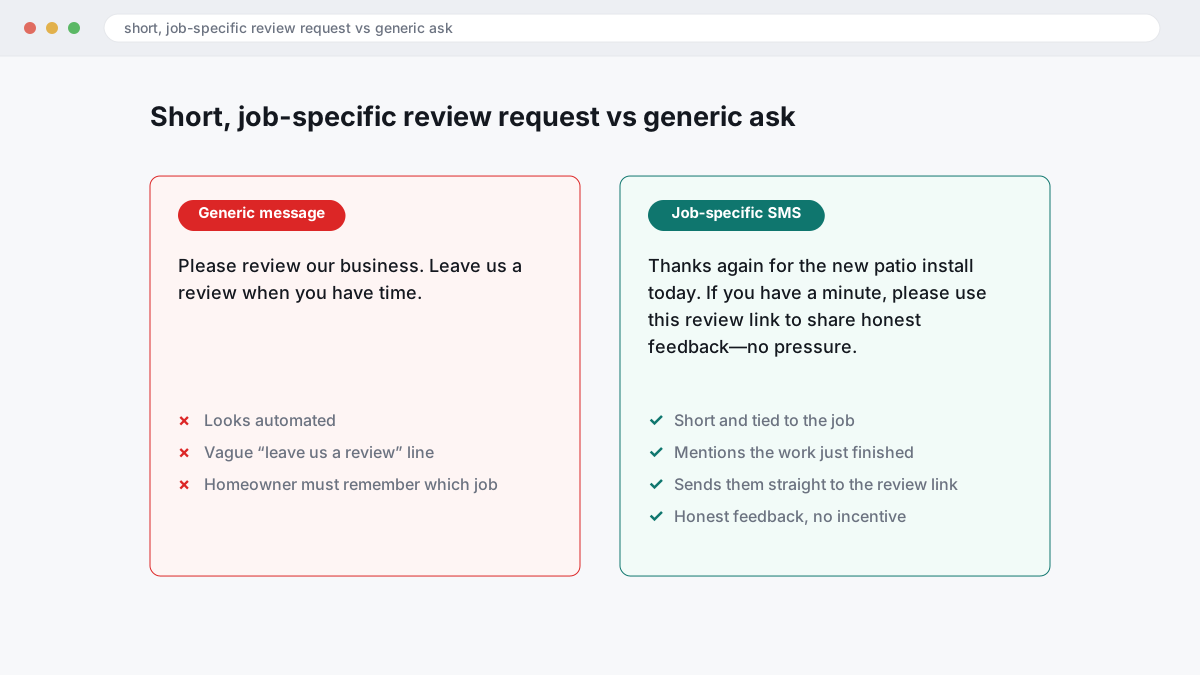
Generic messages fail because they look automated and force the homeowner to remember which job you mean. A text that says “Please review our business” gets ignored; a job-specific ask works because it reconnects the request to the new patio, turf install, or hedge cut they can see from the kitchen window, and SMS usually wins speed because homeowners read texts within minutes. Keep the copy under 320 characters so it stays easy to scan on mobile, and add a familiar location cue such as “near Oak Park” if you cover a wide service-area business.
Use these as sent, then swap in the job details and your review link. If you use before-and-after photos in your workflow, mention them only when the customer has already seen or approved them.
- SMS: Hi [Name], thanks for choosing [Company]. We’ve finished the front garden tidy and edging at your home near [Landmark]. If you’re happy with the result, could you leave an honest Google review here: [review link]
- SMS: Hi [Name], your new patio install on [Street/area] is now complete. We’ve also sent the before-and-after photos. If you have 60 seconds, please share honest feedback on Google: [review link]
- Email: Subject: Quick favour about your recent landscaping job
Hi [Name], thanks again for trusting us with the [job type] near [Landmark]. If the finished work looks right to you, please leave an honest Google review here: [review link]. If anything needs fixing, reply to this email first.
If you want this built into a managed process, BGR Review sets up review-link delivery and follow-up campaigns starting in 24-48 hours, with a 30-day free replacement guarantee on review packages.
How many reviews does a landscaper need before review work outranks other marketing tasks?
A landscaper needs enough reviews to beat the nearby map-pack baseline, not some national target copied from a franchise blog. On a Google Business Profile, fresh reviews and a believable 4.7+ average usually change click-through rate and estimate requests before the ranking shift is obvious.
The wrong approach is chasing a round number like 100 reviews because a national guide said that is “strong”. It fails because homeowners compare the top three local profiles, not the whole country, and they read count, recency and star rating distribution together. A 4.8 profile with 35 reviews from the last few months can win more map-pack clicks than a triple-digit profile whose latest review is old and whose visible spread includes too many 1-star and 2-star complaints with no owner responses.
Check the top three landscaping rivals in your service area before you move budget away from leaflets, paid ads or website work. Use this simple threshold inside Google Business Profile and review it harder in spring, when seasonal demand compresses decision time and people request multiple bids in a day or two.
| What to compare | What usually makes review work the priority | What delays it |
|---|---|---|
| Review count | You are clearly behind all top 3 rivals | You are already in the same band as them |
| Recency | Your rivals have recent reviews and yours are stale | No one in the pack has fresh activity |
| Rating mix | You hold 4.7 to 4.9 with a natural spread and active replies | Your average is unstable because too few reviews are in yet |
In BGR Review’s dataset of 1,485 businesses observed from February to July 2026, new trades and local service firms typically reached their first reviews around two weeks after launch, and reaching 20–30 reviews over the first three months was associated with stronger local visibility while other ranking factors were still in play. For a landscaper, that makes review work a higher-ROI task once your profile looks thin beside the local pack, especially before spring peak demand lifts calls, form fills and booked estimates for the profiles that already look trusted.
How fast can a landscaping company grow reviews without looking manipulated?
Review growth is safe when it tracks real job volume, seasonal demand and ordinary customer flow. For a landscaping company, a spring lift looks credible; a sudden burst with no visible request process, no invoice trail and reviews scattered across mixed locations looks far riskier.
The wrong approach is pushing dozens of reviews in a few days because the weather breaks and you want the map pack to move fast. That fails when your review velocity jumps far beyond the pace of completed jobs, especially for a service-area business where Google already has fewer walk-in signals to compare. Bought-review patterns also tend to clump by timing, wording and reviewer history. A burst after months of zero asking usually filters less, because there is a real workflow change behind it, but only if the requests match actual completed work and go out from the right location profile.
The right approach is simple: track weekly review velocity by branch or service area, not just one company-wide total, and let spring growth mirror crews, invoices and completed jobs. In BGR Review's dataset of 1,485 businesses observed February-July 2026, new trades and local service businesses typically saw first reviews around two weeks after launch, and reaching 20-30 reviews over the first three months was associated with improved local visibility while other ranking factors were active too. That kind of steady rise usually lifts click-through rate and estimate requests before rankings visibly shift. If one depot suddenly posts 18 reviews while the others stay flat, check the request process before Google does.
What gets landscapers into trouble when asking for reviews on Google?
Landscapers get into trouble when they filter out unhappy customers, offer something in return for a review, or fail to disclose a compensated endorsement. Google Business Profile rules bar review gating, and the FTC endorsement guides require clear disclosure when a review follows any discount, gift card, raffle entry or other benefit.
The wrong approach is common: your office asks the crew which jobs “went well”, sends the review link only to those homeowners, and parks complaints in a private feedback form. That is review gating. It fails because Google wants honest broad solicitation across your completed jobs, not a cleaned-up sample, and a profile built that way can lose trust with readers even before your map pack visibility or click-through rate moves.
The safer approach is simple. Send the same Google review request to every completed job after the same milestone in your workflow, whether the customer loved the patio install or raised a snag on the turf edges, and handle complaints through owner responses and service recovery rather than by excluding those customers from outreach. If you use a review service, check the method: BGR Review sells managed review help with a 30-day free replacement guarantee on review packages, but the request flow still has to avoid selective targeting and hidden incentives.
Rules vary by country and platform, and this is general information rather than legal advice. On Google Business Profile, do not trade reviews for money-off, free mulch top-ups or prize draws; in the US, the FTC endorsement guides require disclosure when something of value changed hands, because that affects trust, conversions and the quality of leads coming from your profile.
What should you do after a bad landscaping review to protect trust and future leads?
Answer a bad landscaping review quickly, stick to what you can verify, and give the reviewer a direct offline route to sort it out. A calm owner response within 24-72 hours protects calls and estimate requests even if your Google Business Profile rating does not move.
The wrong move is a public argument: blaming the homeowner, listing every dispute point, or accusing the reviewer of lying before you have checked the job file, crew notes and photos. That reply stays on the profile longer than the complaint itself, hurts map-pack click-through, and makes your star rating distribution look worse because prospects read the newest 1- to 3-star reviews first and judge how you handle friction.
The better move is short and specific: acknowledge the experience, avoid admitting facts you have not verified, and move the detail offline. On Google Business Profile, owner responses matter most on recent low-star reviews because they shape conversions before rankings visibly change; a simple line such as “We’re sorry this was your experience. Please email the property address and job date to our office so we can review this properly” does the job.
Keep the public reply factual, then resolve by phone or email, document the outcome, and return to post a neutral follow-up if the issue is fixed. If the review later appears false or policy-breaking, save screenshots before anything changes, because evidence quality decides whether a later removal attempt has any chance; BGR Review handles removals on a pay-after-success basis at $449 per removed link with $0 upfront.
When is a negative review removable instead of just answerable?
A negative review is removable when it appears to breach platform rules or makes verifiably false claims, not because it is blunt or annoying. The strongest fake review removal reports on Google Business Profile pair a clear policy ground with proof that no matching customer record exists.
The wrong approach is reporting every one-star review you dislike and writing “this is unfair” in the form. That usually fails. Google Business Profile removes reviews for policy reasons such as spam, impersonation, conflict of interest or content that misrepresents a real experience; a homeowner who genuinely hired you can still leave harsh feedback, and that review is usually answerable rather than removable. In BGR Review’s case file of 12,000+ negative review cases logged June 2025 to June 2026, roughly 90% of businesses that came to us after a failed attempt had used only the basic in-platform report button with no supporting documentation, and 70–80% of those initial requests had been rejected.
The right approach is building an evidence pack before you file anything. Pull CRM logs, call records, crew schedules, invoices, property address history, and before-and-after photos that show who was actually booked on that date. If the reviewer names a service, date or price that never existed in your system, that gap matters; if the account appears to be a competitor, ex-staffer or impersonator, state that conflict plainly and attach the record trail. A clean evidence pack gives the platform something concrete to check.
False factual claims sit in a different bucket from ordinary complaints. “They left mud by the gate” is usually a service dispute; “they damaged my wall on 14 June” when you never attended that property may raise defamation issues as well as platform-policy issues. Laws vary by country and platform, including US FTC endorsement rules, UK consumer-protection rules and local defamation standards, so treat this as general information rather than legal advice.
How does DIY compare with managed review help for a landscaping business?
DIY review management fits one disciplined landscaping location with a clean quote-to-job workflow. Managed help makes more sense once multiple crews, several service-area profiles, or fake review removal issues start creating consistency and compliance risk; the trade-off is control versus time and exposure.
The wrong approach is buying software, sending one request after every invoice, and assuming the job is done. It fails because somebody still has to check missed jobs each week, enforce crew handoff, post owner responses on new reviews, and catch anything that crosses Google Business Profile policy or the FTC endorsement guides if incentives or selective asks creep into the process.
This comparison is usually enough to choose the right setup.
| Option | Setup time | Monthly cost shape | Escalation support |
|---|---|---|---|
| DIY with software | Fast if your office already closes jobs cleanly | Lower monthly software spend, plus staff time every week | Usually none beyond templates and dashboard reporting |
| In-house manual | Slowest, because the office builds links, reminders and reporting | Low cash cost, high admin cost | Owner handles complaints and policy decisions alone |
| Managed help | Faster once workflows and review links are mapped to crews and office staff | Higher service cost, less internal enforcement work | Fixed price per removed link |
The right approach is simpler: keep DIY if one office can follow up every week without fail. Move to managed support when review velocity varies by crew, locations need consistent owner responses, or one false complaint can derail estimate requests and map-pack clicks while you wait for an escalation path.
How should multi-location landscaping brands keep each service area profile competitive?
Multi-location landscapers need separate review operations for each profile, city and crew, even under one brand name. Sending every customer to one Google Business Profile weakens local relevance for a service-area business and hides which territories are losing review velocity, calls and estimate requests.
The wrong setup is a brand-wide review stream: every branch shares one master link, head office replies when it gets time, and the strongest city carries the weaker ones on paper. That fails because Google Business Profile performance is profile-level, not brand-level, so one busy branch can make the whole company look healthy while another profile goes stale, slips on recency and loses map-pack click-through in its own service area. A homeowner in Croydon reading praise for jobs in Bromley has less reason to call.
The fix is simple and stricter. Give each location its own review link, its own response owner, and its own tracking for review count, recency and response time. Route requests from the completed-job record, not from a central marketing blast, so the right crew feeds the right profile and before-and-after photos match the city being reviewed.
If you manage this in-house, make one person accountable for each profile and review replies the same business day where possible. If you outsource, keep the reporting at location level anyway; at BGR Review, that is how we stop one branch masking another before any review package starts, and our review packages carry a 30-day free replacement guarantee rather than a vague brand-wide promise.
Where to go from here
Build the review habit into your quote-to-job workflow this week. Have the crew mark the job complete, let the office send your Google Business Profile review link within hours, then send one follow-up only after the invoice or before-and-after photos go out. That timing usually gives you better review velocity, cleaner star rating distribution and more useful comments for the map pack than a vague monthly reminder.
Keep the reply process just as tight. Thank genuine reviewers by name, mention the service delivered, and move complaints into one owner-response workflow so every public reply is calm, short and consistent. That helps click-through rate from local listings because prospects read replies before they call.
If a false review is dragging down trust or booked estimates, get the link checked quickly. In our removal work, the strongest outcomes usually come from early reports with evidence attached, while bare in-platform flags often stall.