
Quick answer
To improve your google maps ranking in 2026, fix the signals Google uses for local visibility: relevance, distance and prominence. Start by tightening your Google Business Profile with the right primary category, accurate services, complete NAP details and matching business attributes, then support it with recent verified Google reviews, consistent replies, fresh photos and regular business updates. After that, clean up trust signals by removing policy-violating reviews under Google’s prohibited and restricted content rules. If a review clearly qualifies, BGR Review handles removals on a pay-after-success basis at $449 per removed review link with $0 upfront.
This page is written for operators who need actions in the right order, because generic guides usually dump ranking factors without saying what to fix first. We work daily on review acquisition, dispute handling and Google review removals, and the difference between a rejected flag and a successful escalation often comes down to one thing: whether you matched the review to a named Google policy breach and attached evidence before the support thread stalls.
That matters because rankings, click-through rate and calls can dip while a bad review sits live. BGR Review has served 15,000+ businesses, and our removal model stays simple: $0 upfront, $449 only after success, with review packages covered by a 30-day free replacement guarantee.
Why are some businesses still invisible on Google Maps after basic setup?
Businesses stay buried in Google Maps when the profile’s core relevance signals are weak: unresolved Google Business Profile verification, incomplete fields, the wrong categories, or duplicate listings. Those faults usually block local pack and map pack visibility before citations, links, or posting frequency have much chance to help.
A claimed profile is often mistaken for a competitive profile. That fails because Google can index a listing that still sends mixed signals: a broad primary category instead of the real service, missing business attributes such as wheelchair access or women-led, thin service details, or a verification issue that limits trust in edits. The right approach is to check whether the listing is fully verified, choose the best primary category first and only then add secondary categories, and complete the fields that affect matching and click-through. In BGR Review audits before any managed review work, this is the first pass because fixing relevance usually moves faster than buying more visibility elsewhere.
Duplicate listings cause a different problem. One profile picks up reviews, another gets user edits, and the ranking signals split, so neither version earns stable map pack exposure even when your distance to the searcher is favourable. Google Business Profile Help treats duplicates and merged profiles as separate support issues, and if you leave both live, your calls, bookings, and branded search demand can bleed across the wrong CID.
Which fixes raise Google Maps rankings first when time is tight?
The fastest order is relevance first, review quality second, review removal third, then citation and website support. Generic factor lists treat local ranking factors as equal, but rankings usually move faster when you fix category fit and service relevance before you spend weeks chasing slower trust signals.
This is the operating order that usually gives you the quickest return.
| Priority | Fix | Why it moves first |
|---|---|---|
| 1 | Correct primary category, tighten services, remove irrelevant profile noise | Google can only rank you for searches your profile clearly matches. Wrong relevance blocks map pack visibility before review count matters. |
| 2 | Improve review quality and recency | Better review text, recent sentiment and steady review velocity lift click-through rate and conversions once the profile already matches the query. |
| 3 | Challenge policy-violating reviews inside 30 days | In BGR Review’s log of 12,000+ negative review cases from June 2025 to June 2026, reviews raised within 28 days and backed by a clear policy issue resolved successfully in roughly 90% of cases; beyond 28 days, observed success fell to approximately 25–30%. |
| 4 | Clean citations and build website local landing pages | These support trust and branded search demand, but they rarely rescue a poorly matched profile on their own. |
The wrong approach is adding photos, posts, citations and city pages while your Google Business Profile still says the wrong thing about what you do. That fails because Google reads weak relevance first, so extra activity can improve clicks without fixing position.
The right approach is blunt: make the profile eligible, then make it trustworthy, then support it.
How do you rank higher on Google Maps without guessing what Google values?
Rank higher in Google Maps by benchmarking the three strongest nearby profiles, fixing Google Business Profile relevance first, then building review quality and support pages around that baseline. Track changes weekly for 8 to 12 weeks because movement in the local pack and map pack usually trails your edits.
Random tweaks fail because they mix causes. If you change categories, add photos, rewrite services, ask for reviews and publish new location pages in the same week, you will not know which local ranking factors moved visibility, click-through rate or calls. Start with the top three competitors that already show for your money terms in the same area, then compare four things only: primary category, secondary categories, recent review pace and whether each profile points to a strong local landing page.
A simple benchmark grid keeps the work honest.
| Check | What to record | What to fix on your profile |
|---|---|---|
| Categories | One primary, relevant secondary set | Match real services only |
| Review pace | New reviews over the last 8-12 weeks | Set a steady request process |
| Landing page support | Service or location page quality | Link to the closest relevant page |
The right approach is narrower. Pick one primary category that describes the core service you actually sell, add only secondary categories tied to live services, then measure calls, direction requests and rank changes every week. In BGR Review's dataset of 1,485 businesses observed from February to July 2026, new trades and local service businesses that reached 20 to 30 reviews over the first three months were associated with stronger local visibility, though other factors were active at the same time. That is why measured review velocity works better than bursts: it supports conversions and branded search without muddying the test.
How should you choose categories so Google matches you to the right searches?
Categories in Google Business Profile are one of the clearest relevance signals Google uses to decide which searches can trigger your listing. Your primary category should match the service that drives the most revenue, and your secondary categories should cover real services that also appear on your website and profile.
The wrong move is broad category stuffing. A locksmith who sets the primary category to “Contractor” or adds every nearby fit like “Handyman”, “Security Service” and “Home Improvement” gives Google a muddy relevance picture, and that usually weakens map pack visibility for the terms that actually convert into calls and bookings. The right move is tighter: set the primary category to the core money service, then add secondary categories only where the service has a visible landing page, service section, or supporting proof in the Google Business Profile itself.
You can usually find profitable gaps in 15 minutes with a manual review. Check the top local pack competitors for your target query, note their primary and secondary categories, then compare that list against your own service pages and booking intent. If three ranking profiles use “Emergency Plumber” as primary and you use “Plumber”, that is worth testing first; if you do not actually offer emergency callouts on-site, leave it alone. At BGR Review, that category-to-service check is one of the first filters we use before pushing review growth, because better relevance lifts click-through rate faster than extra profile activity on a mismatched setup.
Which Google Business Profile fields still change visibility and clicks in 2026?
A Google Business Profile still changes both visibility and click-through rate in 2026 when its services, hours, business attributes and verification status help Google match the search, and when the profile gives a searcher enough detail to choose you over the listing beside it.
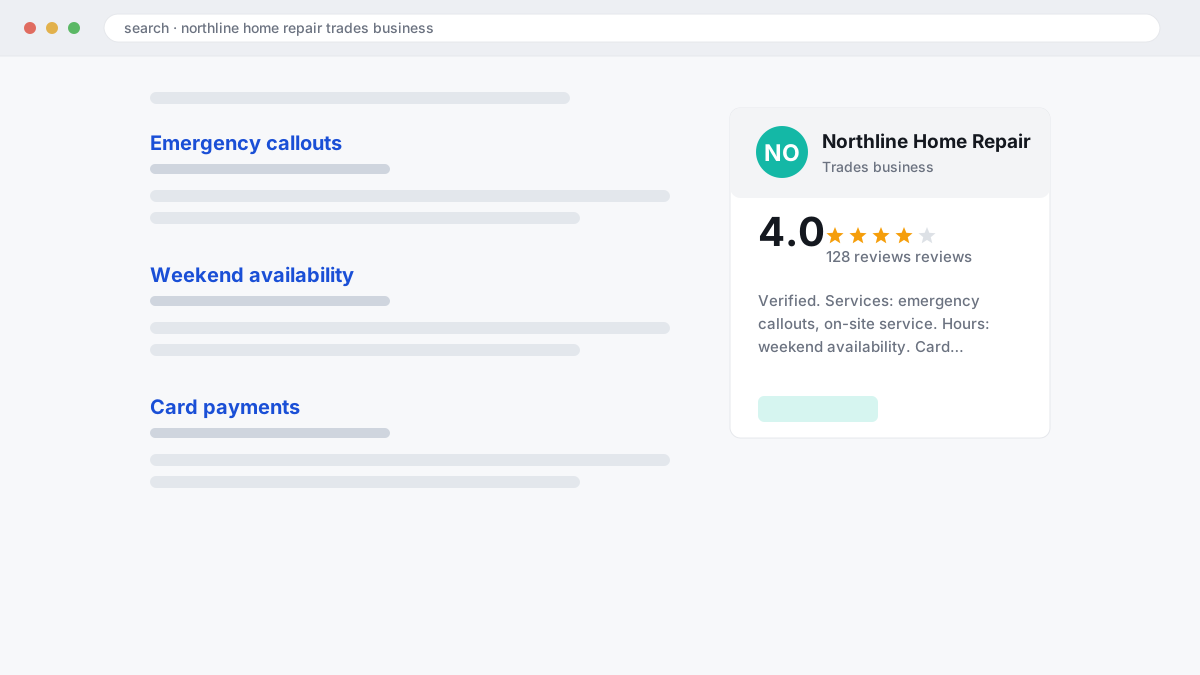
Most guides stop at “fill everything in”. That leaves you complete enough to appear, but not conversion-ready in the local pack. A profile with basic setup and no service detail can still surface for a broad query, then lose the click because the listing hides whether you offer emergency callouts, wheelchair access, on-site service, card payments or weekend availability. Among trades businesses with complete enquiry-source data in BGR Review’s dataset of 1,485 businesses observed February to July 2026, 70–80% of calls and bookings were attributed to a Google Business Profile or Yelp listing rather than a website, which is why missing fields cost real enquiries, not just neatness points.
The right approach is to treat the Google Business Profile as a sales asset: publish actual services, keep opening hours and holiday hours current, complete business attributes that affect decision-making, and verify the profile so edits stick and trust signals are visible. Photos and business updates help most where competitor profiles are sparse; a fresh job photo, menu image or team shot gives the eye somewhere to land, and recent updates can lift engagement even when position stays flat. If your profile appears but clicks lag, missing accessibility and service details are often the first thing to fix.
How much do reviews help Google Maps, and when do they start hurting instead?
Reviews help your Google Maps visibility when they arrive recently, read like real customer experiences, and build at a believable pace. They start hurting when the pattern looks manufactured, incentivised, or conflict-driven, because low-trust signals depress clicks, calls and booking intent before any ranking recovery work even starts.
Most guides push volume. What actually moves the local pack is a better review profile: fresh text reviews, steady review velocity, and language that matches the service the searcher wants. Within the same category, with similar distance and profile completeness, a 4.3 listing with credible reviews from the last few weeks can beat a stale 4.8 profile whose last detailed feedback landed months ago, because the newer profile earns stronger click-through rate and converts the visit more cleanly.
Believable pace matters. In BGR Review’s own dataset of 1,485 businesses observed from February to July 2026, new trades and local service firms typically saw first reviews around two weeks after launch, and reaching 20–30 reviews over the first three months was associated with improved local visibility while other ranking factors were active at the same time. That is very different from a one-week burst of thin five-star posts with no service detail, which often gets filtered or leaves you with a profile that looks less trustworthy than its rating suggests.
Risk starts climbing when reviews trigger Google Business Profile review-policy issues or obvious customer-conflict signals. Policy-violating reviews, reviewer-account clusters, duplicate wording, and retaliation after a refund dispute can weaken trust, stall map-pack momentum, and force support work that you could have avoided with a cleaner request process.
When should you try to remove a Google review instead of simply replying to it?
Try to remove a review when it looks fake, off-topic, retaliatory or otherwise breaches Google's review rules. A reply can protect calls, bookings and form fills, but removal is the better route when the post is deceptive, unverifiable or tied to someone who was never a customer.
Most businesses treat every bad review as removable. That fails because Google does not remove criticism just because it hurts conversions or slows review velocity. A harsh but genuine complaint usually needs a calm public reply. A removable review is different: it falls under Google's prohibited and restricted content rules, such as spam, off-topic content, conflicts of interest, impersonation or a reviewer with no real transaction behind the claim. Google acts faster when the report names the policy issue directly instead of saying the review is "unfair".
Strong evidence decides the case. The useful pack usually includes order records showing no match to the reviewer name, staff rotas proving the named employee was not working that day, call logs, CCTV timestamps where lawful, and screenshots of a competitor link, ex-employee dispute or threat made outside the profile. The weak route is the in-profile flag alone. In BGR Review's dataset of negative review cases with prior self-filed attempts, logged June 2025 to June 2026, roughly 90% had used only the basic report button, and 70-80% of those initial requests had been rejected.
Escalation rarely finishes the same week. A clean policy match may move in days; support threads, follow-up evidence requests and manual review can stretch into several weeks. Across 12,000+ negative review cases logged by BGR Review from June 2025 to June 2026, reviews raised within 28 days and backed by an identifiable policy issue resolved successfully in roughly 90% of cases, while comparable cases raised later fell to approximately 25-30%. While that runs, reply briefly, keep requesting legitimate fresh feedback, and avoid letting one policy-violating review choke click-through rate in the map pack.
Why do citations and NAP still matter after Google knows your business exists?
Google can recognise that your business exists and still hesitate to rank the right profile if your name, address or phone appears in conflicting forms across your website, Google Business Profile and core local citations, because those mismatches muddy entity trust and duplicate resolution.
Most guides push citation quantity. That fails on messy profiles. Fifty directory listings with an old suite number, a tracking phone on one branch page, or “Ltd” added in some places and dropped in others gives Google more conflict to reconcile, not more confidence. The right approach is exact NAP consistency at the location level: the same trading name, the same address format, the same primary phone in your website footer, key directories and GBP details. That works because Google can cluster those references to one entity instead of splitting signals across near-duplicates.
If you are paying for reputation work, fix this first.
How do local landing pages support Maps rankings without turning into thin city-page spam?
Evidence-backed website local landing pages help Maps rankings by confirming the exact service-and-place combination on your Google Business Profile, while thin city pages with swapped place names usually fail because they add no local proof, weak NAP consistency and poor reasons to click.
The wrong approach is the old template stack: one page per town, the same copy on each, no named services, no staff, no jobs completed there, and contact details that do not match the profile. Google can read that as low-value duplication, and it does little for local pack click-through rate or conversions because the page gives the searcher nothing to verify. A usable location page needs the service mix you actually sell in that area, matching name, address and phone details, local photos or project examples, and a clear route to calls or form fills.
Internal links do the heavy lifting. Link your core service pages to the relevant location pages, and link back with anchor text that joins the geography to the service naturally, because that strengthens the relevance pairing Google Maps depends on. In BGR Review's dataset of trades businesses with complete enquiry-source data, observed from February to July 2026, 70–80% of calls and bookings came through a Google Business Profile or Yelp listing rather than a website, which is exactly why the site should support map visibility with proof instead of trying to replace it.
How should multi-location brands improve Maps rankings without competing against themselves?
Multi-location brands rank better when each branch proves its own local relevance inside Google Business Profile. Shared branding can stay, but primary and secondary categories, hours, reviews, photos, citation data and website local landing pages need to match the actual site, or nearby branches start cannibalising each other in the map pack.
Most head offices make the same mistake: one central template, one category set, one block of copy, one review request flow. That fails because Google reads each listing at location level. If two branches offer different services, serve different postcodes or keep different opening hours, cloned profiles weaken relevance, reduce click-through rate in the local pack and blur conversions between calls, bookings and form fills. In BGR Review's managed review work, the fix starts with branch-level review requests and location-specific landing-page support, not another round of generic citation submissions.
Location groups help multi-location management because they tighten permissions, bulk edits and governance, but they do not solve duplicate profiles. A duplicate still needs manual cleanup through Google Business Profile support, merged-profile checks and citation corrections. Brand control should live in guardrails: approved response templates, brand-safe photo rules and naming standards. Local relevance should live with each site manager, who can add real service photos, answer reviews for that branch and keep local landing pages aligned with what that team actually sells. If you outsource review growth across locations, BGR Review's packages include a 30-day free replacement guarantee, which matters when one branch lags and branded search demand shifts to a stronger neighbour.
What should you check first after a sudden Google Maps ranking drop?
After a Maps ranking drop, check suspensions, major Google Business Profile edits, lost reviews, category changes and duplicate-profile merges before you do any new optimisation. If visibility fell suddenly, recovery work usually beats fresh growth tactics until the cause is fixed.
Most guides tell you to post updates, add photos and chase more reviews straight away. That fails when the drop came from a hidden profile change, a soft suspension, or a duplicate merge that replaced your primary category and old CID data. Open your change history first, confirm your primary and secondary categories still match the service you want to rank for, check whether Google has marked the profile suspended or needs reverification, and search Maps for a second listing using the same name, phone or address.
If clicks from the local pack fell with the rankings, inspect the review profile on the same day. A spam burst or removed legitimate reviews can hit click-through rate before you recover position, and policy-violating reviews often sit beside category edits or ownership issues. In BGR Review's log of 12,000+ negative review cases from June 2025 to June 2026, cases raised within 28 days of posting and tied to an identifiable policy issue resolved successfully in roughly 90% of cases; comparable cases raised later fell to approximately 25–30%.
If reinstatement is involved, submit dated evidence, ownership proof and exact business details rather than a short complaint. Google Business Profile appeals move better when the business name, address, phone, signage, licence or utility record, and website details all match the live profile, because mismatched details stall ranking drops and reinstatement alike.
When is DIY enough, and when does a Google Maps SEO agency earn its cost?
DIY is enough when one location has a stable Google Business Profile, one person owns the weekly workflow, and the work is mostly checklist execution. Managed help earns its cost when ranking drops need diagnosis, policy-violating reviews keep sticking, or multi-location management turns simple updates into a governance problem.
The wrong approach is hiring an agency to do basic upkeep you can run in-house in 30-60 minutes a week: category checks, photo uploads, review request timing, reply coverage, and tracking calls, bookings and map-pack clicks. That fails because you end up paying a monthly fee for admin while the real blockers sit elsewhere. If profile ownership is clean, access is secure, and you are not dealing with reinstatement, a simple internal checklist usually moves faster than a six-month retainer.
Specialist intervention works when the issue is technical, policy-led or spread across locations. A suspended listing, a merged profile, a ranking drop after an edit, or a fake review that breaches Google Business Profile review policy needs evidence, escalation and outcome tracking, not another spreadsheet. In BGR Review's dataset of 12,000+ negative review cases logged June 2025 to June 2026, reviews raised within 28 days of posting and tied to an identifiable policy issue resolved successfully in roughly 90% of cases; beyond 28 days, the observed success rate fell to approximately 25-30%.
Compare these points before you sign any six-month agreement.
| Option | Monthly cost | Response time and deliverables |
|---|---|---|
| DIY, one location | Internal staff time | Weekly tracking, profile edits, review requests, replies, local landing page checks |
| Agency or specialist help | Ask for a clear monthly fee or fixed-scope work | Ranking-drop diagnosis, reinstatement support, multi-location governance, citation cleanup, removal workflow for policy-violating reviews |
| BGR Review removal work | Fixed price per removed link | Fixed price per removed link |
What actually happens when you report fake reviews or local spam to Google?
Google review disputes work best when you match each report to a named policy ground and attach evidence that proves it. The useful pack is simple: screenshots, posting dates, timestamps, order or booking records, account conflicts, and a clear trail showing you used Google’s first report route before escalating.
The weak approach is an angry complaint saying a review is “fake” or “unfair”. That usually fails because Google’s review systems and support teams act on policy matches, not frustration. If the issue is spam and fake reviews, conflict of interest, off-topic content or impersonation under Google’s Maps user-contributed content policies, say which rule is broken and show why your customer records do not match the reviewer’s claim, date or name.
Start inside your Google Business Profile tools and report the review or local spam there first. If Google rejects it, escalate with the evidence pack: screenshots of the live review, the profile URL, dates of posting and reporting, proof the person was never a customer or booked under a different name, and any linked spam pattern across nearby listings. Across 12,000+ negative review cases logged by BGR Review from June 2025 to June 2026, roughly 90% of businesses who came to us after a failed attempt had used only the basic in-platform report button, with no supporting documentation.
Unresolved disputes can keep dragging on your map pack performance even after profile edits, because review velocity, click-through rate and trust signals do not recover the moment you fix categories or photos. A bad edit can also trigger GBP suspensions and edits review, which slows the process further. Rules vary by country and platform — FTC endorsement rules in the US, UK consumer law and Google’s own policies are different — so treat this as general information, not legal advice.
Where to go from here
Start with a profile audit you can finish this week: check your primary category, trim weak secondary categories, rewrite the service description for the actual searches you want, and fix any NAP inconsistencies between your Google Business Profile, local citations and location page. Then look at review quality. Recent, specific reviews and sensible owner replies usually lift map-pack click-through before they lift position, and better clicks tend to turn into more calls, bookings and branded search over the following weeks.
If a fake, abusive or policy-violating review is sitting on the profile, assess that before you spend time on citations or new photos. The practical next step is simple: capture the review URL, screenshots, reviewer profile details, timing, and the exact Google Business Profile policy point you believe it breaches, then file the report and track the case. Expect an honest yes or no on whether the review matches a removable policy issue, because some bad reviews stay live even when they are unfair.