


Quick answer
Handle fake reviews in this order: save the evidence, post a calm public owner response, then file the report under the exact policy the review breaks. On Google, fabricated engagement usually sits under the Google review prohibited content policy for spam and fake content. If your first flag is rejected, rebuild the case with booking or order logs, staff rotas, screenshots, reviewer-account clues and a dated timeline before you appeal. If you want managed removal, BGR Review charges $449 per removed review link with $0 upfront, and speed matters most during review bombing.
This page is written from live removal work, where the first failed report is usually the point your case either sharpens or collapses. Across 12,000+ negative review cases logged by BGR Review from June 2025 to June 2026, outcomes were tracked as removal success, unresolved or unknown, and unconfirmed cases were never padded into a success rate.
The operational difference is simple: a weak flag says “this is false”, while a strong one maps the review to a named rule, attaches proof the reviewer was never a customer, and explains the timeline clearly enough for a moderation queue to follow. You are here because fake reviews affect trust, map-pack clicks, and calls fast, so this guide focuses on what to document, what to say in public, and when paid support is worth the cost.
How do you tell a fake negative review from a real complaint fast?
A likely fake negative review fails three checks at once: you cannot match it to a customer record, the reviewer account history looks off, and the timing lines up with a spike or campaign. Diagnose before you report it, because weak flags often fail in the moderation pipeline before a human reviewer looks at the account.
The wrong approach is to treat every harsh 1-star post as fake. That fails because a real customer can be angry, vague and unfair while still being genuine. Start with fast checks you control: reviewer profile age, how many reviews that account has left, whether those reviews jump between unrelated cities, and whether the reviewer's location fits your service area. Then check your side: no order record, no CRM log, no call note, no booking, and no staff rota match for the date mentioned all raise risk.
A same-day cluster matters more than tone. If three or five 1-star reviews land within hours, share similar wording, or come from accounts with thin histories, treat it as possible review bombing rather than separate complaints. In BGR Review's log of 12,000+ negative review cases recorded from June 2025 to June 2026, reviews raised within 28 days and tied to an identifiable policy issue resolved successfully in roughly 90% of cases; beyond 28 days, the observed success rate fell to approximately 25–30%. Fast diagnosis protects your star rating, map pack click-through rate and conversions while you decide whether to dispute or respond.
Why do so many fake-review reports fail even when the review looks obvious?
Most reports about fake reviews fail because the complaint is upset and plausible, not tied to a provable rule breach. A platform’s moderation pipeline looks for a policy-based claim, supporting records and a clear timeline; without that, your report can stall before any meaningful manual review.
Most guides say “if it looks fake, flag it”. That fails because Google does not remove a review for feeling unfair, hostile or suspicious. It checks whether the post appears to breach the Google review prohibited content policy such as spam, off-topic content, impersonation, conflicts of interest or content tied to a person who was never a real customer. “Clearly fake to us” is not the test. “Provable under platform policy” is.
The first pass is often thin. Across 12,000+ negative review cases logged by BGR Review from June 2025 to June 2026, roughly 90% of businesses that came to us after a failed attempt had used only the basic in-platform flag, with no supporting documentation, and 70–80% of those first requests had been rejected. That does not prove the review was genuine. It usually means the report gave the moderation system nothing verifiable to work with.
Missing dates, screenshots and account context are what sink the first decision. If you cannot show that no booking, invoice, call log, email thread or site visit matches the reviewer name, and you do not capture the reviewer profile, posting date and account history before edits happen, the case reads like a disagreement rather than a policy violation. That is why a weak first flag hurts map-pack click-through and conversions longer than it should: the review stays live while your evidence is still missing.
What should go into a fake-review evidence pack before you report anything?
A usable evidence pack starts with the live review URL, full screenshots, visible date stamps, and a same-day capture of your profile page. Build that file before you report anything, because edited text, deleted reviewer profiles, and missing timestamps leave you with a weaker appeal later.
The wrong approach is a folder of loose screenshots taken after the first flag fails. That usually collapses because the moderator cannot tie the review to a specific policy issue or a real-world contradiction. In BGR Review's case file of 12,000+ negative review cases logged June 2025 to June 2026, roughly 90% of businesses who came to us after a failed attempt had used only the basic in-platform report button with no supporting documentation, and 70–80% of those initial requests had been rejected. A rejection did not prove the review was genuine. It usually proved the file was thin.
The right approach is a dated, cross-checked evidence file. Save the review capture and the profile capture immediately, then match the claimed visit, purchase, booking or staff interaction against order records, CRM logs, call history, job sheets, and the staff rota for that date and time. If nobody with that name, phone number, email, or complaint detail exists in your records, note that clearly.
Add an incident log when the pattern points to review bombing. Record posting times, repeat wording, copied phrases across accounts, sudden star-rating impact, and any obvious competitor links such as shared business names, outbound links, or reviewer profiles that only target rivals in your niche. A moderator can dismiss suspicion. They have a harder time dismissing a dated evidence pack that shows the review does not map to a real transaction and sits inside a coordinated spike.
How do you report a fake Google review so it matches Google’s own rules?
Report a fake Google review by flagging it in Google Search or Google Maps, choosing the closest ground under Google’s review prohibited content policy, and then tracking the case through Google Business Profile support tools if escalation opens. “This is unfair” usually goes nowhere; “this appears to breach spam and fake content rules” gives moderation something they can assess.
Start on the live review itself. In Search, open your Business Profile, find the review, use the report option, and pick the nearest policy category. In Maps, open the review on your profile and do the same. Google’s policy language matters here: if the reviewer was never a customer, frame it around spam and fake content; if a former employee, competitor or agency partner posted it, conflict-based grounds may fit better under the same prohibited-content framework than a generic complaint about tone.
Most reports fail because the description says the review is false, damaging or unfair, which is your business view, not Google’s enforcement standard. The stronger route is to map the problem to a rule Google already enforces: no transaction record, no matching job, reviewer account history that looks non-local or recently created, copied wording across locations, or a clear competitor connection. In BGR Review’s log of 12,000+ negative review cases from June 2025 to June 2026, roughly 90% of businesses who came to us after a failed attempt had used only the basic in-platform report with no supporting documentation.
After you flag it, monitor the case in your Google Business Profile support path rather than filing the same report repeatedly. Google sometimes reviews simple reports within days, but complex disputes often take longer because they move through a moderation pipeline that can require a second look. Repeated duplicate flags rarely speed removal, and they do nothing for your map pack click-through or conversions while the review stays live.
Which platform gives you the best chance of removal: Google, Trustpilot, or Yelp?
Google, Trustpilot and Yelp remove fake reviews by different rules. Trustpilot leans on consumer verification, Yelp checks user history and conflicts of interest, and Google routes reports through prohibited-content categories inside a large moderation pipeline, so the same wording will not work on all three.
A generic dispute template fails because each platform is looking for a different trigger. In BGR Review's case log of negative review files with prior self-filed attempts, recorded June 2025 to June 2026, roughly 90% arrived after the business had used only the in-platform report button, and 70-80% of those first requests had been rejected; the usual problem was weak policy matching, not a lack of outrage. The better route is platform-specific reporting logic: on Google, map the review to a named prohibited-content category; on Trustpilot, use the Trustpilot flagging process to challenge authenticity or harmful content and be ready for a consumer verification step with a response window; on Yelp, tie your report to Yelp content guidelines, reviewer account history and any clear conflict of interest.
This is the comparison that matters before you file.
| Platform | What usually decides the case | What makes removal harder |
|---|---|---|
| Correct prohibited-content category and clean evidence | High-volume moderation pipeline and limited support transparency | |
| Trustpilot | Whether the reviewer can verify a genuine buying or service experience within the response window | Real customers with poor proof on your side often stay live |
| Yelp | User history, recommendation signals, conflict-of-interest issues and guideline breaches | Thin reports that ignore account behaviour rarely move |
If you need the fastest DIY win, Google often gives you the quickest yes or no. If you need the most explainable route, Trustpilot is usually clearer because verification sits in the middle of the process. Yelp is often the hardest to predict because recommendation signals and account trust can outweigh a bare denial from the business owner.
What should you do if Google rejects your fake-review report the first time?
If Google rejects your first report, do not send the same complaint again. Rebuild it around one clear breach of Google review prohibited content policy, add the proof that was missing, and escalate only after the file is materially stronger.
The wrong move is stacking weak accusations like spam, harassment, conflict of interest and defamation in one report. Google’s moderation pipeline tends to reject broad claims that do not map cleanly to a single rule, especially when the report contains no evidence pack beyond the in-product flag. In BGR Review’s negative-review dataset of 12,000+ cases logged June 2025 to June 2026, roughly 90% of businesses who came to us after a failed attempt had used only the basic report button, and 70–80% of those first requests had been rejected.
The right move is narrower. If the reviewer was never a customer, anchor the claim to deceptive or fake engagement under Google’s policy and support it with order logs, booking records, staff rota notes, and a dated timeline showing no matching transaction. Then add screenshots of reviewer-pattern signals that help a human reviewer fast: a new account, no local history, identical wording across locations, or a burst of reviews during review bombing.
Escalate once with the cleaner file. Repeating the same flag usually dies in the same queue; a rewritten submission with one policy ground, one timeline and attached screenshots gives support something concrete to verify. If the review is still live while Google checks it, keep your public owner response short and factual so you protect click-through from the map pack and do not hand the reviewer fresh material to exploit.
How should you reply publicly while a fake review is still live?
Reply briefly, say you cannot verify the experience from your current records, invite the reviewer to contact you directly, and keep personal data out of it. The aim of a public owner response is to look credible to future readers while the dispute stays unresolved, not to win a comment fight.
The wrong move is the defensive public fight: “This is fake, we know who sent you, take it down now.” That fails because it looks rattled, can push more clicks onto the bad review in the map pack, and can create a privacy problem if you mention order history, phone numbers, or account details in public. If you later escalate the case to BGR Review for pay-after-success removal at $449 per removed link with $0 upfront, that kind of over-sharing often weakens the paper trail rather than helping it.
The better response is calm and specific: say you cannot locate a matching transaction or service record, ask the reviewer to email or call so you can verify the matter offline, and leave it there. Do not accuse a named competitor, even if review bombing is your suspicion, and do not post invoices, booking logs, or screenshots to prove a point. A measured reply protects click-through from future searchers, supports conversions from readers who check replies before calling, and keeps your position consistent with the evidence pack if the moderation pipeline reviews the case later.
Which fake-review fix moves revenue fastest when time and budget are tight?
The fastest return usually comes from the smallest blockage: get recent fake 1-star reviews removed if they are dragging the visible rating, then improve review recency and reply coverage. That order protects click-through from the local pack and lifts conversions faster than spreading effort across every bad review on the profile.
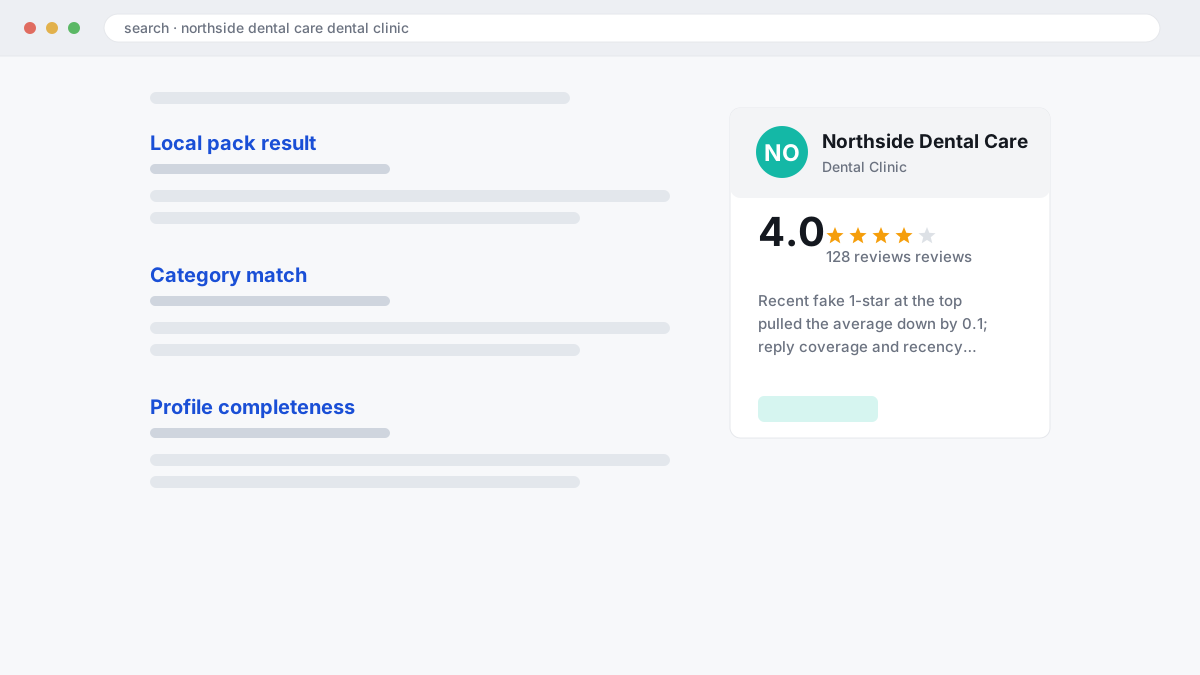
The wrong move is treating every review as equal. That burns time on old, low-visibility posts while a fresh 1-star sits at the top of your Google Business Profile or Trustpilot page, pulls your average down by 0.1, and changes which listing gets the click in a tight map-pack result where the category, distance and profile completeness are otherwise similar. In BGR Review's case file of 12,000+ negative review cases logged June 2025 to June 2026, reviews raised within 28 days of posting and backed by a clear policy issue resolved successfully in roughly 90% of cases; beyond 28 days, observed success fell to approximately 25-30%.
The better move is triage. Remove the obvious fake first if it is recent, visible and depressing conversions on calls, bookings or form fills, then use a calm public owner response on any live disputed review so the reader sees you are handling it rather than hiding from it. If removal lags, push authentic recent feedback from real customers and close reply gaps on the latest reviews, because star rating impact works with recency: a steadier recent review mix plus visible owner responses usually recovers click choice before broader branded search demand catches up.
When does DIY stop making sense and managed removal support start paying off?
DIY works for one-off fake reviews when the policy breach is obvious and your records are clean. Paid removal support starts earning its keep after a rejection, across multiple locations, or during review bombing, when the result depends on a stronger evidence pack and a better escalation route rather than another click on the same flag button.
The cheap mistake is repeating the in-platform report with slightly different wording. Across BGR Review's negative review cases with prior self-filed attempts, from June 2025 to June 2026, roughly 90% had used only the basic report button and 70-80% of those initial requests were rejected; that usually means more owner time, slower recovery in the map pack, and a longer drag on click-through rate and conversions while the review stays live.
This is the practical trade-off.
| Route | Best fit | Owner cost | What changes the outcome |
|---|---|---|---|
| DIY reporting | One location, one review, clear policy match, simple booking or CRM record | Low cash cost, higher owner time | A tight evidence pack that matches the platform rule exactly |
| Managed removal support | Rejected reports, multi-location review management, coordinated review bombing | Fixed price per removed link | Policy remap, evidence rebuild, consistent filing order, cleaner escalation |
Managed help does not create powers you cannot access yourself. It pays off when the total cost of delay gets bigger than the fee: hours lost by staff, inconsistent filings across profiles, weaker public owner response timing, and rating damage that suppresses branded search demand before rankings move back.
Where is the legal line on removing fake reviews without creating a bigger problem?
Removing a fake review is usually lawful, but the method you use decides whether you solve the problem or create a second one. False factual allegations can raise defamation issues, while undisclosed paid reviews and deceptive endorsements can trigger platform enforcement and regulatory scrutiny under rules that differ by country and platform; this is general information, not legal advice.
The wrong move is to answer a fake review with legal threats, post a fake counter-review, or publish the reviewer's personal data to pressure them. That fails for two reasons: defamation usually turns on false statements of fact, not bare opinion, sarcasm or rudeness, and privacy breaches or retaliatory posting can leave you with a worse moderation record than the original complaint. The safer route is an evidence-based dispute tied to the platform rule you are using, then a narrow public owner response while the review is still live.
Regulators care about deception more than hurt feelings. In the US, the FTC endorsement guides and the FTC's 2024 rule on fake reviews target undisclosed incentives, employee reviews posing as customers, and other deceptive endorsements. In the UK and EU, consumer protection rules focus on misleading trader practices, including suppressing genuine criticism or manufacturing praise, so replacing one fake negative with a planted positive can damage trust, click-through from the map pack, and conversions from branded search long after the original post is gone.
What should you do in the first seven days after a fake review comes down?
Once the review is removed, use the next seven days to rebuild trust fast: watch your star rating, recency and lead quality, ask real customers for neutral reviews, and log the case so the next incident is quicker to route across every location.
Most teams treat removal as the finish line. That wastes the short recovery window where star rating impact, fresh review recency and owner replies can lift click-through from the map pack and improve conversions on calls, bookings and form fills. Check your profile daily for seven days: average rating, latest visible review date, call volume, direction requests, booking leads and any drop in branded search demand. If BGR Review handled the removal, keep the removed link, evidence pack and final platform response in the same case record rather than leaving it buried in email.
The right move is compliant review outreach. Ask customers from the last 7-14 days for honest feedback with a neutral request that does not pressure for positive sentiment, which keeps you aligned with platform rules and the FTC’s endorsement guidance. In multi-location review management, update the location log, assign one escalation owner per branch, and note who checks reviewer mismatches, duplicate incidents and response timing before the next fake review lands.
Where to go from here
Start with a triage decision. Put each suspicious review into one of three lanes: evidence if you can show no customer record, policy breach or account pattern; response if the post may stay live for a while and your map-pack click-through and conversions need protecting now; escalation if your first flag failed but the policy issue is still clear. Repeating the same thin report rarely changes the outcome.
The next concrete action is to rebuild the case before you touch the platform again. Match the review to a named rule such as Google review prohibited content policy, Trustpilot's flagging categories or Yelp content guidelines, attach your evidence pack, then post a short public owner response that does not admit fault or accuse the reviewer of lying. In BGR Review's case file of 12,000+ negative review cases logged June 2025 to June 2026, reviews raised within 28 days and backed by an identifiable policy issue resolved successfully in roughly 90% of cases; beyond 28 days, the observed success rate fell to approximately 25-30%.
If the case is clear but stuck, use a structured removal route instead of another identical flag.