


Quick answer
Google review removal usually takes anywhere from a few days to several weeks. The timeline depends on the policy issue, the proof you submit, and whether Google accepts the first report filed through Google Maps or Google Business Profile. Clear breaches of Google Maps content policy, such as spam, impersonation or off-topic content, tend to move faster. Reviews built around disputed facts, defamation allegations or mixed factual and opinion language usually take longer and often need an appeal or support escalation. If a case qualifies for managed help, BGR Review charges $449 per removed review link with $0 upfront.
This page is written for buyers comparing a DIY flag with paid help, not for readers who need another generic policy summary. In our workflow, the first decision point is always the violation category because a fake review, a competitor post, and a false factual claim do not move through Google's review system on the same timeline.
We handle the steps that most guides skip: building an evidence pack, filing the initial report, tracking the wait, appealing rejections, escalating support, and drafting an owner response while the case stays live. Across 12,000+ negative review cases logged June 2025 to June 2026, our records showed that reviews raised within 28 days of posting and backed by an identifiable policy issue resolved successfully in roughly 90% of cases.
How long does Google review removal actually take from first flag to final outcome?
Google review removal can take a few days or several weeks. The fastest cases are obvious spam under Google Maps content policy; the slowest cases involve false factual claims, thin evidence, an appeal queue, or support escalation through your Google Business Profile.
Most guides say Google “may review it soon”. That fails because a real review investigation timeline has three separate clocks: the initial flag, the appeal if Google rejects or ignores it, and the monitoring period after removal in case of review reinstatement. In BGR Review’s record of 12,000+ negative review cases logged June 2025 to June 2026, cases raised within 28 days of posting and backed by an identifiable policy issue resolved successfully in roughly 90% of cases; for comparable cases raised beyond 28 days, the observed success rate fell to approximately 25–30%.
This is the route-by-route timeline you should expect before deciding whether to keep it DIY or pay for managed help at $449 per removed review link with $0 upfront.
| Route | Usual wait | Main blocker | Next step |
|---|---|---|---|
| Basic in-profile flag in Google Business Profile, Search or Maps | A few days to about a week | Report filed with no context, so Google treats it as a weak signal | If no action or rejection, move to a formal appeal with evidence |
| Appeal with supporting proof | Often one to three weeks | Wrong policy category or screenshots that do not prove the breach | Escalate through support only after the policy angle is clear |
| Post-removal monitoring | Several days to a few weeks | Review reinstatement after automated reprocessing | Keep records and re-open fast if the same review returns |
A simple spam post can disappear quickly. A review alleging a false event, fake visit, or invented staff interaction usually takes longer because Google wants evidence that the claim is factually wrong or impossible, not just damaging.
Which review issue should you try to remove first for the fastest business impact?
Start with the review that has the most visibility and the clearest Google Maps content policy breach. A recent 1-star post sitting in your newest visible set, with strong fake-engagement or impersonation signals, usually deserves attention before an older complaint buried lower on the profile.
Most owners go lowest star first. That fails because a two-year-old 1-star review on page two may have less effect on map-pack click-through, calls and form fills than a fresh attack shown in the first five reviews on your Google Business Profile. In BGR Review's case file of 12,000+ negative review cases logged June 2025 to June 2026, reviews raised within 28 days of posting and tied to an identifiable policy issue resolved successfully in roughly 90% of cases; for comparable cases raised after 28 days, observed success fell to approximately 25-30%.
Use a simple scoring pass before you flag anything.
| Factor | High priority | Why it moves first |
|---|---|---|
| Rating | 1-star or 2-star | Hits trust and conversions fastest |
| Recency | Posted in the last 28 days | Faster investigation window, stronger removal odds |
| Visibility | Appears in the newest visible set | Depresses branded search clicks and local pack response first |
| Removability | Clear policy violation category | Impersonation, spam or off-topic content is easier to evidence than a vague unfair opinion |
Fake competitor attacks usually outrun older genuine complaints in business damage because they look current, they sit high on the profile, and they poison trust before a reader reaches your better reviews. Your owner response strategy should match that priority: reply briefly, state that you cannot verify the transaction, and avoid arguing facts in public while the removal request is live.
Which Google policy violation gives you the best chance of removal?
Your best removal odds come from matching the review to a named rule in the Google Maps content policy, not arguing that it feels unfair or inaccurate. Spam, fake engagement, impersonation, harassment and clearly off-topic content usually move faster than disputes over opinion, because Google removes prohibited and restricted content, not harsh but lawful criticism.
Most failed requests say some version of “this review is false”. That usually fails because “untrue” is not a policy violation category on its own, and Google will not investigate a normal service dispute for you. In BGR Review’s case file of negative review cases with prior self-filed attempts, logged June 2025 to June 2026, roughly 90% had used only the basic report button with no supporting documentation, and in that group 70–80% of initial requests had been rejected. The stronger route is narrower: call the review what it is under policy, then prove that category.
Spam and fake engagement usually give you the cleanest opening. If the reviewer never existed in your CRM, invoice log, booking system or visitor record, that supports a spam case better than a general complaint about fairness. Conflict of interest needs a different proof set: competitor link, staff connection, former employee link, or a pattern of reviewing direct rivals from the same account. Harassment works when the wording targets a person with abuse or threats. Impersonation works when the reviewer claims to be someone they are not. Off-topic works when the post talks politics, another business, or a delivery issue your listing does not even cover.
Defamation and false factual claims sit in a harder middle ground. If a review says “I hate this place”, Google usually leaves it up; if it states a checkable false fact, you still need to fit that fact into the relevant policy violation category rather than asking Google to referee the truth.
How do you report a Google review correctly in Business Profile, Search, and Maps?
Report the review through your verified Google Business Profile, Google Search, or the Maps app, then save the submission details straight away. The route matters less than picking the right policy breach and keeping a case reference for follow-up.
The one-click flagging myth causes most avoidable failures. Tapping “Report review” without owner access, profile verification, or a record of what you filed often leaves you with no usable support trail when Google rejects or stalls the request. The right approach is a short flagging workflow: confirm you have owner or manager access to the correct Google Business Profile, make sure the profile is verified, choose the review inside Business Profile, branded Search results, or the Maps app, and note the reviewer name, posting date, suspected violation, and any case ID the same day.
Each route reaches the same moderation system, but your follow-up options change. In Business Profile, sign in, open the reviews list, find the review, and use the report option tied to that listing. In branded Google Search, search your business name while logged into the account that manages the profile, open reviews, select the review, and report it there. In Maps, open your place listing in the app, find the review, and submit the report from that screen.
Documenting the first submission is what makes later escalation workable. BGR Review asks for the original report date, reviewer name, review link or screenshot, and any Google reference number before we touch a removal case, because missing those basics slows follow-up more than the choice between Search, Maps, or Business Profile.
What evidence makes Google act faster on a fake or false review?
Google moves faster when your proof shows a specific Google Maps content policy breach, not general annoyance with a bad review. Order records, CRM logs, reservation data, call logs and visit history usually beat a long complaint because they let a reviewer check the mismatch in minutes instead of reading a page of argument.
The weak approach is an emotional timeline: “this review is unfair, damaging and clearly fake”. That usually fails because Google’s flagging workflow is built to assess evidence, not feelings, and the first pass is often short. The stronger approach is a tight evidence pack: no invoice, no call record, no booking, no site visit, no customer profile on the claimed date. In BGR Review’s dataset of negative review cases with prior self-filed attempts, logged June 2025 to June 2026, roughly 90% of businesses came to us after using only the in-platform report button, and 70–80% of those initial requests had been rejected.
If the reviewer mentions a date or incident, use documents that make that detail impossible. CCTV, door logs, technician route sheets, appointment records and card terminal history can narrow the claimed time window fast. For defamation and false factual claims, the useful proof is the smallest set that disproves the fact stated, such as “your engineer never attended” versus a signed job sheet and dispatch log.
This is the proof set that usually gives support escalation something concrete to verify.
| Violation type | Strongest supporting documents |
|---|---|
| No customer relationship | Order records, CRM logs, call history, invoice search, visit history |
| Impossible date or time | Appointment calendar, CCTV, staff rota, route sheets, access logs |
| False factual claim | Signed job sheet, email thread, refund record, photos, service report |
| Wrong location or branch | Google Business Profile location details, booking branch record, receipt address |
What should your Google review removal request actually say?
A strong Google review removal request is short, policy-led and evidence-specific. Name the policy violation category in the first sentence, state the factual mismatch, list the records in your evidence pack, and avoid threats, emotion or vague claims that the review hurts your business.
Generic complaint letters fail because Google does not remove reviews for being unfair, angry or commercially damaging. A policy-grounded request works because a reviewer or automated check can match your wording to the Google Maps content policy, then verify the dates, lookup result and account mismatch against the documents you attached.
We request removal of this review under Google Maps content policy for spam and fake engagement [or the correct policy violation category]. Our records show no customer, booking or transaction matching the reviewer name, date or claims in the review. We checked orders/appointments for 12-14 August 2026 and found no transaction under “[name]”, “[email]” or “[phone]”. The review states “[false factual claim]”, but our attached records show [brief contradiction]. The reviewer does not match any customer in our CRM or payment history. Attached evidence pack: booking log, invoice search result, call log and screenshot of the review URL.
Keep the body under roughly 120 words. Extra backstory usually weakens the request.
What do you do after Google rejects the first removal request?
If Google rejects your first request, use the appeal path attached to that case and add new proof or a sharper policy match. Sending the same weak report again usually burns time and can bury the version of the case that actually has a chance.
The wrong move is opening fresh flags in Google Business Profile, Search and Maps as if volume will force a different outcome. It usually does the opposite. You lose case continuity, support escalation starts from a thinner record, and the review investigation timeline gets harder to track because each report sits in a separate queue. The better move is to appeal from the original rejection email or support thread, quote the case ID, and attach something Google did not have the first time: order records showing no customer match, screenshots of edited claims, location proof, or a direct citation to the Google Maps content policy category that fits the review.
Date control matters. In BGR Review's file of 12,000+ negative review cases logged June 2025 to June 2026, reviews raised within 28 days of posting and backed by an identifiable policy issue resolved successfully in roughly 90% of cases, while comparable cases raised beyond 28 days fell to approximately 25-30%. Google can take long enough that your first appeal lands after that early window, so log the posting date, first flag date, rejection date and appeal date in one place.
Frustration does not help an appeal. New evidence does.
Should you post a public reply while the removal request is pending?
Yes, you should often post a public reply while the removal request is pending, because a calm owner response can protect calls, bookings and form fills while Google leaves the review live for days or weeks. The reply will rarely trigger Google review removal by itself, but it can steady click-through from your Google Business Profile and stop one visible complaint from dragging down map-pack conversions.
Silence until removal sounds tidy. It usually fails because prospects only see an unanswered accusation on your listing, especially if the review sits near the top by relevance. A parallel reply-and-removal strategy works better: submit the flag, build the evidence pack, then post a short reply within 24 to 72 hours if the review is still visible and attracting views.
Your owner response strategy should stay neutral. Do not admit facts you may later dispute in Google support, a defamation complaint, or legal correspondence. Say you cannot verify the visit, invite the reviewer to contact you offline, and avoid accusing them of fraud in public.
When is DIY enough and when does managed removal earn its cost?
DIY is usually enough when the breach is obvious, your Google Business Profile is verified, and your records are clean. Managed removal earns its cost when a review threatens high-value calls or bookings, the facts are contested, or Google has already rejected the first request and the next step needs tighter evidence handling and support escalation.
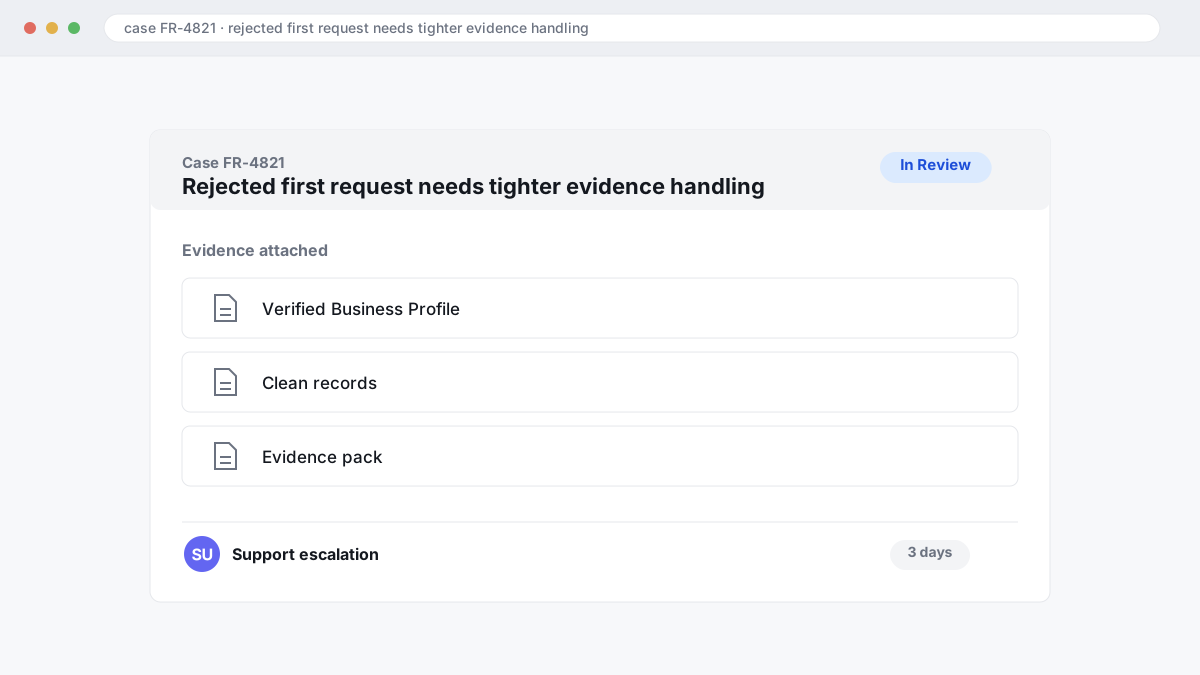
The cheap mistake is treating every bad review the same and pressing the report button once. That fails because Google often rejects thin submissions; in BGR Review's dataset of negative review cases with prior self-filed attempts, logged June 2025 to June 2026, roughly 90% arrived with only the basic in-platform report and no evidence pack, and 70-80% of those initial requests had been rejected. DIY works best for duplicate posts, obvious spam, and off-topic reviews where screenshots, order records, timestamps, and profile mismatches make the policy issue easy to see.
This table is the practical split between cheapest route and best expected outcome per hour and risk.
| Route | Effort and timeline control | Cost and success constraints |
|---|---|---|
| DIY flag and appeal | Low cash cost, but you do the drafting, proof gathering, and follow-up. Good when the review clearly breaches Google's Maps content policy and the first response lands inside the normal review window. | No agency fee. Weak if facts are disputed, reviewer identity is unclear, or you need support escalation after a stalled appeal. |
| Managed removal | Higher control over the file because the evidence pack is built properly from the start and escalations are timed rather than guessed. | Best fit when one review is depressing map-pack click-through, conversions from calls or form fills, or branded search demand on a profile that matters commercially. |
Is Google review removal legal, and where are the compliance lines?
Google review removal is lawful when you report a real Google Maps content policy breach or a false factual claim and back it with evidence. Risk starts when you invent proof, lean on reviewers, bury lawful opinion, or stray into endorsement and review-manipulation rules; this is general information, not legal advice, and country and platform rules differ.
The wrong approach is trying to erase criticism because it hurts conversions, branded search demand, or map-pack click-through. That usually fails because Google removes policy violations, not bad sentiment, and a harsh opinion is rarely the same as defamation. The right approach is narrower: challenge impersonation, conflict of interest, harassment, or a review that states a checkable false fact such as “your clinic is closed” or “you charged me twice” when your records show no transaction. Defamation turns on false factual claims, not “rude service” or “I would not return”.
The compliance line gets tighter once money or incentives appear. The FTC endorsement guides and the FTC’s rule on fake reviews and deceptive testimonials target undisclosed incentives, purchased testimonials, employee reviews presented as independent, and any deceptive endorsement practice. In the UK and EU, consumer-protection rules address misleading commercial practices and trader review manipulation, including hiding genuine feedback or presenting sponsored praise as organic.
What does a real removal workflow look like from first flag to possible reinstatement?
A practical Google review removal workflow starts with capture, categorisation and evidence assembly before you file anything. Submit one clean report, save the case reference, post a measured owner response if the review is still live, escalate only when you have new proof, and keep the file in case the review returns.
The wrong approach is ad hoc reporting: you hit the report button, edit your Google Business Profile, delete photos or service details, then try to remember what the review said three weeks later. That fails because Google support escalation works better when your evidence pack shows the original text, the reviewer profile, the review URL, timestamps, and the exact Google Maps content policy category you are alleging. Across negative review cases with prior self-filed attempts in BGR Review's case log, June 2025 to June 2026, roughly 90% of businesses had used only the basic in-platform report button with no supporting documentation, and 70–80% of those initial requests had been rejected.
A cleaner workflow looks like this. First, take screenshots before any edits, deletions or profile changes occur, then save the review link, reviewer name, profile screenshots, order records or call logs, and any proof of false factual claims or impersonation. File the first report once, log the submission date, wait for Google's decision, and if the review stays live, publish a calm owner response that protects click-through rate and conversions from the local pack while the case is open.
One example: a one-star review alleges a job was never completed, but your CRM shows no matching customer and your call log shows no inbound lead. You flag it under deceptive content or conflict of interest if the account ties to a competitor, attach the evidence pack on appeal, then monitor the listing for 90 days because review reinstatement does happen after manual review or profile changes. If Google removes it, keep the file anyway. If Google restores it later, you reopen with the old case reference and updated proof instead of starting from zero.
Where to go from here
Start by classifying the review against the Google Maps content policy. If it is spam, conflict of interest, off-topic, harassment, impersonation, or a false factual claim you can evidence, build the evidence pack before you file anything else: the review URL, screenshots, dates, order or booking records, customer list checks, staff statements, and any prior owner response. That prep changes the review investigation timeline more than most guides admit, because Google often rejects bare report-button submissions with no context.
If your first flag is still unresolved, do not keep resubmitting the same one-line report. Move to appeal and support escalation with the same evidence pack, and keep a measured public response live on the Google Business Profile while the case is open. That protects click-through from the map pack and helps conversions from people comparing listings before they call or book.
If it does not fit, you are better off improving the owner response and review recovery plan instead.