

Quick answer
Google AI Overviews are AI-generated summaries that can appear above the standard organic results, changing how much traffic a normal ranking can still win. Since Google’s May 2024 US launch, the feature has expanded, tightened quality controls, added clearer citation links, and tied more closely into shopping and local-intent searches. The practical impact is simple: fewer guaranteed clicks on some queries, more brand comparison inside the SERP, and heavier reliance on trusted sources, Google Business Profile accuracy, and review strength. Track branded impressions, click-through rate, and local review movement after visible SERP changes.
This page is written from live reputation and local visibility work, not from watching launch demos. We spend our time fixing review problems on Google, Trustpilot, Yelp, Clutch and TripAdvisor, and the same pattern keeps showing up: owners react by rewriting pages first, while the faster checks are usually Search Console CTR drops, missing citation sources, and a Google Business Profile field that drifted out of date.
That operator view matters with google ai overviews because the traffic loss rarely starts as a pure ranking problem. In removal work, the difference between a weak report and a usable evidence pack is often one field: the policy reason and supporting proof attached to the review URL, which is why this guide stays focused on what you can verify and act on.
What changed for businesses after Google AI Overviews expanded beyond a lab test?
Google AI Overviews changed more than the page layout. They compress research inside Google Search, push brand comparison up into the results page, and make trusted citations, review signals and result type matter more than a simple rank report.
Most launch coverage treated this as Search Generative Experience leaving Labs and becoming a broader Google Search feature in 2024. That framing misses the business shift. Your page can still hold a familiar organic position and lose visits because the overview answers enough of the question before the click, then places your brand beside rivals in one synthesised block instead of ten separate blue links.
The wrong response is to read this as another SEO news cycle and keep watching rank trackers alone. That fails because rankings measure placement, while AI Overviews change what the searcher sees, compares and trusts before they choose. The better response is to treat the results page as a comparison surface: check whether your brand appears in the answer, whether Google cites a source you control, and whether your review profile supports the trust gap the overview creates. If you are paying for reputation work, keep the trade-off clear. A BGR Review package can carry a 30-day free replacement guarantee on delivered reviews, and negative review removal stays pay-after-success at $449 per removed link with $0 upfront, but neither service replaces lost clicks if the SERP now resolves more intent before anyone visits your site.
How do Google AI Overviews actually build an answer and decide which sources to cite?
Google AI Overviews build a composite answer from several indexed pages, then attach citation links so the searcher can check the supporting sources. They do not appear on every query, and Google applies tighter caution on sensitive YMYL queries, where bad health, legal or financial information carries higher risk.
Most guides still write as if Google picks one authoritative page and paraphrases it. That fails because the overview behaves more like multi-source synthesis: one page may supply the definition, another the current example, and a third the supporting detail that earns a citation link. Google has said through Google Search Central that these systems use multiple sources and helpful web content, which is why content freshness matters more on changing topics than on stable reference queries.
Source selection is heavily query-dependent. A search about a software update, policy change or pricing shift is more likely to reward recently updated pages, while a basic evergreen question can pull from older but clearer documents. For BGR Review clients checking brand mentions after a traffic dip, the useful test is simple: look at the cited pages and ask whether they are current, specific and easy to verify, because a stale directory listing can outrank your newer page if your own wording is vague or your supporting details are thin.
YMYL queries get narrower treatment for a reason. Google has been more restrained where medical, legal, financial or safety advice could cause harm, so you may see fewer expansive AI answers, fewer speculative summaries and stronger reliance on clearly attributable sources. That matters if you market a clinic, law firm or financial service, because a page with clean facts, visible authorship and up-to-date policies is easier for Google to trust than broad copy written to sound authoritative.
Why can clicks fall even when your ranking report barely moves?
Your rankings can stay roughly where they were while clicks fall, because AI Overviews often answer the informational part of the search before a user reaches the first organic result, which turns a position report into a weak proxy for demand.
The wrong approach is to look at average position, see little movement, and assume organic traffic should hold. That fails because the results page changed shape: Google inserted an AI block above or between classic listings, so click-through rate becomes the live metric once the answer is visible on the page. A query that used to send visits from a straightforward informational search can now satisfy that intent inside the SERP, especially when the overview summarises definitions, steps, prices or pros and cons clearly enough for the searcher to move on.
The better approach is to separate stable rankings from unstable traffic and read them together. In BGR Review’s dataset of 1,485 businesses observed from February to July 2026, trades firms with complete enquiry-source data attributed 70–80% of calls and bookings to a Google Business Profile or Yelp listing rather than a website, which is a useful reminder that lost organic traffic does not always mean lost conversions. Commercial and comparison searches still win clicks more often, but later in the decision path, after the user has scanned the overview, compared brands in the SERP, and decided which source looks credible enough to visit.
How are AI Overviews different from featured snippets when traffic is on the line?
Featured snippets usually lift one page and quote it directly; AI Overviews combine several pages into one answer with multiple citation links. You get less exclusive visibility, and the chance of a zero-click search goes up because the searcher can finish the job on the results page.
Most guides treat these two features as close substitutes. That reading fails once traffic is on the line. A featured snippet can still send a concentrated burst of clicks to one source because Google has effectively chosen a winner for that query, while an AI Overview spreads attention across several cited pages and takes more screen space before a user reaches the classic organic listings, your Google Business Profile, or your review-rich result.
The better comparison is single-source extraction versus multi-source synthesis. That matters if you are tracking branded search demand, calls, bookings or form fills after a visibility change. At BGR Review, this is the same reason we tell local clients to check which pages are cited before they rewrite copy or buy more traffic: if your brand is mentioned but buried among other citation links, visibility can rise while clicks flatten.
This table is the practical difference.
| SERP feature | Source count | Visibility on screen | Click pattern and zero-click risk |
|---|---|---|---|
| Featured snippet | Usually one primary source | Prominent, but often shorter | Clicks tend to concentrate on one page; zero-click risk exists but the source is clearer |
| AI Overviews | Several synthesised sources with citation links | Larger block that pushes classic results lower | Clicks fragment across sources; higher zero-click risk because the answer is more complete inside Google |
What makes your pages more likely to become sources instead of being ignored?
Pages become source-worthy when they make one claim per sentence, attach that claim to a checkable fact, and stay current enough that Google can trust them for citation links on a live topic rather than skip them for something clearer.
Generic commentary fails because it reads like opinion: “reviews matter”, “AI is changing search”, “keep your profile updated”. An AI Overview cannot anchor much to that. Citation-ready evidence works because the page states the fact, the scope and the proof in plain English, the way Google Search Central documentation does: name the platform, name the policy, date the update, and use examples that can be verified. If you offer review help, “we manage Google, Trustpilot and Yelp reviews” is weak; “review packages include a 30-day free replacement guarantee, and negative review removal is pay-after-success at $449 per removed link with $0 upfront” gives the system something factual to quote or compare.
Freshness matters more on topics that move. A page about AI Overviews, AI Mode, Google Business Profile fields or review policy should carry an updated date, replace stale screenshots, and swap vague examples for named ones from 2026. EEAT then does the final job: clear authorship, primary-source references such as Google Search Central or Google Business Profile Help, and accurate business details reduce the chance that your page is treated as thin commentary and ignored.
How do AI Overviews change local pack visibility for reputation-led businesses?
For local businesses, AI Overviews do not replace the local pack, but they do change who gets researched first. When Google summarises options before a Maps click, accurate Google Business Profile details, stronger review signals and consistent brand facts carry more weight because trust now starts inside the search results page.
The wrong approach is chasing rank alone and treating “position 1 in the local pack” as the win. That fails when AI Overviews answer the early comparison query first, pull in your category, opening hours, ratings or review themes, and send the searcher into a brand comparison before they ever tap your listing. In BGR Review’s dataset of trades businesses with complete enquiry-source data, observed February to July 2026, 70–80% of calls and bookings were attributed to a Google Business Profile or Yelp listing rather than a branded website visit, which is why local trust signals matter even when your map position barely moves.
The better approach is to optimise for trust before the click. That means tightening primary and secondary category relevance in your Google Business Profile, fixing service areas, checking that your phone and hours match across citations, and improving review quality and recency so the profile reads cleanly when Google compresses it into an AI summary. A 4.9 average with thin, vague comments can lose attention to a 4.7 profile with detailed, recent reviews and owner replies because the second profile gives Google more usable sentiment to summarise.
If you want to measure the local effect properly, track three things together every week: branded queries in Search Console, map actions in Google Business Profile performance, and review sentiment in new reviews. That combination shows whether AI Overviews are shifting discovery away from generic local searches and towards brand-led searches, while your local pack visibility still converts through calls, direction requests and form fills.
Can Google AI Overviews cite wrong information about a brand, and what should worry you most?
Yes, Google AI Overviews can restate wrong brand information when the source set is thin, stale or inconsistent. The biggest risks are false facts about pricing, safety, availability and review reputation, because a searcher may trust the summary before opening any citation links.
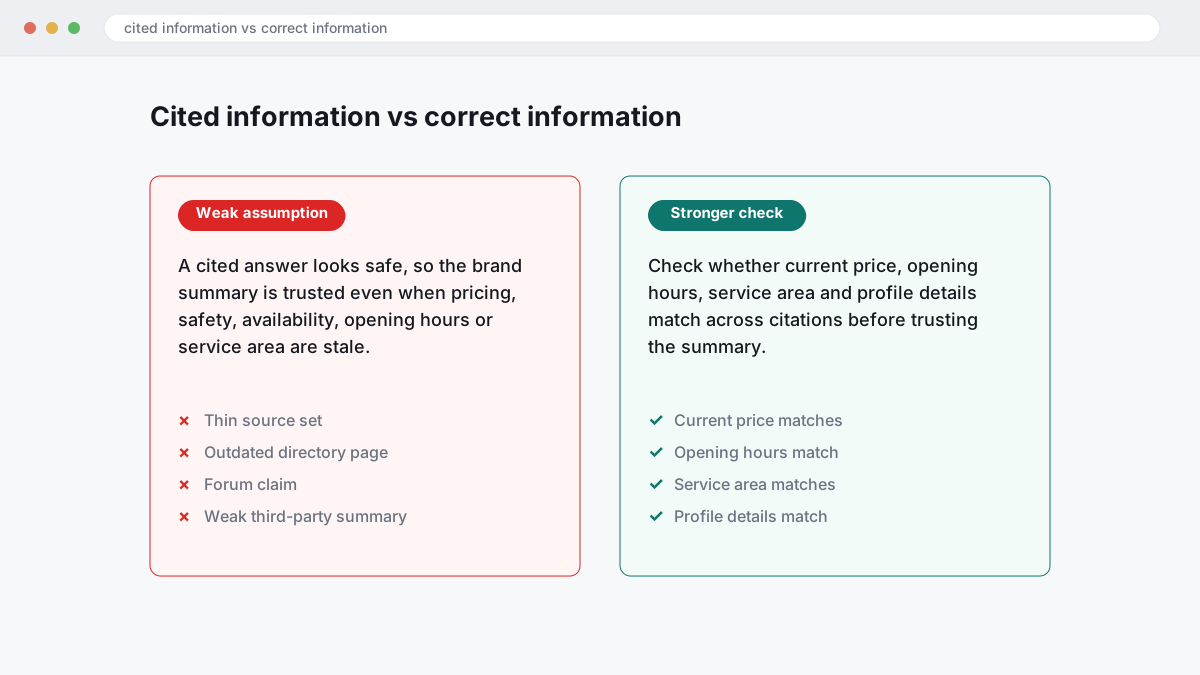
Most guides treat a cited answer as a safe answer. That fails because hallucinations often come from blending one outdated directory page, one forum claim and one weak third-party summary into a confident paragraph that still looks sourced. Cited information and correct information are different things; if your current price, opening hours, service area or Google Business Profile details conflict with older pages, the overview can repeat the wrong version and attach a link that only half-supports it.
The harm gets sharper when the error touches brand safety. A wrong line about “hidden fees”, “unsafe practice” or “poor reviews” can poison click-through rate, calls and form fills even if the source was a low-trust page or a misread review snippet.
YMYL queries carry higher stakes because Google compresses sensitive topics into short answers. For healthcare, legal, finance and other regulated sectors, an oversimplified claim about treatment, guarantees, qualifications or compliance can create reputational and legal risk across countries and platforms, including the FTC rules on endorsements in the US and UK consumer-protection rules on misleading commercial practices. This is general information, not legal advice; your safer move is to audit every cited source against your live site, your Google Business Profile and your regulated wording before you rewrite anything else.
Where do ads and AI Mode fit when commercial searches become more conversational?
Ads in AI Overviews and Google’s AI Mode shift commercial queries toward a Google-contained journey, where users compare, refine and click within the SERP longer before they ever reach your site, which changes where you should expect visibility to turn into leads.
The wrong approach is to treat every impression like a lost publisher visit and respond by rewriting blog pages first. That fails because product-led and service-led searches now hold more research inside Google: ads in AI Overviews can absorb the high-intent click, and AI Mode encourages follow-up prompts that keep comparison shopping on-platform instead of sending the user to your article.
The better approach is to split informational visibility from commercial conversion opportunities. For BGR Review clients buying Google review packages with a 30-day free replacement guarantee, the stronger commercial lift usually comes from a clean Google Business Profile, current reviews and branded search demand that convert into calls or bookings, while informational pages still matter as citation support rather than the only destination.
How can you measure AI Overview impact in Search Console without guessing?
Use Search Console to compare query-level impressions, clicks and click-through rate before and after an AI Overview starts showing. The useful view is weekly rather than daily, because short swings hide the real shift unless you track the same query groups for 8 to 12 weeks.
Search Console does not give you a clean report called “AI Overview traffic”, so a one-week panic check usually sends you in the wrong direction. You see clicks dip on Monday, assume ranking loss, and start rewriting pages that still hold the same positions. What actually helps is pairing a visible SERP change with query-level exports: the search term, the landing page, impressions, clicks and CTR from the weeks before and after the overview appeared. That shows whether the page lost demand, lost appeal in the results, or stayed visible while the SERP absorbed the click.
This is the export view we use before we advise on review work or page changes, because the wrong fix costs time and often misses the source of the loss.
| What to track | Before/after window | What it tells you |
|---|---|---|
| Query impressions | 4 weeks before, then weekly for 8-12 weeks | Whether demand stayed stable while clicks moved |
| Clicks and CTR | Same query group, same landing page | Whether AI Overviews are taking attention inside the SERP |
| Landing-page mix | Pre-change vs post-change | Whether Google started preferring a different page for the query |
If your branded search, local pack clicks and core service queries all soften at once, do not treat that as one problem. Split branded terms from non-branded terms, and split local intent queries from broader research phrases. In BGR Review’s workflow, that separation is usually the point where you find the real issue: a citation-heavy AI Overview crushing non-branded CTR, while your Google Business Profile still holds calls and map-pack visibility for branded and nearby searches.
What should you fix first if traffic drops after AI Overviews start showing?
If clicks fall after AI Overviews start appearing, fix the query groups that actually lost traffic first. Use Search Console to compare the last 28 days against the previous 28 days, then tighten answer-first formatting, evidence, content freshness and brand consistency before you touch the rest of the site.
Most guides push a sitewide rewrite. That usually fails because AI Overviews do not suppress every page equally; they hit specific intents, usually comparison, definition and high-level research searches, while branded terms and bottom-funnel pages often behave differently. Pull the affected queries into clusters, check which landing pages lost clicks while impressions held or rose, and rewrite only those pages to answer faster, show named sources, add original comparison points and remove stale claims that no longer deserve citation links.
If local-intent pages dropped at the same time, check whether your Google Business Profile, review signals and branded search demand weakened together. A page refresh will not recover map-pack visibility if your opening hours, services, categories or recent review quality look weaker than the businesses Google can cite directly in the SERP. In BGR Review's dataset of 1,485 businesses observed February to July 2026, trades firms often depended more on profile listings than websites for calls and bookings, which is why a traffic dip sometimes starts with local visibility rather than page copy.
Fix the page, then check the reputation layer behind it.
What does a practical weekly workflow look like for citations, reviews, and local visibility?
A workable weekly routine checks the full search surface in one pass: pages Google may cite, your branded results page, and your Google Business Profile signals, then logs what changed so you can fix the cause before clicks, calls and local pack visibility slide.
The wrong approach is publishing another page every week and hoping freshness solves it. That fails because AI Overviews, branded SERPs and the map pack often pull trust from outside your latest article: citation links, review signals, profile accuracy, old third-party mentions and what Search Console shows for top-query click-through rate.
Run the same review every 7 days and keep it in one sheet, not three separate tools. Log newly cited pages, branded-search inaccuracies, new reviews, repeated complaints, star-rating drift, top-query CTR shifts from Search Console, and any Google Business Profile edits, missing services, wrong hours or weak photo coverage.
| Check | What to record | First action |
|---|---|---|
| Citation-worthy pages | Pages cited, pages skipped, outdated claims | Refresh facts, add clearer sourcing |
| Branded SERPs | Wrong summaries, comparison pages, review-site prominence | Fix source pages and weak review coverage |
| GBP and local pack | New reviews, unanswered reviews, category errors, falling actions | Reply, correct profile data, request fresh legitimate reviews |
If you manage multiple locations, start with the branches showing falling calls, click volume or rating trends, because that is where visibility usually weakens first.
Where to go from here
Treat AI Overviews as a change in where comparison happens. Your prospect can now read an answer, scan citation links, see the local pack, check your Google Business Profile and read review snippets before deciding whether your site deserves the click. That means your first move is measurement: pull the queries that lost or gained visibility in Search Console, compare pre and post click-through rate, then check which pages, directories or profile pages Google is citing for those searches.
Next, fix the inputs Google can verify quickly. Tighten your business data, remove old address or phone inconsistencies, update your GBP categories and services, and make sure your best pages answer the exact question that triggered the overview. If your reviews are thin, stale or mixed with unresolved policy issues, audit that before you rewrite half the site. In our removal work, the weak point is often evidence, not the report button itself; across 12,000+ negative review cases logged June 2025 to June 2026, early, policy-backed cases resolved far more often than late, unsupported ones.
Your next concrete step is a query-by-query audit with three columns: CTR change, cited sources and reputation gaps. That will show whether you need content work, profile cleanup, or a review and removal strategy audit.