


Quick answer
Platforms detect fake reviews by scoring patterns together rather than trusting one red flag on its own. The main triggers are review velocity spikes, repeated wording, weak reviewer account age, poor reviewer diversity, IP and device overlap, star-rating distortion, location mismatches, and undisclosed incentives or conflicts. Google’s fake engagement policy bans content posted to manipulate ratings, while Yelp often filters suspicious posts into its “not currently recommended” section instead of removing them. Your next move is simple: check timing, wording, reviewer profiles, and source channels before you appeal, replace, or scale any campaign.
This guide comes from live platform work, not desk research. We handle review acquisition and negative-review removals across Google, Trustpilot, Yelp, Clutch and TripAdvisor, and the same pattern keeps showing up: a spike lands, visibility drops, the platform applies an automatic filter, then a manual audit only moves if the evidence pack is tight.
That matters because fake review detection usually turns on small details most generic guides skip, such as whether the reviewer has prior activity, whether multiple posts came from the same device cluster, and whether your appeal includes timestamps, order records, screenshots and policy matching instead of only the in-platform report button. If a review qualifies for removal, our model is $0 upfront and $449 per removed review link; if you need replacement reviews, packages carry a 30-day free replacement guarantee.
Which fake-review signals do platforms rarely judge alone?
Platforms rarely filter a review on one red flag alone. Most systems weigh several signals together, such as a timing spike, a low-trust reviewer account, repeated wording, and shared device or network clues, then decide whether to demote, hold, recommend less, or remove.
Most guides tell you to hunt for one suspicious phrase. That fails because a single awkward line can come from a real customer, and one five-star review from a new account can still survive. The stronger test is stacked anomalies: ten reviews land inside a short window, most accounts have little history, the text overlaps, and the submissions trace back to the same IP or device cluster. That is how a platform moderation pipeline usually moves from light automation to a harder check.
Google review policies prohibit spam and fake engagement, but Google often acts through visibility changes before you get a clear removal notice. Yelp's recommendation filter works differently: it may leave the review published on the profile while pushing it out of the main count if the reviewer looks low-trust. Amazon fake review enforcement is harsher again, because marketplaces can tie review quality to seller risk, order history, and account relationships, then escalate to manual moderation or account action.
If you see a sudden visibility drop after a review burst, treat it as a cluster problem, not a wording problem. Across BGR Review's negative review cases with prior self-filed attempts, logged June 2025 to June 2026, roughly 90% of businesses had used only the basic in-platform report button, and 70-80% of those initial requests had been rejected; that usually happens because the report names one review but proves none of the linked signals. Your next move is to document the stack: posting times, reviewer profile age, wording overlap, and any shared network evidence before you appeal or ask for removal.
How does review velocity cross the line from normal growth to filter risk?
Review velocity turns risky when review volume climbs faster than your real customer activity can plausibly explain. A holiday rush can look normal; a quiet service business pulling in 25 near-simultaneous reviews from fresh accounts will usually draw automated filtering.
The wrong benchmark is count alone. Thirty reviews in 24 hours and 30 reviews across 30 days are different events, because platforms compare timing against your usual booking flow, your category pattern and the age of the profile, not just the total on the screen. In BGR Review’s dataset of 1,485 businesses observed from February to July 2026, new trades and local service firms typically saw first reviews around two weeks after launch and then built toward 20–30 reviews over the first three months, which is a normal growth curve for local-pack visibility rather than a single-day burst.
The right benchmark is volume relative to customer flow and timing. If your December footfall doubled, your CRM sent more review requests after completed jobs, and the reviews arrived over the same few days as those transactions, that spike is easier to defend because it matches real demand; if nothing changed in sales, bookings or site traffic, the same spike looks manufactured. When a burst does get filtered, the first damage is usually fewer visible recent reviews, which can weaken map-pack click-through and conversions before you notice any ranking movement.
Why do new or thin reviewer accounts get filtered more often?
Reviewer account age matters because platforms trust behaviour patterns, not a profile name alone. A review from an account opened that day, with no prior activity, is more likely to be filtered, downranked or treated as low-confidence than one from an older account with a visible history.
Most guides assume every verified customer review carries equal weight once it is posted. That fails because reviewer account age, prior activity and profile completeness still shape visibility. Google can hold a first-time review for extra checks, and Yelp goes further: its Yelp recommendation filter is designed to surface reviews from users with established activity, profile details and a history that looks real rather than one-off.
If you are asking for reviews, send the request after a genuine job or purchase and let each customer use their own account in their own time. Do not coach wording, do not batch requests through staff phones, and do not panic when a thin-account review disappears from the map pack at first. If a legitimate review gets suppressed, the evidence that later helps is proof of transaction, dates and reviewer identity; in BGR Review's logged cases from June 2025 to June 2026, roughly 90% of failed self-filed attempts used only the in-platform report button with no supporting documentation.
When do shared devices, IPs, or locations make reviews look coordinated?
Shared network and device patterns often suggest coordination. If several accounts post from the same IP range, handset, or location cluster within a few hours, platforms can read that as organised activity rather than independent customer feedback.
The wrong assumption is that different names mean different reviewers. That fails because IP and device signals sit underneath the username: the same office Wi-Fi, the same phone model with a matching browser fingerprint, or a tablet on a front desk can tie supposedly separate accounts together, even when the star rating and wording differ. Reviewer diversity matters here. Ten five-star reviews from ten accounts look less credible if they all trace back to one network and arrive from one suburb while your customers normally come from a wider service area.
Location mismatch adds another layer. A review posted hundreds of miles from your business is not automatically fake, but platforms look for travel context, delivery context, or some other reason the reviewer would be there; marketplace platforms do this aggressively because fulfilment data gives them another cross-check. If a review is flagged, the evidence pack that usually helps most is practical: booking record, invoice, staff rota, visit date, and any message trail showing the person was a real customer. Filing only the in-platform report button is weak; across 12,000+ negative review cases logged by BGR Review from June 2025 to June 2026, roughly 90% of businesses who came to us after a failed attempt had submitted no supporting documentation.
How does wording overlap expose templates, incentives, and review farms?
Wording overlap turns suspicious when a batch of reviews repeats the same phrases, sentence shape, or inflated claims. Platforms can spot duplicate language at scale, and the signal gets stronger when similar text lands in a short burst or comes from low-trust accounts.
The wrong approach is tweaking a template by swapping a few adjectives: “great service” becomes “excellent service”, while the rest of the review still follows the same structure, repeats the same benefit claims, and ends with the same callout. That fails because wording overlap is broader than exact-match duplication; filters can compare phrase order, claim clustering, and repeated talking points such as “fast response”, “best price”, and “highly recommend” appearing together across 5-star posts. Under Google review policies, content must reflect a genuine experience, so template-heavy outreach and incentive-led scripts can mimic review-farm footprints even when each review looks slightly different on its own.
The safer approach is to stop giving customers copy to paste. Ask for a review after the job is complete, but keep the request neutral and specific to the transaction, then let the reviewer choose what mattered: speed, communication, cleanliness, price, or outcome. That produces natural variation in wording, which is easier to defend if a cluster gets flagged and far less likely to depress click-through rate, map pack trust, or later conversions from branded search.
What rating patterns make a profile look manipulated even before text is checked?
Star-pattern anomalies can break trust before anyone reads a single review. If your profile sits on mixed feedback for months and then suddenly picks up a block of perfect ratings, both platforms and real buyers can read that as manipulation.
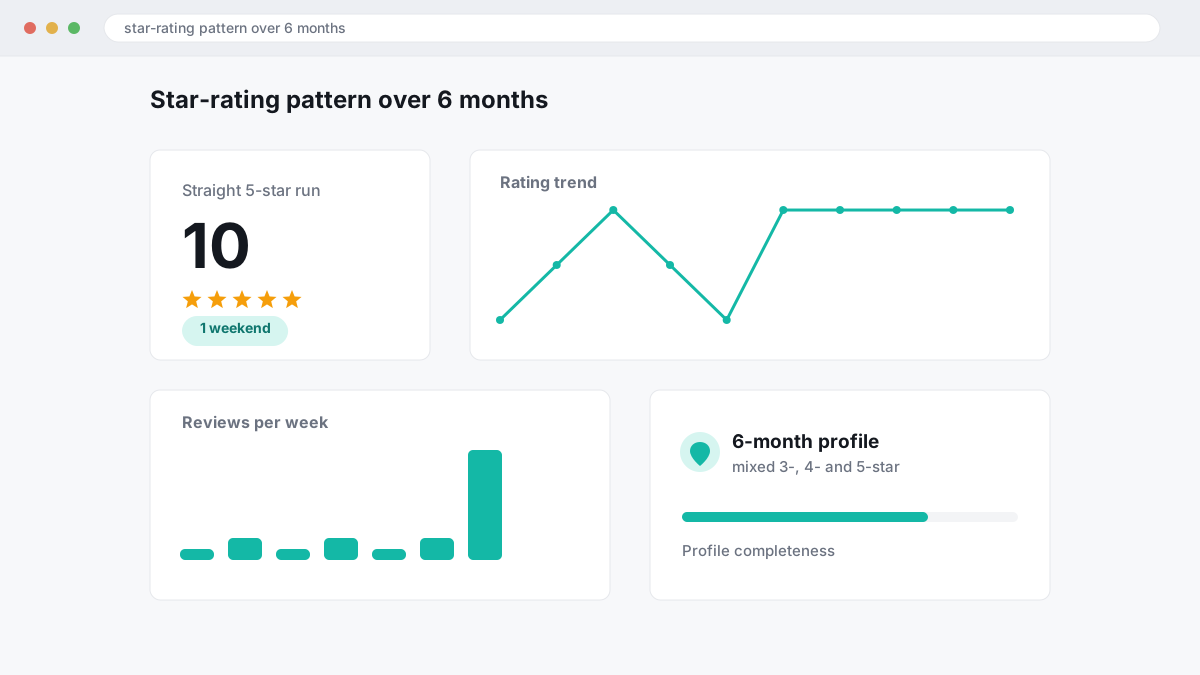
The wrong goal is chasing pure 5-star volume. A six-month profile with scattered 3-, 4- and 5-star feedback that suddenly adds ten straight 5-star reviews over one weekend can look engineered before the text is even checked, because the star-rating distribution no longer matches the history of the account. That kind of swing gives Google’s review systems and Yelp’s recommendation filter a reason to look harder, and it also dents click-through from the local pack because the pattern feels staged at a glance.
The better goal is a believable rating shape. Profiles with mostly positive feedback plus the occasional lower rating usually convert better into calls, bookings and form fills than all-or-nothing profiles, because buyers trust a stable average more than a suspicious jump. If your visible rating moves sharply in a short burst, the commercial risk lands fast: fewer map-pack clicks now, weaker branded search demand later, and a harder defence if a flagged batch needs an evidence pack.
Which review problems hurt conversions first when filters or fake patterns appear?
The first conversion hit is usually visible trust loss, not policy theory. When filtered reviews cut your visible count, recency or average rating, click-through from the local pack and lead confidence usually drop before any platform sends a formal warning or penalty notice.
The wrong approach is to treat suspected fake-review detection as a legal problem first and wait for a notice. That fails because buyers react faster than regulators do: a thin profile with a weak star-rating distribution, one recent suspicious 5-star burst, or a sudden loss of visible reviews can depress calls, bookings and form fills within days. In BGR Review’s dataset of 1,485 businesses observed from February to July 2026, trades businesses with complete enquiry-source data attributed 70–80% of calls and bookings to a Google Business Profile or Yelp listing, so any visible trust loss on-platform hits revenue before paperwork does.
If your review base is already thin, fix the visible trust signals first. Reply to suspicious reviews fast, document what changed in the platform moderation pipeline, and rebuild reviewer diversity with legitimate recent feedback instead of obsessing over minor wording overlap on older posts. Mixed legitimacy signals reduce map-pack clicks and branded search follow-through faster than awkward phrasing alone, because the reader sees uncertainty at a glance. If a review clearly breaches policy, removal can still be the right next step, and BGR Review handles that on a pay-after-success basis at $449 per removed link with $0 upfront.
Can fake reviews get a business penalised on Google, Yelp, Amazon, or by regulators?
Yes. Fake reviews can lead to removals, weaker visibility, listing or seller-account penalties, and regulatory exposure. Platform rules differ by company, and legal standards differ by country, so you need separate checks for disclosure, conflicts of interest, and false factual claims.
The wrong view is to treat fake reviews as a branding problem that only affects trust and click-through rate in the local pack or map pack. That fails because Google review policies also prohibit spam, misrepresentation, and reviews posted by people with a conflict of interest, such as staff reviewing their own business or paying for undisclosed endorsements; once Google distrusts the review pattern, you can lose visible reviews and the profile can convert fewer calls, bookings, and form fills even before rank moves.
Amazon pushes this further. Under Amazon fake review enforcement, the platform can delete review content, suppress ASIN visibility, withhold selling privileges, or penalise the seller account itself when the activity looks coordinated or incentivised without disclosure. Yelp usually filters suspicious reviews through its recommendation software rather than explaining every decision, which still cuts conversion rate and branded search demand because fewer trusted reviews remain visible.
The right approach is compliance first: document who requested the review, whether any incentive was offered, and whether the reviewer had a material connection that needed disclosure under the FTC endorsement guides in the United States. Country rules vary, and platform rules vary with them; undisclosed paid endorsements can raise FTC issues, false statements of fact can move into defamation territory, and UK or EU consumer-protection rules can also apply. This is general information, not legal advice.
What does a practical fake-review audit checklist need to catch in one pass?
A usable fake-review audit checklist needs one worksheet that captures timing, reviewer trust, text similarity, star-pattern shifts and evidence links together. If your team cannot log each anomaly with an exact URL, timestamp and screenshot, escalation usually slows down.
Most checklists fail because they stop at vague red flags such as “suspicious account” or “too many 5-star reviews”. That falls apart the moment you need an appeal evidence pack for Google Business Profile, Yelp’s recommendation filter or a marketplace report, because nobody can verify what changed, when it changed or which review triggered concern. In BGR Review’s dataset of 12,000+ negative review cases logged June 2025 to June 2026, roughly 90% of businesses that came to us after a failed attempt had used only the basic in-platform report button with no supporting documentation, and 70–80% of those initial requests had been rejected.
The checklist that works starts with the last 30 to 90 days, because that is where review velocity, rating mix and wording overlap usually show themselves first. Put the reviewer name beside the profile link, posted time, star rating, account age if visible, repeated phrases, and any shared network pattern such as matching locations, devices or posting windows. If three new accounts leave near-identical language inside a tight burst and push your rating mix sharply upward, record that cluster first. You can expand into older reviews after the recent spike is mapped.
What actually happens after a review is filtered, held, or reported?
A filtered or reported review usually faces an automated visibility decision before any human checks it. In the platform moderation pipeline, the first outcome is often simple suppression, a temporary hold, or reduced prominence; a manual appeal may follow later, and the end state can be reinstatement, removal, continued hiding, or account action.
The wrong move is assuming that pressing “report” sends your case straight to a reviewer. That fails because Google, Yelp and marketplace platforms score the review against spam signals first, so a weak complaint often dies at that stage with no useful context attached. The better move is to file an appeal evidence pack: transaction proof, dated screenshots of the review and profile, timeline notes showing what happened before and after posting, and any policy match under Google review policies or marketplace abuse rules. In BGR Review’s dataset of 12,000+ negative review cases logged June 2025 to June 2026, roughly 90% of businesses who came to us after a failed attempt had used only the in-platform report button, and 70–80% of those initial requests had been rejected.
Platform outcomes diverge enough that your evidence has to fit the system you are using.
| Platform | What usually happens first | Common appeal outcome |
|---|---|---|
| Automated hold or quiet visibility drop | Reinstate, remove for policy breach, or leave live if evidence is thin | |
| Yelp | Yelp recommendation filter may hide the review without deleting it | Often stays hidden; clear policy breaches can be removed, but many filtered reviews are never restored to prominence |
| Amazon and other marketplaces | Automated fraud checks plus seller or reviewer risk scoring | Review removal, account warning, or stronger account action where manipulation looks coordinated |
If you are already in the appeal stage, speed matters. In BGR Review’s case file covering 12,000+ negative review cases from June 2025 to June 2026, reviews raised within 28 days of posting and backed by an identifiable policy issue resolved successfully in roughly 90% of cases, while comparable cases raised beyond 28 days fell to approximately 25–30%.
When should you use detection software, manual checks, or outside help?
Detection software is fastest for spotting patterns across large review sets, manual review is strongest for context, and specialist help fits cases where evidence, appeals or multi-platform risk get messy. Most teams do better with a hybrid workflow: software narrows the queue, a person verifies the edge cases, then escalation starts only where the platform moderation pipeline is likely to need a full record.
If you manage more than one profile or marketplace, use the split below instead of asking one method to do every job.
| Method | Best use | Main limit |
|---|---|---|
| Detection software | Flags review velocity spikes, wording overlap, thin reviewer accounts and repeated IP or device patterns across hundreds of reviews | Cannot confirm whether the reviewer was a real customer, had a refund, or used a family device legitimately |
| Manual checks | Matches names, dates, invoices, booking logs, support emails and location history before you report or reply | Slow at scale and easy to miss cross-platform coordination without a structured queue |
| Outside help | Builds the appeal evidence pack, sequences reports, and manages Google, Yelp, Amazon or Trustpilot together | Best saved for repeated attacks, high-value listings or removals where internal attempts already failed |
The wrong choice is treating software as a decision-maker. It fails because platforms rarely judge one signal alone, and your strongest evidence often sits outside the review text in order records or CRM notes. In BGR Review's case file of negative review cases with prior self-filed attempts, logged June 2025 to June 2026, roughly 90% came to us after using only the in-platform report button, and 70-80% of those first requests had been rejected.
The right choice is using software to narrow cases humans verify, then bringing in outside support when the review hit affects map-pack clicks, conversions or branded search across more than one platform. That is where evidence management matters: screenshots, timestamps, transaction proof, prior correspondence and policy mapping in one appeal evidence pack.
Where to go from here
Audit the pattern before you do anything public. Pull your last 30-90 days of reviews into a sheet and mark review velocity, reviewer account age, wording overlap, star-rating distribution, missing purchase evidence, and any IP or device signals your platform exposes. That gives you a triage list: reviews that probably need an appeal evidence pack, reviews that need a calm public reply, and review requests you should pause before they trigger another filter or dent map-pack click-through and conversions.
If suspicious reviews are already live, start with the oldest platform-native evidence you can get: order record, booking log, support ticket, staff rota, message thread, and a dated screenshot of the profile drop. Then file one policy-based report per review, not a bundle. On Google and Yelp, weak reports often disappear into the moderation pipeline; in BGR Review's case file of 12,000+ negative review cases logged June 2025 to June 2026, roughly 90% of businesses coming to us after a failed attempt had used only the basic report button with no supporting documentation.
If you need outside help, expect one of two sensible routes: a removal assessment for reviews with a clear policy issue, or a slower verified-review plan that improves branded search demand, local pack trust and conversion quality without chasing shortcuts.