


Quick answer
Yes, some Amazon reviews can be removed, but only when you match the review to the right policy category and show evidence that fits that category. The categories that usually move are abusive or obscene language, personal information, seller feedback posted as a product review, incentivised or manipulated content, conflict of interest, promotional spam, and wrong-product or variant mismatch. Generic complaints rarely go anywhere. The practical route is a precise first report, a clean evidence pack, and a documented escalation trail. If you want managed help, BGR Review runs removals at $0 upfront and $449 per removed review link.
This page is written from the removal workflow itself, where the first report often fails because the review was flagged under the wrong rule rather than because Amazon approved it. The field that changes outcomes is usually the evidence framing: screenshot the live review, tie it to the exact Amazon Community Guidelines issue, then separate seller feedback from a product-page review before you escalate.
BGR Review sells review and removal services, so the commercial interest is plain. We have served 15,000+ businesses, logged 12,000+ negative review cases in our research period from June 2025 to June 2026, and we see the same pattern repeatedly: most rejected requests arrive after a bare in-platform flag with no supporting documentation.
Which policy bucket gives your report the best chance of removal?
Amazon review removal works best when you match the review to a specific policy category before you report it. The seven buckets that usually give Amazon support something concrete to test are abusive or obscene language, personal information, off-topic content, seller feedback posted as a product review, incentivised reviews, conflicts of interest, and variant review mismatch.
Most guides tell you to report a review as unfair. That fails because “unfair” is not a rule in the Amazon Community Guidelines, so support has nothing verifiable to check. The stronger approach is a one-line category match such as “this is seller feedback vs product review because the text only discusses late delivery and packaging” or “this is a variant review mismatch because the ASIN family merged different products and the review describes a different item.” In BGR Review’s case file of negative review disputes with prior self-filed attempts, logged June 2025 to June 2026, roughly 90% had used only the basic report button and 70–80% of those initial requests were rejected.
Use this category map before you submit anything, because the label often decides whether Amazon closes the report or passes it to a human queue.
| Bucket | What Amazon can test |
|---|---|
| Abuse | Insults, threats, obscene language |
| Personal data | Phone number, email, address, full name |
| Off-topic | Content unrelated to the product |
| Feedback misuse | Shipping, returns or seller service posted in a product review |
| Incentives | Discounts, refunds or freebies tied to review activity |
| Conflicts | Competitor, employee, seller or connected-party review |
| Variant mismatch | Review text matches another child ASIN in a merged family |
If you sell review help or removals, say that plainly. BGR Review does: review packages carry a 30-day free replacement guarantee, and removals are pay-after-success at $449 per removed review link with $0 upfront. For Amazon disputes, that matters because you should pay for escalation work only when the review actually fits a policy bucket; if it is a genuine negative opinion with no policy breach, Amazon usually leaves it up.
How do the seven Amazon review removal categories actually differ?
Amazon review removal turns on what Amazon can verify fast under its Community Guidelines. Abusive language, privacy leaks and wrong-content issues are usually the cleanest fits; incentivised reviews, conflict of interest cases and catalogue mismatches need tighter evidence and a better-labelled report.
Most guides treat amazon reviews as if any damaging post can be removed. That fails because “unfair”, “false” or “hurting sales” is not a rule trigger on its own, so the report gets closed with no action.
The categories differ because the proof differs. Abusive or obscene language covers threats, slurs and targeted harassment written in the review text itself, so the trigger is usually visible on the page. Personal information covers phone numbers, email addresses, street addresses or doxxing details that expose a private person. Incentivised reviews and conflict of interest sit further up the proof ladder: Amazon usually needs evidence of compensation, rebate offers, employee or family ties, competitor links, or a review pattern that supports the claim, not suspicion alone.
The comparison is easier in a table.
| Category | What triggers the rule | Evidence Amazon can verify fast |
|---|---|---|
| Abusive or obscene language | Threats, slurs, targeted harassment | Quoted text and screenshot of the exact wording |
| Personal information | Phone, address, email, doxxing details | Screenshot showing the exposed data in the live review |
| Incentivised review | Compensation, refund, gift or discount tied to a review | Messages, voucher terms, outreach copy, FTC endorsement context |
| Conflict of interest | Reviewer is staff, seller, agency partner, relative or competitor | Employment link, company records, profile overlap, account trail |
| Misleading medical or illegal claims | Content promoting unsafe, unlawful or prohibited use | Quoted claim matched to the listing and policy language |
| Off-topic or wrong content type | Comment is about fulfilment, shipping or seller conduct, not the product | Text showing it belongs in seller feedback instead |
| Variant or catalogue mismatch | Review attaches to the wrong child ASIN after a merge | ASIN history, variation screenshots, review references to another item |
Amazon will still refuse plenty of reports. In BGR Review’s case file of 12,000+ negative review cases logged June 2025 to June 2026, outcomes were recorded as removal success, unresolved or unknown, and unconfirmed cases stayed unknown rather than being counted as failures. That matters here because a rejected flag often means the category was wrong or the proof was thin, not that the review was valid.
How do you build evidence Amazon support can verify fast?
A usable Amazon evidence pack is short, dated, and testable. Include the review URL, ASIN, screenshots, the exact policy category, and one piece of corroboration such as no matching order, a variant mismatch, or a disclosure failure.
Most failed reports read like a rant: “this is fake”, “competitor attack”, “please remove now”. Amazon support cannot verify any of that quickly, so the case stalls or closes. Your fake review evidence pack should show the review URL, ASIN, review date, star rating, and reviewer name in the same screenshot set, then place your proof underneath in time order so a support agent can confirm it in minutes rather than hunt through attachments.
Build one chronology. Start with the review capture, then add the product detail page, then the matching order lookup showing no order for that reviewer or a mismatch between the reviewed item and what your catalogue actually sells, then any account links you can evidence without speculation, such as the same name appearing on a competing seller profile or in prior contact records. At BGR Review, weak first attempts usually lack this single dated sequence; across negative review cases with prior self-filed attempts, roughly 90% had used only the in-platform report button and no supporting documentation, in our case log from June 2025 to June 2026.
Keep every claim factual. If you are pointing to an undisclosed incentive, cite the disclosure gap and frame it against the FTC endorsement guides rather than accusing the reviewer of fraud you cannot prove.
How do you remove Amazon reviews step by step when the first report matters most?
Start with Amazon’s in-review report option, then open a Seller Support case that names the exact Amazon Community Guidelines issue, attaches evidence, and cites the original report. If Amazon gives you no useful action, escalate using the same case ID thread and a tighter evidence summary after a short wait.
The wrong move is repeated flagging. It usually fails because each fresh report strips away context, splits the trail, and makes your appeal and escalation workflow look like noise rather than one documented policy issue. In BGR Review’s dataset of negative review cases with prior self-filed attempts, logged June 2025 to June 2026, roughly 90% of businesses came to us after using only the basic in-platform report button, and 70–80% of those initial requests had been rejected.
The right move is one traceable sequence. Open the review first and submit the in-platform report, then raise Seller Support with the review link, ASIN, order reference if relevant, screenshots, and the single best policy category rather than a list of possible breaches. If the review also suggests manipulation tied to brand harm, such as coordinated attacks, counterfeit-linked messaging, or infringement claims wrapped into the review text, Brand Registry can improve routing because the case reaches teams that already handle brand protection rather than general support.
Keep every follow-up inside the same case history. Quote the case ID in each reply, wait 3 to 7 days before re-submitting, and tighten the evidence instead of rephrasing the complaint. A practical example: first file it as abusive or obscene language under the Community Guidelines; if Amazon rejects that but the review clearly exposes personal information or shows a conflict of interest, reopen with the same case ID, attach the exact quoted lines, and reframe the breach under the stronger category. That preserves the audit trail and gives support something they can verify fast.
What should you do when Amazon says no or closes the case without action?
If Amazon rejects your report, do not send the same complaint again. Reclassify the issue, tighten the proof, cite the original case ID, and reopen the matter through Seller Support or Brand Registry under one rule with one clear action request.
A first-line rejection usually means the report had weak policy fit, missing proof, or the wrong content type. The common mistake is arguing that the review is unfair, damaging, or bad for conversions; Amazon support rarely acts on that. What works better is showing that the first decision missed a verifiable rule in the Amazon Community Guidelines, such as a conflict of interest, personal information, abusive or obscene language, or an incentivised review. In BGR Review's records of negative review cases with prior self-filed attempts, logged June 2025 to June 2026, roughly 90% had used only the basic in-platform report button with no supporting documentation, and 70-80% of those initial requests had been rejected.
Keep the appeal and escalation workflow narrow. Rewrite the case around one policy ground only, attach the prior case ID, and add a fake review evidence pack that Amazon can verify fast: screenshots, order-history mismatch, reviewer link pattern, catalogue/ASIN context, or contact details exposed in the text. Multi-argument reports often stall because support cannot see the lead issue. If you have Brand Registry access, use it to frame the escalation around listing integrity rather than general dissatisfaction, then ask for one outcome: remove the review or confirm why that rule does not apply.
Which review problems should you fix first for the fastest trust and conversion lift?
Fix the reviews that slow buying decisions first: recent 1-star posts on high-traffic ASINs, policy-breaking comments sitting near the top of the review feed, and wrong-content posts about delivery or seller service rather than the product itself.
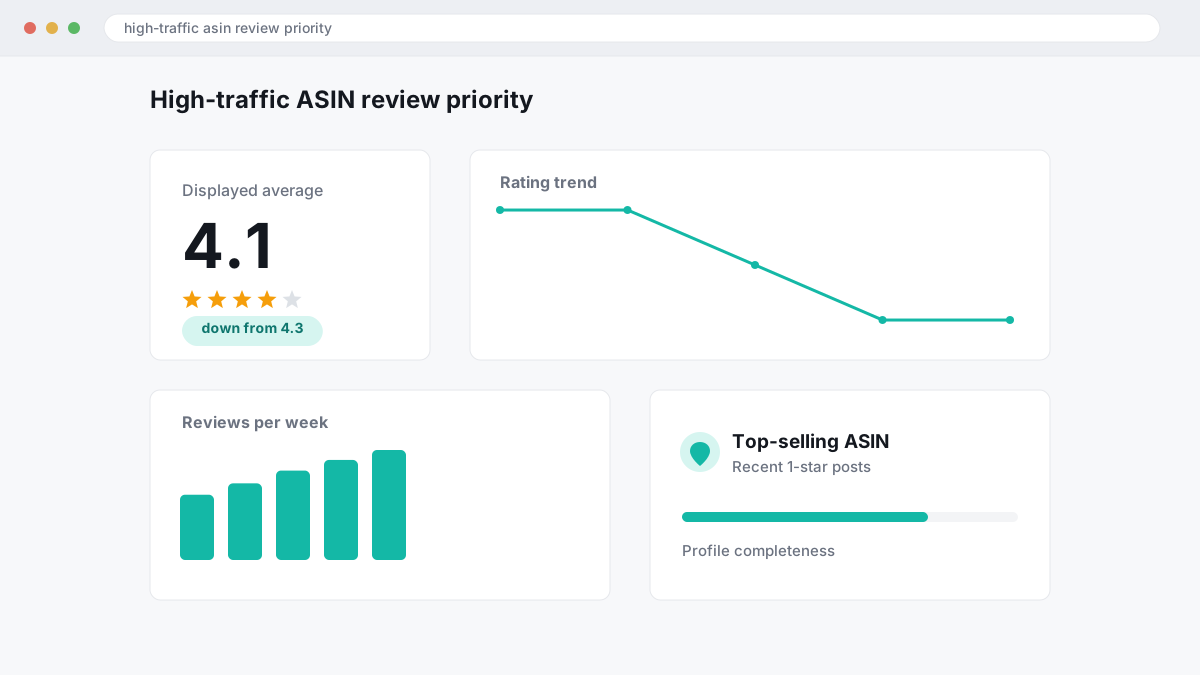
Most sellers chase the nastiest wording first. That fails because a buried complaint from last year often does less damage than a fresh low-star review on a top-selling listing, especially when it pulls the displayed average from 4.3 to 4.1 and dents click confidence before a shopper even reaches your bullets or A+ content. The star-rating impact is rarely linear; that small drop can change how safe the listing feels, which usually shows up in weaker click-through from search and lower conversion once shoppers compare you with a nearby alternative.
If you are choosing where to spend time or budget, start with the pages that already drive revenue. A misclassified Seller feedback vs product review issue belongs near the top of that queue because comments about late shipping, refunds or courier damage can sit on the product page, mislead shoppers about product quality and suppress conversion on a listing that did nothing wrong.
When is a review really seller feedback, not a product review?
A review belongs in seller feedback when it complains about shipping, customer service, packaging, or fulfilment rather than the item itself. Misfiled content is one of the cleaner Amazon removal routes because Amazon can usually verify that the comment targets the seller experience, not the product page.
Most guides treat every bad Amazon review as a product-review dispute. That fails because the report lands in the wrong bucket. Under Amazon Community Guidelines, a product review should help shoppers judge the item, while seller feedback vs product review is a channel split: seller feedback covers dispatch, delivery, returns and service. If an FBA complaint says “arrived late”, “box was damaged” or “seller never replied”, your stronger argument is that the content belongs in seller feedback, and Amazon may strike delivery, packaging or service remarks from the product-review side.
Your evidence is simple: quote the exact sentence, show the listing it sits on, and point out that the text discusses fulfilment rather than product performance. If your first in-platform report gets rejected, that is usually a classification problem rather than proof the review is valid.
How do variant mismatches and catalogue merges create removable reviews?
Variant-mismatch reviews are removable when the wording clearly describes a different child ASIN, size, flavour, model or an unrelated item pulled in by a bad catalogue merge. Amazon is more likely to act when you show the parent-child structure and the wrong product path with screenshots, rather than sending a bare complaint through the report button.
Most guides treat a bad-fit review as permanent because it sits on your detail page. That fails when the review is actually a variant review mismatch — for example, the text complains about a 500ml bottle leaking while your one-litre child ASIN has different packaging and dimensions, or a merged listing surfaces comments from a separate product family. The stronger route is to frame it as a catalogue-structure error and attach a fake review evidence pack with the parent ASIN, child ASINs, variation theme, live detail-page screenshots and the review text highlighted against the wrong model.
Amazon support can verify structure faster than motive. In BGR Review’s case file of 12,000+ negative review cases logged June 2025 to June 2026, outcomes were tracked as removal success, unresolved or unknown, and reviews raised within 28 days with a clear policy issue resolved successfully in roughly 90% of cases; beyond 28 days, comparable cases fell to approximately 25–30%.
Should you handle Amazon review removal yourself or use a specialist?
DIY usually works for obvious breaches under Amazon Community Guidelines, such as abusive or obscene language, personal information, or a review that clearly belongs on seller feedback instead of a product page. A specialist becomes useful when the evidence is messy, several ASINs are involved, or Amazon has already rejected one or more well-documented reports.
The wrong reason to pay is simple frustration with a low star rating. That fails because no legitimate service can promise to delete all negatives, and any pitch built on that claim should put you on guard. The right reason to pay is complexity: your team has already used the report flow, built the basic screenshots, and still needs a tighter fake review evidence pack or a cleaner appeal and escalation workflow.
DIY gives you control and no service fee, but it costs staff time and policy fluency. Across 12,000+ negative review cases logged by BGR Review from June 2025 to June 2026, roughly 90% of businesses who came to us after a failed attempt had used only the basic in-platform report button, with no supporting documentation, and 70–80% of those initial requests had been rejected.
Managed help earns its keep when the same reviewer pattern hits multiple listings, a variant review mismatch crosses child ASINs, or support closes the case with a stock response.
What wording should your Amazon dispute template use to stay clear and credible?
A strong Amazon dispute template is brief and rule-led: identify the review, name the policy breach, list the evidence, and ask Amazon to review it under that specific rule. Clear structure gives support something they can verify under the Amazon Community Guidelines; aggressive wording usually gives them nothing useful to act on.
Start with the exact policy category and paste the full review URL. Then state three facts in one short block: where the review appears on the ASIN, why it violates the named rule, and what sits in your fake review evidence pack, such as order mismatch, reviewer history, screenshots, or catalogue data showing the review targets the wrong variant. Most bad reports threaten, moralise, or mention lawyers, which fails because support cannot process emotion. A better line is: “Please review this post under the Amazon Community Guidelines for [named rule]. It appears on [URL], violates that rule because [fact], and I have attached [evidence] for verification.”
Where do the legal and policy lines sit before you push harder?
Amazon review removal is generally lawful when you report content that breaches Amazon policy or applicable law, such as undisclosed paid endorsements, false factual allegations, or exposure of personal information. The risk starts when you treat honest opinion as removable content, pressure a reviewer to delete criticism, or dress a reputation problem up as a policy complaint.
Most bad disputes fail for one reason: you argue that the review is negative, so Amazon should take it down. That fails because negative sentiment is allowed under the Amazon Community Guidelines if it is genuine product opinion. Stronger action starts where the review crosses a line you can evidence, such as incentivised reviews, a hidden conflict of interest, or a factual claim that is false and verifiable rather than subjective.
The FTC endorsement guides matter if money, free product, affiliate commission, employment, or family ties influenced the review and the relationship was not disclosed. In that scenario, your report is about a misleading endorsement, not thin skin. Country and platform rules differ, though: US FTC standards, UK and EU consumer-protection rules, and Amazon’s own policy stack do not use identical language, so this is general information rather than legal advice.
What should you do after a review comes down so the listing does not stay weakened?
After a review is removed, check whether the visible rating, review order and conversion recover, then fix any product or listing issue the complaint exposed. Removal stops the drag on trust; it does not repair star-rating impact or rebuild buyer confidence on its own.
The wrong move is to celebrate the takedown and stop. That fails because Amazon can leave the listing looking thin for a while: the review count may drop, older comments can move to the top of the page, and conversion can stay soft even after the bad review disappears. Track four things for 14 days: visible rating, review count, conversion on the ASIN, and which reviews sit highest on page one. If a valid complaint pointed to weak images, unclear copy, missing instructions or poor packaging, fix that fast so the next buyer does not write the same thing inside Amazon Community Guidelines.
Use compliant post-purchase follow-up next. Ask for an honest review through Amazon-approved messaging or the request-a-review flow, and never offer refunds, discounts or any other compensation, because that turns into an incentivised-review problem instead of a recovery plan.
Where to go from here
Classify the review before you touch Amazon’s report button. A bad report filed under the wrong policy bucket usually gets a fast rejection, and that first rejection can slow down the next appeal because you now need to reframe the same facts under a stronger section of the Amazon Community Guidelines.
Start with three checks: is it a product review or seller feedback, which policy category fits best, and what proof can you attach now rather than later. Screenshots, order-history gaps, variant mismatch evidence, account links that suggest a conflict of interest, and any abusive or obscene language should sit in one file before you submit anything. If the review is simply harsh but compliant, removal is unlikely and your time is better spent on a public reply that protects click-through rate, conversions and branded search trust.
That first pass usually tells you whether this is a quick DIY report or an escalation job.