

Quick answer
Roofing reputation management means controlling the signals that decide whether a prospect clicks your Google Business Profile, trusts your branch, and asks for an estimate. For most roofers, the priority is Google because it drives map-pack visibility, click-through rate and first-contact trust. The fastest gains usually come from better review request timing after job completion, disciplined response management, and a proper dispute path for reviews that breach platform rules. Google bars fake engagement and undisclosed incentives, so low-quality paid reviews create risk. Where removal is justified, BGR Review charges $0 upfront and $449 per removed review link, only after success.
This page is written from live roofing reputation management work, where the difference between a reply and a removal request changes the outcome. A weak flag usually dies because the business only pressed the in-profile report button and attached no evidence; the stronger route classifies the policy breach first, packages invoices, call logs or CRM records, then chooses the right escalation path and keeps the branch team from arguing in public while the case is open.
That is the level this guide stays at. BGR Review handles verified review campaigns, negative review removal and branch rollout for local-service companies, with a 30-day free replacement guarantee on review packages and a pay-after-success removal model rather than an upfront retainer.
Why does roofing reputation management break when storms hit and crews get busy?
Roofing reputation management breaks when you treat storm demand like normal demand. Review velocity, delayed completions, insurance back-and-forth and crew handoffs all shift the right customer request timing, the right reply window, and the point where a bad review needs removal work rather than a public back-and-forth.
Most local-service guides tell you to fire the same email automation after every job. That fails in roofing because storm jobs bunch together, homeowners stay in claim limbo, and the person who finished the repair is often not the person who collected the final sign-off. Your Google Business Profile can see a burst of map-pack clicks within 72 hours of hail or wind damage, but if reviews arrive in one unnatural spike and then stop, recency fades fast and the profile looks neglected just as branded search demand starts rising.
The better approach is to tie the ask to the crew handoff, not the calendar. Ask when the homeowner has seen the completed roof, the site is clean, and the insurance or payment conversation has reached a natural pause; that point consistently gets more usable responses than a generic three-day drip. In BGR Review's dataset of 1,485 businesses observed from February to July 2026, roofers and other established practices usually needed 30–50 reviews before profile performance stabilised, which is why steady review recency beats a storm-week dump.
Google Business Profile demand also behaves differently from website-led categories. In BGR Review's dataset of trades businesses with complete enquiry-source data, observed from February to July 2026, 70–80% of calls and bookings came through a Google Business Profile or Yelp listing rather than a website. That means missed request timing hits twice: fewer fresh reviews for the local pack, and weaker click-through from homeowners comparing three roofers on the map before they ever fill in a form.
Which roofing reputation fixes move estimate volume and close rates first?
Start with the signals a homeowner sees before they call: fresh reviews, a believable star-rating distribution, and public replies on negative posts. Those change map-pack click-through and estimate trust faster than software dashboards, extra platform logins, or review templates nobody sends.
Dashboard-first spending fails because it measures activity before it fixes the profile that is losing clicks. If your Google Business Profile shows a stale 5.0 average from last season, a thin review recency pattern, and two unanswered complaints about cleanup or no-shows, more software will only report the drop in conversions. Within the same category, at comparable distance, relevance and profile completeness, a 4.7 profile with recent reviews usually outconverts a stale 5.0 because buyers trust a natural star-rating distribution and current proof more than perfection that looks dormant.
Roofing profiles usually need more review depth before performance steadies. In BGR Review's dataset of 1,485 businesses observed February to July 2026, roofers and other established local practices typically accumulated 30-50 reviews before profiles performed consistently. That does not mean you chase volume everywhere. Fix the Google profile first, answer visible negatives, then add steady review demand so branded search, map-pack clicks and booked estimates rise together.
Track the next 8 weeks with three numbers tied to revenue: estimate requests, appointment rate, and lead-to-close conversion. If estimate requests rise but close rate stalls, your profile is winning the click and the sales process is losing the job. If both rise after review recency improves and negative replies are handled properly, you have your priority order and can delay extra software spend.
How should a roofing company improve reviews every week without chasing homeowners manually?
A roofing review system works best with two asks: one at substantial completion, when the homeowner can see the result, and one at final payment or insurance claim closure. SMS sent within 24 hours usually gets the fastest action, but customer request timing matters more than channel when your crew triggers the ask on the same two milestones every week.
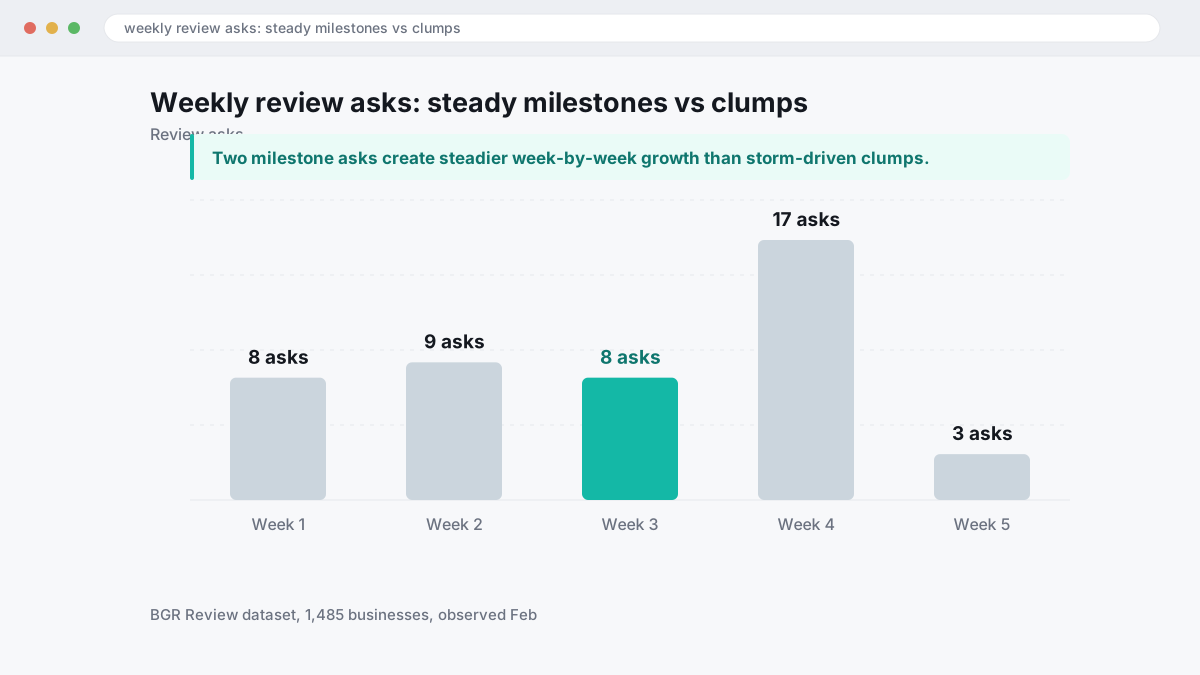
One-off request blasts fail because they follow your office calendar, not the job. After a storm, teams get buried, requests go out in clumps, review recency turns erratic, and your Google Business Profile ends up with spikes that look unnatural compared with steady week-by-week growth. In BGR Review's dataset of 1,485 businesses observed February-July 2026, roofers were among the established local businesses that usually needed 30-50 reviews before profiles performed consistently, so consistency beats the end-of-month scramble.
A crew-triggered workflow works because the request goes out when the homeowner is most likely to answer. The site lead marks substantial completion in your CRM, an SMS goes within 24 hours, and email follows after 48 hours only if the link was not clicked. Then the office reviews one queue every week instead of chasing people manually.
Keep that queue simple and check the same five statuses every Friday.
| Status | What your team does |
|---|---|
| Sent | Confirm the trigger fired from the completed job stage. |
| Clicked | Leave it alone for 48 hours before any backup email. |
| Posted | Log platform mix and assign response management if a reply is needed. |
| Unresolved | Move to second ask at payment or claim closure. |
| Negative follow-up | Route to service recovery first, then decide whether a public reply is appropriate. |
This is the part most guides miss: response management starts before a review goes live. If a homeowner raises an install issue in reply to the SMS or follow-up email, your branch team should fix the job first and pause any second ask. That keeps recency healthy, reduces avoidable negatives, and gives your map-pack clicks a better chance of turning into estimate requests instead of bounced visits.
When should roofers ask for reviews so Google sees steady growth instead of suspicious spikes?
Google expects review growth to track real customer flow on your Google Business Profile. For a roofer, that means smoothing storm-season surges, spacing asks across several days, and avoiding one-day mass sends that create unnatural review velocity on a single service-area profile.
The wrong move is finishing 30 storm jobs, then blasting all 30 homeowners with the same review request on Friday afternoon. That looks like an artificial burst because the request timing is compressed even if the work was genuine, and Google’s filters do not get a note explaining your hail week. In BGR Review’s dataset of 1,485 businesses observed February to July 2026, roofers sat in the group that usually needed 30–50 reviews before profiles performed consistently, so losing a chunk of a burst to filtering hurts your map pack clicks and estimate conversions more than most owners expect.
The better approach is to queue those requests over 7 to 14 days after the completion peak, usually by job-close date, crew, or branch. You still capture fresh sentiment, but the growth curve on the Google Business Profile looks closer to normal buying behaviour, which supports recency without creating a suspicious spike. During slower months, keep a minimum recency target in place even if completed jobs drop: a smaller, steady flow helps click-through rate from the local pack and protects branded search demand better than letting the profile go quiet for weeks.
What should your Google Business Profile show before you spend on more review generation?
Fix your Google Business Profile before you pay for more review generation. Wrong categories, patchy service-area coverage, old job photos and vague review text weaken trust even when your review volume looks strong.
The wrong approach is buying more requests to lift the count while the profile buyers actually inspect still looks thin. That fails because the map pack click happens after a fast comparison: your primary category, the cities you list, the freshness of your roof photos, and whether your recent reviews sound like real roofing work. In BGR Review's dataset of 1,485 businesses observed February to July 2026, established practices including roofers usually needed 30-50 reviews before profiles performed consistently, but count alone did not settle the decision if nearby rivals showed better profile completeness and more relevant recent text.
Check your Google Business Profile against the top three local rivals on the same search terms. Match the closest valid category, make sure service-area businesses cover the cities you genuinely serve, and avoid fake staffed-address signals that create trust problems if the listing suggests a location you do not operate from. Then audit photos and review text: recent reviews should mention reroofing, leak repair, storm cleanup and crew professionalism, because that lifts click-through rate and conversions more than another batch of generic five-star posts.
What do you do the day a bad roofing review goes live?
Treat a new one-star roofing review as a service recovery issue or a removal issue within hours, not days. Fast triage protects lead-to-close conversion, preserves job records, and stops a rushed public reply on your Google Business Profile from weakening a later policy-based challenge.
The wrong move is arguing straight away. Crew leaders get tagged, the office replies defensively, and response management turns into a public dispute that scares off estimate requests from the map pack before you have checked whether the reviewer was even a customer. The right move is evidence-first triage inside 2 hours: classify the review as a genuine complaint, a misunderstanding, or a negative review removal candidate under the platform's review policy, then freeze the facts before anyone contacts the reviewer.
Start the file with the job date, property address, crew name, contract scope, change orders, completion photos, and any text or call notes. In BGR Review's dataset of 12,000+ negative review cases logged June 2025 to June 2026, reviews raised within 28 days of posting and backed by an identifiable policy issue resolved successfully in roughly 90% of cases; for comparable cases raised later than 28 days, the observed success rate fell to approximately 25-30%. Delay costs options.
Reply once in public, calmly, within 24 hours, then move specifics offline. Keep it short: acknowledge the concern, state that you are checking the project record, and give one real contact route such as team@bgrreview.com or your office line if a managed team is handling escalation. Do not accuse the reviewer of lying, do not mention legal action, and do not publish contract details while the case is open.
When can a roofing company remove a review instead of just replying to it?
A roofing company can get a review removed when it breaks platform rules such as impersonation, off-topic abuse, or a non-customer posting as if they hired you. The strongest negative review removal requests tie one clear policy ground to records a reviewer can check fast: CRM entries, job logs, site photos, call or text timestamps, and the service address history tied to that lead.
Most owners argue that a review is unfair. That usually fails. Google Business Profile and Yelp do not remove content because it feels one-sided, harsh, or commercially damaging; they act on policy violations. The right approach is to classify the review first: wrong company, no matching customer, prohibited content, conflict of interest, or copied text posted across profiles in your platform mix. In BGR Review's log of 12,000+ negative review cases recorded June 2025 to June 2026, reviews raised within 28 days of posting and backed by an identifiable policy issue resolved successfully in roughly 90% of cases; for comparable cases raised after 28 days, the observed success rate fell to approximately 25–30%.
The evidence pack decides whether the flag looks credible. For a roofing firm, that usually means your CRM showing no matching lead, production or dispatch logs showing no job at that address, dated roof photos proving the property in the review was never serviced, and communication timestamps showing the reviewer never called, texted, or approved an estimate.
The route changes by platform after the first rejection, which is why roofers lose time treating Google and Yelp as the same job. Google Business Profile starts with the in-profile report flow, then moves to its review management support path where the written policy explanation and attached evidence matter; Yelp starts with a report, then relies on its own moderation review and any follow-up detail you submit through support. Across negative review cases with prior self-filed attempts, 90% of businesses that came to BGR Review after a failed try had used only the basic report button, and 70–80% of those initial requests had been rejected between June 2025 and June 2026.
What does a real roofing review-removal workflow look like from first flag to outcome?
A real removal workflow starts with classification before any public reply goes live. One policy-matched submission with evidence usually beats repeated weak flags, and the next move changes based on whether the platform removes the review, rejects the report or leaves it untouched.
Day 1 is triage. Your branch manager classifies the review against a named rule such as Google Business Profile prohibited and restricted content, Yelp’s content guidelines or Trustpilot’s flagging reasons, then saves full-page screenshots, the review URL, profile ID, dates, reviewer name, and any job records that prove a mismatch. Freeze internal notes at that point. Staff love adding theories after a heated call; that ruins negative review removal because the evidence pack stops looking contemporaneous and response management turns into damage control.
Most roofing teams fail here by hammering the report button five times and posting an angry reply on the same day. That usually fails because the platform sees emotion, not a policy issue. In BGR Review’s negative review cases with prior self-filed attempts, logged June 2025 to June 2026, roughly 90% had used only the basic in-platform report button with no supporting documentation, and 70–80% of those initial requests had been rejected.
Day 2 is one clean filing. Attach the screenshot set, CRM or invoice extract, call log, service address check for service-area businesses, and a short note that matches one rule only. Days 3 to 14 are for a single escalation, not daily resubmissions. Google and Trustpilot usually need different evidence formats, which is why platform mix matters; the same packet rarely works unchanged. If the case stays open, decide whether a holding reply protects map-pack click-through and conversions, then tell the branch team not to accuse the reviewer, admit fault, or mention compensation while review is pending. If removal succeeds, delete the draft reply. If it fails, switch fully to response management and keep the evidence file in case a second route opens later.
Is roofing reputation software enough, or do you need a managed service?
Roofing reputation software sends review invites, tracks alerts and builds reports. It rarely resolves policy disputes, Google Business Profile review appeals or branch-level enforcement on its own, which is where managed help becomes stronger if you are juggling removals, multi-location governance and estimate-volume priorities.
The wrong approach is buying an automation tool and assuming the workflow is finished. That fails as soon as storm demand hits, crews close jobs out of sequence, and one marketer has to manage Google, Yelp, Trustpilot and sometimes Clutch as a platform mix while also replying to complaints and checking whether a bad review breaks a named policy. A software dashboard will tell you a review landed. It will not package evidence, choose the right escalation route, stop branch managers from arguing in public, or decide whether the review is hurting map-pack click-through more than lead-to-close conversion.
This is the practical split.
| Need | Software only | Managed service |
|---|---|---|
| Invite sends and alerts | Automates SMS/email request timing and reporting | Usually included, with branch rollout rules and follow-up handling |
| Disputed review removal | Usually limited to the in-platform flag button | Fixed price per removed link |
| Branch control | Data without enforcement | Multi-location governance, reply approvals and escalation rules |
| ROI check | Shows review volume | Compares labour hours saved against recovered calls, form fills and close-ready estimates |
The right choice depends on bandwidth. If one branch has stable review recency and no disputes, software may be enough. If you have several branches, storm-driven spikes, or one fake review can choke conversions for a high-value service area, operator-led reputation management usually pays for itself faster because it protects branded search demand, steadier map-pack clicks and the sales team's time.
How do multi-location roofing companies keep branch reviews growing without losing control?
Multi-location roofing brands need local review growth with central control. The model that holds up is branch-triggered review requests, centrally approved templates, one location-level scorecard, and clear escalation rules for removals, replies and storm-season surges so one branch does not create account-wide risk across every Google Business Profile.
The wrong setup gives each branch manager free rein. One office texts every homeowner the same day, another waits a week, a third offers a discount for a review, and a fourth replies emotionally when an owner posts photos of a missed tarp job. That fails for two reasons: review velocity becomes uneven across locations, and improvised language creates platform and legal risk. Google Business Profile reviews sit at location level, so your map-pack click-through and branded search demand rise or stall branch by branch, not from a polished corporate page.
The workable setup keeps local execution and removes local improvisation. Your branch teams trigger requests from the job-complete stage or final invoice stage, but they use central templates, central approval rules and one KPI scorecard across every office: review recency, star-rating distribution, response time, open disputes and estimate-to-close trend by branch. Service-area businesses still need location-specific asks even without showroom traffic, because the customer hired the Dallas crew or the Bristol crew, not “head office”. If a review looks fake, defamatory or off-platform, branch staff should log the job data and stop there; corporate owns the response and any negative review removal escalation.
Which review request template actually fits a roofing job without sounding scripted?
A roofing review request works best when it sounds tied to the job that just finished, stays brief, and can be sent from the field in under a minute. Mention the completed scope, use the homeowner’s first name, send one direct Google Business Profile link, and leave out rewards, discounts, or any language that filters who should reply.
Generic blast copy fails because it reads like office automation: “Please rate our service” could describe a roof replacement, a gutter cleanup, or a takeaway order. That hurts customer request timing and response rates. Crew-ready copy works because it names the repair, replacement, gutters, or cleanup the homeowner has just seen completed, which makes the ask feel earned and lifts the chance that your map pack clicks convert into calls later.
Use these exactly as written, then swap the job type and link.
SMS: Hi Sarah, thanks for choosing us for your gutter cleanup today. If you have 30 seconds, would you share a Google review here: https://g.page/r/EXAMPLE/review? Your feedback helps other homeowners find our team.
Email: Subject: Thanks for choosing us
Hi Sarah,
Thank you for trusting us with your roof repair today. If you can spare a minute, please leave a Google review here: https://g.page/r/EXAMPLE/review
Your feedback helps our Google Business Profile and gives our response management team something specific to reply to if neighbours ask about the job.
Thank you,
James
Send it after completion, once the site is clean and the homeowner has seen the finished work. That timing beats next-week follow-up because the job details are still fresh.
Are paid, gated or filtered roofing reviews worth the risk?
Paid, gated or selectively filtered roofing reviews create platform and legal risk that usually outweighs any short-term rating lift. Google can remove reviews, strip review volume from a profile, or suspend Google Business Profile visibility, and undisclosed paid endorsements can raise FTC endorsement guide issues in the United States.
The wrong approach is easy to spot after a storm: offer rewards for five-star posts, send only happy homeowners to Google, or use a mixed platform strategy where weaker feedback gets diverted to a private form while public reviews are filtered. That fails because fake or incentivised reviews break Google’s policy against fake engagement, and gated collection can leave an unnatural star-rating distribution and review velocity that does not match real crew output. The lift looks good for a week. The downside hits your map pack visibility, click-through rate and conversions when reviews disappear or the profile is suspended.
The safer approach is plain: ask every eligible customer, use the same request path across your platform mix, and disclose any compensation where local law and platform rules require it. In the US, the FTC endorsement guides require clear disclosure of paid endorsements; other countries apply different consumer-protection rules, and platforms such as Google, Yelp and Trustpilot each enforce their own standards. This is general information, not legal advice.
Where to go from here
Start with one branch, one crew and one platform. Set a fixed request point at practical completion or the first leak-free check-in, track review recency and star-rating distribution on your Google Business Profile for 30 days, and watch what happens to map-pack click-through, calls and form fills before you add more software or another vendor. Roofing demand moves with storms and seasonality, so you need a request cadence that your crews can repeat during busy weeks, not a campaign that works only in calm periods.
If a new review looks fake, abusive or otherwise policy-breaking, do not argue inside the thread first. Save the review URL, job records, call logs, photos, technician notes and any proof the reviewer was never a customer, then classify the likely policy issue before you flag it. That gives you a removal case rather than a complaint. Expect clarity first: keep, reply, or escalate.