

Quick answer
Online reputation affects discovery, click-through rate and conversions before a buyer calls, books or fills in a form, so a useful 2026 statistics page has to separate review volume, star rating, recency, response speed and branded-search sentiment instead of recycling old averages. At BGR Review, after serving 15,000+ businesses, the pattern is consistent: profiles improve faster when you keep fresh review velocity, answer reviews quickly, and remove ineligible content through the right platform route, rather than chasing vanity totals across Google Business Profile, Trustpilot, Yelp and other mixed-value profiles.
This page is built the way an operator would audit a live profile: source date first, platform rules second, then the commercial effect on the map pack, branded search results and enquiry quality. We work with review acquisition and negative review removal every day, and the details matter — a Google flag filed with only the in-platform report button often stalls, while the same case backed by screenshots, order records and a clear policy ground has a very different path.
We also separate what is observed from what is guaranteed. BGR Review's own records cover 12,000+ negative review cases logged June 2025 to June 2026, with outcomes tracked as success, unresolved or unknown, and removal is still pay-after-success at $449 per removed review link with $0 upfront.
Which online reputation statistics actually change decisions in 2026?
The statistics that change decisions in 2026 are the ones tied to an action, not the ones repeated in every roundup. Prioritise source-dated numbers that map to sales, local visibility, compliance risk or recovery speed, and treat any pre-2023 figure as unverified until you check the original source.
Most reputation roundups still recycle vanity percentages with no source year, no sample and no operational use. That fails fast when you are deciding whether to push Google review generation, fix a weak Trustpilot profile, respond faster on Yelp, or clean up branded search results, because each surface affects a different buyer moment and a different risk profile.
Use the data in decision buckets instead.
| Decision bucket | Platforms | What to trust in 2026 |
|---|---|---|
| Sales impact | Google, branded SERPs | Use current review volume, star-rating distribution, recency and response coverage from your own profiles. In BGR Review's dataset of 1,485 businesses observed February-July 2026, trades firms with complete enquiry-source data attributed 70-80% of calls and bookings to Google Business Profile or Yelp listings. |
| Compliance risk | Trustpilot, Yelp, branded SERPs | Check named rules, not blog summaries: the FTC's endorsement guides and 2024 fake review rule, platform terms on incentivised or misleading reviews, and any false factual claims that raise defamation issues under local law. |
| Operational control | Google, Trustpilot, Yelp | Track what you can directly change this month: review request timing, response time, evidence quality on flags, and review velocity by location. BGR Review logged 12,000+ negative review cases from June 2025-June 2026, and outcome records showed case age sharply changed removal prospects. |
The right approach works because it separates unlike signals. Google and Yelp often drive map-pack clicks and calls, Trustpilot can shape conversion on branded comparison searches, and branded SERPs tell you whether review pages outrank your own site for your name. Those are different decisions, so they need different statistics.
How does online reputation affect sales once a buyer actually sees your brand?
Online reputation affects sales in four steps: impression, click, shortlist and conversion. A buyer reads your rating, snippets of review text and the tone of your branded search results before they call, book or fill in a form, so revenue moves before any sales conversation starts.
The wrong approach is to treat reputation as a traffic problem. You buy ads, rank a service page, or push a Google Business Profile into the map pack, then assume the hard part is done. It fails because the click happens through a trust filter first: if your brand name shows weak review text, an unanswered one-star complaint, or a thin profile with poor recency of reviews, people either skip the click or arrive ready to doubt you, which drags lead quality down.
The right approach is to manage the result a buyer sees at the moment of intent. That means keeping your Google Business Profile active, adding steady review volume through compliant review generation methods, responding fast enough that the public reply appears in the snippet trail, and fixing damaging false statements through the proper flagging or appeal route where platform policy allows it. BGR Review sells both verified review packages with a 30-day free replacement guarantee and negative review removal on a pay-after-success basis at $449 per removed link with $0 upfront, because weak sentiment in branded search results keeps hurting conversion even after strong ad traffic lands.
When does review volume start helping trust and local visibility enough to matter?
Review volume starts to matter when it changes how you compare with nearby rivals, not when you hit a universal target. Buyers and Google Business Profile both read count as proof of real demand, but the payoff depends on category competition, location density, recent review flow and how complete the profile is.
Most guides push a magic threshold such as “get 10” or “get 50”. That fails because review volume does not work on its own. A profile with 18 recent reviews, a 4.7 average, services filled in, fresh photos and active replies can win more map-pack clicks and stronger conversions than a profile with 60 stale reviews and weak profile completeness. Google’s local system rolls relevance, distance and prominence together, so count helps most when the rest of the profile is already credible.
In BGR Review’s own dataset of 1,485 businesses observed from February to July 2026, new trades and local service businesses that reached 20–30 reviews in their first three months were associated with improved local visibility, though other ranking factors were active at the same time. That does not mean 20 is the number for everyone. A 20-review gain can move you sharply in a thin category or smaller town; in a crowded metro, the same gain may only narrow the trust gap until recency, rating distribution and branded search demand catch up.
How much does star-rating distribution matter once buyers compare you with close alternatives?
Star ratings matter more as a pattern than as a lone average. When two businesses sit within 0.2 stars of each other, buyers usually judge the spread of recent 5-star, 3-star and 1-star reviews, plus any unresolved complaint trail, before they click or call.
The wrong approach is to fixate on a 4.8 and assume the average closes the sale. That fails because a 4.8 can hide a fresh cluster of 1-star complaints, or a page full of glowing but stale praise from last year, and both issues depress click-through from the local pack once a buyer opens the profile. Google Business Profile, Trustpilot and Yelp all display rounded stars, but the underlying star-rating distribution still shapes trust because people read the newest review text for complaint mix, staff names, delivery dates and whether you replied.
The better read is average plus distribution plus review velocity. If your last 10-20 reviews are recent, varied in wording and mostly resolved when problems appear, the profile converts better than a near-identical average with dead recency or repeated complaints. If you use review generation methods, judge them that way; at BGR Review, our review packages include a 30-day free replacement guarantee, but replacement alone will not fix a profile where the latest negatives remain unanswered.
Why do recent reviews and response speed keep showing up in the strongest reputation datasets?
Recent reviews and fast replies cut buyer uncertainty. A profile with steady current feedback and visible owner responses looks active and credible, while a profile living on old praise can look neglected even if its lifetime average still sits high.
The wrong approach is leaning on a strong all-time rating and ignoring the recency of reviews. That fails because buyers checking a Google Business Profile, Trustpilot page or Yelp listing are trying to answer a current question: “What happens if I deal with this company now?” Fresh review velocity does that. A cluster of reviews from the last few weeks tells them your service level is current, your staff are still delivering, and your map-pack click-through is less likely to stall on first inspection.
The right approach is to pair current customer proof with short review response time. A same-week reply works because it shows live service recovery in public: you noticed the problem, answered it, and gave the next buyer less to worry about. A 30-day-late apology usually reads as damage control. In BGR Review’s recovery workflow, the public response goes up early, before any removal appeal finishes, because unanswered criticism depresses conversions faster than an imperfect but prompt reply.
How should you read Google, Trustpilot, and Yelp statistics without mixing unlike signals?
Platform statistics are not interchangeable. Google Business Profile usually tells you most about local discovery and map-pack click behaviour, Trustpilot says more about ecommerce reassurance and branded search sentiment, and Yelp needs extra caution because its recommendation software can hide reviews that still reflect real customer feedback.
The wrong approach is averaging everything into one score and then buying the same fix everywhere. That fails because each platform measures a different buying moment: Google Business Profile affects whether you appear and get clicked in Maps, Trustpilot often shapes what a shopper thinks after searching your brand name, and Yelp can make review volume look weaker than the underlying customer response because some feedback is “not currently recommended” under Yelp’s recommendation software.
This platform-by-platform reading works because it matches the signal to the decision. In BGR Review’s own dataset of 1,485 businesses observed February to July 2026, trades firms with complete enquiry-source data attributed 70–80% of calls and bookings to a Google Business Profile or Yelp listing, which makes local profile health more urgent than a prettier cross-platform average for many service firms. Ecommerce brands often feel the damage later, in lower branded-search click-through and weaker conversion once a buyer lands on Trustpilot and starts reading recency, reply quality and complaint patterns.
Use this quick reading frame before you act.
| Platform | What the numbers usually mean | What to check before spending |
|---|---|---|
| Google Business Profile | Local pack visibility, Maps clicks, call intent, review recency | Star spread, fresh reviews, response speed, category match |
| Trustpilot | Brand reassurance during ecommerce research and branded search | Recent complaint themes, reply quality, verified-order flow |
| Yelp | Local service trust, with raw counts reduced by filtering | Recommended vs filtered reviews, service category norms, city-level user base |
Which reputation fixes usually pay back first when budget and time are limited?
The quickest payback usually comes from fixing recency gaps, clearing a visible response backlog, and repairing weak review generation methods. Those three move buyer confidence faster than a rebrand, a legal threat, or months of content work.
The wrong starting point is usually branding: new photography, a rewritten homepage, fresh social posts. That fails when your Google Business Profile or Trustpilot page still shows no recent feedback and two unanswered one-star reviews at the top, because the local pack and branded search clicks leak before your new assets get seen. If you sell a service like BGR Review does, the order still stays the same even when budget is tight.
Fix recency first when nearby competitors look active. In BGR Review's dataset of 1,485 businesses observed from February to July 2026, new trades and local service firms typically saw first reviews around two weeks after launch, and reaching 20-30 reviews over the first three months was associated with better local visibility. That is why stale review recency usually costs more than an outdated banner image.
Fix response time second, starting with the negative reviews that already rank on your profile and in branded search. A short, factual reply on Google or Yelp will not erase the complaint, but it does change click-through and conversions because the next buyer sees that you answer.
Improve review generation methods third, once profile hygiene is stable. Use compliant request timing, job-completion triggers, and channel-specific asks rather than blasting the same message everywhere; if you need help, BGR Review starts review delivery in 24-48 hours and backs review packages with a 30-day free replacement guarantee.
Should you use reputation software or an agency when the goal is measurable improvement?
Use software when your team can run the work every day. Use an agency when response speed, consistency, or removal handling keeps slipping, because measurable improvement depends less on features than on who actually monitors alerts, replies, escalates issues, and reports progress each week.
Most buyers compare software by feature checklist. That fails when the bottleneck is execution capacity. Review generation methods, response drafting, escalation paths, and multi-location reputation management all look tidy in a dashboard, but the map pack and branded search only improve when someone sends the requests, checks recency gaps, approves replies, and chases unresolved platform actions on time.
The practical split looks like this.
| Need | Software usually fits | Agency usually fits |
|---|---|---|
| Requesting and tracking reviews across locations | Centralises requests, alerts, routing, and reporting for multi-location reputation management | Builds the cadence, trains staff, and fixes drop-off when local teams stop sending requests |
| Negative review removal | Flags reviews, but your team still needs evidence, policy matching, and follow-up | Fixed price per removed link |
| Response lag | Shows alerts quickly | Usually costs more, but cuts internal delay that hurts click-through rate, conversions, and review recency signals |
If removal work is part of the brief, software alone usually stalls after the first rejection. In BGR Review’s dataset of 12,000+ negative review cases logged June 2025 to June 2026, roughly 90% of businesses that came to us after a failed attempt had used only the basic in-platform report button, and 70–80% of those initial requests had been rejected. That does not mean software is weak. It means software organises tasks, while an agency takes ownership of the parts that require judgement, policy reading, and repeated follow-up.
Are paid reviews illegal, and where do the real compliance lines get crossed?
Paid reviews turn risky when the incentive is hidden, the reviewer is not genuine, or the claim itself is false. Under the FTC endorsement guides, disclosure is the line that matters in the US, and platforms can delete reviews or restrict an account long before any regulator or court gets involved.
The wrong approach is buying undisclosed praise and treating it as ordinary customer feedback. That fails because the FTC expects incentivised endorsements to be clearly disclosed, and platforms apply their own rules faster than any legal process: Yelp bars compensated recommendation requests and can remove content under its policies, while Google and Trustpilot can also pull reviews that look deceptive or policy-breaching. If you use any review generation method that involves an incentive, the safer route is obvious disclosure, a real customer relationship, and wording the reviewer writes themselves. BGR Review sells review and removal services, so the compliance point matters directly: a 30-day free replacement guarantee on review packages does not override platform rules, and it should never be read that way.
False factual claims are a separate risk. A review that says “this clinic billed me twice” or “this contractor never turned up” can move from opinion into defamation and false statements if the fact is untrue, but the legal test varies by country and platform, including UK and US differences, so this is general information rather than legal advice.
What actually happens after a bad review lands and you need to recover fast?
Review-crisis recovery starts with classification, not panic. Sort the review into a removable policy breach, a genuine service complaint, or a false factual statement, secure the evidence that day, post a measured public reply if needed, and then use the platform’s appeal route with documentation.
Most guides tell you to argue in public first. That fails because the first hour is when screenshots, timestamps, order records, call logs, staff notes and profile URLs are easiest to preserve, and those details decide whether negative review removal has a real basis or whether you need service recovery instead. On Google Business Profile, a review that alleges something false can still stay live unless you can tie the claim to a clear policy issue or show that the reviewer was never a customer; a rant and a false statement are treated differently, and defamation claims depend on jurisdiction, platform rules and proof. This is general information, not legal advice.
The timelines then split. Your public response should usually go up quickly, stay short, and avoid arguing facts you may need in an appeal; your private outreach can run in parallel if the complaint looks genuine. Flagging on Google Business Profile often starts with the in-profile report flow, but the basic button alone is weak: in BGR Review’s dataset of 12,000+ negative review cases logged June 2025 to June 2026, roughly 90% of businesses who came to us after a failed attempt had used only the basic in-platform report button with no supporting documentation, and 70–80% of those initial requests had been rejected.
If removal fails, the recovery plan changes from takedown to replacement. You keep the reply live, close the service issue privately if one exists, and then rebuild review recency with compliant review generation methods rather than chasing a public fight.
How does reputation management change when one brand runs many locations?
Multi-location reputation management is an operations problem before it is a reporting problem. Once you add branches, reply ownership, escalation rules, and consistent reporting matter more than one location's average rating.
The wrong approach is to run ten, twenty or fifty locations with single-profile habits: one shared inbox, branch managers replying ad hoc, and no rule for who handles a policy breach, a service complaint or a possible fake. That fails because review volume rises faster than accountability does. One careless public reply can create a brand-wide compliance issue, especially where staff mention incentives, personal data or disputed facts that should have gone into a private evidence file instead.
The right approach is governed access inside Google Business Profile: location groups, least-privilege permissions, named owners for first response, and a single playbook for response tone, escalation timing and review generation methods. That works because each branch keeps local relevance in the map pack while head office keeps control of branded search results, compliance wording and reporting consistency. You need branch-level scorecards, but one master view for response time, unresolved issues and review routing.
What should an online reputation audit checklist include before you set targets?
A useful reputation audit checks visibility, trust signals and risk in one pass. Start with your Google Business Profile, branded search results, major review platforms such as Trustpilot, and any unresolved negative reviews, then score each issue by urgency and likely commercial impact inside the next 30 days.
Most audits fail because they dump screenshots and averages into a slide deck. That gives you inventory, not a decision. The better approach is to check what a buyer actually sees first: your average rating, review count, recency of reviews, reply backlog, platform coverage, branded search results, Google knowledge panel accuracy, and whether third-party profiles outrank your own site for your brand name. That works because it ties the audit to click-through rate, map-pack trust and conversions, instead of producing a long list nobody owns.
Use a simple action score so the next 30 days are obvious.
| Check | What to look for | 30-day score |
|---|---|---|
| Google Business Profile | Rating, review volume, recent review velocity, unanswered reviews, wrong categories or hours | Impact, effort, policy risk |
| Trustpilot and other profiles | Profile claimed or unclaimed, rating gap versus Google, stale review feed, missing replies | Impact, effort, policy risk |
| Branded search results | Knowledge panel accuracy, negative articles or profiles on page one, weak owned assets | Impact, effort, policy risk |
Score high-impact, low-effort fixes first, and separate policy-sensitive work from routine review generation.
What should you do next if the numbers show a real reputation gap?
Start with the smallest visible problem buyers can already see: old reviews, unanswered complaints, or a request flow that never fires after the job. Then compare the three rivals winning clicks in your local pack or branded search, assign one owner for the next 30 days, and only push negative review removal where the evidence matches platform policy or a false statement of fact.
Trying to fix everything at once usually fails because review generation methods, public replies, and appeals get spread across sales, support, and whoever checks Google Business Profile last. The better sequence is simpler: benchmark your top three competitors on average rating, review recency, and response backlog first, then close the most visible gap. If your profile has fresh five-star feedback but two unanswered complaints from last month, review response time is the faster win because buyers see it before they read your tenth praise review.
Give one person clear weekly ownership of collection, replies, and escalation for 30 days. Escalate removal only when the review appears to breach a named platform rule or rests on a provably false factual claim; if the proof is thin, reply publicly and keep collecting legitimate new reviews instead.
Where to go from here
Your priority order is simple: fix review freshness first, lift response coverage second, then deal with high-risk negative reviews that allege false facts, target the wrong business, or threaten map-pack click-through on your main Google Business Profile. Fresh, recent reviews help branded search results look current. Fast, visible replies steady conversions from people comparing you against two or three nearby profiles.
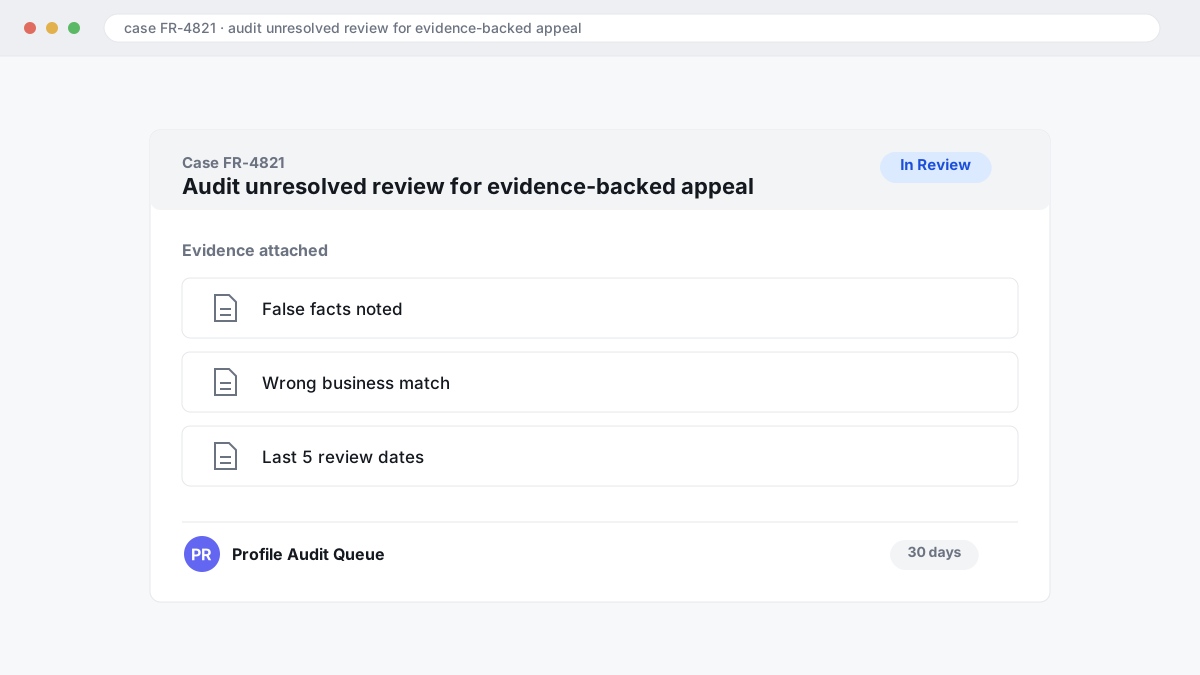
Your next step is to audit one location or one core profile today. Check the date of your last five reviews, your reply rate over the last 30 days, and any unresolved review that could support a policy flag, defamation complaint, or evidence-backed appeal. If removal is realistic, act early: in BGR Review's case file of 12,000+ negative review cases logged June 2025 to June 2026, reviews raised within 28 days with a clear policy issue resolved successfully far more often than older cases.
If your volume is low and the issue count is small, DIY tools and a tight review request workflow are usually enough. If you are juggling multiple locations, recurring false reviews, or platform-specific disputes across Google, Trustpilot and Yelp, managed support saves time.