

Quick answer
Local SEO is the work that gets your business into Google’s local pack, Google Maps and nearby organic results when someone searches for your service. Google Business Profile Help states local ranking depends on relevance, distance and prominence. Your first jobs are practical: complete your Google Business Profile, keep your name, address and phone consistent across key listings, publish service and location pages that match search intent, and run a steady process for legitimate reviews and replies. If a fake or policy-breaking review is live, handle it early because it cuts click-through rate, calls and bookings before rankings move.
This page is written from live reputation and profile work, not from generic SEO theory. At BGR Review, we deal with review acquisition, review responses and removals across Google, Trustpilot, Yelp, Clutch and TripAdvisor, and our removal model stays simple: $0 upfront and $449 only after a review link is removed.
The detail matters. A weak flag usually fails because the business only pressed the in-platform report button and attached no evidence, while a workable case starts with claim triage, policy mapping, screenshots, order records or call logs, then a flag and escalation path that matches the platform’s own rules. That is the lens used here, because local seo decisions get expensive when you fix the wrong thing first.
Why are calls low even when your business already shows up nearby?
Low calls usually come from one of three faults: weak local pack rankings, weak click appeal in the map results, or weak trust after the click. Compare your map visibility, star rating, review recency and profile completeness before you assume you need a full local SEO rebuild.
The wrong move is rebuilding pages, changing categories and rewriting your whole site before you check whether people already see you and then choose someone else. That fails because a business can sit in the top three nearby and still lose calls if the profile shows a 4.1 average, stale customer reviews, thin photos, or unanswered complaints. In BGR Review's dataset of trades businesses with complete enquiry-source data, observed February-July 2026, 70-80% of calls and bookings were attributed to a Google Business Profile or Yelp listing rather than a website, which tells you where the conversion leak often sits.
The right move is simpler. Open your Business Profile performance data and compare impressions, clicks, calls and direction requests before you touch service pages or citations. If impressions are healthy but actions are weak, you have a behavioural signals problem driven by poor click-through rate and trust, not a visibility problem; fresh legitimate reviews, better review responses and a fuller profile usually move faster than a full rebuild. That distinction matters because BGR Review sells review growth and pay-after-success removals at $449 per removed link with $0 upfront, but plenty of low-call cases need diagnosis first, not a bigger package.
Which local SEO fixes usually move first for a small business?
For most small businesses, the quickest gains in local SEO usually come from a fully built Google Business Profile, stronger customer review signals and tighter service pages. Citation cleanup and local backlinks help, but they tend to pay later, after trust and relevance problems on the profile and site are fixed.
Most guides give every task the same weight. That fails because your calls, bookings and map-pack click-through rate usually move first where Google can see service relevance, review recency and profile completeness in one place. In BGR Review's dataset of 1,485 businesses observed from February to July 2026, trades businesses with complete enquiry-source data attributed 70–80% of calls and bookings to a Google Business Profile or Yelp listing, which is why profile work usually beats background citation work early.
The better order is simple: finish the Google Business Profile, tighten the service pages around the jobs you actually want, then build fresh legitimate customer reviews with replies. That works because the profile affects local pack visibility, the page gives Google a clear destination for intent, and review quality changes both trust and conversions before a searcher ever reaches your contact form. A page called “Plumbing Services” is weaker than separate service pages for emergency plumber, boiler repair and leak detection tied to the right location signals.
Clean up citations after that. NAP consistency still matters for trust, but fixing ten old directory listings rarely beats adding missing categories, services, photos, review responses and stronger page copy. Track rankings, calls, direction requests and form fills every week for 8–12 weeks before you judge the channel, otherwise you end up rewriting a working setup too early.
How do reviews change local SEO before backlinks or blog content do?
Reviews change local SEO through trust, recency and decision-stage conversion before backlinks or blog posts usually do. A profile with recent, credible customer reviews and sensible owner replies will often generate more calls than a similar profile with stronger traditional SEO signals but weaker reputation signals.
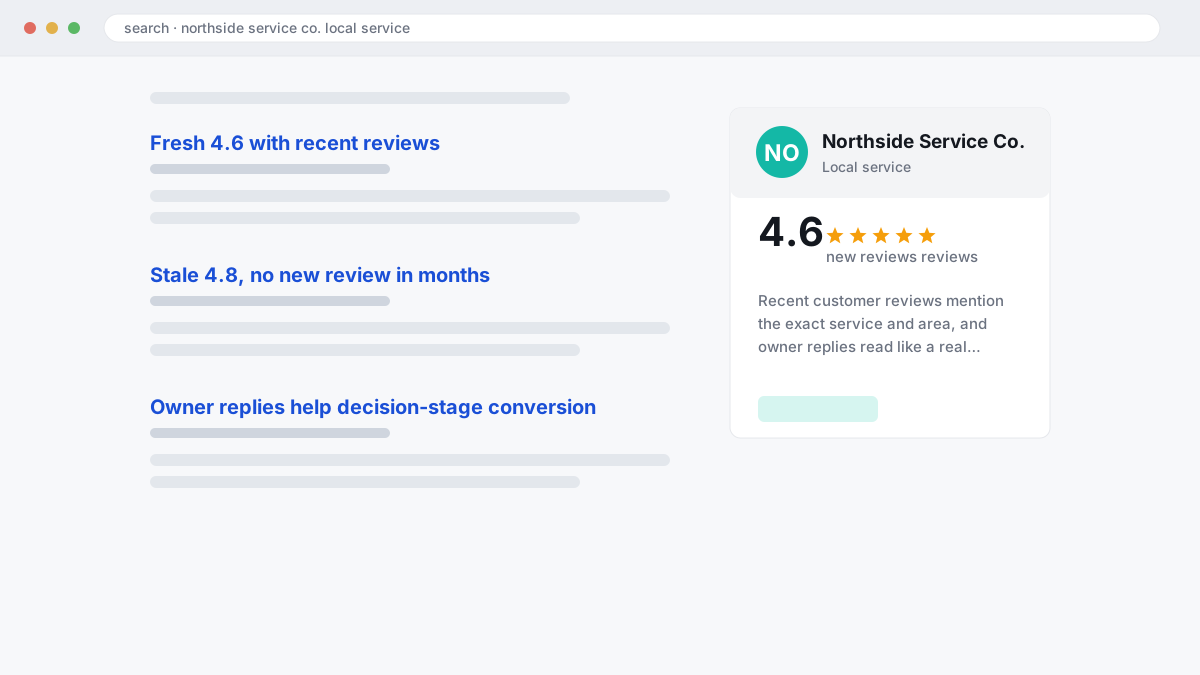
Most guides treat reviews as a checkbox: get some stars on your Google Business Profile and move on. That fails because the searcher decides before they click. A stale 4.8 with no new review in months and no review responses can lose calls to a fresh 4.6 where the last few reviews describe the exact service, mention the area, and show the owner replying like a real operator. In BGR Review's dataset of 1,485 businesses observed from February to July 2026, trades businesses that reached 20-30 reviews over the first three months were associated with improved local visibility, though other ranking factors were active at the same time.
The mechanism is simple. Customer reviews raise click-through from the local pack when they look current and believable, then review responses help conversions because the reader can see how you handle delays, complaints and job follow-up before they call. Those clicks and calls create behavioural signals Google can observe at profile level, even if Google never tells you the exact weighting. You feel it first in bookings and form fills, then in branded search demand, long before a blog post earns a local backlink.
If a review breaks platform rules, the damage can sit below the ranking layer. Google may keep your position roughly where it is, but a fake allegation, competitor post or abusive review can still cut conversions because the warning sits in plain view.
How do you do local SEO in the right setup order?
Do your local SEO in this order: fix your Google Business Profile, match your website to your services and locations, clean core citations, set a review request and reply routine, then chase local links and supporting content. That order cuts wasted work and gets you to calls faster.
The wrong setup is a random task list: one week posting on your profile, the next buying directory submissions, then asking for backlinks before your service pages exist. It fails because Google weighs relevance, distance and prominence together, and a half-built site with mismatched NAP details gives weak signals even if your profile already appears nearby. In BGR Review's dataset of trades businesses with complete enquiry-source data, observed February to July 2026, 70-80% of calls and bookings were attributed to a Google Business Profile or Yelp listing, which is why the profile and core website setup come first.
The right setup starts with your Google Business Profile categories, services, opening hours, business description and photos, then moves to local keyword research that maps one primary intent to each page. Build service pages before you spend time on local backlinks or frequent posts. A plumber needs clear pages for emergency plumber, boiler repair and leak detection in the actual towns served; one generic homepage rarely converts map-pack clicks into calls.
Use one owner and one weekly checklist for a 30-day rollout. One person should control edits, review request timing, citation corrections and page updates, otherwise changes collide and nobody knows what moved the needle.
| Week | Primary job | What “done” looks like |
|---|---|---|
| 1 | Google Business Profile | Correct categories, services, hours, photos, call tracking decision, reply owner set |
| 2 | Website basics | Core service pages live, titles and headings aligned to local keyword research, phone number prominent |
| 3 | Citations and reviews | Top citations corrected, NAP consistency checked, review request workflow live, reply templates approved |
| 4 | Expansion | Only then start local backlinks, supporting content and event or partner mentions |
If you outsource the review part, keep the rules straight.
Which Google Business Profile changes affect map-pack visibility most?
Your Google Business Profile moves map-pack visibility most through accurate categories, complete service details and credible review signals. Posts and small cosmetic edits can help freshness, but wrong categories or thin service data weaken relevance before other tweaks can lift local pack rankings.
Most guides push constant posting, weekly photo uploads and minor profile edits as if activity alone moves you up. That fails when your primary category is off, because Google sorts local results through relevance, distance and prominence, and category choice is one of the clearest relevance signals you control inside the profile. If you are a locksmith using a broad home services label, or a personal injury solicitor filed under legal services, you can sit close to the searcher and still lose map-pack clicks and calls to a better-matched listing.
The better order is plain: fix the primary category first, then tighten secondary categories, then fill in services, hours and photos so the profile answers buyer questions fast. Complete service menus and accurate opening hours improve usefulness, raise click-through rate from the map pack and help conversions because the searcher does not need another step to decide whether to call. In BGR Review's dataset of 1,485 businesses observed from February to July 2026, trades businesses with complete enquiry-source data attributed 70-80% of calls and bookings to a Google Business Profile or Yelp listing, which is why thin profile data costs real leads.
Google Posts support freshness and can reinforce branded search demand when they reflect real offers, seasonal jobs or recent work. Categories still matter more. A polished profile with weekly Posts rarely outranks a simpler listing whose category, services and hours match the query exactly.
How do service pages and local keywords turn visibility into leads?
A service page turns local visibility into calls when it matches one buying intent, one place served and one clear next step, which is why a strong “Emergency Plumber in Bristol” page will usually outpull a stack of thin city pages.
Most weak local SEO builds location-stuffed pages first: “plumber in Bristol”, “plumber in Bath”, “plumber in Weston-super-Mare”, all saying the same thing with a town name swapped. That fails because Google reads thin duplication, and the visitor who lands there gets no proof, no pricing cues, no service detail and no reason to call. A service-led landing page works better. Build one proper page for each revenue service, use service terms plus city or area modifiers naturally in the title, H1 and subheadings, and write for the job the person needs done today.
Your local keyword research should start with conversion intent, not search-volume vanity. “Boiler repair Bristol”, “blocked drain near Clifton” and “same-day electrician Camden” carry clearer lead value than a generic “home services” page, so they lift click-through rate and conversions even if the page never ranks for every variation. In BGR Review’s dataset of trades businesses with complete enquiry-source data, observed February to July 2026, 70–80% of calls and bookings were attributed to a Google Business Profile or Yelp listing, which makes the landing page linked from that profile part of the sale, not a brochure.
Internal links matter here. Link each service page from the homepage, from the relevant navigation path, and from the Google Business Profile landing page you use for that service area, because stronger discovery helps Google connect relevance and helps users reach the page that can actually convert the visit into a call or form fill.
When does citation cleanup matter, and when is it wasted effort?
Citation cleanup matters when your name, address and phone details changed, your Google Business Profile has duplicates, or old listings still point to the wrong location; outside those cases, mass-directory work rarely lifts calls before profile quality and review trust do.
The wrong approach is buying hundreds of citations because a checklist said “more directories”. That fails when your core NAP consistency is already fine but your Google Business Profile has thin service detail, weak review recency or a duplicate listing splitting signals and map-pack clicks. If you are deciding where to spend first, BGR Review usually tells clients to fix trust blockers before extra directory volume, because review repair changes click-through rate and conversions faster than another batch of low-value listings.
Fix the platforms that feed the rest of the local ecosystem first.
| Fix first | Why it matters |
|---|---|
| Google, Bing, Apple, Yelp | These are the profiles people actually see and call from, and mismatched NAP here confuses both users and platforms. |
| Main aggregators | They syndicate business data outward, so one correction can clean up multiple citations over time. |
The right approach is tight core citation accuracy after a move, rebrand or phone change, then stop unless you find live duplicates or old addresses still ranking. In BGR Review’s dataset of 1,485 businesses observed February to July 2026, trades firms attributed 70–80% of calls and bookings to a Google Business Profile or Yelp listing, which is why cleanup supports visibility but rarely outranks a weak profile on its own.
How is local SEO different from regular SEO when budgets are tight?
Local SEO puts your budget into map visibility, nearby intent, and actions such as calls, direction requests, and booking clicks. Regular SEO spends more of that budget on broader organic rankings and informational demand, so a small local service business usually gets more from its Google Business Profile, service pages, and review flow before it funds a content-heavy blog plan.
The wrong approach is to copy a national SEO playbook and publish articles while your local pack rankings sit on a half-filled profile with thin location signals. That fails because a plumber, roofer, dentist, or locksmith usually wins the lead before a reader wants a 1,500-word guide; in BGR Review's dataset of trades businesses with complete enquiry-source data, observed from February to July 2026, 70–80% of calls and bookings were attributed to a Google Business Profile or Yelp listing. The right approach is simpler: complete the profile, tighten categories and services, build out the service pages that match local keyword research, and keep legitimate review volume moving.
This is the budget split most small local operators should use first.
| Focus | Local SEO | Regular SEO |
|---|---|---|
| Demand captured | Map-pack demand from nearby searches with location intent | Broad organic demand, including nonlocal and informational searches |
| Main assets | Google Business Profile, service pages, review responses | Blog content, category pages, link-led content hubs |
| Primary outcome | Calls, form fills, directions, booked jobs | Traffic growth, wider reach, future branded search demand |
Broader SEO earns its keep later, once the local profile converts cleanly and your service pages already answer the commercial query. If your budget is tight, fund the assets that can move click-through from the map pack into real enquiries first.
Can bad or fake reviews hurt local SEO even if rankings stay stable?
Yes. Bad or fake reviews can cut click-through, trust and conversions even when your map-pack position barely shifts. Removal turns on the platform rule you can evidence, the strength of your documentation, and sometimes the legal context around the review, not whether it feels unfair.
Most guides treat customer reviews as a ranking checkbox. The commercial damage usually lands first in behaviour: a searcher sees one star-heavy complaint, no useful review responses, and skips your profile for the next listing even though your local visibility looks unchanged. In BGR Review's dataset of 1,485 businesses observed February to July 2026, trades firms traced 70-80% of calls and bookings to a Google Business Profile or Yelp listing rather than a website, so weaker trust on the profile can reduce calls before any obvious ranking drop shows up.
The wrong move is arguing that a negative review should come down because it is harsh. Google removes content under its Prohibited and restricted content rules and review policy, not because the business dislikes it. A genuine bad experience usually stays live; spam and fake reviews, impersonation, conflict-of-interest posts, off-topic rants and reviews copied across locations give you a policy route that can work if you attach evidence. Across 12,000+ negative review cases logged June 2025 to June 2026, BGR Review recorded that roughly 90% of businesses who came to us after a failed attempt had used only the in-platform report button with no supporting documentation, and 70-80% of those first attempts had been rejected.
Legal context can matter, but it is narrower than most owners think. Rules vary by country and platform: in the US, the FTC's rule on fake reviews and testimonials covers undisclosed paid endorsements; in the UK, fake review practices sit inside consumer-protection enforcement under the DMCC Act; defamation issues turn on false statements of fact, not opinion, and that is general information rather than legal advice.
What does a practical fake-review escalation workflow look like?
A workable fake-review process starts by checking whether the reviewer was ever a real customer, matching the post to a named platform rule, assembling evidence, filing one clean report, and waiting before you escalate. This is general information, not legal advice, and platform rules and local laws vary by country.
The wrong move is to hit the report button five times and write an angry reply. That usually fails because Google Business Profile moderation looks for a policy issue it can verify, not your level of frustration. Across 12,000+ negative review cases logged by BGR Review from June 2025 to June 2026, roughly 90% of businesses who came to us after a failed attempt had used only the basic in-platform report button with no supporting documentation, and in that group 70–80% of initial requests had been rejected.
The right move is slower for the first 20 minutes and faster after that. Screenshot the review, the profile URL, the date posted, the reviewer name, and every factual claim inside the text. Then pull the records that test the claim: invoice, booking log, CRM entry, call record, staff rota, refund trail, or the absence of any transaction at all. For spam and fake reviews, the useful question is simple: can you show this person was never a customer, or that the review breaks a named rule such as deceptive content, conflict of interest, or impersonation under Google’s review policy.
If removal may take several days, post a calm public response. Good review responses protect click-through rate and conversions while the case is open because the next searcher in the map pack sees that you checked the facts instead of panicking.
Escalate once with the evidence matched to the rule. Include the review link, your timeline, the policy section, and the supporting files in one pack. Repeated weak reports rarely help; they often just create duplicate noise without improving the chance of action.
What should you do after Google Business Profile optimisation is finished?
After your Google Business Profile is fully set up, the next gains usually come from stronger service pages, tighter internal links and a steady flow of legitimate new reviews, then from local backlinks that reinforce prominence and trust.
The wrong move is endless profile tweaking: changing categories again, rewriting the business description, swapping photos every few days. That rarely fixes low calls once the basics are already right. The better move is bottleneck analysis. If you appear in the map pack but clicks stall, your review profile and review responses are usually the first leak because they change click-through rate before rankings move. If clicks are healthy but calls are weak, fix the landing path with clearer service pages, stronger location intent and internal links from your homepage and nav to the pages that actually convert.
Then build local backlinks from places Google can map to your area and trade: chambers, suppliers, trade associations and community organisations. Those links support prominence more than generic blog outreach does. In BGR Review's dataset of trades businesses with complete enquiry-source data, observed from February to July 2026, 70–80% of calls and bookings were attributed to a Google Business Profile or Yelp listing rather than a standalone website, so use GBP insights and call data together to find the next constraint. If direction requests rise but calls do not, your behavioural signals are fine and your offer page or trust signals need work.
What belongs on a local SEO checklist your team will actually use weekly?
A weekly checklist that drives more calls is a live operating sheet with six to eight repeat tasks tied to your Google Business Profile, customer reviews, NAP consistency and service pages, each carrying one owner, one due date and one status.
The wrong approach is the generic audit template: 40 rows, no priority, no named owner, and the same “check listings” note copied every week. It fails because nothing gets shipped. Your profile keeps old hours, unanswered reviews cut click-through rate, and a citation mismatch sends one phone lead to the wrong number while the team assumes local SEO is “done”. A working sheet is shorter and stricter.
Use a checklist your team can clear in 20 minutes.
| Weekly task | What to check | Track |
|---|---|---|
| Google Business Profile edits | Hours, primary category, services, photos, booking link | Owner, due date, status |
| New reviews and replies | Reply to every legitimate review, flag policy-breaking content, request fresh reviews after completed jobs | Owner, due date, status |
| Citation issues | Fix NAP consistency on key listings only when phone, address or trading name changed | Owner, due date, status |
| Page updates | Refresh service pages with local terms, pricing cues, new proof and stronger call prompts | Owner, due date, status |
| Monthly competitor review | Check category choices, rating gaps, review recency and missing service-page coverage | Owner, due date, status |
How should multi-location businesses scale local SEO without creating duplicate work?
Multi-location businesses scale local SEO cleanly by standardising the parts that should match across every branch, then giving each location its own Google Business Profile, its own landing page, and its own review-monitoring routine so relevance, trust and call volume grow by market instead of getting blurred together.
The wrong approach is brand consistency turned into copy-paste localisation. Ten near-identical service pages, one shared tracking number and the same photo set across every branch create avoidable relevance issues, weaken NAP consistency and make local pack clicks harder to convert because the page does not prove that this branch does this work here.
The right approach keeps brand standards fixed at template level: same page structure, same review-request timing, same response rules. Then each branch gets unique services, staff or job photos, opening details, local proof, and a location-specific phone number where possible.
Where to go from here
Start with your Google Business Profile. Check category fit, service areas, opening hours, photos, unanswered Q&As, and the last 10 reviews. Then audit the review profile itself: rating trend, recency, response quality, and whether any review appears to breach a named platform policy rather than simply being negative. Finish with your location pages by checking NAP consistency, local intent in titles and copy, and whether each page gives a searcher a clear reason to call.
If a harmful review is suppressing trust, clicks from the map pack, or call conversions, pause the wider local SEO work and assess removal first. A weak review signal can drag down response rate even when relevance and distance are fine. In our review-removal work, the fastest wins usually come from reviews raised early and backed by evidence matched to platform policy, while unsupported flags often go nowhere.