

Quick answer
Local SEO is the work that gets your business into Google’s local pack, Google Maps and nearby organic results when people search with local intent. Google Business Profile Help says local ranking comes from relevance, distance and prominence, so the first jobs are practical: complete your Google Business Profile, fix categories, clean up duplicate listings, keep NAP details consistent, strengthen local landing pages and improve review coverage. For most businesses, profile corrections and review cleanup move calls and click-through sooner than citation building or a long local backlink campaign.
This page is written from live reputation and profile work, not from recycled SEO theory. BGR Review has served 15,000+ businesses, and the patterns here come from the same workflow we use when a weak Google Business Profile is losing map-pack clicks: check category fit, find duplicate GBP listings by CID and address variation, review owner responses, then decide whether the next pound should go into cleanup, review generation or content.
That matters because owners often misread the order of progress. In our process, click-through rate and calls usually improve before rankings look dramatic, while spam-review disputes can stall if you only use Google’s basic in-product report button without an evidence pack tied to the Google Business Profile review policy.
Why do some nearby businesses win the map results before stronger websites do?
Local SEO works when Google matches local intent to the business that looks most relevant, nearby and credible at that moment. For queries with place intent, Google blends your Google Business Profile, website location signals, reviews and prominence, then often puts the local pack above the first organic result on mobile.
The wrong approach is building a strong website and assuming that authority will carry the map results. It often fails because Google treats a local entity differently from a page: your profile category, address or service areas, review coverage and profile completeness help decide whether you appear in Maps, while the website helps confirm what you do and where you do it. A polished site can rank organically and still lose calls to a weaker site attached to a better-built profile.
The better approach is to make your website, profile and reputation agree with each other. That works because the local pack rewards a complete business record that matches the query, the location context and the searcher’s proximity, then converts the click with visible ratings and owner responses before the visitor ever reaches your site. In BGR Review’s dataset of trades businesses with complete enquiry-source data, observed from February to July 2026, 70–80% of calls and bookings were attributed to a Google Business Profile or Yelp listing rather than a standalone website.
Which local ranking factors deserve attention first when leads matter more than traffic?
For most local businesses, the priorities that move leads first are Google Business Profile accuracy, the right business categories, strong review coverage, and location pages that match the area and service. Those inputs usually change local pack visibility, click-through rate, and call intent sooner than publishing more blogs or chasing slow link gains.
Google frames local ranking around relevance, distance and prominence, and that should shape your order of work. Relevance comes from your primary and secondary categories, service descriptions and location-page wording; distance is mostly fixed by where the searcher is; prominence is where reviews, owner responses and brand signals start to compound. If your Google Business Profile is miscategorised, thin on service detail or pointing at a weak page, extra traffic from generic content often lands colder and converts worse than a smaller number of map-pack visits from people ready to call.
Most guides push citation building too early. That fails because a tidy list of directories does little for a profile that still has the wrong category, patchy reviews or a location page that barely mentions the actual service area. In BGR Review’s dataset of 1,485 businesses observed from February to July 2026, trades businesses with complete enquiry-source data attributed 70–80% of calls and bookings to a Google Business Profile or Yelp listing rather than a website visit, which is why profile fixes usually beat blog expansion for lead impact on small local sites.
Start where the buying signal is strongest: clean the profile, set the closest-fit primary category, tighten secondary categories, improve review quality, and align each location page to the town and service searched. Citation cleanup still matters later, especially if old NAP variants are confusing Google, but it rarely deserves week-one attention when the local pack is where your calls and bookings are being won or lost.
How do reviews influence visibility, trust, and clicks at the same time?
Reviews change local performance in two linked ways: they strengthen prominence and they change click behaviour before a searcher ever reaches your site. Fresh, descriptive reviews and credible owner responses can make your profile look safer in the local pack before rank movement becomes obvious, which is why review work often lifts calls faster than technical tidy-up alone.
Most guides treat reviews as a minor signal beside categories and citations. That fails because the searcher does not experience your profile as a ranking factor list; they see a star rating, the age of the latest feedback, the wording in the review text, and whether the owner responses sound real or defensive. In BGR Review's dataset of 1,485 businesses observed from February to July 2026, trades businesses with complete enquiry-source data attributed 70–80% of calls and bookings to a Google Business Profile or Yelp listing, which is why weak review coverage drags conversions even when visibility is acceptable.
Prominence does include review signals, but the first gain you usually notice is click-through rate from the map results. A profile at 4.8 with recent comments about punctuality, pricing or aftercare usually earns more trust than a perfect 5.0 where the last review is old and the owner never replies; stale perfection often looks unmanaged or filtered. That trust shift shows up in clicks and calls first, while pack position can lag because relevance, distance and category fit still hold their ground.
If you want the review layer to work, ask for specific feedback after the job is complete, reply to new reviews inside a few days, and clean up policy issues such as fake or duplicate review patterns before pushing volume. BGR Review sells verified review campaigns with delivery starting in 24–48 hours and a 30-day free replacement guarantee, but the cheaper DIY route is fine if your request timing is good and your team can answer every review consistently. Owners misread progress when they watch rank alone; the earlier signal is usually a better-looking local pack listing that wins more clicks from the same position.
Which Google Business Profile settings most often decide whether you appear for the right searches?
Your Google Business Profile settings usually rise or fall on four fields: the primary category, verification status, core business details, and service setup. Google uses those settings to judge relevance and eligibility, and a weak category choice can hold back local pack visibility even when your review count looks healthy.
Most owners stuff in every possible field and every secondary label. That fails because Google leans hardest on the primary category when it decides which searches match your profile. A plumber who chooses “Bathroom Remodeler” as the main category may look complete on paper and still miss higher-intent calls for plumbing terms; adding ten secondary business categories rarely fixes that. Before BGR Review starts any Google review package covered by our 30-day free replacement guarantee, the first audit check is whether the main category matches the service you actually want enquiries from.
Verification and completeness are table stakes because unverified or half-built profiles lose access, trust and control. Google Business Profile verification is what lets you fully manage edits, replies, photos and service details, and incomplete basics such as opening hours, phone number and website link suppress click-through rate because searchers hesitate before they call. The wrong approach is filling every optional field while leaving the decisive ones vague. The right approach is tight relevance: accurate name, real category, correct hours, proper service list, and one consistent phone number.
If you serve customers at their premises, set service areas to reflect where you actually operate. Service-area settings do not grant city-wide rankings by themselves, because distance still applies and Google does not treat a wider radius as permission to appear everywhere in a city. We regularly see profiles gain the right impressions after category cleanup and service-area correction, while ranking breadth lags until duplicate listings are cleaned up and fresh reviews start reinforcing the same service intent.
When do location pages and local signals on your site move rankings more than profile edits?
On-page local signals matter most when Google needs confirmation beyond your Google Business Profile. A clear location page, city-matched title tag, LocalBusiness schema and internal links help validate your service areas and support map visibility, especially when several nearby firms share similar categories and review counts.
The wrong approach is one generic service page with a footer list of 20 suburbs. It fails because Google reads that as weak location relevance, and users do too; the page rarely lifts click-through rate or conversions because it gives no city-specific proof, no named team, no local jobs, and no reason for the map pack searcher to trust you after the first click. If you are already paying for reputation work, including BGR Review's review packages with a 30-day free replacement guarantee, this is the point where profile edits stop carrying the whole job.
The right approach is one solid city page per real market. Give each page unique service detail, local proof, area-specific FAQs, a consistent NAP where appropriate, and internal links from the main service pages back to that location page; then mark it up with LocalBusiness schema that matches the Google Business Profile and the actual service areas you cover.
This beats doorway pages across 20 suburbs because Google can connect the page to a real location signal set instead of a copied template. Profile edits can influence relevance quickly, but site-side changes usually lag until Google recrawls and reprocesses them, so owners often misread progress and start changing categories again when the page build was the part still catching up.
How much do citations, NAP consistency, and duplicate listings still matter now?
Local citations still matter mainly as consistency signals, not as your first growth lever. Accurate NAP consistency and duplicate cleanup help Google trust the business entity behind your Google Business Profile, while broken listings create user confusion, ranking dilution and, in some duplicate GBP listings, suspension risk; direct impact usually trails reviews, category choices and on-page local relevance.
The wrong approach is chasing citation volume with bulk directory submissions while your name, address or phone varies across the web. That fails because Google has to reconcile conflicting entity data, and real people hit dead numbers, old suites or tracking lines that do not match the profile they saw in the local pack, which drags click-through rate and conversions before you notice any ranking change. If you are already paying for reputation work, this is where owners waste money: a $449 pay-after-success review removal fixes one harmful review link after success, but it does nothing if the underlying profile data is still fragmented across local citations.
The right approach is accuracy first, then duplicate control. Clean your core listings, keep one canonical business name and phone, and merge or remove duplicate GBP listings before you add more citations, because duplicates can split reviews between profiles, confuse category signals and sometimes trigger reinstatement work instead of lead growth. Citation quantity helps only after the foundation is clean.
When does local SEO beat broader SEO, and when should you invest in both?
Local SEO wins when your leads come from nearby searches, map results and branded discovery inside a defined service area. Broader SEO matters more when you sell outside location boundaries or depend on content-led demand, so the right mix comes down to geography, offer and buying journey.
The wrong move is sending a plumber, roofer or dentist straight into national content production while the local pack is still weak. In BGR Review’s dataset of trades businesses with complete enquiry-source data, observed from February to July 2026, 70–80% of calls and bookings came through a Google Business Profile or Yelp listing rather than a website, so map visibility usually beats blog traffic when leads matter this month. The right order is tighter business categories, stronger review coverage, clean service areas, then on-page local signals on the site such as location terms in titles, service pages and matching contact details.
Broader SEO starts to pull its weight when you sell across multiple cities, run ecommerce, or need demand before a buyer searches your brand name. A multi-city firm can use local backlinks, city pages and profile strength to win nearby intent, while broader guides and category pages build organic demand that later lifts branded search and conversions. If you operate in one town, fix the map layer first; if you sell across regions, fund both together so the website creates reach and the profile captures ready-to-call traffic.
Why is your business missing from Google Maps even when the profile looks live?
A Google Business Profile can look live and still miss Google Maps because the profile is miscategorised, tied up in duplicate GBP listings, limited by address rules, filtered in a crowded local pack, or simply too far from the searcher. Check verification status, your primary business categories, address eligibility, map-pin placement and duplicate conflicts before you touch anything else.
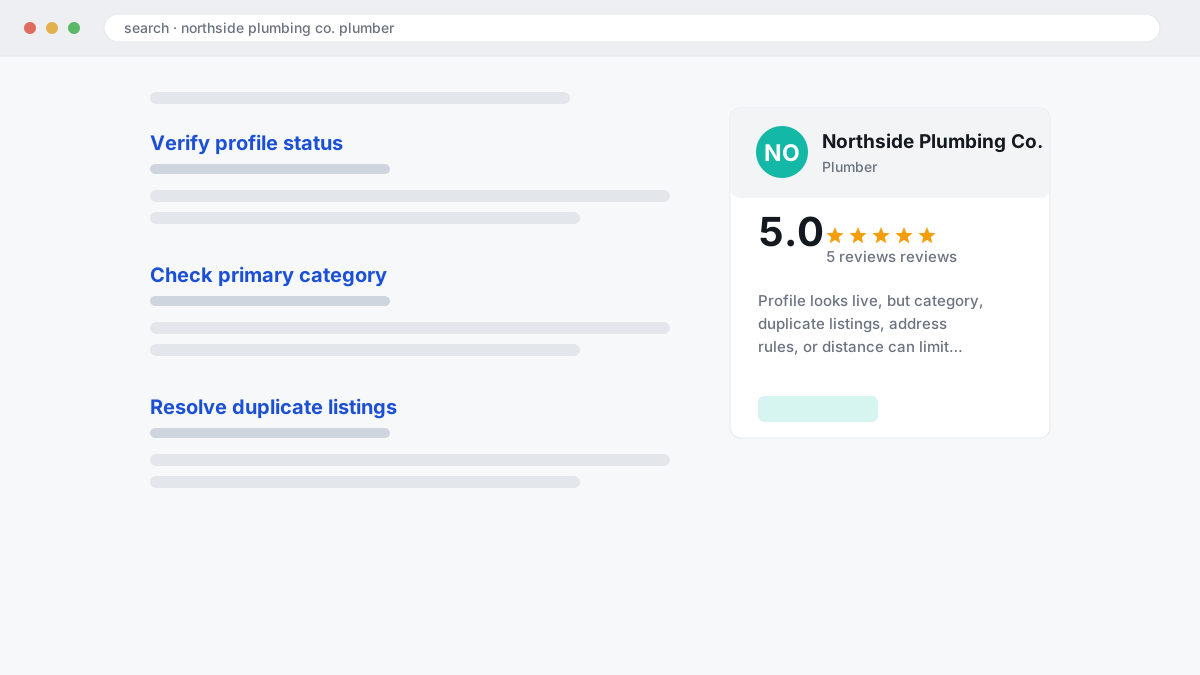
The wrong approach is assuming “published” means competitive. It fails because Google only shows profiles it considers eligible, trusted and relevant for that query in that area. A plumber can have a complete Google Business Profile, five fresh reviews and a working website, yet still disappear for “emergency plumber near me” if the primary category says “bathroom remodeler”, the pin sits on the wrong street, or a second profile at the same address splits prominence and confuses relevance.
A live profile also gets filtered for crowded terms. That is common in dense categories where several similar businesses sit in the same building, postcode or service area, and Google chooses one for the local pack while suppressing the others nearby. Google Business Profile Help is clear that service-area businesses should not show a staffed office as a storefront, and profiles that break that rule can stay visible in the dashboard while losing map visibility in search.
The right approach is a short audit in order: verify the profile, confirm the primary category matches the main lead term, remove or merge duplicate GBP listings, check the address follows Google’s eligibility rules, and drag the pin to the exact entrance if Maps placed it badly. If the profile is clean and you still vanish, compare proximity honestly: a weaker website often outranks you in the local pack because it is materially closer and better categorised, not because Google “ignored” your listing.
Can reviews hurt local rankings when they are fake, filtered, or handled badly?
Yes. Reviews can damage local performance when they are fake, manipulated, policy-breaching or handled badly in public. The main risks are Google filtering, lower trust, complaint patterns and avoidable policy exposure, especially when staff push undisclosed incentivised reviews or leave obvious fake-review grounds unchallenged.
Most guides still treat spam and fake reviews as a side issue. That fails because Google’s Business Profile review policy bars fake engagement, review gating and conflicts of interest, so a burst of low-trust reviews can disappear, drag click-through rate down in the local pack and leave you with a weaker profile than before. In BGR Review’s log of 12,000+ negative review cases recorded June 2025 to June 2026, roughly 90% of businesses that came to us after failing alone had used only the in-platform report button, and 70-80% of those first requests had been rejected; the missing piece was usually evidence, not outrage.
The better approach is compliant review collection that survives scrutiny: ask every real customer, do not screen unhappy ones out, disclose any incentive where local law or platform rules require it, and document the transaction if a review later needs challenging. Owner responses matter here. A defensive reply to a fake allegation can repeat the claim in public, cut conversions from map-pack clicks and make a solvable policy issue look like a customer-service problem.
Legal risk sits alongside ranking risk. A false factual allegation in a review can raise defamation issues under local law, while undisclosed paid endorsements can trigger US FTC endorsement rules and UK or EU misleading-practice rules, including the UK’s DMCC Act regime on fake reviews; this is general information, not legal advice. If a review clearly breaches policy, BGR Review handles removals on a pay-after-success basis at $449 per removed link with $0 upfront, but weak evidence and purely opinion-based criticism often stay live.
How should multi-location businesses split control without creating local chaos?
Multi-location local SEO works when head office controls the non-negotiables and location teams control the local proof. Lock your Google Business Profile naming format, primary and secondary business categories, landing-page URLs and UTM standards centrally, then give each branch authority to update hours, upload recent photos, and add market-specific service evidence that improves relevance.
Central control of everything is the wrong model. It fails because one spreadsheet owner rarely knows that the Leeds branch closed early for a bank holiday, the Brooklyn team has new job-site photos, or the Thornhill office keeps getting the same pre-sale question that needs a fast owner response. Those gaps lower click-through rate before they change ranking, and they drag conversions because the profile looks stale even when the website is strong.
Governed local flexibility works better. Set one playbook for profile names, category rules, response tone, review request links, and tracking tags, then assign location managers limited permissions for hours, photos, posts, and owner responses while keeping category changes and URL edits with the central team. Bulk updates start paying off at 20+ locations because they stop drift, but local proof still needs local nuance: the right service-area wording, neighbourhood photos, and replies that mention the actual job or visit rather than a canned template.
What practical local SEO checklist should your team finish in the next 30 days?
Start with the fixes that change eligibility and trust fastest: your Google Business Profile accuracy, primary category, duplicate cleanup, location-page relevance and review workflow. Then tighten local citations, track map-pack rivals every week, and measure calls, clicks and direction requests for the next 30 days.
Most teams lose a month to a huge audit backlog. That fails because lead impact comes from a short chain: if your Google Business Profile points to the wrong category, has a duplicate listing, or sends traffic to a thin location page, you can have a strong website and still lose the local pack to a weaker one nearby. Clean the signals that decide relevance and prominence first, then expand.
Use this sequence and finish it in order.
- Week 1: Correct your business name, address, phone, opening hours, service areas and website URL in Google Business Profile. Check the primary category first, then secondary categories, remove duplicate GBP listings, and fix the core on-page local signals on your main location page: title tag, H1, city/service copy, embedded map, matching NAP and conversion points for calls or form fills.
- Week 2: Standardise NAP across your site and priority local citations. Start with Google, Apple Business Connect, Bing Places, Yelp, Facebook and the main sector directories that actually rank for your searches; ignore low-value citation blasts that create more inconsistencies than they solve.
- Weeks 3-4: Launch review requests from completed jobs, set a same-day owner response workflow, and track the top map-pack competitors each week for categories, review recency and landing-page relevance. In BGR Review’s dataset of 1,485 businesses observed from February to July 2026, new trades and local service businesses typically saw first reviews around two weeks after launch, which is why review request timing belongs in the first month rather than “later”.
What should you measure next if you want rankings to turn into real enquiries?
Measure whether your local SEO work is producing enquiries, not whether a rank tracker shows a prettier position. Start by logging calls, direction requests, form leads and local landing-page conversions each month, then keep the fixes that improved both local pack visibility and actual enquiries.
Watching rankings alone fails because position swings create noise, especially after a primary category edit, a citation cleanup or review removal work. The better read is month-over-month lead data alongside branded and non-branded query trends in Search Console: if non-branded impressions rise but calls stay flat, your behavioural signals are weak after the click, usually because the profile, reviews or landing page did not earn trust.
Among trades businesses with complete enquiry-source data in BGR Review's dataset of 1,485 businesses observed February-July 2026, 70-80% of calls and bookings were attributed to a Google Business Profile or Yelp listing. Check competitor gaps every 4 weeks, not daily. Daily checks push bad decisions; a 4-week view shows whether a rival gained review recency, category relevance or stronger local pack click-through rate.
Where to go from here
Audit your Google Business Profile before you buy another click. Check the primary category, service areas, NAP consistency, duplicate GBP listings, missing owner responses, and the last 10 reviews for recency, detail and obvious policy issues. If your map-pack clicks are weak, the block often sits there first, not in your ad budget.
Expect the signals to move in stages. Duplicate cleanup and category fixes can change relevance and profile clarity first; stronger review coverage usually lifts click-through rate before it changes local pack position; branded search demand tends to lag because people search your name more after they have seen the profile, read replies and decided to trust it. Owners often misread this and call the work a failure too early.
If harmful reviews or fake listings are the blocker, fix that before you chase more traffic. If you want the practical next step, run the audit, list the blockers in order, then decide whether you need cleanup, review growth, or both.