


Quick answer
Gym reputation management comes down to three jobs: earn more genuine member reviews, answer complaints before they spread, and challenge reviews that break platform rules. For most gyms, Google Business Profile comes first because it drives map-pack visibility, click-through rate and first-click trust. The quickest wins usually come from tighter review request timing after classes or PT sessions, faster handling of membership billing complaints, and fixing weak locations one by one. If a review is false, abusive or from a non-member, you cannot delete it yourself on Google; you have to report it under Google’s review policies or use a removal service. BGR Review handles removals with $0 upfront and charges $449 per removed review link after success.
This page is written from live platform work, not software brochure copy. After a gym flags a Google review, the outcome usually turns on the evidence pack: whether you can show no member record, a billing ledger mismatch, CCTV or check-in gaps, or a clear policy match such as spam, off-topic content or harassment under Google Business Profile review rules.
That difference matters because the basic “Report review” button rarely gives enough context on its own. In BGR Review’s log of 12,000+ negative review cases recorded June 2025 to June 2026, most rejected requests arrived with minimal supporting evidence, and timing mattered sharply: cases raised within 28 days of posting and tied to an identifiable policy issue resolved successfully in roughly 90% of cases in our records, while comparable cases raised later dropped to approximately 25–30%.
Why does gym reputation break in different places at once?
Gym reputation usually breaks across three separate systems: member sentiment, local visibility, and policy-breaking content. Your members can be broadly happy while your Google Business Profile loses map-pack reach, or your profile can rank well while a false review cuts calls, bookings and form fills on the page where prospects decide.
The wrong approach is to treat every dip as one reputation issue and answer it with one tool, usually more review requests. That fails because billing complaints, class-level issues and fake reviews behave differently. A billing spike is often a churn signal inside your membership system and front-desk workflow; weak local SEO for gyms is a Google Business Profile problem; a no-member-record review is a policy problem that needs evidence, not a nicer reply. At BGR Review, we separate those tracks before any work starts because the fix, cost and timing are different, including $0 upfront removal work at $449 per removed review link when a review appears to breach platform rules.
A 4.7 average does not protect lead flow if visibility drops. If your star rating holds but branded search demand, map-pack clicks or direction requests fall, the damage sits in rankings, listing completeness, category relevance or review recency rather than sentiment alone. Social mentions, your landing pages and your Google profile rarely fail together, so diagnose each one on its own: member feedback for churn signals, the profile for local reach, and the review itself against platform policy.
Which reputation fixes move gym leads fastest in the next 30 days?
For most gyms, the fastest lift in leads comes from three moves: tighten Google review capture, answer fresh complaints within 24 hours, and place recent member proof on trial and membership pages. Brand campaigns and polished social content usually take longer to change calls, bookings, form fills or map-pack clicks.
The wrong approach is redesigning Instagram, filming new reels and rewriting brand copy while your last six 1- to 3-star reviews sit unanswered on Google Business Profile. That fails because low-star reviews hit intent at the point of decision: a searcher sees the star-rating distribution in the local pack, opens the profile, then reads owner responses before they visit your site. A short, specific reply on billing friction, class overcrowding or staff attitude can steady click-through rate faster than a week of social posting.
The right approach is to improve review mix around the locations that actually sell memberships in the next 30 days, then carry that proof onto your high-intent pages this week. Put recent class and PT reviews beside the free-trial form, day-pass page and membership pricing page as social proof on landing pages, using real names where permission allows and staying inside the FTC endorsement guides on disclosure.
How do you improve gym reputation online without creating more admin?
A gym reputation system works when it runs every seven days, not as a burst campaign once a quarter. Put one person in charge of a weekly check on review growth, complaint themes, owner responses and proof on your landing pages, so small issues get fixed before they turn into lost leads.
The wrong approach is a one-off push for Google reviews after a promotion, then silence for a month. That fails because gym sentiment breaks in different places at once: a billing complaint appears in your Google Business Profile, a class review praises one coach and criticises another, and your website still shows six-month-old testimonials, so map-pack clicks and landing-page conversions drift apart instead of reinforcing each other.
Keep the routine simple. Every week you request reviews from recent joiners and satisfied long-term members, monitor new posts and direct messages, reply fast, escalate anything tied to cancellations or payment disputes, and publish fresh social proof on landing pages where trial bookings and form fills happen. The admin stays light because each task has one owner and one deadline.
Use one owner per lane.
| Role | Weekly job | What to flag |
|---|---|---|
| Front desk | Ask for reviews and log member comments | Churn signals like freezes, cancellation requests, billing friction |
| GM | Approve escalations and handle sensitive owner responses | Staff complaints, trainer conduct, recurring class issues |
| Marketing | Track profile performance and update landing-page proof | Drop in leads, stale testimonials, weak click-through from the local pack |
Track four numbers every week: total reviews, average rating, response time and leads. If reviews rise but leads stall, your profile may be earning clicks while your page proof is weak; if rating slips and cancellation language climbs, you are looking at member churn signals, not a copy problem.
How often should gyms ask for reviews before growth starts looking unnatural?
Safe review velocity for a gym should track real member flow and seasonality. A January challenge or new-year joiner surge can support a visible lift in reviews; a quiet studio posting dozens in 48 hours looks artificial and creates filtering risk on Google Business Profile.
Most generic advice says to ask everyone all at once. That fails because gym demand is lumpy: January sign-ups, spring cut cycles and summer body goals create healthy bursts, while August often slows as holidays cut check-ins and class attendance. For local SEO for gyms, Google tends to trust review growth that matches visible activity on the profile and in the club, especially when class and PT reviews mention specific sessions, coaches and dates rather than sounding copied.
The safer approach is staggered asks tied to member milestones. Ask after a PT progress checkpoint, at the end of a four- or six-week class block, after a membership freeze is resolved, or once a billing complaint is fixed and the member confirms the outcome. If you use a managed service, the delivery pattern matters more than the package size; BGR Review drip-feeds review campaigns instead of dropping them in a single burst, and review packages carry a 30-day free replacement guarantee if posts do not stick.
Keep the cadence proportional to actual traffic. A high-volume club with daily classes can sustain a steady stream; a boutique reformer studio should expect slower review velocity and protect credibility by spacing requests across the month.
How should you handle billing complaints before they turn into churn signals?
Handle billing disputes fast, briefly and in public, then move the account check offline within 24 hours, because most gym review flare-ups start with cancellation, freeze or unexpected charge complaints and quickly become visible member churn signals on Google Business Profile.
The wrong approach is arguing policy in the review thread: pasting your terms, disputing notice periods, or implying the member is at fault. That fails because the reader cannot verify account facts, but they can see tone, and poor owner responses depress click-through from the map pack before they affect your average rating. The right approach is a short reply that acknowledges the issue, states that billing needs account verification, and gives one direct route to resolve it the same day by email or phone.
Keep the public reply simple: “We’re sorry this happened. Billing and freeze requests need us to verify the membership record privately. ” Then tag the cause each month: cancellation timing, freeze request, failed card retry, PT add-on, family membership confusion. Those tags show avoidable churn patterns early.
What should a gym say in review replies when members praise classes or complain about staff?
Use short owner responses that mention the exact class, PT session or service when the facts are clear, stay under 90 words, and never argue about private account history or unresolved staff accusations in public.
Copy-paste replies fail because they flatten class and PT reviews into the same bland script. A member who praises spin at 6am and a member who reports a rude front-desk interaction should not get the same “thanks for your feedback” line. Specific replies lift trust, improve click-through from your Google Business Profile, and give a better first impression before a call, trial booking or branded search.
Use the examples below as daily templates. Keep each one public-facing, factual and brief; if a review includes trainer misconduct allegations, acknowledge it, avoid judging the claim in public, and move the conversation to a named contact the same day.
| Review type | Reply template |
|---|---|
| Positive class review | Thanks, [Name]. Glad you enjoyed Tuesday’s HIIT class with Sarah. We’ve passed this to the coaching team. If you want to try another session, reception can help with booking. |
| Mixed PT review | Thanks for the honest review, [Name]. Good to hear PT programming helped, and sorry the schedule changes caused frustration. Please email us so we can check your sessions and sort this properly. |
| Staff complaint | We’re sorry you left with that impression, [Name]. We take service concerns seriously. Please email the manager with the visit time and any detail you’re happy to share so we can review it promptly. |
What do you do first after a false gym review goes live?
Start by preserving the review, then match it to a specific Google policy ground before you flag it. Google Business Profile removals move on provable issues such as impersonation, conflicts of interest or a reviewer with no customer relationship, not on a claim that the post feels unfair.
The wrong first move is an angry flag and a public argument under the review. That usually fails because Google does not remove a post for being harsh, rude or damaging to your gym reputation; it removes false or policy-breaking reviews when the report lines up with its user-contributed content rules. Save the full review URL, screenshots, posting date, reviewer name, star rating, and each alleged fact straight away, because edits, deletions and account changes can make later evidence weaker.
Capture the facts in one file before anyone on staff replies.
- Screenshot the review on desktop and mobile, including the reviewer profile if visible.
- Copy the direct review link from your Google Business Profile.
- Note the exact claims: billing issue, trainer misconduct allegations, unsafe equipment, fake cancellation refusal, or staff names.
- Pull matching records: membership database search, class attendance, PT booking logs, waiver records, CCTV retention window, and staff rota for that date.
Flagging on emotion fails most often when the review is really an opinion-based complaint. The right move is to frame the breach precisely: impersonation if the name belongs to a competitor or ex-staffer using a false identity, conflict of interest if the reviewer is linked to another local gym, or non-customer if you have no member, trial, guest-pass or PT record at all. In BGR Review's log of 12,000+ negative review cases from June 2025 to June 2026, reviews raised within 28 days and tied to an identifiable policy issue resolved successfully in roughly 90% of cases; beyond 28 days, the observed success rate fell to approximately 25–30%.
If the review alleges trainer misconduct, do not argue the facts inside the reply box. Preserve safeguarding notes, internal incident logs and attendance data, then escalate through the policy route that fits the evidence.
Which evidence actually helps remove a policy-breaking gym review?
The best removal evidence shows a clear mismatch you can prove: no member record, no visit, no contract, or a documented conflict. “This review is fake” carries little weight on a Google Business Profile compared with dated attendance logs, CRM records, screenshots, and an incident report attached to one short explanation.
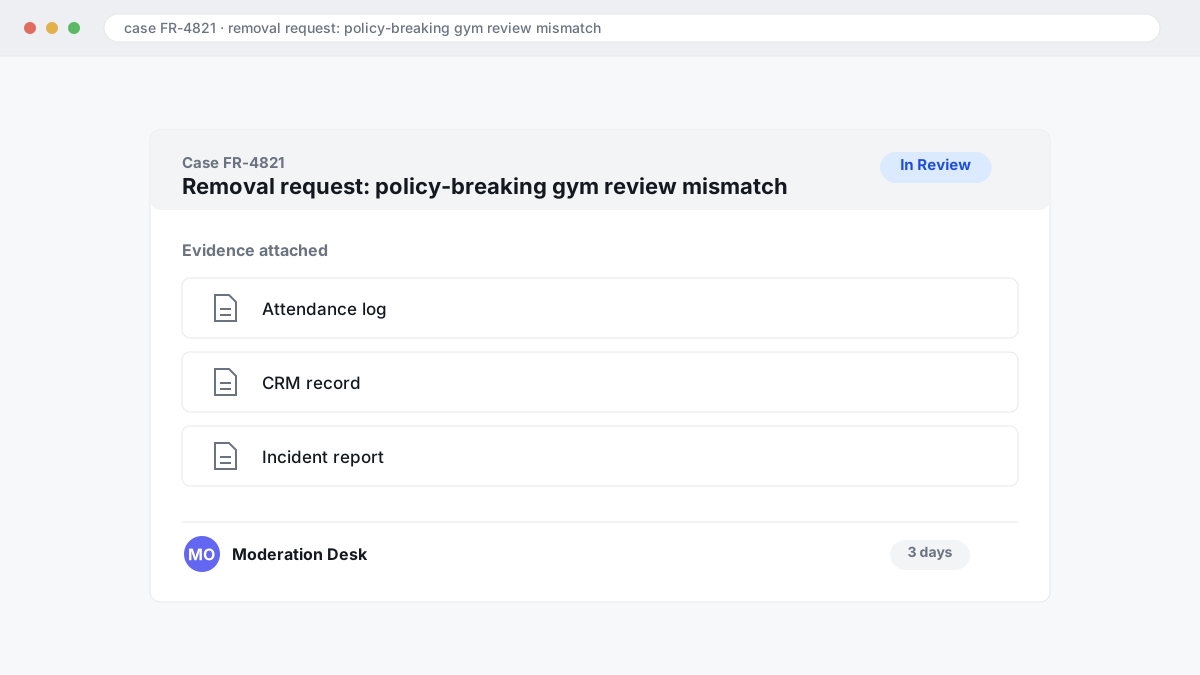
General denial fails because the report button gives Google almost no context. Across 12,000+ negative review cases logged by BGR Review from June 2025 to June 2026, roughly 90% of businesses that came to us after a failed attempt had used only the in-platform report flow with no supporting documentation, and 70–80% of those initial requests had been rejected. A rejection does not prove the review is genuine. It usually means the policy match was weak or the evidence was missing.
The stronger route is to tie the review to a named rule breach and keep the narrative tight. If the reviewer never checked in, attach the date-range attendance log, the member database search showing no account, and any no-booking result for the class or PT session they mention. If the post alleges a billing dispute, include the signed contract, cancellation record, payment timeline, and any incident notes showing the complaint came from a non-member or from a different location. That works better because Google can compare a specific claim against a specific record, instead of weighing opinion against opinion.
Limits matter. A harsh review from a real member usually stays up if it reads as opinion, even when it spikes member churn signals and hurts map-pack click-through.
How should multi-location gyms control reviews without flattening local trust?
Multi-location gyms need central rules and local execution. Head office should control templates, escalation paths and reporting, while each club owns its own Google Business Profile, review requests, profile accuracy and fast owner responses so one weak site does not drag down the rest.
The wrong approach is brand-average reporting. It fails because a clean national average hides the club that has old photos, duplicate multi-location listings, slow replies and three fresh billing complaints killing map-pack click-through and trial conversions in one postcode while the wider brand still looks healthy. Benchmark each club on its own rating, review recency and response time, then escalate only what needs central handling: suspected fake reviews, trainer misconduct allegations and refund disputes that need records checked.
Each location also needs one named reply owner and one backup. If nobody owns replies locally, owner responses drift into generic corporate language, class and PT reviews go unanswered, and the profile stops sounding like the actual club. Corporate should supply approved response frames and a clear escalation route to compliance or legal, but the club manager should answer local service issues because local trust is built in the branch feed, not in a brand dashboard.
Audit duplicate profiles, closed locations and naming drift every 30 days. On Google Business Profile, the club name should match real-world branding rather than keyword-stuffed variations, and duplicate listings should be merged or removed before reviews split between two profiles and weaken local pack visibility and branded search demand for that branch.
Should a gym buy reputation software or hire a managed service?
Software is useful for collecting, routing and reporting reviews, but it does not replace judgement when a billing dispute, a false review or franchise-level governance problem lands in your queue. Managed service costs more, yet it usually covers the work software leaves with you: owner responses, escalation and policy-based removal support.
The wrong buy is a dashboard for a chain that already struggles to monitor daily. You get inboxes, templates and alerts, but nobody actually checks multi-location listings, writes location-specific owner responses or builds an evidence pack when a review appears to breach Google Business Profile review policy. That fails because tool access is not execution. The right fit is software for a single site or lean in-house team that can review posts every day, approve replies fast and keep request timing consistent without pushing review velocity into something that looks manufactured.
This is the cleaner comparison before you sign anything.
| Model | Typical fee structure | Response coverage | Removal support |
|---|---|---|---|
| Software | Usually a monthly subscription | Your staff still write, approve and post owner responses | Usually limited to flag buttons, policy articles and ticket prompts |
| Managed service | Higher monthly spend or per-case work | Human-written replies across locations, with escalation for staff allegations and billing complaints | Fixed price per removed link |
If you run several clubs, managed service usually wins because the real risk sits in uneven execution. One ignored review on a weak branch can drag map-pack click-through, branded search demand and conversions even while your head office dashboard looks tidy.
Where do review requests and testimonials cross the line for gyms?
Gyms cross the line when they reward reviews without disclosure, steer unhappy members away from public platforms, or publish testimonials that hide incentives. The FTC endorsement guides can apply alongside a platform's own rules and local consumer-protection law, so a tactic that lifts ratings can still create false or policy-breaking reviews and legal risk.
The wrong approach is simple: offer a free shake, day pass or merch credit for a five-star review, send only happy members to Google, and keep complaints in a private form. That fails for two reasons. First, the FTC endorsement guides require clear disclosure when a reviewer gets a material incentive. Second, review gating can breach platform rules even if the member's words are genuine, because you are manipulating who gets seen publicly rather than asking all members for honest feedback on the same terms.
The safer approach is to request feedback from every relevant member after a clear trigger such as joining, a class block ending or a billing issue being resolved, and to separate service recovery from the public review ask. If you reuse praise as social proof on landing pages, keep the quote accurate, disclose any incentive, and avoid editing that changes the claim. Rules vary by country, platform and claim type: US FTC disclosure standards, UK consumer law on misleading practices, and platform policies can all point in different directions. This is general information, not legal advice. If you hire help, check the method before you buy; BGR Review sells managed review services and uses a 30-day free replacement guarantee on review packages, but that guarantee does not override platform policy.
Where to go from here
Start with the places and complaint types that suppress leads first: your Google reviews, recurring membership billing complaints, and any false-review disputes on your Google Business Profile. Those issues hit the map pack hardest, drag down click-through rate before a prospect ever reaches your site, and depress conversions from calls, class bookings and day-pass enquiries. Class and PT reviews matter too, but if your main profile shows unresolved payment complaints or a false allegation, fix that before you spend on social proof, landing-page changes or local SEO for gyms.
Your next step is a focused reputation service assessment. Pull the review URLs, your owner responses, membership records, billing logs, check-in history and any screenshots that show no member record or a policy breach, then sort each review into one of three buckets: answer publicly, fix operationally, or dispute for removal. Expect a clear route, not a generic software demo.