

Quick answer
For most dental practices, the review system that works in 2026 is straightforward: prioritise Google Business Profile first, ask every eligible patient within 24 hours of the visit, send the request by SMS before email, and reply without confirming treatment details or patient status. Google’s fake engagement policy makes paid or fabricated feedback a long-term risk, so review generation and negative review removal need different workflows. If a review is false, abusive or from a competitor, generic flagging rarely gets it removed without evidence. BGR Review handles removals on a pay-after-success basis at $449 per removed review link, with $0 upfront.
We write this from live reputation work, not from a software sales script. In the failed cases that reach us, the weak point is usually obvious: the clinic used only the in-platform report button, attached no evidence, chose the wrong policy angle, and then waited while the review stayed live in the map pack.
Across 12,000+ negative review cases logged by BGR Review from June 2025 to June 2026, outcomes were tracked as removal success, unresolved or unknown, and unconfirmed cases were kept as unknown rather than padded into a win rate. That matters if you are comparing dentist reviews services, because the real decision is not who promises more reviews, but who can separate Google-first growth, HIPAA-safe response rules, Yelp filter risk and a removal process that holds up when a fake review needs escalation.
Why do most dental review plans stall after a few weeks?
Dental review programmes usually stall because the practice asks inconsistently, pushes the wrong platform first, and leaves staff worried that a reply could expose patient information. A workable 2026 setup starts with platform order, privacy-safe scripts, and one named owner checking requests, new ratings and replies every week.
Most guides tell you to ask more often. That fails after one enthusiastic week because a dental practice is juggling Google Business Profile, Yelp and private feedback forms with different rules, different visibility and different staff comfort levels. Google rewards review recency more than a burst followed by silence, Yelp can filter low-trust solicitation patterns, and a weak review response policy leaves front-desk staff avoiding replies altogether. The result is a lopsided star-rating distribution: a few glowing reviews from one campaign, then a flat line, then one angry review dominating map-pack click-through and bookings.
A simple 3-step system holds better: pick the primary platform first, send one privacy-safe request flow, and assign one weekly reviewer owner. In BGR Review’s dataset of 1,485 businesses observed February to July 2026, established professional practices including dentists usually needed 30–50 reviews before profiles performed consistently. Ad hoc asking rarely gets you there. A paced system does, because it protects recency, keeps response quality consistent, and stops staff from improvising replies that create compliance risk.
Which review platform should a dentist prioritize first for the fastest payoff?
For most dental practices, Google Business Profile deserves the first push because it affects local pack visibility, branded search impressions and first-click trust faster than any third-party profile. Yelp and Trustpilot still have a place, but they do different jobs: Yelp can support category credibility, while Trustpilot adds broader third-party proof rather than driving local patient discovery.
Most guides treat every platform as equal. That fails because a patient looking for “dentist near me” usually meets your Google profile before they reach your website, and before they compare a Trustpilot page. If your Google Business Profile has fresh reviews, a believable star-rating distribution and recent replies, you usually improve map-pack click-through first; calls and booking intent follow because the patient has already read social proof inside Google’s own interface.
This is the practical order we recommend before you spend on any managed review package with a 30-day free replacement guarantee: start where the patient discovers you, then add platforms that match the way your practice is actually researched.
| Platform | Best use for a dentist | Main risk or limit |
|---|---|---|
| Google Business Profile | Fastest effect on the local pack, branded search trust and map-based clicks | Needs steady recency; a stale profile loses click-through even with a good average |
| Yelp | Useful where patients already use Yelp to compare local services | Yelp’s recommendation filter may hide prompted reviews, and Yelp publicly discourages asking for reviews |
| Trustpilot | Good for third-party credibility on your website, ads and non-local comparison journeys | Rarely beats Google for local discovery when the goal is calls from nearby patients |
If you are choosing one place to build momentum first, pick Google. Add Yelp only if your market already shows active dental or healthcare review behaviour there, and use Trustpilot when you want extra proof on landing pages or branded search results, not as your primary source of new local enquiries. BGR Review sells managed review support across Google, Yelp and Trustpilot, but for a single-location clinic the fastest payoff usually starts with Google and nowhere else.
How many reviews does a dentist need before review work starts paying off?
A dental practice needs enough reviews to look credible against the top nearby alternatives on Google Business Profile, not against a generic national target. In practice, count, review recency, and a believable 4.6-4.9 star-rating distribution move the local pack faster than chasing a perfect 5.0.
Most dental review plans stall because they aim for one magic number like 20 or 50 and stop there. That fails in competitive markets where a 4.8 average with 80 reviews can still lose map-pack click-through and bookings to a practice half a mile away sitting at 4.7 with 300 reviews, especially if that competitor added fresh reviews this week and your last one was six weeks ago. In BGR Review's own dataset of 1,485 businesses observed February-July 2026, established professional practices including dentists typically needed 30-50 reviews before profiles performed consistently, but that is a floor, not a finish line.
This is the comparison that matters each week for at least 8 weeks.
| What to track | Why it changes payoff |
|---|---|
| Your review count vs top 3 local pack competitors | Shows the threshold Google users see before they click or call |
| Review recency | Fresh activity usually lifts trust and conversions before rank fully shifts |
| Star-rating distribution | A natural mix of 4-star and 5-star reviews often looks more credible than a thin perfect score |
The right target is competitor-relative: get within range of the top three first, then keep pace on recency. If you want help setting that target or building the volume safely, BGR Review manages verified review campaigns with delivery starting in 24-48 hours and a 30-day free replacement guarantee on review packages.
When should a dental practice ask for reviews to get more responses without creating friction?
The best time to ask is when the patient has just felt relief or seen the result, usually at checkout with a same-day text sent soon after. Wait a few days and the visit blurs into the rest of the week, which lowers response and makes the experience easier to second-guess.
Monthly batch requests are where most dental review plans stall. A spreadsheet goes out at month end, half the patients barely remember which clinician they saw, and the message lands with no emotional trigger tied to treatment completion. The workflow we set for dental clinics at BGR Review is simpler: front desk asks verbally while the patient is paying or rebooking, then an SMS goes within 2 hours; email can follow later, but SMS and email review requests work best when text carries the first ask and email acts as the backup.
The timing should change by visit type. Hygiene appointments usually convert best with a checkout ask plus same-day text because the visit is routine and easy to forget by tomorrow. Cosmetic cases often do better after the patient has seen the result in normal life, so send the first request later that day or the next day after whitening, bonding or aligner milestone visits. Urgent pain appointments need the most restraint: ask only if the patient leaves clearly relieved, and send a short message that evening rather than pushing for a public review while they are still numb, sore or anxious.
What review request message can a dentist send today without sounding awkward or pushy?
A dental review request that gets replies today is short, sent soon after the visit, asks for one action on one platform, and gives unhappy patients a private route back to the practice instead of pushing everyone straight to a public review page.
Long branded blasts fail because they read like marketing: logo header, three links, a paragraph about your clinic, then a vague ask. Patients ignore them. A short SMS works better because it feels like a real follow-up from the front desk, especially when review request timing is close to the appointment and the message carries one clear link. Keep SMS and email review requests free of incentives; Google’s review policies and the FTC’s endorsement rules both make that the wrong shortcut.
Use copy like this.
SMS: Hi Sarah, thanks for visiting Oak Street Dental today. Could you leave us a quick Google review? [link] If anything felt off, reply here and we’ll help.
Email subject: Thanks for visiting Dr Patel today
Email body: Hi Sarah, this is Emma from Oak Street Dental. Thanks for coming in for your hygiene visit today. If you have a minute, would you leave a review on Google here: [link]. If you’d rather share feedback privately, just reply to this email and I’ll make sure the practice manager sees it.
The single-action version works because the patient does not have to choose between Google, Trustpilot and Yelp, and your staff name plus visit context makes the message feel human instead of automated. If you want this built for you, BGR Review runs managed review campaigns and gives a 30-day free replacement guarantee on review packages.
Can dentists ask patients for reviews without creating HIPAA or FTC problems?
Dentists can ask for reviews, but the request and any reply must avoid disclosing protected health information, and incentives create a separate disclosure problem. Google Business Profile allows review requests; Yelp’s anti-solicitation stance and recommendation filter make the same outreach flow riskier there.
The wrong approach is treating review outreach as banned, or swinging to the other extreme and sending messages that confirm treatment, procedure type, insurance status or appointment details. HIPAA and patient confidentiality rules limit what your team can say if a message or reply could identify someone and connect them to care, which turns routine follow-up into a privacy issue fast. The safer approach is a neutral request sent after the visit by SMS or email that says only that you value feedback and links to the profile you want to prioritise.
The second mistake is offering a gift card, discount or competition entry without thinking about the FTC endorsement rules or platform terms. In the US, the FTC’s endorsements framework requires clear disclosure when a review is incentivised, and some platforms treat that kind of solicitation far more aggressively than others; Yelp’s recommendation software is especially unforgiving if the review pattern looks pushed. If you operate outside the US, the legal standard changes again, so country-specific advice matters.
Keep the workflow simple: ask every eligible patient the same way, do not script staff to mention treatment outcomes, and never write a public reply that confirms someone was a patient. If you use a managed service, the compliance burden does not disappear; even with BGR Review’s review packages and 30-day free replacement guarantee, your practice still needs HIPAA-safe wording and platform-specific routing. This is general information, not legal advice.
How should a dentist reply to reviews without confirming someone was ever a patient?
A dentist should reply in a way that acknowledges the comment, offers an offline path, and reveals nothing that confirms treatment, timing, billing or even whether the reviewer was ever a patient.
The wrong move is a personalised public defence: “You came in on Tuesday for a root canal and your insurer declined the claim.” That fails on HIPAA and patient confidentiality grounds because you have now tied a real or alleged visit to treatment details and insurance discussion without consent. Google Business Profile, Yelp and Trustpilot all leave your reply visible to future searchers, so one defensive sentence can hurt click-through from the map pack and reduce conversions from branded search later.
The safer approach is a written review response policy that every front-desk and practice manager follows. Use neutral wording such as, “We take feedback seriously and would like to look into this. Please contact the practice directly so we can review your concerns.” For negative reviews that may need service recovery, reply within 2 business days. That protects confidentiality, keeps the public record clean, and still shows prospective patients that your practice responds.
What should a dental office do in the first 24 hours after a bad review appears?
In the first 24 hours, preserve the evidence, decide whether the reviewer is likely real, and separate service recovery from negative review removal. A bad post on your Google Business Profile needs triage, not an automatic flag and not a public back-and-forth.
The wrong move is to hit “report review” on everything the moment it lands. That fails because Google usually wants a policy issue, not a disagreement, and the basic flag gives almost no context. Screenshot the review, capture the timestamp, profile name, star rating, and URL, then classify it as either a genuine complaint or a likely policy violation such as impersonation, harassment, off-topic content, or a competitor review. Across 12,000+ negative review cases logged by BGR Review from June 2025 to June 2026, roughly 90% of businesses that came to us after a failed attempt had used only the in-platform report button, and 70–80% of those initial requests had been rejected.
If the facts are unclear or removal is uncertain, post a short reply that follows your review response policy and protects patient confidentiality. Do not confirm treatment, dates, or identity. Say you take concerns seriously and invite the person to call the practice manager or email a monitored inbox within 1 business day. If the reviewer appears to be a real patient, move service recovery offline first; if the post clearly breaches platform rules, build the evidence pack before escalating. Where a removal case exists, BGR Review handles it on a pay-after-success basis at $0 upfront and $449 per removed review link.
When can a dentist actually get a fake or competitor review removed?
A dentist can sometimes get a fake review removed, but only when the report is tied to a named policy violation and backed by evidence. Strong cases usually involve non-customers, impersonation, conflicts of interest, or false factual claims you can prove.
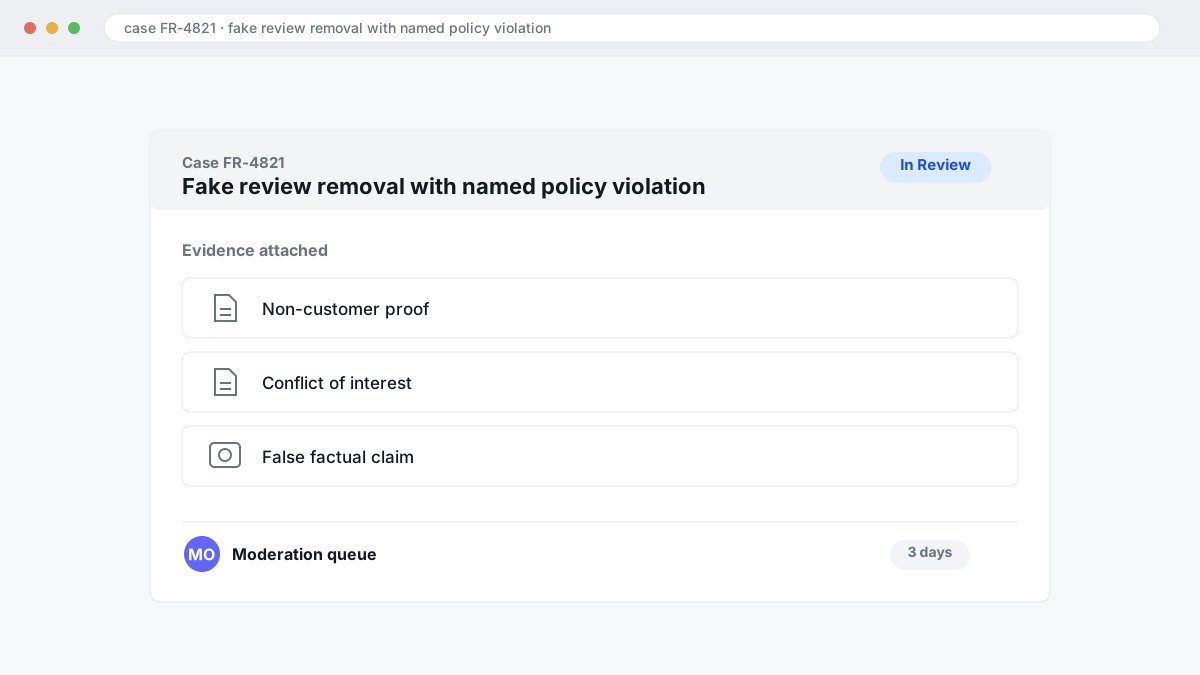
Most clinics file a bad review because it feels unfair. That usually fails. Google removal works best when you match the post to a Google Business Profile review-policy ground such as spam, fake engagement, impersonation, conflict of interest, or prohibited content, then support that claim with an evidence pack instead of a one-line complaint. In BGR Review's log of 12,000+ negative review cases from June 2025 to June 2026, roughly 90% of businesses who came to us after a failed attempt had used only the in-platform report button, and 70–80% of those first requests had been rejected.
The evidence pack matters more than the clinic thinks. For fake or competitor reviews, that can include appointment-booking records for the date claimed, staff rosters showing no interaction with the named person, call logs, screenshots of the reviewer promoting a rival practice, and proof of non-customer status where that can be shown cleanly. A weak submission stalls because the platform reviewer cannot see the policy angle fast enough; “this review is false” is an opinion, while “no patient by this name attended, no booking exists, and the account is advertising a nearby clinic” gives them something actionable.
Defamation sits on a different track. If a review says “I waited too long”, removal is unlikely; if it says “this dentist billed me for treatment never performed” and your records show the statement is factually false, the argument is stronger, but laws vary by country and platform, so this is general information, not legal advice.
Should a dental practice buy review software or hire a managed service?
Review software suits a practice that already has disciplined front-desk follow-through. A managed service suits a clinic that needs someone to run the asks, watch replies, spot risks on Google Business Profile and Trustpilot, and escalate fake-review removal; the real comparison is monthly licence cost versus licence cost plus staff time.
Most dental teams buy software for the lower subscription price, switch on SMS and email review requests, and assume the system will run itself. It stalls because somebody still has to check failed sends, chase patients after treatment, route unhappy feedback away from public platforms, and reply safely without breaching patient confidentiality. A cheap tool with no owner usually means your Google profile gets attention for two weeks, then review recency drops and the map pack benefit fades.
This is the comparison to make before you choose.
| Option | What you still need internally | Where it usually wins |
|---|---|---|
| Software only | Staff owner, message timing, follow-up discipline, platform-by-platform checking | Lower monthly cost, faster setup, useful if your PMS or CRM already triggers SMS and email requests cleanly |
| Managed service | Approval on tone, access, and escalation decisions | Fixed price per removed link |
The right choice depends on execution burden, not software demos. If one practice manager can reliably run Google requests, watch Trustpilot, and follow up every week, buy the tool. If nobody owns that process across locations, outsourcing is usually cheaper in total because the work actually gets done, and BGR Review's review packages also carry a 30-day free replacement guarantee.
How do multi-location dental groups stop one office from carrying the whole brand?
Multi-location dental groups stop one office carrying the whole brand by running each clinic as its own review unit: its own request flow, its own Google Business Profile link, its own response owner, and a monthly audit for review attribution and duplicate listings.
The wrong setup pushes every patient to a corporate profile or a homepage contact page. That fails because patients usually see location-level reputation in the map pack, not brand-level reputation, and Google Business Profile reviews tied to one surgery in one postcode do very little for another clinic across town. The right setup sends the SMS or email request to the exact location page and matching review destination for that branch, so clicks, reviews and branded search demand build around the office that actually needs calls and bookings.
Use separate tracking and accountability, or the plan stalls within weeks because no one knows which manager owns replies, which branch generated the review, or whether a merged or duplicate listing is stealing feedback. Franchises and DSOs should check this once a month: review attribution by branch, duplicate Google Business Profile entries, wrong-map-pin listings, and reviews landing on the parent entity instead of the clinic. If you use outside help, this is where a managed service beats generic software: someone has to catch misrouted links, response gaps and listing duplication before one high-volume office masks weak locations.
| Area | Wrong approach | Working approach |
|---|---|---|
| Request link | Corporate profile or homepage | Exact branch location page and branch review link |
| Ownership | One central inbox, no branch owner | One dashboard and one response owner per clinic |
| Monthly checks | No audit | Review attribution, duplicates, map-pin accuracy, parent/branch split |
What should a dental practice do over the next 30 days to build a review system that holds?
Start with one location, one lead platform, one same-day request, and one privacy-safe reply script. Track review count, review recency on your Google Business Profile, and reply consistency every week for 30 days before you add more automation, another channel, or a second clinic.
Most dental plans stall because the practice rolls out everything at once: front desk scripts, bulk email, QR cards, two platforms, and no check on review request timing. That fails fast. Staff forget the handoff, patients get mixed prompts, and you cannot tell whether Google, email, or SMS is driving calls, bookings, map-pack clicks, or branded search. A controlled 30-day pilot works because you can spot the break point and fix it before it spreads.
Use this rollout.
- Week 1: Benchmark your top three local competitors on Google Business Profile review count, average stars, and how recently they were reviewed. You are checking the local pack, not building a vanity spreadsheet.
- Week 2: Launch one SMS ask, one email ask, and one private feedback path sent the same day as treatment completion or checkout. Keep the ask to Google first.
- Weeks 3-4: Review results each week and fix the weak point: staff handoff, ask timing, or platform mix. If Google replies are slipping, tighten the script before you test Trustpilot or anything else.
If you need outside help, keep the scope tight at first.
Where to go from here
Start with a 30-minute audit of the places patients actually check before they call: your Google Business Profile first, then any active Yelp or Trustpilot profile, then your own website testimonials if you use them. Check three things in order: review recency, star-rating distribution, and whether your latest replies protect patient confidentiality under HIPAA and basic patient privacy rules in your country. That audit usually tells you where map-pack click-through is leaking and whether the problem is visibility, trust, or both.
Fix the request system next. Set one review ask after the visit, one follow-up by SMS or email if the patient has consented, and one written response policy so front-desk staff do not improvise online. If a fake or competitor review is already dragging down calls, bookings or branded search demand, move straight to removal handling rather than posting more requests on top of the problem.