
Quick answer
Auto dealership reputation management is the day-to-day control of how buyers and service customers judge your store across Google Business Profile, DealerRater and other review surfaces that influence map-pack clicks, calls and booked test drives. The fastest gains usually come from three moves: remove false or policy-breaching reviews, fix the review request workflow after both sale and service, and enforce a public response SLA by department. At BGR Review, negative review removal is pay after success at $449 per removed review link with $0 upfront, and review packages carry a 30-day free replacement guarantee.
This playbook comes from live platform work, not dealership marketing theory. We handle verified review delivery and false-review disputes across Google, Trustpilot, Yelp, Clutch and TripAdvisor, and one detail generic guides miss is what happens after a flag fails: Google often rejects a first submission when the report contains no dated invoice, RO, staff timeline or screenshot that ties the review to a policy issue.
You are reading this because auto dealership reputation affects lead flow differently in sales, finance and service, and the wrong fix wastes time. We have served 15,000+ businesses, worked with 1,240+ verified clients, and built this for operators comparing DIY, software and managed help under the real constraint that platform policy decides what gets removed.
Why does one service complaint outweigh dozens of five-star sales reviews at a dealership?
Dealership buyers and service customers judge risk in different ways. One detailed service complaint about safety, billing or repeat repairs can outweigh dozens of routine five-star sales reviews because it points to a live operating problem, not a completed handover.
The wrong approach is to watch the average rating and treat all feedback as one pool. That fails because sales vs service department reviews do different jobs: delivery-day praise tells a shopper the handoff felt good, while a complaint about a comeback repair, a delayed part or an invoice dispute tells them what happens after the keys are handed over. On Google Business Profile, that recent service complaint can sit inside the newest 10 visible reviews for days or weeks, and that star-rating distribution changes how risky the dealership feels even if the headline average still looks strong.
The fix is departmental routing with a hard response time. In BGR Review’s dealership workflow, sales feedback goes to the sales manager, finance complaints go to the F&I lead, and service issues go to the service manager or dealer principal within 24 hours, because the public reply and the internal recovery step need different owners. A fast service response works because it shows control: acknowledge the visit, check the RO, call the customer, and post a public update after the internal check starts. If you leave service complaints sitting unanswered while sales reviews keep landing, the profile reads like two different businesses, and the risk signal wins.
Which reputation signals actually change calls, leads and showroom visits first?
For most dealerships, the fastest payoff comes from fixing Google Business Profile completeness, recent review flow and negative-review response speed. Those three changes usually lift local SEO visibility and map-pack click-through before a new template set, another niche profile or broad monitoring software changes calls, leads or showroom visits.
The wrong approach is adding more platforms first because it feels like growth. It usually fails because your main buying journey still runs through Google Business Profile: missing services, wrong hours, weak category setup, sparse photos and stale Q&A suppress click confidence even if your average rating looks decent. A move from 4.2 to 4.5 on Google often matters more than 4.8 to 4.9, especially where distance, query relevance and profile completeness are similar, because the first jump fixes a trust problem in the star-rating distribution; the second is marginal.
The right approach is operational. Route reviews by department, keep service review requests moving weekly, and answer negatives fast enough that a shopper comparing dealers sees an active fix rather than silence. BGR Review's removal work is filed pay-after-success at $449 per removed review link with $0 upfront, but removal should sit behind basics: complete the profile, tighten response time, and stop sending all post-visit requests through one generic sales flow when service complaints are what drag conversions and branded search demand down first.
How should a dealership review workflow run from delivery or pickup to published review?
A workable dealership review workflow uses timed SMS and email asks, department routing, and a suppression rule for unresolved complaints. The cleanest sequence starts within 2 hours of vehicle delivery or completed service pickup, then sends happy customers toward a review request and unhappy customers into a service recovery loop.
Blast every customer and you create your own review problem. The failed pattern is simple: one generic ask goes to everyone, including customers with an open RO, a disputed warranty charge, or a finance complaint still sitting in the CRM. That approach turns fresh friction into public feedback, drags down map-pack click-through, and wastes sales wins because one unresolved service issue is what future buyers read first.
The right review generation workflow starts with CRM and DMS integration. Your CRM should trigger the first SMS after clean delivery, your DMS should trigger the service ask only after the RO is closed, and both systems should suppress anyone tagged with an open case, refund request, CSI failure, or manager escalation. If the customer ignores the first ask, send one follow-up email the next day and stop there; pushing harder usually lowers conversion quality rather than increasing published reviews.
Routing matters by department. A sales delivery can go straight to a Google Business Profile or DealerRater request if the handoff is complete, but a service pickup should first ask for a simple rating in-message or on a landing page. Anything below 4 stars should create a manager callback task within 1 business day, and that callback should try to fix the issue before a public post hardens. If you want this built for you rather than configured in-house, BGR Review sets up managed review flows and backs review packages with a 30-day free replacement guarantee.
How should Google Business Profile and DealerRater be managed differently in 2026?
Google Business Profile and DealerRater do different jobs for a dealership. Google shapes map-pack visibility, local SEO visibility and immediate clicks for “car dealer near me” searches, while DealerRater carries more weight when a buyer searches your name, checks salesperson credibility or compares stores before calling.
Treating both platforms the same is where most dealership setups go wrong. A single script, one monthly target and the same response cadence across both profiles usually leaves Google under-managed and DealerRater stale. Google Business Profile needs fast owner replies and policy-aware flagging under Google Business Profile’s review rules, because unresolved service complaints can depress click-through from the local pack before your showroom team notices a lead dip; DealerRater needs profile upkeep, current salesperson pages and department-aware review routing, because buyers use it to judge whether the praise is attached to real staff or generic store reputation.
Run separate monthly goals. On Google, track recency, response time and whether service reviews are being answered inside 24-48 hours; if a review contains false factual claims, build the evidence pack before you hit the report flow, because across 12,000+ negative review cases logged by BGR Review from June 2025 to June 2026, roughly 90% of businesses coming to us after a failed attempt had used only the in-platform report button, and 70-80% of those first requests had been rejected. On DealerRater, track profile completeness, named-staff mentions and whether sales and service prompts use different request scripts.
This split is usually the practical line: use Google to protect calls, directions requests and map-pack clicks; use DealerRater to protect branded search demand and conversion trust once a buyer is already comparing your dealership with the one across town.
What should happen in the first 48 hours after a false dealership review goes live?
In the first 48 hours, lock down the evidence, confirm whether the reviewer was a real customer, and match the post to a platform rule or a false factual claim. Fast, documented action improves your negative review removal chances and stops a rushed public reply from creating contradictions that weaken the appeal.
The wrong move is an emotional response written five minutes after the review lands on your Google Business Profile. That usually fails because Google removes reviews on policy grounds, not because a dealer sounds offended, and a defensive reply can accidentally confirm details you later need to dispute. Start by screenshotting the full review, the profile URL, the reviewer name, the star rating, and the visible timestamp before edits or deletions change the record. Then pull the repair order, CRM notes, booking history and inbound call records to check whether the person exists in your system at all, whether the vehicle details match, and whether the review contains false factual claims such as “they kept my car for 19 days” when the DMS shows same-day release.
Your first filing should name the removal ground plainly. On Google Business Profile, that usually means reporting the review under the relevant policy route and then preparing an evidence pack if the first submission is rejected. In BGR Review’s case file of 12,000+ negative review cases logged June 2025 to June 2026, reviews raised within 28 days of posting and supported by an identifiable policy issue resolved successfully in roughly 90% of cases; for comparable cases raised beyond 28 days, the observed success rate fell to approximately 25–30%.
If Google rejects the basic flag, do not rewrite the story from scratch in public. Escalate with the screenshots, profile link, timestamps, job records, CRM extracts and the exact sentence that is false, then post a short neutral reply while the appeal is pending. That sequence works because it keeps your public position consistent with the evidence you submit, which is the difference between a messy complaint thread and a removal request that can actually be reviewed.
What does an evidence pack need before you flag a review for removal?
A strong evidence pack ties each document to one review-policy breach or one false factual claim. Your job in a negative review removal request is to help a moderator verify identity, timing, conflict or factual impossibility quickly, not to prove your dealership feels hard done by.
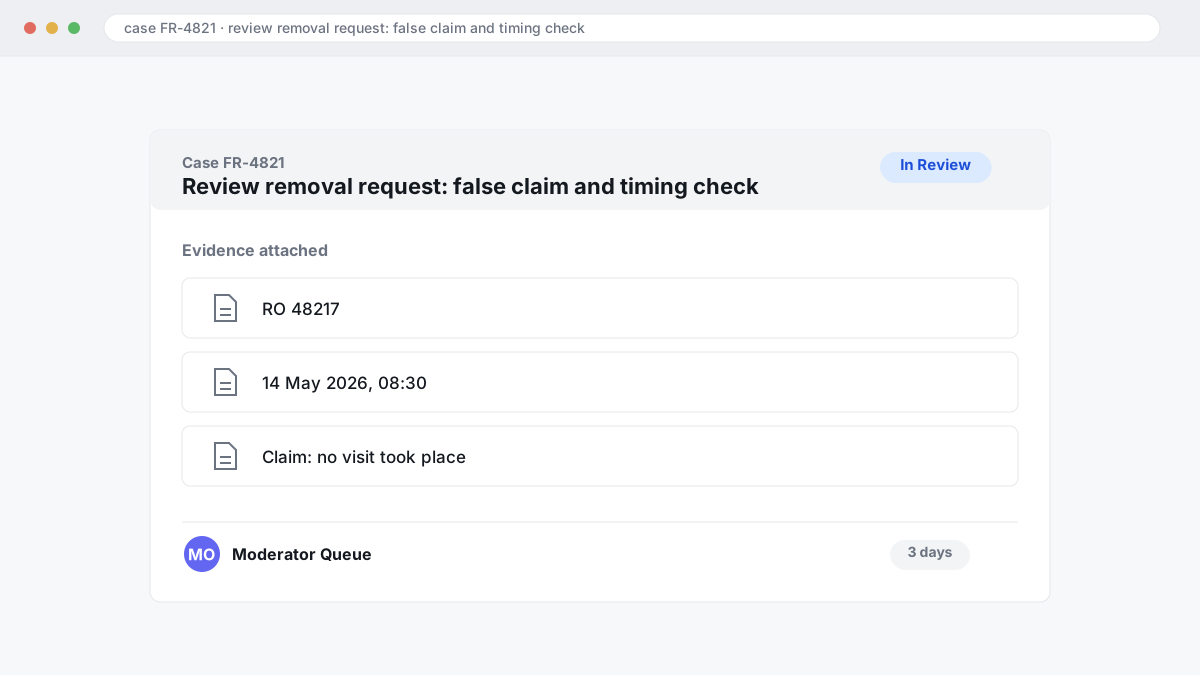
The weak approach is a long, angry explanation about how unfair the review feels, plus screenshots with no anchor. That fails because Google Business Profile and DealerRater moderators are checking whether a rule was broken, not whether your service lane had a bad week. The stronger approach is short and mapped: “Reviewer states no visit took place; attached RO 48217, booked appointment for 14 May 2026 at 08:30, advisor notes signed at check-in, vehicle collected 14 May 2026 at 17:42.” Keep the narrative under 150 words, use verifiable facts only, and attach the repair order number, appointment record, advisor notes, and delivery or pickup timestamp as separate exhibits.
Each exhibit needs a job. If the review says “they never returned my car,” the pickup timestamp supports a false factual claim. If the account attacks a member of staff by name but no matching appointment exists, the DMS or CRM record supports a no-customer relationship argument. Across 12,000+ negative review cases logged by BGR Review from June 2025 to June 2026, roughly 90% of businesses that came to us after a failed attempt had used only the in-platform report button with no supporting documentation, and 70-80% of those initial requests had been rejected. A first rejection does not settle legitimacy; it usually means the evidence was too loose, especially on DealerRater where vague fairness complaints rarely move a case forward.
Should you use software, internal staff or a managed service for dealership reputation work?
Choose software if your team can run the process every week, choose a managed service if removals and escalations keep stalling, and keep it fully internal only when one accountable owner enforces timing, routing and quality across sales, finance and service.
The wrong buy is software without ownership. A dashboard will not fix a broken review generation workflow if nobody maps the handoff from CRM trigger to DMS job-close event to review request, checks missed sends on Friday, and chases stores that reply late. That is why some multi-location dealership groups pay for monitoring tools and still end up with fast sales-review growth, weak service-review coverage, and unresolved complaints sitting on Google Business Profile for days.
This comparison is easier if you judge each model by who owns the weekly operating work.
| Model | Best fit | Where it breaks |
|---|---|---|
| Software | Groups with in-house managers, CRM and DMS integration access, and time for weekly review routing, response checks and store-level scorecards. | Fails when the tool is treated as the process. Software sends requests; it does not decide whether a service complaint needs recovery, a public reply or a removal flag. |
| Internal only | Single stores or small groups where one owner tracks KPIs weekly across departments and can enforce response time. | Breaks once that owner gets pulled into sales or ops and review governance slips for two or three weeks. |
| Managed service | Stores that need removal handling, escalation paths and approval rules for replies. | Less useful if you already have disciplined staff, clean routing and only need a basic monitor. |
Managed service works best when the bottleneck is judgement, not collection. If a store needs help deciding which posts breach platform policy, which replies need legal caution, and which service cases should be pushed back into the service recovery loop within 24-48 hours, outside handling earns its keep. If your team already does that well, software is cheaper.
How do multi-location dealership groups keep one brand standard without hiding store-level problems?
Multi-location dealership groups keep one brand standard by using one review and response playbook for every rooftop, then judging performance at three levels at once: store, department and brand line, so weak service performance cannot hide inside a strong group average.
The wrong approach is a single corporate scorecard that reports one star average for the whole group. It fails because local SEO visibility is earned location by location: your Honda store competes in its own map pack against nearby Honda dealers, while your GM service department can lose calls and bookings even if group-wide sales reviews look healthy. The right approach is one operating standard for Google Business Profile, DealerRater routing and response rules, with KPIs split by rooftop, then by sales, finance and service, then by brand line where the franchise mix changes buyer expectations.
If you're running head-office reporting, benchmark each location against its local pack rivals, not against group averages alone. Compare rating trend, review recency, star-rating distribution and response time against the dealers that actually appear beside that rooftop in Google, because that is where click-through rate, conversions and branded search demand are won or lost. Escalate any store that sits below your target response time for 14 consecutive days. That threshold is long enough to expose a process failure, short enough to stop one ignored service thread dragging down trust.
Where a single rooftop is hit by false factual claims, keep that issue out of the brand-standard dashboard and move it into a removal queue.
Which response templates actually work for sales, finance and service complaints?
Department-specific replies work because a dealership complaint about sales, finance or service needs a different clock, a different owner and a different next step; the reply that lifts trust fastest is the one that routes the issue correctly on day one.
A generic apology fails because it treats sales vs service department reviews as interchangeable. They are not. A sales complaint needs you to confirm delivery date, vehicle details and a named contact the same day; a service complaint needs a fast handoff into the service recovery loop within hours, before the thread starts depressing calls from your Google Business Profile; a finance complaint needs privacy first, because public back-and-forth about terms, lender decisions or signed paperwork creates risk without resolving anything.
Use scripts that match the department and the escalation path.
| Department | What to post publicly | What happens next |
|---|---|---|
| Sales | “Thanks for raising this. I’ve asked James Carter, Sales Manager, to review your handover and delivery details today. Please expect contact before close of business.” | Check deal file, delivery promises and CRM notes. Same-day callback. |
| Service | “I’m sorry you left with this concern. Priya in Service will review the job card and contact you within 2 hours so we can diagnose this directly.” | Pull technician notes, inspect comeback history and book recovery action. |
| Finance | “We take this seriously. For your privacy, our Finance Director will contact you through a secure channel today to review the matter.” | Move to phone or encrypted email. Do not discuss contract specifics in public. |
The right script works because response time signals control and because the reader can see who owns the issue.
Where do dealership review tactics cross legal or platform lines?
Dealership review tactics cross the line when you filter out unhappy buyers, hide compensation, or dress up a staff-prompted testimonial as spontaneous feedback, because Google Business Profile policy bars review gating and the FTC endorsement guides require clear disclosure of incentivised endorsements.
The wrong approach is simple: ask only your happiest sales customers, send service complainants to a private form, or offer a gift card for a review without saying so. That fails twice. Google can treat selective solicitation on a Google Business Profile as policy abuse, and undisclosed incentives can breach the FTC endorsement guides in the US; if you operate across the UK or EU, consumer-protection rules on misleading commercial practices can also apply. This is general information, not legal advice.
The safer approach is to request feedback from the full eligible customer set after delivery or service pickup, use the same trigger for promoters and detractors, and disclose any compensation in plain language if you offer it at all. Encouraging happy customers is allowed; suppressing unhappy customers is where the risk starts. If you use a third party such as BGR Review for review generation, the operational promise might be a 30-day free replacement on a package, but that does not override platform policy or disclosure law.
False factual claims sit in a different lane. A review saying “slow service” is opinion. A review claiming you forged finance paperwork or charged for work your DMS shows was never booked can raise a platform dispute and, in some countries, a defamation issue. That is where you preserve the RO, invoice, call log and advisor notes first, then choose the platform route or legal advice based on the country and the exact wording.
What should a dealer principal measure weekly before expanding budget or hiring outside help?
Run a weekly scorecard by department and rooftop before you add budget or hire help. Track review volume, average rating, recency, response time and unresolved complaints so you can see whether the gap sits in process, staffing, software, service recovery or removal handling.
Average stars alone send dealer principals in the wrong direction. A 4.7 can hide a bad star-rating distribution in service, where a cluster of fresh one-star complaints cuts map-pack click-through, calls and workshop bookings faster than older five-star sales reviews lift them; for multi-location dealership groups, that distortion gets worse when one rooftop carries the brand search demand for the rest.
Use this split view every week.
| Window | Sales | Service |
|---|---|---|
| Last 30 days | New reviews, average rating, median response time | New reviews, average rating, unresolved complaint count |
| Last 90 days | Star-rating distribution, response backlog | Star-rating distribution, repeat complaint themes |
| Last 180 days | Trend by rooftop | Trend by rooftop |
If removals stall after one appeal, stop switching vendors and document the outcome first: date filed, policy reason used, evidence attached, platform reply and public-response timing.
What should a dealer dashboard show each week so reputation work stays tied to revenue?
A useful dealer dashboard splits sales from service, rooftop from group, and trust signals from business outcomes. Each week, you should see review recency, review response time and complaint themes in one view, so the right manager fixes the right issue before ratings drift lower.
The wrong approach is a vanity report: one blended score, one total review count, and no link to calls, booked test drives or service appointments. It fails because a service-adviser delay and a finance-office complaint can cancel each other out inside the same average. The right dashboard shows review volume, average rating, star rating distribution, newest review date and median reply time by rooftop and by department, then places lead-source and appointment trends beside them so you can spot payoff faster.
Check the last 7 days and the last 30 days together. Seven days catches a bad handover, a parts-delay spike or broken CRM and DMS triggers that stopped review requests after delivery or job completion; 30 days shows whether the issue is spreading into map-pack click-through, branded search demand and conversions. In BGR Review’s dataset of 12,000+ negative review cases logged June 2025 to June 2026, reviews raised within 28 days and backed by a clear policy issue resolved successfully in roughly 90% of cases; comparable cases raised later fell to approximately 25–30%, which is why a weekly dashboard should flag disputed reviews before they age out.
Where to go from here
Fix the review problems that move the needle first: false reviews that drag trust, request timing that misses the moment of satisfaction, and slow replies that leave a service complaint sitting in public for days. Dealership profiles usually do not have a volume problem first. They have a routing problem. One bad service review with no reply can depress map-pack click-through, reduce calls and weaken conversions long before your average rating changes much.
If removal is the blocker, your next step is a review-level assessment. Check the exact wording against the platform rule, pull the matching evidence from your CRM or DMS, save timestamps, and decide whether you have a policy route, a service-recovery route, or only a public-response route. That step tells you whether to file now, escalate, or stop wasting time on a review that will not come down.
If you are buying review growth instead, the fixed safeguard is a 30-day free replacement guarantee on review packages. Your first outcome should be clarity, not another vague dashboard.