

Quick answer
Multi-location reputation management means running reviews, replies, listings and dispute handling branch by branch under one operating system. The setup that usually gives the best return in 2026 is central policy with local response ownership, location-level review targets, a reply SLA, and a defined route for fake or policy-violating reviews on Google Business Profile, Trustpilot, Yelp or Clutch. Platforms do not remove a review because it hurts; they remove it when it breaches policy. At BGR Review, removals run on a pay-after-success model at $449 per removed review link with $0 upfront.
This page is written from the operator side of multi-location reputation, for buyers comparing software, agencies and in-house workflows. We handle review growth and removal work across Google, Trustpilot, Yelp, Clutch and TripAdvisor, and the practical gap is usually the same: one branch has a review drought, another has a response backlog, and head office has no evidence pack ready when a policy breach needs escalation.
The detail here comes from live process work, including what happens after a review is flagged, why basic in-platform reports get rejected, and how to separate service recovery from a platform dispute before you waste time. BGR Review serves 15,000+ businesses, has 1,240+ verified clients, and offers a 30-day free replacement guarantee on review packages.
Which branches should you fix first when reputation problems are spread across 20 or 200 locations?
Fix the branches that are losing demand first, not the ones creating the most internal noise. Rank each location by rating gap, recent-review drought, complaint severity and local search intent, then split fast service fixes from branches that need a policy dispute or an operational fix.
Equal attention per branch fails because a 3.9-star location with no fresh reviews in a high-intent market can drag down map-pack clicks and conversions harder than a 3.6-star branch in a low-demand area. In BGR Review's dataset of trades businesses with complete enquiry-source data, observed from February to July 2026, 70-80% of calls and bookings came through a Google Business Profile or Yelp listing rather than a website. That is why triage starts with demand and risk: rating gap against your network average, location-level review velocity over the last 30-60 days, and sentiment patterns by branch such as repeated mentions of delays, rude staff or billing issues.
The queue needs three tiers, reviewed every week, because location ranking signals move at branch level and they do not decay evenly across a 20-site or 200-site estate.
| Tier | What puts a branch here | What you do this week |
|---|---|---|
| Win-fast | Good demand, weak recency, small rating gap, fixable service issues | Push review generation after completed jobs, reply to recent negatives, recover open complaints |
| Watchlist | Stable rating, mixed sentiment, slower review flow | Monitor trends, tighten response SLA, check if one manager or shift is driving complaints |
| Escalation | Sharp rating drop, fake or policy-violating reviews, serious operational complaints | Separate platform evidence from service recovery and escalate only reviews that can be evidenced against platform rules |
BGR Review uses this three-tier queue because broad rollout hides the branches where lost clicks turn into lost calls fastest. If one location has demand, weak recency and a visible rating gap, you fix that branch before polishing ten quieter profiles that are already converting.
How do you run one review workflow across locations without losing local accountability?
A workable cross-location review workflow keeps the rules in one place and the action near the customer. Your central team sets policy, templates and reporting; branch staff verify what happened and recover the customer; unresolved cases move from branch to region to the central team inside a fixed review response SLA.
Most groups fail because review handling sits in shared inboxes or a marketing tool nobody truly owns. A one-star Google Business Profile review lands on Saturday, the branch manager assumes head office saw it, head office assumes the branch will reply, and by Monday the local pack click-through rate has already taken a hit because the newest public signal is unanswered. Ad hoc monitoring creates delay, inconsistent replies and weak evidence when a case later needs escalation.
Use named owners with deadlines instead. The branch manager owns fact-checking and first contact, because they can confirm whether the booking, visit or complaint is real; the regional manager owns unresolved service issues; the central reputation lead owns policy decisions, template control and reporting across locations. For negative reviews, set a 24-hour first-response SLA, including weekends, because a fast public reply protects conversions while the offline fix is still in motion.
This is the simplest version to run:
| Step | Owner and deadline |
|---|---|
| Collection and monitoring | Central team pulls Google Business Profile and other platform alerts daily; branch manager gets the location feed in real time. |
| Public reply | Branch manager replies within 24 hours using approved brand response templates and adds the case note internally. |
| Escalation | Regional manager steps in when the branch cannot resolve the issue, facts are disputed, or the complaint spans multiple visits. |
| Reporting | Central team reports by branch each week: review volume, response time, unresolved cases and repeat themes. |
Centralised vs local ownership works best as a split, not a choice. Local teams should own service recovery because they know the staff, shift logs and customer history; central teams should own policy, quality control and any platform dispute where evidence must match Google’s review policy. If a review stays unresolved after branch and regional review, central decides whether it is a customer-service problem to close offline or a policy issue worth escalating with evidence instead of a basic flag.
When should head office control the response and when should local managers own it?
Head office should control policy, approvals and crisis messaging, while local managers should supply the facts, contact the customer and close the recovery loop within your review response SLA; that split gives you brand control without slowing branch-level fixes.
Total central control fails because a head-office responder rarely knows which fitter missed the slot, which receptionist handled the booking, or whether a refund already went out. The reply lands fast but thin, and that hurts credibility on Google Business Profile and Trustpilot, where readers judge the public answer before they call, book or submit a form. The better model is governed local execution: centralised vs local ownership, with brand response templates, approval rules and platform policy held centrally, and location managers adding the factual context and follow-up.
Use simple approval thresholds so staff know when a reply can go live and when it must stop at head office.
| Situation | Owner | Control needed |
|---|---|---|
| Routine service complaint with clear facts | Local manager | Approved template, named responder, same-day follow-up logged |
| Allegation of discrimination, fraud, injury or media risk | Head office | Central approval before posting, single crisis message, legal check where needed |
| Franchise dispute over discounts, refunds or policy exceptions | Shared | Franchise governance rules, permission levels, audit trail, escalation threshold |
Franchise networks need tighter controls because one weak reply can spread across the brand and drag down map-pack click-through for nearby branches carrying the same name. Give franchisees permissioned access, keep every edit in an audit trail, and require head-office approval for reviews mentioning safety, legal threats or possible fake or policy-violating reviews. If you want outside help, keep the same split: agency or head office approves the language, local staff own the facts.
How do you turn branch-level feedback into fixes instead of another reporting dashboard?
Turn branch feedback into fixes by coding every review into four cause buckets, matching those themes against monthly NPS and support-ticket data, and forcing an operational escalation when one location logs 3 similar complaints in 30 days.
The wrong approach is a sentiment dashboard that tells you Branch 14 is "more negative" than Branch 9. That fails because sentiment patterns by branch only describe mood; they do not tell your ops lead whether the drop came from staffing gaps, wait time, billing errors, or product availability. The workable model is simpler: tag each review on arrival, review the tags once a month beside your NPS and support feedback loop, and assign one owner to the fix. If reviews say "slow service", NPS says "queue too long", and tickets say "understaffed on Saturdays", you have one branch problem, not three reports.
Escalation needs a rule, not a meeting. After 3 similar complaints in 30 days at one branch, head office should open a corrective action item with a due date, then watch whether the next month’s review themes change. If they do not, you have a management issue. If a complaint also looks false or policy-violating, separate that from service recovery; BGR Review handles removals on a pay-after-success basis at $449 per removed link with $0 upfront, but a valid staffing or billing complaint still needs an operational fix first.
What review generation process scales across locations without triggering policy or filter risk?
The safest branch-wide review generation process asks real customers straight after completed service, uses contact data you already hold, and avoids incentives, review gating, and sudden bursts on one profile. Send the ask by SMS or email within 24 hours, while the job, visit or stay is still easy for the customer to describe accurately.
The wrong approach is a monthly blast from head office with discounts, prize draws, or a generic “leave us 5 stars” link sent to every contact in the CRM. That fails for two reasons: the timing is wrong, and the pattern distorts location-level review velocity, which makes one branch look unnaturally active while weaker branches stay flat. In BGR Review’s dataset of 1,485 businesses observed from February to July 2026, new trades and local service businesses typically saw first reviews around two weeks after launch, which is the sort of steady pace branch profiles can absorb without looking manufactured.
The right process is simpler. Trigger a first-party feedback request when the service is marked complete, route complaints into service recovery first, then send every eligible customer the same honest public-review ask without filtering out unhappy people. Collecting private feedback first helps you fix issues, but gating public invites by sentiment crosses the line.
Platform differences matter. Google Business Profile and Trustpilot can support consistent post-service requests when you ask broadly and neutrally; Yelp’s recommendation software and public guidance make active review solicitation a poor fit, so treat Yelp as a by-product of good service rather than a campaign target. If you use an agency for verified review packages, the minimum protection to demand is a 30-day free replacement guarantee, which is how BGR Review structures its own packages.
What should a multi-location review response template include so teams stay fast without sounding scripted?
A usable multi-location response template gives your team a fixed structure rather than a fixed script. Standardise tone, escalation wording and privacy limits, then require one branch-specific detail so each reply still reads like a person at that location wrote it.
Word-for-word scripts fail for a simple reason: they train staff to paste the same apology under praise, mixed feedback and genuine service failure. That hurts credibility on Google Business Profile and Trustpilot, where readers compare owner replies before they click through, call or book. Structured personalisation works better. Your brand response templates should lock the order of the reply, ban promises that need head-office approval, and force one specific reference such as the visit date, service line or staff handoff.
Use the same four-part frame every time: thanks, specifics, next step, sign-off. Keep the public reply under 80 words so it stays readable in the map pack and on mobile. Tie that to a review response SLA: praise within 2 business days, mixed feedback within 1 business day, service failure the same day with an internal escalation note.
| Review type | What changes | Reply shape |
|---|---|---|
| Praise | Name the branch detail and reinforce the service mentioned | Thanks → specific service praised → invite back → named sign-off |
| Mixed feedback | Acknowledge the positive point, then address the issue without arguing facts in public | Thanks → specific issue noted → offline contact route → named sign-off |
| Service failure | Drop marketing language, avoid blame, move to recovery fast | Thanks → clear acknowledgement → direct recovery step → senior sign-off |
If a manager cannot add one real location detail, the reply is not ready to post. That one rule keeps speed high without making 200 branches sound like a bot.
Which metrics improve revenue fastest across locations when budget is limited?
Revenue moves fastest when you fix weak, high-demand branches first. In most multi-location rollouts, the payback order is simple: increase review acquisition at underperforming locations, tighten replies to negative reviews, then fix the recurring service issues behind those complaints.
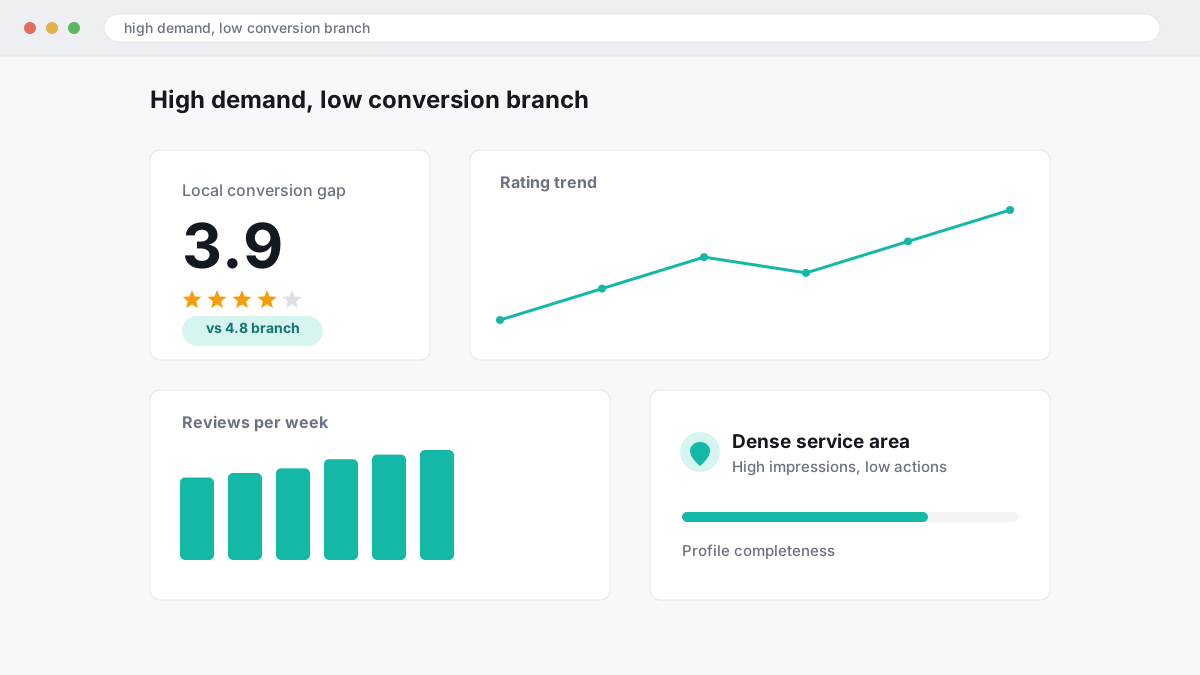
The wrong approach is to chase the brand-wide average score. That fails because a 4.8 branch with steady bookings rarely needs budget before a 3.9 branch sitting in a dense service area, where weaker sentiment is dragging map pack click-through, calls and form fills. Your first priority is the location with the biggest gap between local demand and local conversion: high impressions, low actions, thin location-level review velocity, and poor review response SLA. In BGR Review's dataset of 1,485 businesses observed from February to July 2026, trades firms that built early review volume reached first reviews in about two weeks and stronger local visibility followed as they moved towards 20-30 reviews in the first three months, alongside other ranking factors.
The faster win usually comes from recency and speed, not from spreading effort across long-tail platforms too early. Google Business Profile drives the local pack and direction requests for most branch-led searches, so fresh reviews and replies inside a clear response window tend to move revenue sooner than polishing a lower-impact profile. If budget is tight, set a branch-level review response SLA for every negative review, then restore review flow at the same locations before you expand elsewhere.
Track three outcomes for 8 to 12 weeks: calls, bookings and direction requests by branch. If those lift after review recency improves and complaint themes soften, your location ranking signals are moving in the right direction; if they do not, the issue sits in operations, pricing or demand, not reputation alone.
Should you buy software, hire an agency, or keep multi-location reputation in-house?
Choose software when your branches already have accountable local operators and a weekly reporting habit. Choose an agency when replies, escalations and governance keep slipping. The deciding factor is rarely whether you run 20 or 200 locations; it is who will actually manage your Google Business Profile reviews, recover service issues and report exceptions every week.
The wrong buy is software for a network that has no clear owner at branch level. You get dashboards, alert emails and sentiment charts, but no one sends the reply inside your response SLA, no one separates a service complaint from a policy dispute, and platform differences get ignored. Google Business Profile disputes, Yelp recommendation filtering and Trustpilot flagging all work differently, so tool access without execution capacity usually turns into a reporting layer that head office reads and local managers sidestep.
The right model follows your ownership structure. Centralised ownership works when head office controls brand risk, approvals and escalations; local ownership works when managers can solve the underlying issue on the same day and log the outcome.
This is the practical split.
| Model | Best fit | Trade-off |
|---|---|---|
| In-house with software | Strong local managers, clear response ownership, weekly QA | Fast visibility, weak escalation if nobody owns disputes |
| Agency-led | Head office needs governance, removals, template control and branch QA | Better execution, higher ongoing cost, slower if local facts are withheld |
| Hybrid | You want software visibility plus managed disputes and quality checks | Works best when local teams reply and an agency handles exceptions |
Hybrid is usually the cleanest option for multi-location reputation. Your team keeps visibility and local accountability, while an agency steps in for escalations, policy evidence packs and QA on brand response templates; if you are also running review generation, BGR Review's packages include a 30-day free replacement guarantee, which helps when one branch falls behind and needs the campaign corrected quickly.
What changes when the network is franchised rather than company-owned?
A franchised network needs tighter policy control than a company-owned chain: the franchisor should set franchise governance, brand response templates and regional oversight, while each franchisee keeps local reply rights for day-to-day service issues inside a defined editing range.
The wrong approach is to run franchise reviews like a company-owned estate, with head office writing every reply or giving every branch full freedom. Centralised vs local ownership breaks both ways. Full central control slows response, strips out local facts and drags down your review response SLA; full local freedom creates policy drift, inconsistent promises and replies that can conflict with Google Business Profile rules or your own franchise agreement.
The better model is simple. Franchisors approve the template library, escalation rules and who can publish, then franchisees personalise only the facts: staff name, visit date, service recovery step and contact route. Keep legal claims, refund language, regulated services and safeguarding wording locked. The moment a review alleges injury, discrimination, criminal conduct, extortion or attracts press attention, local editing stops and regional or legal approval takes over.
What do you do when one location gets fake reviews and the problem starts affecting the brand?
Treat a fake-review burst at one branch as a local incident with brand-level risk. Verify whether the reviewer was a real customer, tie the post to a specific policy breach, save the evidence first, then escalate on the right platform before the pattern distorts branch reporting.
Replying politely and hoping the problem dies usually fails. A public reply can help with service recovery, but fake or policy-violating reviews are a dispute issue, and platforms act on evidence, not on how reasonable your tone sounds. Start with the branch record: booking, invoice, CRM entry, call log, staff rota, CCTV window if relevant, and a screenshot of the review, reviewer name, date, star rating, and any profile anomalies such as a new account, duplicate wording across locations, or a city that does not match the branch.
Build the evidence pack before you touch the report button. On a Google Business Profile, the review must map to a named rule in Google Business Profile review policies, such as spam, impersonation, conflict of interest, or off-topic content; “this feels fake” is weak and gets rejected fast.
The reporting route changes by platform, so one generic escalation note wastes time.
| Platform | What to check first | Escalation route |
|---|---|---|
| Match the review to a Google policy ground and capture profile anomalies | In-profile report, then Business Profile support or appeal path with evidence | |
| Yelp | Whether Yelp’s recommendation software has already filtered similar content | Report the review and submit a clear policy explanation through Yelp support |
| Trustpilot | Whether the reviewer can be tied to a genuine service experience under Trustpilot rules | Flag from the business account and answer Trustpilot’s follow-up verification requests |
Google, Yelp, and Trustpilot each separate bad service feedback from removable content in different ways. Google often turns on policy wording and evidence quality, Yelp is tighter on what it will treat as a clear violation, and Trustpilot may ask for customer-reference detail during its flagging flow. Your branch manager should own fact collection in the first 24 hours; head office should own the platform dispute once the issue risks the wider brand, local pack clicks, or cross-location sentiment reporting.
Where do compliance lines get crossed on incentives, templates, removals, and disclosures?
Compliance lines get crossed when head office turns helpful standardisation into pressure, concealment, or falsehood: offering rewards for positive reviews, using scripts that tell staff what rating to ask for, disputing legitimate criticism as if every bad review were fake, or failing to disclose a paid endorsement.
Most policy trouble starts with shortcuts. Google Business Profile content rules prohibit fake engagement and misleading content, and Yelp bars businesses from asking for reviews in ways that distort authenticity; the platform differences matter because a review request flow that passes on one site can still damage trust or get filtered on another. The wrong approach is a branch playbook that says “ask happy customers only”, offers discounts for a 5-star post, or uses brand response templates that imply facts you cannot verify. That fails because it creates deceptive testimonials, weakens credibility in the local pack / map pack, and leaves you exposed if a regulator reviews the process.
The safer approach is narrower. Use templates for tone, approval rules, and escalation paths, but let local staff write the factual detail; ask all eligible customers for feedback without tying it to a reward; disclose any paid partnership clearly under the FTC’s rules on endorsements and testimonials. On removals, challenge only fake or policy-violating reviews that you can evidence against a named platform rule. Defamation is different: it usually turns on a false factual claim, not an opinion, and the legal test varies by country and platform. This is general information, not legal advice.
What does a practical 30-day rollout look like for a multi-location reputation program?
Your first 30 days should do four things: audit branch access and baselines, assign owners and a review response SLA, then launch one repeatable workflow for asks, replies, escalations and reporting. The goal is consistency by location, not a fast platform setup that leaves every branch improvising.
The wrong rollout is to connect software, add brand response templates and call it done. That fails because half the network still lacks Google Business Profile access, local managers do not know who owns a one-star service complaint, and head office only notices a policy issue after the review has spread across screenshots and branded search.
Use this 30-day sequence instead:
- Week 1: audit every location for profile access, missing owners, live ratings, response gaps, duplicate listings, and template quality. Confirm who can enter each Google Business Profile, who can reply, and who approves edits.
- Week 2: set a review response SLA by review type, plus triage rules. Local managers own normal service recovery. Head office owns legal risk, media risk, and fake or policy-violating reviews.
- Weeks 3-4: launch one review generation process tied to real customer milestones such as job completion, checkout or discharge, then review branch reports weekly. Coach managers on sentiment trends, weak replies and recurring complaints so feedback changes operations rather than sitting in another dashboard.
This works because every branch follows the same operating model while keeping local accountability where it belongs. If you sell review packages, keep the terms clear as well: BGR Review's replacement cover is 30 days, and that matters once asks and review velocity start ramping across multiple locations.
Where to go from here
Start with a branch-by-branch audit. Pull each Google Business Profile, compare rating, review recency, response rate, unresolved complaints and any obvious policy issues, then rank locations by commercial impact: the branch losing map-pack clicks, calls or bookings gets attention first. Set one owner for replies at each site, give them a clear response SLA, and separate service recovery from platform disputes so a real customer complaint does not get treated like a fake review case.
From there, move the problem branch into a managed workflow. That usually means drafting location-specific replies, fixing the review request process, and only escalating reviews that can be evidenced against platform rules. In the removal work we handle, the outcome often turns on the evidence pack rather than the first flag alone; cases raised within 28 days also tend to resolve better in our records than older ones.