

Quick answer
HVAC reputation management is the work of shaping what people see about your company on Google Business Profile, review sites and local search results so more of those views turn into calls and booked jobs. The fastest gains usually come from three actions: request Google reviews immediately after a completed job, answer complaints within 24 hours, and challenge reviews that breach platform rules such as Google's prohibited and restricted content policy. If a disputed review will not come down through the standard flag, a documented appeal path often decides the outcome. BGR Review handles removals on a pay-after-success basis at $449 per removed review link.
This page is written from live review acquisition and review-removal work, including Google, Trustpilot, Yelp and Clutch cases where the first in-platform flag failed and the business needed an evidence pack that matched the platform's policy language. Across 12,000+ negative review cases logged June 2025 to June 2026, we recorded outcomes as removal success, unresolved or unknown, never padding unknowns into failures.
That matters for HVAC reputation management because generic guides miss dispatch reality: late arrivals, no-heat emergencies, technician conduct, and the weeks where one bad Google review can hurt Local Pack click-through and Local Services Ads trust during a demand spike. We also sell these services, so where DIY is the right move, this guide says so plainly.
Why does HVAC reputation management break differently from other local services?
HVAC reputation problems follow dispatch reality, seasonal demand spikes and technician-led service delivery. That changes the playbook: some complaints need service recovery fast, while policy-violating reviews need evidence, a platform match and a removal route instead.
Generic local-business advice tells you to “reply to every review and ask for more”. That fails in HVAC because the complaint often starts before the job is finished: a missed arrival window, a no-cool callback during a heatwave, or a weekend emergency that sat in the queue for 48 hours. Restaurants and dentists deal with appointment friction too, but they rarely face a broken compressor in July or a dead boiler in January, where the review lands while your team still has only a partial dispatch record.
The fix starts with technician accountability, not polished wording. If your technician notes show access problems, declined repairs, quoted options or a same-day return visit, you can often resolve the issue with a precise public reply and an offline recovery call; if the review names the wrong company, contains threats, or comes from a non-customer, those notes become part of the evidence pack for Google review removal rather than a customer-service script.
That distinction matters because booked jobs usually come from profile listings first. In BGR Review’s dataset of 1,485 businesses observed February to July 2026, trades firms with complete enquiry-source data attributed 70–80% of calls and bookings to a Google Business Profile or Yelp listing, so a live HVAC complaint can hit click-through rate and conversions in the exact 24 to 72 hour window when you need the phone ringing.
What should an HVAC owner fix first if the goal is more booked jobs, not prettier metrics?
For more booked jobs, fix trust leaks first. An incomplete Google Business Profile, weak recent reviews and unanswered service complaints usually cut calls faster than any vanity push for more followers or a bigger lifetime review count.
The wrong move is chasing volume before credibility. If your Google Business Profile has missing service categories, thin job descriptions, old opening hours, no recent photos and a jagged star-rating distribution with a clump of older five-star reviews followed by fresh one- and two-star complaints, your Google Local Pack click-through rate drops before rankings move much. People do not book an emergency AC call after reading a stale profile and three unresolved technician complaints, even if the average rating still looks decent.
The right move is to tighten the profile elements that reduce booking friction on the same screen where the call button sits. In BGR Review’s dataset of 1,485 businesses observed from February to July 2026, trades businesses with complete enquiry-source data attributed 70–80% of calls and bookings to a Google Business Profile or Yelp listing rather than a website. That is why profile completeness usually beats low-value social posting for HVAC: corrected hours during peak season, accurate service areas, working phone numbers, service-led photos and recent replies all help the reader trust the listing enough to call.
Recent review gaps matter more in HVAC than generic guides admit. If summer or winter demand spikes hit and your last positive review is two months old, a strong lifetime rating can still lose clicks to a nearby competitor with fresher proof of completed jobs, especially when both listings sit in the same Local Pack and have similar relevance. Fix the stale recency signal first, then ask for more reviews in a controlled way.
How do Google Business Profile and the local pack turn reputation into HVAC calls?
Google Business Profile turns reputation into HVAC calls by affecting both where you appear in the Google Local Pack and which listing gets the click. For HVAC companies, reviews work with category accuracy, service details and trust signals such as Local Services Ads; they do not work on their own.
The wrong approach is chasing stars and ignoring the rest of the profile. That fails because Google Local Pack placement still depends on relevance, distance and prominence, so a 4.9 average will not rescue an HVAC listing with the wrong primary category, thin service entries or an inconsistent service area setup. Service area businesses feel this hard: if your Google Business Profile says “air conditioning contractor” but your review text, services and booked jobs lean toward furnace repair and emergency HVAC, you lose both map-pack visibility and click-through rate on high-intent searches.
The right approach is to treat reputation as profile fuel. In BGR Review’s dataset of 1,485 businesses observed from February to July 2026, trades companies with complete enquiry-source data attributed 70–80% of calls and bookings to a Google Business Profile or Yelp listing rather than a standalone website. That means your star-rating distribution, review recency, technician-specific comments and filled-out services page all affect conversions at the same moment the pack decides visibility.
Local Services Ads usually help after the profile already looks credible. If your reviews look recent, your service categories are tight and your replies show technician accountability, the Google Screened or Google Guaranteed layer can lift trust and branded search demand; if the underlying profile looks messy, LSA spend tends to amplify the mess.
How should an HVAC company improve reviews without hounding customers?
The cleanest HVAC review process is a two-step handoff: your technician asks once the heating or cooling issue is fully resolved, then your office sends an SMS within 2 to 24 hours. Add a private feedback route first, so complaints land in recovery before they turn into public reviews on Google Business Profile.
Random asking fails because HVAC jobs have clear stages and customers know the difference between “the technician has left” and “the fix held overnight”. If you request reviews at booking, mid-visit, or before the system is actually cooling or heating properly, you pull in the worst timing: uncertainty, callbacks, and billing friction. That hurts review request timing, weakens click-through from the Google Local Pack, and drags down conversions because the next searcher reads fresh complaints instead of resolved outcomes.
The better process is simple. The technician closes the job, confirms the unit is working, explains any next step, and says one line in person: if everything is sorted, you will get a text from the office later today. Then the office sends the review link by SMS while the visit is still fresh, usually within 2 to 24 hours, which is the same delivery window BGR Review uses when review campaigns start. Short gap. Better recall.
First-party feedback capture belongs before the public link for any customer who sounds unsure, mentions price, or reports the issue returning. Send them to a private form, inbox, or callback queue instead of straight to Google. That split is what most generic guides miss: you do not “suppress” complaints; you recover them privately, fix the service issue, and only ask publicly after the outcome is clean. If you use any managed review service, keep it inside the FTC endorsement guides and platform rules, and avoid scripts that pressure for positive-only reviews.
Which review request message can your team send today without sounding scripted?
Send a short, service-specific text with one review link and one private help option. Example: “Thanks for choosing [Brand] for your AC repair today. If you can spare 30 seconds, we’d value your feedback here: [direct link]. Need help first? Reply here.”
The generic blast template fails because it reads like automation, names no completed service, and gives an unhappy customer nowhere to go except your public profile. Keep the SMS under 320 characters so it reads cleanly on a phone, send it soon after job completion while the visit is still fresh, and route problems into first-party feedback capture before they turn into a one-star post. In BGR Review’s dataset of 1,485 businesses observed February to July 2026, new trades and local service businesses typically saw first reviews around two weeks after launch, which is why review request timing matters early.
Use this: “Thanks for choosing [Brand] for your furnace tune-up today. Could you share a quick review here: [direct Google link]? If anything needs sorting first, reply to this text and our team will help.” One link lifts completion. One private reply path protects bookings, conversions and local pack click-through because you fix the issue before the complaint becomes public.
What should you do in the first hour after a bad Google review goes live?
In the first hour, confirm the job record, sort the complaint by type and draft a calm public reply. If the reviewer is genuine, move to service recovery straight away; if the post may breach Google Business Profile review policy, save screenshots and evidence before you flag it.
Check your dispatch logs first. Match the name, date, postcode, invoice, technician notes and any call recording before you write a negative review response, because HVAC complaints often come from a missed arrival window, a quoted price dispute or a technician conduct issue rather than a fake reviewer. The wrong move is arguing from memory in public, denying the visit, or blaming the customer. That fails because Google leaves the review live while your reply becomes part of the trust signal that affects click-through from the local pack and whether the next homeowner calls you or keeps scrolling.
The right move is a verified service-recovery response within 24 hours, even if your full investigation takes longer. Keep it short: acknowledge the concern, say you are checking the service record, and give an offline path such as a direct phone number or monitored email. Do not post account numbers, addresses, appointment IDs or anything that exposes the customer publicly. If the notes show a real service failure, fix the technician accountability issue internally while the review is still live. If the review looks policy-violating, preserve the evidence pack now; if you later need outside help, BGR Review handles Google review removal on a pay-after-success basis at $449 per removed link with $0 upfront.
When should you respond, recover, or try to remove a review?
Use a three-part triage. Reply to genuine dissatisfaction, recover when your team actually missed the mark, and try Google review removal only when the post breaks a platform rule. Mixing those paths burns time, makes your negative review response look evasive, and gives support a weak file.
The wrong approach is trying to delete every one-star post. That fails because a real but unhappy customer usually does belong on your Google Business Profile, even if the complaint hurts conversions, booked jobs and local-pack click-through. A late technician, a missed call-back, a messy install, or a disputed invoice needs a public reply and an offline recovery step; asking for removal on those facts usually goes nowhere. In BGR Review's case file of negative review cases with prior self-filed attempts, logged June 2025 to June 2026, roughly 90% had used only the basic in-platform report button, and 70–80% of those initial requests had been rejected.
The right approach is to sort the review by type before you act. Policy-violating reviews include clear spam, competitor posts, impersonation, off-topic political rants, or content that has no customer experience at all; those are removal candidates if your evidence matches one clear Google policy ground instead of five vague allegations at once. If the review is real, answer it fast, own the service failure plainly, and move the fix to phone or email.
How do you build a Google review removal case that has a real chance?
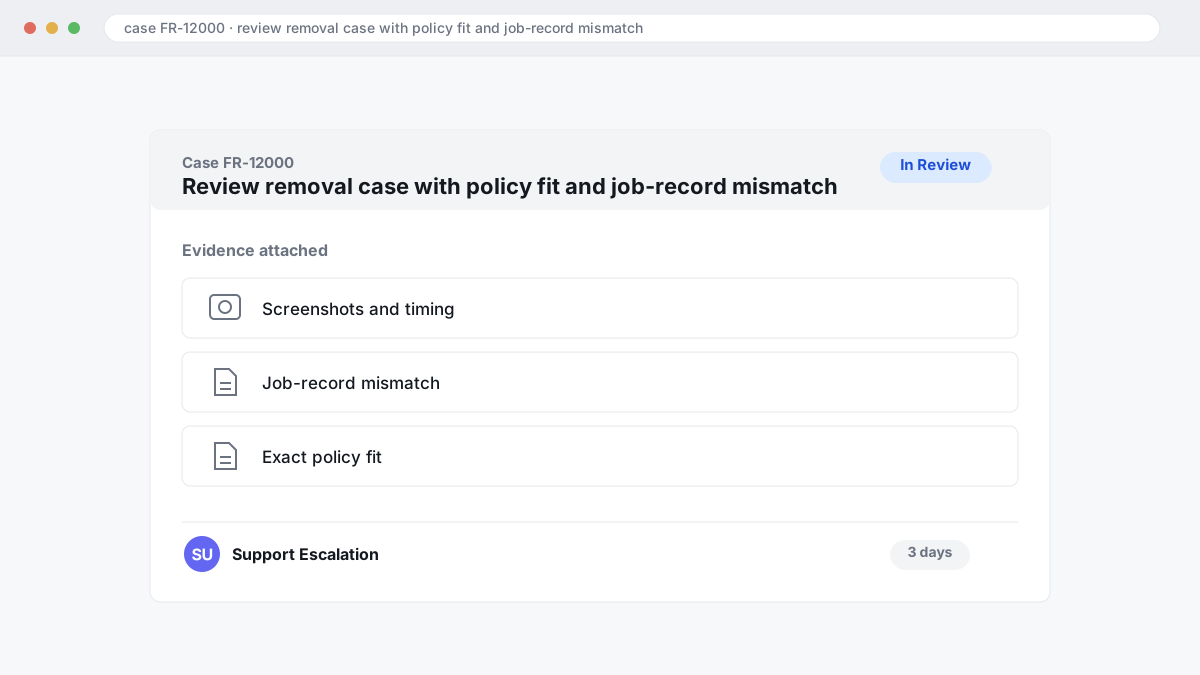
A Google review removal request needs more than “this is unfair”. Your best chance is a tight evidence pack: screenshots, timing, job-record mismatch, the exact policy fit, and short escalation notes, because Google support responds to verifiable rule breaches more reliably than emotional explanations.
The wrong approach is to hit the report button on your Google Business Profile and then send support a long complaint about lost jobs. That usually fails because Google review removal turns on whether the review is policy-violating, not whether it hurts. In BGR Review’s log of 12,000+ negative review cases from June 2025 to June 2026, roughly 90% of businesses who came to us after a failed self-filed attempt had used only the basic in-platform report button with no supporting documentation, and 70–80% of those initial requests had been rejected.
The right approach starts before you flag anything. Capture full-page screenshots, the review text, the reviewer name, the date and time, the live review URL, your profile URL, and the exact claims made against your HVAC company. Then test those claims against named Google Business Profile review rules: spam, conflict of interest, off-topic content, impersonation, or content tied to no real service record. “This person was rude” is weak. “No job at this address, no invoice, no caller record, no dispatch entry, and the review promotes a competitor” gives support something they can verify.
If the first report fails, escalate with a concise evidence pack through support rather than rewriting the same complaint. Include a one-page timeline, the policy clause you believe applies, your job-history mismatch, and annotated screenshots. Speed matters: across 12,000+ negative review cases logged June 2025 to June 2026, reviews raised within 28 days and backed by an identifiable policy issue resolved successfully in roughly 90% of cases in BGR Review’s records, while comparable cases raised later fell to approximately 25–30%. While the review is still live, fix the internal issue that made it believable — missing call notes, weak technician accountability, or sloppy dispatch records — because Google may leave the review up even when your side is right.
Is DIY reputation management enough, or should an HVAC company hire help?
DIY works when one accountable owner can watch reviews, send requests and reply on time without reminders slipping. Managed help makes sense once delays, multi-platform issues or repeated removal disputes are already costing calls, form fills and booked jobs.
The wrong move is trying to run Google Business Profile, Yelp and Trustpilot the same way from a busy dispatch desk. That breaks fast because each platform behaves differently: Google Business Profile drives the map pack and Local Services Ads trust signal, Yelp filters aggressively through its recommendation software, and Trustpilot expects a more structured invitation and reporting flow. If you have one location, light review volume and one person who owns review request timing after completed jobs, DIY is usually the cheaper route. If that ownership is vague, replies slow down, unresolved complaints sit on your branded search results, and your click-through rate drops before rankings move.
This comparison is the practical dividing line.
| Approach | Monthly cost | Response time | Owner control |
|---|---|---|---|
| DIY | Staff time only | Depends on internal follow-up; often inconsistent during seasonal demand spikes | Highest direct control |
| Managed service | Fixed price per removed link | Faster when review routing, reporting and policy-based removals run across several platforms | Shared control with clearer process |
The right approach is to keep DIY for a single branch with clear technician accountability and move to managed help when you need removal evidence packs, cross-platform reporting and reply coverage across more than one location. That costs more in cash, but it usually restores speed, protects conversions from live complaint threads, and stops one missed Yelp or Trustpilot issue from dragging down the stronger Google profile.
Are paid reviews illegal for HVAC companies, and what gets you penalized fastest?
Paid or undisclosed incentivised reviews create platform risk and legal risk at the same time. Under the FTC endorsement guides, and reinforced by the FTC’s 2024 rule on fake reviews and testimonials, any material connection behind an endorsement has to be disclosed; Google and Yelp can remove reviews or restrict visibility when the pattern looks manipulated.
The wrong move is paying for five-star HVAC reviews, offering discounts for positive wording, or asking staff and friends to post as ordinary customers. That fails because the review itself becomes a policy-violating review, and the footprint around it often looks unnatural: same-day bursts, reviewer accounts with no local history, repeated phrasing, or review request timing tied to incentives rather than completed jobs. Google’s prohibited and restricted content policy bars fake engagement, and Yelp’s recommendation software is aggressive about filtering reviews that look solicited or unreliable.
The right move is simpler. Ask real customers for honest feedback after the job is complete, keep the request neutral, and disclose any incentive if you offer one at all. Trustpilot and Yelp differences matter here: Trustpilot is built for structured invitations and verification flows, while Yelp is far less tolerant of active review solicitation, so copying the same playbook across platforms creates avoidable risk.
False factual claims in a review can raise defamation issues, but the route depends on country and platform rules. In the US, UK and EU markets, the line between a harsh opinion and a false statement of fact is not the same, so treat this as general information rather than legal advice.
How should a multi-location HVAC brand keep every branch consistent without slowing replies?
Multi-location HVAC reputation management works best when head office sets the rules and each branch owns the reply. The model that keeps speed and control assigns branch-level response ownership, sends risky cases into a central escalation path, and uses one shared workflow to route reviews, service fixes and removals.
The wrong setup is a central marketing inbox approving every reply for every Google Business Profile. It fails because a no-heat complaint in one branch sits behind ten routine five-star reviews from somewhere else, replies slow down, and technician accountability disappears into generic brand language. A governed local model fixes that: each branch manager or dispatcher answers standard reviews the same day, follows shared tone rules, and escalates only three classes of issue to head office — alleged safety incidents, legal threats, and policy-violating reviews that may need formal Google review removal. If a review names “your tech broke the condenser”, route it to the branch first for job lookup and technician follow-up; if the same complaint appears across locations, route it as a brand-wide service failure.
Monthly governance checks keep the network clean without daily micromanagement. Review every branch page for primary category accuracy, trading hours, service-area drift, duplicate profile risk and whether replies still match the brand standard. Google Business Profile duplicates are easy to miss after relocations, mergers or call-tracking changes, and they split review signals across listings, which weakens map-pack click-through and sends calls to the wrong branch. Keep one branch owner, one escalation owner, and one shared log so local replies stay fast while central oversight stays tight.
How do Yelp and Trustpilot fit an HVAC reputation plan after Google is stable?
Once Google is stable, Yelp and Trustpilot do different jobs for an HVAC company. Yelp can shape local trust in some markets, while Trustpilot helps branded credibility more than Google Local Pack visibility, and their solicitation and moderation rules differ in ways your process has to respect.
Treating every review site the same is where HVAC teams waste time. Sending the same review-request flow everywhere fails because Yelp has tighter solicitation expectations than Google in many use cases, while Trustpilot is built for a more structured invitation flow and public company profile. The better plan is platform by platform: keep Google as the main booking driver, use Yelp selectively where homeowners already search it, and use Trustpilot to strengthen branded search click-through when prospects compare your name after seeing a van, ad or estimate. At BGR Review, that is also how we scope review packages across Google, Yelp and Trustpilot, with a 30-day free replacement guarantee on package delivery.
This is the practical split.
| Platform | Moderation style | Visibility | Best HVAC use |
|---|---|---|---|
| Policy-led reporting and review removal process | Direct effect on Google Local Pack and calls | Primary review focus | |
| Yelp | Stricter around solicitation and recommendation filtering | Useful in Yelp-active local markets | Secondary trust layer |
| Trustpilot | Invitation and profile moderation built for brand reviews | Indirect for map-pack, stronger for branded trust | Support branded search and estimate-stage confidence |
What should your team do over the next 30 days to turn reputation fixes into more booked jobs?
Run a 30-day sprint: audit trust leaks, fix review-request timing, answer live complaints and review call outcomes each week. If removals, lead routing or branch governance keep stalling, that is usually when specialist help starts paying for itself.
Trying to fix every channel at once usually fails because your team spreads effort across Facebook, email templates, ads and listings without fixing the profile that books the work. Start in week 1 with your Google Business Profile, your last 20 reviews and every unresolved complaint in the office inbox or CRM. In BGR Review’s dataset of 1,485 businesses observed February to July 2026, trades firms with complete enquiry-source data attributed 70–80% of calls and bookings to a Google Business Profile or Yelp listing, so that audit sits first for a reason.
Use week 2 to launch timed review requests tied to job completion, then route unhappy customers into first-party feedback capture before they post publicly. That gives you something useful to fix internally while your technician follow-up and negative review response process are still messy. Keep the ask simple, sent the same day, and stop chasing every customer three times.
Spend weeks 3 and 4 tracking calls, form leads and review response times by branch or dispatcher, not just star count.
Where to go from here
Start with your Google Business Profile, because that is where most HVAC owners lose booked jobs first. Export your last 90 days of reviews, mark anything unanswered after 24 hours, and separate true service complaints from reviews that may breach Google Business Profile policy through impersonation, off-topic claims, harassment or a reviewer with no real customer link. Then check whether the problem is operational or procedural: dispatch delays, missed arrival windows and technician conduct need an internal fix, while policy-violating reviews need evidence, timestamps and a documented Google review removal route.
Expect two outcomes from that audit. You will usually find a small number of unresolved negatives hurting map-pack click-through and conversion rate more than the star average alone, and you will also find response gaps that make legitimate complaints look ignored. If a review appears removable, do not stop at the basic flag button. Build the evidence pack while it is still live.
Whether you do it yourself or hand it off, the next move is the same: audit, sort, respond, document, then escalate fast.