

Quick answer
For HVAC companies, reviews on Google Business Profile usually move calls and bookings faster than almost any other reputation task because homeowners often decide from the map pack before they visit your site. The best results come from requesting a review straight after job completion, keeping review velocity steady, replying to negatives quickly, and challenging posts that break platform rules such as Google’s prohibited and restricted content policy. If a review is fake, removal depends on evidence, timing and platform route. At BGR Review, removal is pay after success: $0 upfront and $449 per removed review link.
This page is written from live review operations, not recycled local SEO advice. We handle review acquisition and fake review removal across Google, Trustpilot, Yelp, Clutch and TripAdvisor, and the work is procedural: completed job, technician prompt, SMS request, customer reply, public review, response, then evidence-led flagging if the post breaches policy.
One detail generic guides miss: the first flag often fails because the business only used the in-platform report button and attached nothing else. In BGR Review’s log of 12,000+ negative review cases from June 2025 to June 2026, roughly 90% of businesses who came to us after a failed attempt had filed with minimal evidence, which is why this guide focuses on scripts, timing and proof you can actually submit this week.
Why do HVAC reviews drive calls differently from other local services?
HVAC reviews change booked jobs faster than most local-service reviews because the customer is making a rushed, high-trust decision about expensive in-home work. In urgent searches, visible stars, recent feedback and believable job details can decide who gets the call within minutes.
Generic local SEO advice tells you to collect reviews steadily and let volume do the work. That fails for heating and cooling because a no-cool breakdown during a heat wave is not a slow comparison purchase; the searcher scans the local pack, looks at star-rating distribution, checks whether the last few reviews are fresh, and calls the profile that feels safest right now. In BGR Review's dataset of 1,485 businesses observed from February to July 2026, trades businesses that shared complete enquiry-source data attributed 70-80% of calls and bookings to a Google Business Profile or Yelp listing rather than a website.
Trust also gets harsher once the ticket moves past $200 and a stranger needs access to the home. A flat 5.0 from a handful of reviews can lose call and booking conversion against a 4.7 profile with a broader spread of recent service comments, if both profiles sit in similar local pack rankings and category relevance. The right approach for HVAC is review-specific operations built around urgency, recency and credible service detail, because seasonal spikes expose stale profiles fast and weak review recency becomes obvious the moment demand jumps.
How should an HVAC company ask after tune-ups, installs and no-cool emergencies?
The right HVAC review timing changes with the job: same day for routine maintenance, 24-72 hours after installs, and only after service recovery for stressful no-cool calls. Sending the same request to every customer straight after every visit hurts response quality and creates avoidable complaint risk.
Most guides say ask every customer immediately. That fails because a tune-up, a full install and an emergency repair leave the customer in different moods, and your review velocity gets noisy in the wrong way: bursts after high-stress jobs often produce weaker wording, no reply, or a public complaint that should have been handled privately first. In the technician request workflow we build for HVAC firms, the engineer closes the job, marks the outcome in the CRM, and that tag controls the first SMS or email request rather than a one-size-fits-all blast.
The timing split is simple enough to automate.
| Job type | Best ask window | Why it works |
|---|---|---|
| Tune-up / maintenance | Same day, after the system is running normally | Relief is immediate, so review recency stays tight and the customer can describe a clear result. |
| New install / replacement | 24-72 hours later | Comfort has been confirmed, the homeowner has lived with the system, and the review reads more credible. |
| No-cool emergency | Only after a recovery check | If parts were delayed or the first visit was rough, fix that first; otherwise you invite a bad review you could have prevented. |
If you use managed review help, this is usually where BGR Review sets the trigger logic before any outreach starts, with delivery on review packages starting in 24-48 hours once the workflow is approved. The point is control: better recency, steadier review velocity, and fewer requests sent at the exact moment a customer is still deciding whether the job is actually finished.
Which platform rules change how HVAC companies should ask for reviews?
HVAC companies cannot use one review script everywhere. Google Business Profile generally allows you to ask for reviews if you ask all customers the same way, while Yelp solicitation rules warn against directly asking for Yelp reviews, so the same message can help on Google and create problems on Yelp.
Most generic advice says to text every customer the same review link after every call. That fails because platform rules and filters do different jobs. Google is usually fine with a post-job request tied to a completed invoice, but Google Business Profile guidance also warns against review gating, which means you should not screen for happy customers first and only send the link to them. Yelp goes further: its support guidance says businesses should not ask for Yelp reviews at all, so an HVAC technician saying “please review us on Yelp” can work against the profile you wanted to build.
This is why a rule-matched channel strategy works better. Send your Google request after the technician handoff and paid invoice, use your field service CRM to trigger that request consistently, and keep Yelp as a passive destination through your website, email signature or Yelp badge rather than direct solicitation. Filtered or missing reviews usually trace back to trust signals the platform controls: a brand-new reviewer account, repeated request language, or a review pattern that looks pushed. That is one reason BGR Review includes a 30-day free replacement guarantee on review packages.
The practical difference is easier to see side by side.
| Platform | Request approach | What usually causes trouble |
|---|---|---|
| Google Business Profile | Ask all customers after job completion with the same process | Sentiment gating, review kiosks, or inconsistent technician follow-up |
| Yelp | Do not directly ask for Yelp reviews; let customers find the profile themselves | Direct Yelp asks and review patterns that trigger Yelp’s recommendation software |
How many reviews move the needle before more spending stops paying back?
Judge review spend by whether fresh, credible feedback lifts calls and booked jobs, not by whether your profile hits a vanity number. In most HVAC markets, review recency, visible replies, and a believable star-rating distribution change click confidence in the map pack before extreme review volume does.
The wrong move is buying or chasing sheer count after the profile already looks active. That fails because a long block of old 5-star reviews can look staged or stale, while a 4.8 average built from recent service calls, with a few imperfect scores and prompt public responses, gives a better reason to click and then convert. In BGR Review's dataset of 1,485 businesses observed from February to July 2026, new trades and local service businesses typically saw first reviews around two weeks after launch, and reaching 20-30 reviews over the first three months was associated with improved local visibility, though other ranking factors were active at the same time.
The better approach is to improve the review mix that drives action: recent jobs, specific service details, technician names where appropriate, and replies that show the issue was handled. Track that against calls, form leads, and booked jobs for 8-12 weeks from your Google Business Profile and field service CRM, then compare periods with similar demand and weather. If clicks rise but booked work does not, stop spending on volume and fix the message, the response workflow, or the handoff after the job.
Should you use software or hand review operations to a managed service?
Review software sends requests, but it does not run the review operation for you. Managed service usually fits better when you have multiple branches, need replies written for you, and want fake-review escalation handled; software fits teams that already own follow-up tightly inside a field service CRM.
Most HVAC firms buy automation and assume the job is done. That fails once a technician closes the call, the office misses the unhappy-customer check, and nobody owns public replies or escalation after a false Google Business Profile review lands on the profile. The tool can trigger an SMS after job completion, but your staff still has to watch reviews daily, answer them, route complaints back to dispatch, and decide whether a removal case has enough invoice and photo proof to pursue.
This comparison is usually clearer in table form.
| Factor | Software | Managed service |
|---|---|---|
| Setup time | Fast if your CRM already tags completed jobs and stores the right location link | Slower at the start because routing, response rules and escalation paths need agreeing |
| Per-location cost | Usually cheaper monthly, especially for a single branch | Higher, because a real operator monitors, replies, reports and handles removals |
| Escalation coverage | Limited; staff still has to flag, document and chase | Broader; at BGR Review, removals run on a $0 upfront, pay-after-success model at $449 per removed review link |
| Technician adoption | High; techs must close jobs correctly every time or the trigger breaks | Lower; the field step stays simple and the operator handles the rest |
If you already have disciplined branch managers, a clean CRM trigger, and someone accountable for responses before close of business, software is often enough. If that owner does not exist, paying more for execution usually works better because the operator keeps review recency moving, protects map-pack click-through with timely replies, and steps into removals instead of leaving a bad review sitting for weeks.
How do multi-location HVAC brands route review requests without sending customers to the wrong profile?
Multi-location HVAC brands keep review requests accurate by tying each send to the exact branch, technician or dispatch code that completed the job, because a brand-level link sends customers to the wrong Google Business Profile and weakens local pack performance where the call actually happened.
Most generic advice says to use one master review link across the whole brand. That fails as soon as two service-area businesses cover overlapping ZIP codes from a shared call centre, because dispatch may book under one brand number while another branch actually runs the job. The result is messy star-rating distribution, reviews landing on the wrong location, and weaker map-pack click-through for the office that needs the signal.
The clean fix is operational. Your field service CRM should stamp every completed invoice with the servicing location ID, then fire the request from that location's Google Business Profile short link within the same day. At BGR Review, the routing rule we build is simple: booking source does not decide the link, completed job record does. That one rule stops most cross-location leakage.
If dispatch changes the assigned crew on the day, update the location before the request goes out. Otherwise you create the worst clean-up job in multi-location reviews: a genuine customer praising the right technician on the wrong profile, which Google usually leaves live because the review itself is authentic even though the routing was wrong.
What wording gets more HVAC reviews without sounding bought, pushy, or robotic?
The strongest HVAC review requests read like a service follow-up, not an advert. Mention the completed job, thank the customer, and send one direct review link; pressure, incentives and long explanations make the message feel staged.
Generic blast copy fails because it ignores the technician handoff and the actual work done. A text like “Please leave us a review” looks automated, gives no context, and gets skipped after an AC repair or furnace replacement. The version that works is sent straight after the job is marked complete, starts with a satisfaction check, and only asks for a review if the customer sounds happy.
Step 1: “Hi Sarah, thanks for choosing [Company] for today’s AC repair. Before we close the job, is everything working as expected?”
Step 2: “Glad to hear it. If you have a minute, would you share your experience here: [direct link]”
SMS version under 320 characters: “Thanks for choosing [Company] for your furnace replacement today. Is everything working as expected? If yes, we’d really appreciate a quick review here: [direct link]”
Post-job timing matters. Send the text within hours of completion, while the customer still remembers the technician, the fix and the invoice. If you want this handled for you, BGR Review builds this kind of job-specific wording into managed review campaigns and backs review packages with a 30-day free replacement guarantee.
What should happen within 24 hours of a bad HVAC review?
A bad HVAC review needs two things at once: a calm public reply inside 24 hours and an internal fact check against job notes, call recordings, photos and invoices. That speed cuts down on contradictory replies, missed removal options and refund disputes that grow legs.
Public argument first is the wrong move. It fails because your dispatcher remembers one version, the technician remembers another, and the owner ends up promising something in public that the paperwork does not support. A verify-and-respond workflow works better: acknowledge the issue without admitting fault, move the conversation offline, and lock the facts before anyone types a second sentence.
This is the split that keeps the review response workflow usable when crews are in the field.
| Complaint type | Who owns it in hour 1 | Evidence to pull before follow-up |
|---|---|---|
| Billing dispute | Office manager | Estimate, signed approval, final invoice, payment record |
| Safety or damage claim | Owner or senior manager | Site photos, technician notes, part numbers, call recording |
| No-service-match or wrong company | Owner | Schedule log, service-area address check, customer file, photo proof |
If the review may be fake or attached to the wrong service-area business, preserve evidence on day one. In BGR Review's log of 12,000+ negative review cases from June 2025 to June 2026, reviews raised within 28 days of posting and backed by an identifiable policy issue resolved successfully in roughly 90% of cases; beyond 28 days, observed success fell to approximately 25-30%. That does not make every bad review removable, but it does mean slow internal handling costs you options.
When can a bad HVAC review be removed instead of just answered?
Removal usually depends on a documented policy breach or a false statement you can prove wrong. For HVAC firms, the strongest evidence is usually an invoice, dispatch log, technician notes, job photos, and proof that the reviewer was never your customer or described the wrong unit, date, address or service.
The wrong approach is filing the basic report button because the review feels unfair. That fails because platforms do not remove posts for being harsh, sarcastic or commercially painful. Google Business Profile looks for a rule issue such as spam, impersonation, conflict of interest or deceptive content, or for a factual mismatch you can back with records. If a reviewer says your technician never arrived, a dispatch history, call record and timestamped photo proof from site carry more weight than three angry flags from staff accounts.
Fake or competitor reviews usually need identity and transaction gaps, not opinions. If the name, property address and phone number do not match any customer record, say that plainly and attach the relevant date range from your field service CRM or booking system. If the review states false service facts, pair the claim with the invoice and before-and-after photos showing the actual furnace, condenser or thermostat involved.
One strong report beats repeated weak flags. In BGR Review's case file of 12,000+ negative review cases logged June 2025 to June 2026, roughly 90% of businesses coming to us after a failed attempt had used only the in-platform report button with no supporting documentation, and 70-80% of those first attempts had been rejected. A rejection does not prove the review is genuine.
Can HVAC companies offer discounts or gift cards for reviews without creating compliance trouble?
Offering rewards for reviews creates compliance and platform risk quickly. Under the FTC Endorsement Guides, an incentivised endorsement needs clear disclosure, and a platform may remove or discount the review anyway; this is general information, not legal advice, and the rules change by country.
The wrong approach is common in field service: your technician finishes an HVAC call, then the office texts “Leave us a 5-star review for a £10 gift card” or “Post a review and get 10% off your next tune-up.” That fails twice. The FTC endorsement guides treat the gift card or discount as a material connection that must be disclosed clearly, and Google can remove reviews that collide with its fake engagement or conflict-based policy standards on Google Business Profile. If you use outside help, keep the incentive out of the workflow entirely; at BGR Review, review packages carry a 30-day free replacement guarantee, but that does not change platform rules.
The safer approach is a plain thank-you follow-up after job completion: ask for honest feedback, send the correct profile link, and offer the same post-service courtesy to every customer whether they review you or not. That works because a thank-you message is customer service, while a paid endorsement changes the review itself. In the UK and EU, unfair-practice rules can also bite, including the DMCC Act and wider misleading-commercial-practice standards, so a “small reward” still needs legal and platform scrutiny before you send it.
What should you track each month to know the review system is really working?
Track your review system like an operating process, not a vanity dashboard. Measure requests sent, reviews published, average response time, star-rating distribution, review recency, and lead conversion by location so you can see whether the workflow is creating trust and bookings rather than extra notifications.
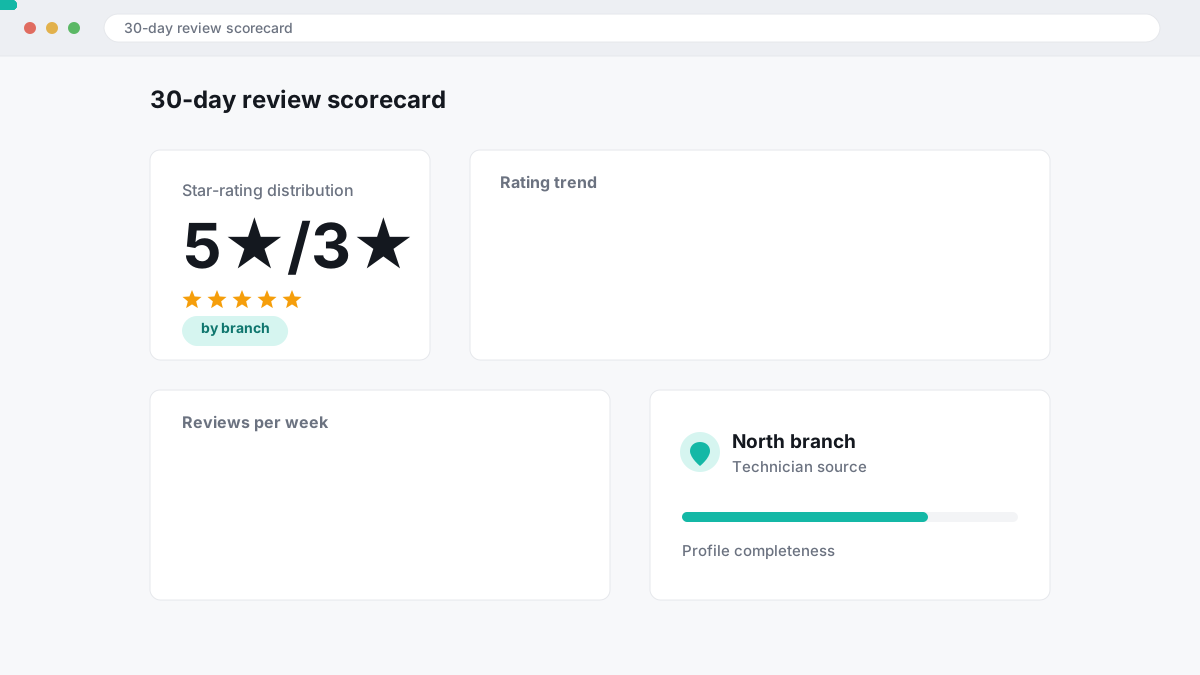
The wrong approach is staring at total review count and average rating. That fails because an HVAC branch can add reviews while its newest feedback goes stale, its 5-star mix hides a run of 3-star install complaints, or one technician stops triggering requests after job close-out. The right approach is a 30-day scorecard broken down by platform, branch and technician source, then a weekly check during seasonal demand spikes in summer and winter when dispatch volume jumps and workflow leaks spread fast.
Use a simple monthly table like the one we align to in BGR Review reporting for managed campaigns, then compare it against calls, bookings and form fills from each service-area location.
| Metric | Why it matters | Breakdown |
|---|---|---|
| Request volume vs published reviews | Shows whether your post-job timing and send rate are working | By Google Business Profile, Yelp, branch, technician |
| Average response time | Protects click-through rate and conversions after public complaints | By location and platform |
| Review recency and rating mix | Supports map-pack trust better than lifetime totals alone | Last 30 days, 90 days, by star band |
| Location-level conversion trend | Tells you whether stronger profiles are actually producing booked work | Calls, bookings, form fills by branch |
Where to go from here
Start with your next 20 completed jobs, not your whole customer base. Set one trigger in your field service CRM for job completion, have the technician confirm the customer is satisfied before leaving, and send the review request the same day to the platform that fits the job: usually Google Business Profile first for service-area HVAC work, never Yelp if you are actively asking because Yelp’s solicitation rules are stricter. Check replies twice a week, and treat any low-rating response as a service-recovery task before it becomes a pattern that drags map-pack click-through, calls and branded search.
If a review looks fake or states facts you can disprove, save the invoice, work order, call log and any photo proof straight away. That timing matters. Across 12,000+ negative review cases logged by BGR Review from June 2025 to June 2026, reviews raised within 28 days of posting and backed by an identifiable policy issue resolved successfully in roughly 90% of cases; beyond 28 days, observed success fell to approximately 25–30%.
Expect a platform-by-platform plan, a technician-friendly request flow, and a straight answer when DIY is the better option.