

Quick answer
AI SEO is the work of making your pages and brand signals easy for large language models and search features to extract, verify and cite. In 2026, the order of work matters: build clear query-led pages, keep your entity details consistent across your site and listings, add original evidence, format pages for clean extraction, and strengthen third-party proof through reviews and citations. Google started rolling out AI Overviews in the US in 2024. The practical lesson is simple: pages get cited more often when content structure, structured data, and off-site trust signals improve together.
This guide comes from live reputation and profile work, not theory. We see what happens after a page rewrite every week: extraction improves first, but citation eligibility usually stalls until the business also fixes review proof, citation consistency and mismatched brand details across Google Business Profile, directories and service pages.
We also work at the evidence layer generic SEO posts skip. A weak removal request often fails because the business only used the in-platform report button, while a stronger submission includes the review URL, the exact policy ground, dated screenshots and account-history context; that same discipline carries into AI SEO because source citations favour brands that look consistent, documented and trusted across more than one surface.
Why do most AI SEO guides miss what actually moves visibility first?
AI search visibility usually moves first when your brand becomes easier to verify, not when you publish another polished article. Clean entity SEO, trustworthy source citations, and review proof tend to lift visibility sooner than more prose, more schema, or another prompt-led rewrite.
Most AI SEO guides treat ranking as a formatting job: tighten copy, add structured data, expand FAQs, repeat entities. That fails when large language models cannot reconcile your business name, service wording, locations, review profiles, and third-party mentions into one stable brand reputation footprint. A page can be perfectly formatted and still lose citation eligibility because the facts around it are thin, inconsistent, or unsupported by sources outside your own site.
The better order is simpler. In the first 30 days, fix brand facts across your top pages, align the same business details on Google Business Profile and the review platforms that matter to your category, then add evidence that matches conversion intent: real reviews, named services, clear location signals, and citations on sites an AI system can quote back. At BGR Review, that is the point where rewritten pages usually start getting used more often in search summaries: page structure improves, third-party proof appears, and source alignment removes doubt. If you sell high-trust services, review proof often changes click-through and conversions before a longer guide does.
Where does AI traffic actually come from before you change a single page?
Start by finding the queries in your market that already trigger AI Overviews, source citations, and comparison-style answers. That tells you whether to fix service pages, proof assets, local profiles, or supporting clusters before you touch a template.
The wrong move is rewriting every page equally for “AI SEO”. It fails because Google Search only shows extraction-heavy results on some searches, and those searches usually sit around commercial, comparative, and local demand: “best divorce lawyer near me”, “roofer vs general contractor”, “Clutch alternative for B2B agencies”, brand-plus-“reviews”, and problem-led queries that already pull People Also Ask style variants. In BGR Review’s editorial workflow, we start with 20 priority queries and check three things on each one: whether AI Overviews appear, what the organic snippet format looks like, and which third-party domains get cited.
That check becomes one clustered brief. Group commercial intent, local intent, competitor-comparison searches, branded questions, and PAA-style follow-ups into the same document, then mark which URLs should answer each cluster inside Google Search. This works because search intent clustering shows where visible demand already exists; it stops you wasting time on low-citation pages and points effort at the queries most likely to lift click-through rate, branded search demand, and eventually conversions from calls, bookings, or form fills.
How is AI SEO different when the goal is citations, not just blue-link rankings?
Traditional SEO tries to rank a page. AI SEO also tries to make your facts reusable inside generated answers, which shifts the work toward clear entities, quotable structure, original proof and third-party corroboration instead of position alone.
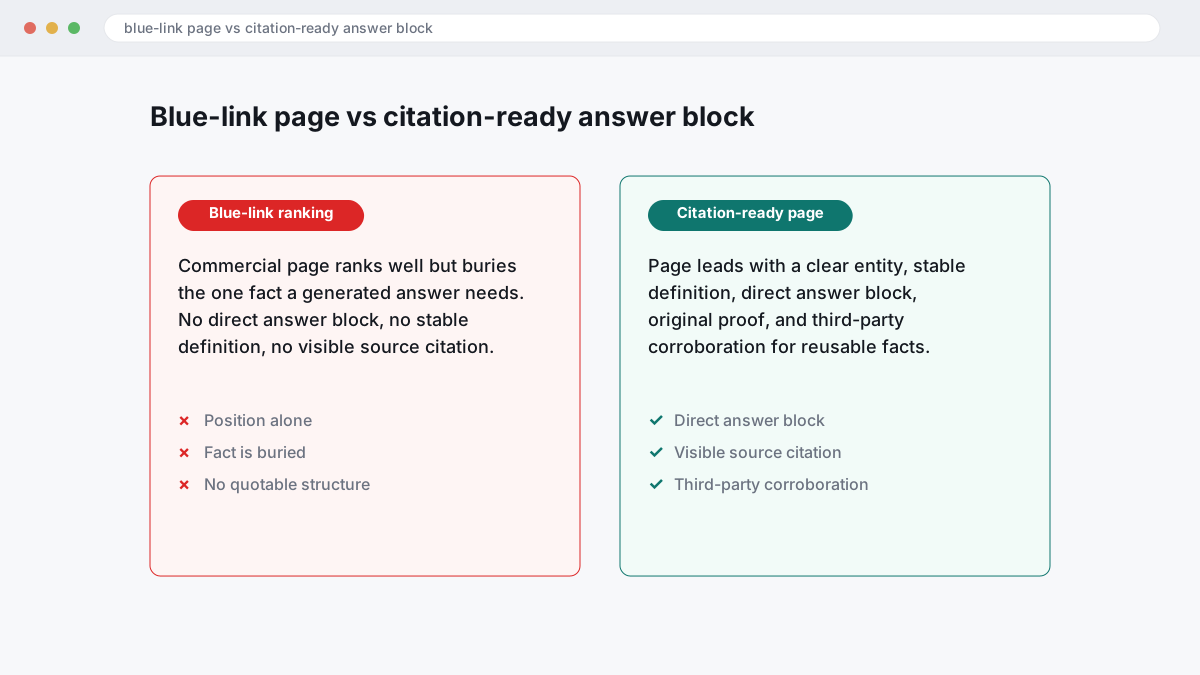
Most guides get this wrong by treating large language models as another SERP feature. That fails because a page can win a blue-link position and still give an AI system nothing clean to lift: no direct answer block, no stable definitions, no visible source citations, and no corroboration from places like Google Business Profile, Clutch or Trustpilot. We see this in commercial pages that read well for humans but bury the one fact an overview needs under sliders, tabs and vague copy.
The better approach keeps classic SEO in place and adds citation-readiness. You still need relevance, internal links and topical authority, but you also need extractable sentences, named evidence, consistent brand details and outside proof that matches the page. In BGR Review’s own dataset of 1,485 businesses observed from February to July 2026, trades firms with complete enquiry-source data attributed 70–80% of calls and bookings to a Google Business Profile or Yelp listing, which shows why AI visibility often depends on entity trust beyond your site.
A service page can rank and still miss AI citations. If the page says one thing, your review platforms say another, and your brand details vary across sources, the model has less confidence in reusing your claims. That is why our review packages focus on verified platform proof with a 30-day free replacement guarantee, while removal work stays separate at $0 upfront and $449 per removed review link: citation-readiness usually improves when the page, the entity profile and the third-party evidence line up together.
How do you optimise for AI Overviews without rewriting your whole site?
Optimise for AI Overviews by upgrading pages that already sit close to visibility, usually on page 1 or 2, with direct-answer openings, cleaner headings, evidence blocks, and citation-friendly content formatting. Rewriting your whole site burns time; improving near-winners usually moves faster because Google already treats those URLs as relevant to the query intent.
Most guides push a full rebuild. That fails because AI Overviews do not need a brand-new site architecture to extract an answer; they need a page that answers the question quickly, then supports it with source citations a model can trust. The first pass we use at BGR Review is narrow: pull the queries that already trigger Overviews in your market, match them to the URLs already ranking, and rewrite the first 100 words so the answer appears before the sales copy, testimonials, or long intros.
Use the page elements that make extraction easy, then check whether the answer survives outside your layout.
| Wrong move | Better move | Why it helps AI Overviews |
|---|---|---|
| Rebuild every service page | Start with URLs already on page 1 or 2 | Google already sees relevance, so formatting gains can change citation eligibility faster |
| Lead with brand copy | Lead with a one-paragraph answer | Large language models can lift the answer without digging through filler |
| Use plain prose only | Add comparison tables and named-source evidence blocks | Structured contrasts and attributed facts are easier to cite |
Then wait 2 to 6 weeks and recheck two things: whether the page still ranks for the same overview-triggering query, and whether the Overview now includes your answer or your cited source. Google Search Central’s guidance on helpful, reliable, people-first content still applies here, but the practical test is simpler: can your answer be quoted cleanly, and does the page prove it with a named source rather than unsupported claims. That is usually the point where a rewritten page starts earning citations instead of just impressions.
Which pages should you fix first if you want AI SEO to pay back sooner?
The quickest return usually comes from service pages, comparison pages, and branded pages that already earn impressions. Those assets sit closest to conversion intent, so cleaner content formatting, stronger proof, and tighter source alignment can lift visibility and conversions before a wider content programme starts paying back.
Most AI SEO guides push blog volume first. That fails because large language models do not reward acreage on its own; they extract from pages that answer a buying question cleanly and match the entity signals already attached to your brand. If your “pricing”, “alternatives”, “reviews”, or branded service pages already get clicks but lose people on thin proof, messy headings, or vague claims, fix those before you commission 30 informational posts. For a reputation service, a page that states “$449 per removed review link, $0 upfront” gives an AI system and a buyer something concrete to cite and compare.
A 5-page sprint beats a 50-page backlog for most SMEs. Pick the pages nearest revenue and demand: core services, one comparison page, one branded search page, and one proof-heavy page with reviews, policies, or process detail. That builds topical authority around the terms that already matter, and it usually improves faster because Google and AI systems have existing engagement data to work with rather than a brand-new URL nobody has touched.
How do entities become easier for AI systems to trust and cite?
AI systems cite a brand with more confidence when the same core facts appear across your site, platform profiles and credible third-party mentions. Clear entity SEO cuts ambiguity, which matters most when your brand name is generic, you run several locations, or your service category overlaps with competitors.
Most AI SEO guides still chase keywords first. That fails because large language models and AI Overviews do not only parse page copy; they try to decide whether your business is the same entity across the web, and whether the source deserves trust. If your homepage says “BGR Review”, your Google Business Profile uses a longer trading name, your Clutch bio lists different services, and your London and New York details drift between pages, the model has weak confidence even if the copy is well written.
The fix is machine-verifiable consistency. Match your business name, primary category, service descriptions, author bios and contact details across owned pages and third-party profiles, then reinforce that with organisation schema and person schema where they belong. BGR Review, for example, should describe the same review and removal services across its site and profiles, keep its offices in New York, London and Thornhill consistent, and show the same support contacts such as team@bgrreview.com and +1 561 461 0399 where relevant.
That is how you make the Knowledge Graph more likely to connect the dots. Structured data helps search systems read the page, but corroborating mentions and aligned bios supply the E-E-A-T signals that page code cannot invent.
What makes a page citation-worthy instead of merely well written?
A page becomes citation-worthy when it gives short answers, checkable facts, and visible proof that an AI system can lift without guessing. Large language models reuse pages that settle ambiguity quickly with named sources, dates, prices, tables, structured data, and first-hand operational detail.
Elegant prose fails because it hides the extractable part. A polished paragraph about review removal says very little to an AI Overview if it does not state the mechanism, the policy, and the condition.
Use formatting that survives extraction. Lead with a 25-45 word answer, put the evidence directly underneath, then add structured data that matches the visible page rather than inventing extra claims. Google Search Central’s structured data guidance makes the same point in plainer terms: markup helps machines interpret content, but it does not replace clear on-page wording.
Comparisons deserve tables because AI systems can quote them with less interpretation.
| Weak page element | Why it gets skipped | Citation-friendly version |
|---|---|---|
| Long intro paragraph | No standalone answer | Direct answer in the first 2 sentences |
| Claim with no source | No attribution path | Named policy, date, price, or platform rule |
| Dense prose list | Hard to lift accurately | Table for timelines, options, or platform differences |
How do reviews and brand sentiment change who AI search recommends?
Reviews change recommendation confidence before they change clicks. When sentiment, recency and third-party proof line up, AI systems have a stronger trust layer around your brand and more reason to surface you in local or comparative answers.
Most guides treat reviews as a conversion asset that matters after you rank. That fails because large language models and AI Overviews lean on source citations from places users already trust, and weak brand reputation across those sources makes the answer look less certain. A clean service page with thin proof often gets ignored, while a business with aligned reviews on Google Business Profile, Trustpilot, Yelp or a niche directory gives the model corroboration it can safely reuse.
Third-party sentiment also feeds branded search demand, which then feeds recommendation credibility again. In BGR Review’s dataset of 1,485 businesses observed February to July 2026, trades firms with complete enquiry-source data attributed 70–80% of calls and bookings to a Google Business Profile or Yelp listing rather than a website, which shows where trust forms first for visible local demand. If you buy review growth, spread proof where people already compare suppliers; BGR Review’s verified review packages cover Google, Trustpilot, Yelp, Clutch and TripAdvisor, with a 30-day free replacement guarantee, because stale or uneven sentiment across platforms weakens the whole signal.
What changes for local businesses when AI search pulls from maps, reviews, and citations?
Local AI search works differently for local firms because answer systems often lean on map data, review signals and citation consistency alongside your site. If you depend on nearby searches, your Google Business Profile and reputation proof can influence visibility as much as any page rewrite.
Most AI SEO guides treat a plumber, clinic or agency like a national publisher. That fails because the first click often comes from the local pack, not a blog result, and the model is pulling from profile categories, opening hours, review snippets and directory mentions before it decides whether your site is a safe citation. In BGR Review's dataset of 1,485 businesses observed from February to July 2026, trades businesses that shared complete enquiry-source data attributed 70-80% of calls and bookings to a Google Business Profile or Yelp listing rather than a website. That is where visible demand starts.
The fix is operational. Complete every Google Business Profile field you can support, keep review velocity steady instead of asking for 20 reviews in one week, and make your name, address and phone match across Google, Yelp, Apple Maps, Bing Places and your core directories. When those records disagree, large language models split the entity, map-pack click-through drops, and branded search demand weakens because users see mixed signals before they ever reach your location page.
Service-area businesses need tighter alignment than storefronts. Your primary category, service areas and location pages should describe the same job in the same places; if your profile says “roofing contractor” but your page targets a broad “home improvement” phrase, citation eligibility gets fuzzy and conversions suffer. If you want help building the proof layer, BGR Review handles verified review campaigns on Google and Yelp with delivery starting in 24-48 hours and a 30-day free replacement guarantee.
What does a practical AI SEO workflow look like from query map to citation win?
A practical AI SEO workflow starts with query mapping, then improves pages that are already close, then adds corroboration through citations and reviews. The order matters: diagnose first, upgrade pages second, strengthen trust signals third, and measure source inclusion the whole way.
Most guides tell you to publish first and hope the model extracts something useful. That fails because AI Overviews rarely lift a weak entity just because the formatting improved; citation eligibility usually appears after search intent clustering, page structure, and brand reputation line up on the same topics. Before you touch copy, pull 20 high-intent queries from your sales and support language, group them by conversion intent, then inspect what the overview cites now: local pack results, trade directories, comparison pages, Google Business Profile reviews, or brand mentions.
Use this sequence if you want a practical rollout rather than a site-wide rewrite.
| Period | What to do | What you check |
|---|---|---|
| Week 1 | Cluster 20 commercial queries into themes such as price, near me, best, alternatives, and service-specific problems. Save every AI Overview source and note whether Google pulls brand mentions, review platforms, or category pages. | Which sources repeat, which pages earn citations, and where your brand is missing. |
| Week 2 | Upgrade five priority pages with direct answer leads, tighter headings, FAQ blocks only where they help the reader, and structured data that matches the page type. Add evidence: reviews, policy pages, contact details, and named service coverage. | Whether the page answers the query in the first lines and matches the cited source format. |
| Weeks 3-6 | Build corroboration. Fix citation consistency across GBP, directories, and service platforms, then strengthen review proof on the profiles AI systems already surface. If you need help, BGR Review runs verified review campaigns with a 30-day free replacement guarantee, and delivery starts in 24-48 hours. | Source inclusion, branded search demand, map-pack click-through, and whether calls or form fills rise on the upgraded query set. |
The workflow works because citations follow corroborated claims. A cleaner page may rank a little better in blue links, but AI extraction gets more reliable when the same business facts appear on the page, in structured data, on review profiles, and across third-party citations. That is the point where source citations start to stick.
What should you do if AI shows the wrong business, wrong details, or weak sources?
When AI shows the wrong business or wrong details, repair the source feeding the answer before you chase the AI surface itself. Most recovery work starts with the same four checks: a duplicate Google Business Profile, an old directory entry, a stale location page, or mismatched entity data across source citations.
Arguing with the AI output fails because the model usually refreshes from underlying records, not from your complaint. Hallucination recovery works when you trace the bad mention back to the page or profile it cited, correct that record, and tighten citation consistency across your site, your Google Business Profile, and the main third-party listings that carry your name, address and phone.
Start with the cited source. If the answer names a directory, fix that listing first; if it pulls from an old profile or duplicate listing, request the merge, closure or edit there first; if it cites a stale page on your own site, update the page and its schema markup immediately. Then document the change with before-and-after screenshots, timestamps, edit confirmations and support ticket IDs, because platform support will often ask for proof that the source record changed before the AI answer did.
Refresh times vary. Your own page can update within days, while duplicate-profile fixes and third-party citation changes can take weeks to flow through source citations and brand SERP results.
Which AI SEO checklist should your team run every month?
Your monthly AI search routine should score 12 checkpoints across content, reputation and citations, then update one priority page, one profile cluster and one evidence asset, because one-off optimisation sprints rarely hold once AI Overviews and source citations refresh.
The wrong approach is a single content rewrite focused on headings and FAQs.
Run this 12-point check each month and score every item on impact, effort, source trust and revenue relevance.
- NAP and entity data match across site, GBP and directories
- Primary category and service labels align
- Top citations are accurate and live
- Google reviews are recent and replied to
- Third-party review profiles match business facts
- Schema markup reflects current services, locations and organisation data
- Priority page has clear content chunking for extraction
- Key answers sit in short, quotable sections
- Brand SERP shows controlled assets first
- One profile cluster gets refreshed monthly
- One evidence asset gets updated monthly
- One priority page gets revised monthly
That cadence works because AI visibility moves when your proof stays fresh everywhere, and BGR Review backs review packages with a 30-day free replacement guarantee when replacement is part of the plan.
Where to go from here
Start with an entity audit, not a content sprint. Pull your Google Business Profile, brand SERP, main review profiles, top citations and the business facts AI systems keep repeating: name, address, phone, category, opening hours, services, review count and review recency. If those disagree across Google, Trustpilot, Yelp, Clutch or TripAdvisor, AI Overviews and source citations can amplify the wrong version, which cuts click-through rate first and conversions after that.
Check three things this week: whether your brand appears consistently in third-party profiles, whether review signals look current enough to survive scrutiny, and whether the same business facts show up on your site, maps listing and citation sources. Then fix mismatches before you rewrite pages or add schema markup. In our removal work, the files that move fastest are the ones raised early with evidence; across 12,000+ negative review cases logged June 2025 to June 2026, reviews raised within 28 days and backed by a policy issue resolved successfully in roughly 90% of cases.